DESE Should Consider District Level Waivers

Let’s recap. In 1965, the United States Congress passed the Elementary and Secondary Education Act (ESEA) as part of Lyndon Johnson’s War on Poverty. The act must be reauthorized every five years. The most recent authorization took place in 2001. Since then, most people know ESEA as No Child Left Behind (NCLB). NCLB required states to implement a system of test-based accountability. The ESEA has not been reauthorized since 2001.

As part of the American Recovery and Reinvestment Act of 2009, the United States Department of Education (U.S. DoE) created a competitive grant process called Race to the Top. The Race to the Top application encouraged states to adopt college- and career-ready standards.

The Missouri Department of Elementary and Secondary Education (DESE) applied for a Race to the Top grant in January of 2010, promising to adopt college- and career-ready standards.

In 2012, the U.S. DoE began awarding waivers to No Child Left Behind. DESE applied for a waiver in February of 2012, again promising to adopt college- and career-ready standards. They received the waiver in June of 2012.

DESE, without approval from the legislature, set Missouri on a new course by adopting the Common Core State Standards. Essentially, DESE committed Missourians to a set of national curriculum standards.

The Common Core State Standards have been met with a considerable amount of consternation.  Bills have been introduced in the Missouri House and Senate that would halt the implementation of the new standards. I have submitted written testimony to the committees and written elsewhere about the impact of these standards.

Now we are finding out that individual districts in states that did not receive waivers from the U.S. DoE are able to apply for waivers. What I want to know is, when will DESE begin awarding waivers to school districts that wish to opt out of Common Core? After all, the state was able to opt out of a federally binding law and now individual school districts may have that ability. Shouldn’t DESE give local schools the ability to opt out of these new state standards if they can demonstrate that they have a comprehensive local system of accountability in place?

Reminder: A Strong Majority Of States ‘Remain Either Defiant Or Undecided’ About Expanding Medicaid

The Associated Press kind of buried the lede this weekend in a story about state legislatures supposedly wanting to “make a deal” with the federal government to expand their Medicaid programs. The story pretty well captures supporters’ movement from the “economic development argument” for a Medicaid expansion to the “inevitability argument” — that it is just a matter of time before Affordable Care Act opponents are forced to expand their Medicaid programs. But if you read down, you will find this tidbit six paragraphs deep. (Emphasis mine.):

Officials in about 30 states that are home to more than 25 million uninsured residents remain either defiant or undecided about implementing Obama’s Medicaid expansion, according to an Associated Press survey.

In other words? A majority of states have not yet implemented the Medicaid expansion, and many are vehemently rejecting it. The Missouri Legislature has repeatedly rejected expansion proposals, for good reason: The “Affordable Care Act” is patently unaffordable, and it seems that most states — Missouri included — are not exactly chomping at the bit to bring many of the law’s burdensome provisions back home.

Inevitable? Far from it.

Kansas City Seeks To Extend Health Levy

In 2005, city leaders in Kansas City sought and received a temporary property tax levy to fund health services. Eight years later, as the nine-year tax is set to expire, city leaders and health care executives want to extend it. Kansas City’s Northeast News reported that the levy helps fund:

. . . two hospitals, Truman Medical Centers and Children’s Mercy, along with six area non-profit health care providers like Samuel U. Rodgers Health Center, Northland Health Care Access, KC Care Clinic, among others, to offset the cost of indigent health care. In addition, approximately $10 million of the levy goes toward the city’s ambulance service. Truman Medical Centers receives the bulk of the levy, about $26.4 million.

The tax, amounting to about $43 on each $100,000 of assessed property, is in addition to an existing health care tax that runs about $94 on each $100,000 of assessed property. However, The Kansas City Star reports that the tax may not be necessary because of the Affordable Care Act. The Star reported earlier this year that Obamacare:

. . . is supposed to improve health coverage for thousands of the city’s poor, they say. By next year, most Americans must carry health insurance or face a tax penalty, a mandate that should mean Truman and the health centers will get an infusion of cash from newly insured patients.

The city is probably correct to be skeptical that Obamacare will live up to its ambitions — it seems to be falling short on its promises — but Kansas Citians are hardly able to foot the bill for a long and growing list of taxes.

Voters’ mailboxes are being filled with mailers about why we should vote to extend the tax. Perhaps that money could be spent on an audit that identifies how to more efficiently spend existing funds. Instead of spending $10 million in tax dollars on ambulances, perhaps some of that service can be privatized, as is the case elsewhere in Missouri. Without being “smarter with the money,” does anyone doubt that in nine years the city will seek to extend this temporary tax again?

The Worst Kind Of Science

St. Louis Post-Dispatch columnist David Nicklaus, in his column “Missouri tax cuts aren’t a magic formula for economic growth,” cites a report by Leachman, Mazerov, Palacios, and Mai that the Center on Budget and Policy Priorities published. In the report, the authors present evidence and then interpret it as indicating that changes in income tax rates are positively correlated with economic growth.

First, the evidence is that six states enacted large personal income tax cuts in the years before the Great Recession. Three of these six states reported economic growth rates that were lower than the nation’s growth rate while the other three reported growth rates that exceeded the nation’s growth rate. The three faster-than-nation states were major oil-producing states, benefiting from the sharp run-up in oil prices that occurred after the tax rate changes were implemented.

Leachman et al. are correct in pointing out that multiple events affect each state’s economic growth rate. But the analysis is so perverted that it is more politics than economics.

Let’s try to be objective about the effects associated with a reduction in the income tax rate. First, the partial effect of a decrease in the income tax rate means that the after-tax returns to factors of production will increase. In other words, the return to workers and to those people taking risks as entrepreneurs and business owners. As the after-tax returns increase, the aggregate supply increases at a faster rate. This is how lower income tax rates, holding everything else constant, result in faster income growth. Leachman et al. do not present a new economic model that overturns this reasoning, so this point is indisputable.

What they must have in mind is the next round of effects associated with smaller state budgets. In the near term, state spending shrinks because the product of the tax rate and the tax base initially shrinks when the tax rate is reduced. The Leachman et al. argument is essentially that the government spending is on public goods — infrastructure, schools, and other capital investments — that offer a higher average return than private citizens could possibly realize from investing on their own. Honestly, this may be true. However, states purchase lots of things that are not about infrastructure, schools, and other capital investments. It may be a hard choice, but if there are fewer resources poured into state coffers, then the state must allocate those to the public projects that offer the highest return to its citizens.

The other part to this dynamic analysis is what happens when income grows faster because of the lower income tax rate. Because of this effect, over time, the state budgets will also grow faster, meaning that the path of state government future spending will exceed the high-tax-rate path. Leachman et al. do not even consider this.

Now, back to the evidence. Their interpretation is the worst kind of science. Ideally, a scientist would like to run a controlled experiment, isolating the treatment that they are considering and then compare results from the control group with the treatment group. Leachman et al. start off by recognizing that no such controls exist. Then they pervert their analysis by using the absence of the controls to argue that oil-producing states benefited only from their oil. Shame on them!!! What they cannot tell you is whether the non-oil producing states would have grown even slower if the income tax rates had been left at their higher levels. Now that would be a comparison.

There are other objective ways to rip their analysis. For example, they focus on a short time horizon. No growth theorist relies on data less than a decade old to try to infer what the growth-rate effects are. Yet Leachman et al. boldly assert the causality from just a few years of data.

You do not have to trust me. You can read the literature on factors affecting economic growth. At the state level, it is important to spend resources on public goods that are most valuable to people living within those boundaries. The next objective is to collect taxes from these people in the way that does the least harm; that is by creating the smallest distortions. Such taxing principles will result in higher living standards and happier people than for one group to nakedly claim their sense of fairness is the right tax structure.

The debate is too important to not carefully think about the best approach. Let’s think carefully.


Part One: The Smallness Of The Potentially ‘Hip’ Core

Just the other day, The Daily Beast published an outstanding piece on redevelopment trends in our urban communities. Joel Kotkin, a professor of urban development, wrote the article, which addressed the idea that, as Kotkin put it, “the ‘creative class’ of the skilled, educated and hip would remake and revive American cities,” and that governments should pursue projects that would bring them to their urban centers.

Urbanists, journalists, and academics — not to mention big-city developers — were easily persuaded that shelling out to court “the hip and cool” would benefit everyone else, too. And [development consultant Richard] Florida himself has prospered through books, articles, lectures, and university positions that have helped promote his ideas and brand and grow his Creative Class Group’s impressive client list. …

Well, oops.

Another way I would describe this development strategy: “Warehouse lofts over warehouses.”

Indeed, the recasting — and really, inversion — of the American city by contemporary urban planners does not share a great deal in common with why American cities developed in the first place: because that is where the jobs were. As transportation and communication became more expansive and readily available, living in or near the city center for work became less of a necessity and more of an active choice. In a time where “creatives” can give a presentation over Skype and telecommute to work, location-location-location ain’t as necessary as it used to be when it comes to jobs. Moving downtown in the 21st Century oftentimes has less to do with labor needs as it does with identity preferences.

And that is, of course, the development quandary. My proximity to my place of work is going to affect where I live greatly if my job is in manufacturing. Indeed, many cities were purpose-built for the manufacturing industry: shoes, cars, etc. But manufacturing is not the industry cities seem to devote too much attention to these days, and unfortunately for cities, the “creatives” they are trying to attract do not exactly have development coattails.

Kotkin:

Indeed in many ways the Floridian focus on industries like entertainment, software, and social media creates a distorted set of economic priorities. The creatives, after all, generally don’t work in factories or warehouses. So why assist these industries? Instead the trend is to declare good-paying blue collar professions a product of the past. If you can’t find work in deindustrialized Michigan, suggests Salon’s Ray Fisman, one can collect “more than a few crumbs” by joining the service class and serving food, cutting hair or grass in creative capitals like San Francisco or Austin.

The story actually quotes Florida, one of the lead movers in the “hip” development scene, admitting to a serious flaw in the last decade’s worth of development fads: “On close inspection, talent clustering provides little in the way of trickle-down benefits.” In other words, if you build it, the “creatives” might come to your converted warehouses and niche dining establishments . . . but that is about it. (Emphasis mine.)

Yet this footprint of such “cool” districts that appeal to largely childless, young urbanistas in the core is far smaller in most cities than commonly reported. Between 2000 and 2010, notes demographer Wendell Cox [who has written for Show-Me], the urban core areas of the 51 largest metropolitan areas — within two miles of the city’s center — added a total of 206,000 residents. But the surrounding rings, between two and five miles from the core, actually lost 272,000. In contrast to those small gains and losses, the suburban areas — between 10 and 20 miles from the center — experienced a growth of roughly 15 million people.

The smallness of the potentially “hip” core is particularly pronounced in Rust Belt cities such as Cleveland and St. Louis, where these core districts are rarely home to more than 1 or 2 percent of the city’s shrinking population. Yet the subsidy money for developers is often justified in the name of “reviving” the entire city, most of which has continued to deteriorate.

More on this topic shortly.

McGraw Milhaven – David Stokes on KTRS

David Stokes has a recurring spot on McGraw Milhaven’s KTRS radio program. In this appearance, Stokes and the host discuss topics such as Prop P (the “Arch Tax”), the possibility of Prop P funds going towards TIFs, specifically how that could work, the Show-Me Institute’s recent analysis of Missouri public pensions, and the vaunted revenue expectations should Prop P pass.


‘O’ My . . .

It appears that Ohio officials are trying to get in on the tax-cutting act. Good for them. Seriously, Ohio is one of the few states that has performed worse economically than Missouri over the past 14 years.

Ohio Gov. John Kasich has proposed a major tax overhaul for the state. Features of the plan include a phased-in individual income tax cut, which would reduce the top rate to 4.74 percent in 2015, and a 50 percent deduction for pass-through entity income that is less than $750,000. A detailed analysis of the plan is on the Tax Foundation website.

I keep harping on these developments in other states to underlie the importance for Missouri to reform its tax code. Show-Me Policy Analyst Patrick Ishmael also has blogged at length about the “American Growth Corridor” sprouting up around Missouri and the need for Missouri to keep up. Gov. Kasich’s plan is an indicator that some in Ohio are starting to recognize the importance of a competitive tax code.

Thankfully, the Missouri Legislature has made progress on some kind of tax cut. The Missouri Senate passed a bill last week that would cut the top rate by a .75 percentage point and also lower taxes on business income. The Missouri House also has good bills with potential to make some significant changes to the state’s tax environment. A lot of work needs to be completed, but there is room for optimism.

Just cutting taxes will not be enough to cure all of Missouri’s economic problems. However, it is a necessary step. Hopefully, the prospect of even more states cutting their taxes will spur Missouri to finally overcome the obstacles to serious tax reform.

Missouri Cities Should Open The Books

How can Saint Louis catch up to Kansas City? Increasing transparency in government spending would be a good start. The state of Missouri was a leader in spending transparency, but many of our cities have not caught on.

Governments often grant public subsidies, tax breaks, and other incentives to powerful corporate interests and other groups at the expense of taxpayers. In Missouri cities, this type of information is not always easily available to the public. But our governments should readily share spending information. Otherwise, taxpayers may not even know when special interests gain unfair advantages through government spending. It is impossible to ensure that government decisions are efficient and reasonable unless information is publicly available.

A few weeks ago, I blogged about Saint Louis’ failing grade in the  U.S. Public Interest Research Group (PIRG) report on the largest cities’ spending transparency online.

Saint Louis has major improvements to make, with the 28th lowest ranking out of 30 cities. Kansas City ranked much higher, at 14th, but still only received a letter grade of “C.”

Kansas City has made a more visible effort to show residents how the city spends funds. The city allows residents to view checkbook level spending, which Saint Louis should allow, but does not. This transparency helps keep Kansas City accountable to taxpayers.

But Kansas City does have room to improve. Some other cities have created centralized transparency websites and provide comprehensive information on tax subsidies. New York City’s “Open Book” website is the perfect example of what Kansas City and Saint Louis should strive to implement.

Dear Affordable Care Act Supporters: You Call This ‘Saving Money’?

Proponents of the Affordable Care Act (a.k.a. Obamacare) have long claimed that the law’s provisions would “bend the cost curve” of American health care. The argument was that the combination of exchanges, the Medicaid expansion, and the other provisions tucked away in the law’s thousands of pages would fix many of the structural problems that have driven health care costs in this country. Of course, the law did no such thing. As the Wall Street Journal reaffirmed today, health care costs are on the rise for families across the country — and are poised to increase especially rapidly next year. (Emphasis mine.)

Health insurers are privately warning brokers that premiums for many individuals and small businesses could increase sharply next year because of the health-care overhaul law, with the nation’s biggest firm projecting that rates could more than double for some consumers buying their own plans.

The projections, made in sessions with brokers and agents, provide some of the most concrete evidence yet of how much insurance companies might increase prices when major provisions of the law kick in next year — a subject of rigorous debate.

That is the personal cost. What about in the aggregate? The Manhattan Institute released a study on Tuesday about the health care “savings” we could expect under the law to provide clarity to this question.

And how much will Obamacare save Americans overall? The answer: nothing. Or more accurately, Americans can expect to pay more for health care in total because of “Obamacare” than if the law . . . was never enacted. (Emphasis mine.)

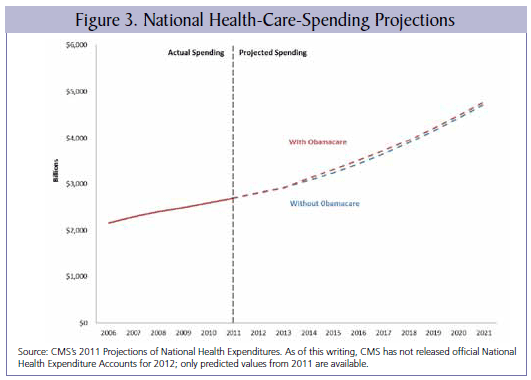
Today, Americans spend well over $2 trillion — close to 18 percent of GDP — on health care, and U.S. health-care costs have grown much faster than either income or GDP growth over the last several decades. However, despite the best intentions of its supporters, Obamacare will not make much of a dent in these trends. The Centers for Medicare and Medicaid Services (CMS) projects that between 2012 and 2021, America will spend $36.8 trillion on health care. Absent Obamacare, CMS estimates that spending would be $36.3 trillion — a difference of just $500 billion over ten years. In other words, without Obamacare, Americans would spend less on health care.

The chart:

Folks, our political betters actually bent the cost curve up, not down.

Why will costs rise? Because the ACA did not fix the cost problems; as I told the St. Louis Beacon in a story published this morning, the law doubled-down on them. Instead of applying market pressures to get the cost of care down, the law just shifted how we pay for care. From the Manhattan Institute (emphasis mine):

As noted earlier, the law shifts health-care costs from individuals to government, with the overarching goal of reducing the share of health-care spending borne by low- and middle-income uninsured consumers. The problem is that evidence strongly suggests that when out-of pocket spending is lower, health-care spending actually rises.

Why would anyone implement an “affordable care act” that was anything but?

Support Us

The work of the Show-Me Institute would not be possible without the generous support of people who are inspired by the vision of liberty and free enterprise. We hope you will join our efforts and become a Show-Me Institute sponsor.

Donate
Man on Horse Charging