
The Continued Growth of the Four-Day School Week in Missouri

The Missouri Department of Elementary and Secondary Education (DESE) reports that 188 of 518 school districts will be operating on a four-day school week (4dsw) during the upcoming school year.

The figure below shows the rapid growth of the 4dsw since the 2010–11 school year.
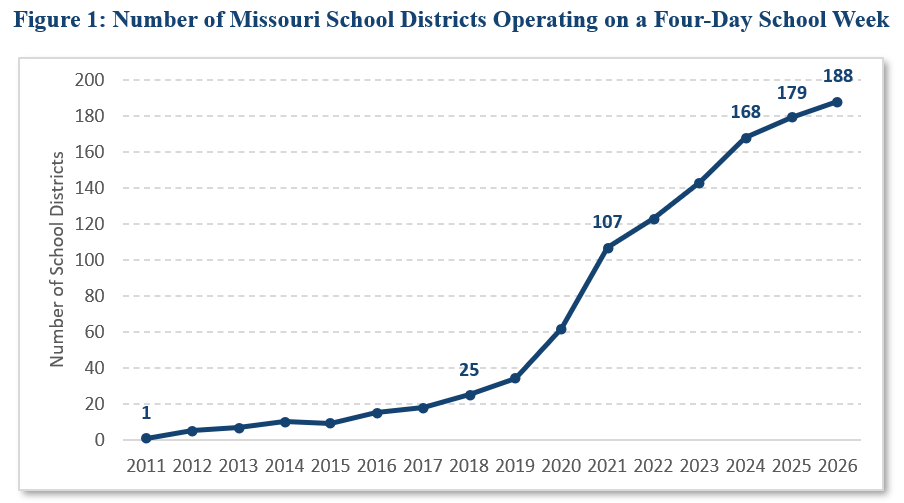
Source: DESE

Missouri is not alone in this phenomenon. The 4dsw is increasingly popular across the country, especially in rural districts. Even though 36 percent of Missouri school districts use a 4dsw, they cover only 13 percent of students because rural districts are smaller. However, it is notable that the Independence School District in Kansas City, with over 13,000 students, is also on a 4dsw.

Districts typically adopt a four-day calendar in hopes of improving teacher recruitment and retention and, in some cases, reducing costs. In 2024, Senate Bill 727 included a modest financial incentive for districts to have at least 169 instructional days to encourage districts to remain on a five-day schedule. Nevertheless, the use of the 4dsw continues to expand.

My colleague James Shuls and I authored a series of papers examining the effects of the 4dsw on academic achievement, district finances, teacher retention, and parental satisfaction:

Across these reports, we found that the 4dsw was harmful for student achievement, with stronger negative effects for non-rural students. We found that the 4dsw either had no meaningful effect on finances, or that a decrease in costs was almost entirely offset by a decrease in revenues. For teacher retention, the results were mixed. We found that parents had a slight preference for the five-day school week (with those using a 4dsw as the strongest supporters, and those concerned about childcare as the strongest opponents).

Since our papers were published, several newer studies have been published, though the number of rigorous, quantitative studies on the effects of the 4dsw is still limited.

A 2024 study from the Center for Analysis of Longitudinal Data in Education Research (CALDER) found “small negative or statistically insignificant effects on teacher recruitment and retention outcomes.”

Similarly, a 2025 CALDER study used Missouri data and “found no evidence that the 4dsw improves teacher recruitment or retention,” despite educators and school leaders believing it does. My colleague, Cory Koedel, was one of the study’s coauthors and wrote about the findings in greater detail here.

The 4dsw is not a loophole that saves money and improves teacher retention at no cost to students. In fact, the available evidence suggests that, on average, it is harmful to students while nothing changes for retention and finances.

This does not mean that a 4dsw could never be successful. A district that adopts a 4dsw as part of an innovative educational model could potentially unearth new benefits. However, that is not why most districts switch. School leaders and policymakers should familiarize themselves with the research and approach the continued expansion of the 4dsw with greater skepticism.


What If You Eliminated Personal Property Taxes and Nobody Noticed?

Listen to this article

There is a lot of ongoing discussion about eliminating personal property taxes. There have been bills introduced to eliminate them. It’s a major topic of debate around the state, particularly in St. Charles County.

Personal property taxes are the taxes levied on your car, boat, livestock, business equipment, farm equipment, and more. (Thanks to data centers, the business equipment part has become much more important in the past year or so.) Missouri indeed taxes personal property more than most other states. I am perfectly fine with eliminating the tax. But people should understand that if personal property taxes were eliminated, the Hancock Amendment would allow local governments to then raise real property taxes by the amount lost in personal property taxes.

So, if the state eliminated all personal property taxes statewide, it would likely end up as a revenue-neutral switch where we taxed land and buildings slightly more and taxed mobile assets not at all while removing a tax that most people find particularly annoying. I think that would be a modestly beneficial switch; I just don’t want to sell it as a tax cut.

But could counties on their own eliminate personal property taxes? Yes, every county and taxing district in the state could eliminate personal property taxes if they wanted to. They just don’t want to and I understand why.

Currently, St. Louis County is the only county that is required to set different tax rates for different classes of property. RSMo §137.073 requires every local government within St. Louis County (including cities, school districts, streetlight districts, etc.) to set a property tax rate for each subclass of property. This means that there are different tax rates for residential, commercial, agricultural, manufacturing, and personal property. The requirement to break down the tax rate by subclass was originally intended for the entire state, but eventually the rest of the state was given the opportunity to opt out if their county commission chose to, which every county in the state did. As a result, the rule currently only applies within St. Louis County and (for an unknown reason) the city of Gladstone in Clay County.

In the rest of Missouri, every government with property tax authority sets one tax rate, which is then applied to all subclasses of real and personal property. There are a few exceptions to this (primarily cities that have never taxed personal property, such as Independence), but almost all governments outside of St. Louis County set the same rate for all real and personal property. But here is the key: Any county in Missouri can adopt different tax rates for different property classifications whenever it wants to.

County officials could require all the taxing entities within their county to set different rates, and then county officials could set the county rate for personal property at zero. But county officials could not tell other taxing districts within the county to apply those new, variable rates. Would any of them choose to set the personal property tax rate at zero? Well, let’s just say that since this switch was made in St. Louis County, I know of no taxing entity that has voluntarily set the personal property tax rate at zero (other than some municipalities that don’t have property taxes at all, such as Chesterfield, or had never set a personal property tax, such as Westwood).

What would happen if a county set its personal property tax rate at zero and no other governments followed? In St. Louis County, the county portion of the tax bill is about five percent. It is a largely similar percentage around Missouri (varying slightly, of course). If St. Louis County government set its personal property tax rate to zero tomorrow, the average car and boat owner would see a five percent reduction in their annual car or boat tax bill. That assumes no other local taxing districts got approval from voters to raise their rates at the same time, which would more than offset it.

The fact is that unless school districts agree to also lower personal property tax rates, any attempt by counties to end personal property taxes will produce underwhelming results. I still think it would be a good thing. We should tax fixed assets like land and buildings instead of mobile ones like cars. It would be a general improvement in tax policy and remove a minor annoyance for most people (i.e., their annual car tax payment).

Let’s just not pretend it would be a large tax cut.

Missouri Missed an Opportunity on Reading Reform

House Bill (HB) 2872, which contained important early literacy reforms, was on the move during the 2026 Missouri legislative session, but did not ultimately become law.

If passed, HB 2872 would have created a mandatory third-grade retention policy for students who could not read effectively and established an enforcement mechanism to align Missouri’s teacher preparation programs with the science of reading.

One of the reasons cited by opponents of the bill was that we needed to wait and let Missouri’s 2022 early literacy reforms take “full effect.” The earlier legislation had some positive aspects, but HB 2872 would have filled important gaps that are clearly seen in a new 2026 report from the National Council on Teacher Quality (NCTQ).

The NCTQ report evaluates colleges and universities across the United States on how effectively their curriculum addresses the five core components of the science of reading: phonemic awareness, phonics, fluency, vocabulary, and comprehension. It also considers whether programs teach practices found to be ineffective, such as the three-cueing method.

Among the 50 states, Missouri ranks 44th in addressing the core components of the science of reading, with an average of just 2.3 out of 5.0 components. Half of all states scored 4.0 or higher, while often-praised Mississippi scored 4.7.

Even more alarming, Missouri ranks 2nd in the nation, behind only Maine, in teaching ineffective reading practices. Our participating programs taught almost four times more ineffective practices, on average, than the national average.

These results suggest Missouri cannot afford to simply wait for our prior literacy reforms to “take effect.” Today’s students in Missouri’s teacher preparation programs are the teachers of tomorrow’s children, and many are not learning how to teach reading correctly.

Nearly half of the universities in Missouri evaluated by NCTQ received an “F” in teaching the science of reading, including Northwest Missouri State University, Truman State University, and Missouri Southern State University. By comparison, 73% of Mississippi’s programs received an A and none earned an F.

It’s also concerning that 52 percent of Missouri’s programs either refused to participate, provided heavily redacted materials, or were otherwise unresponsive to the survey. These institutions partner with the state to prepare future teachers, and there should be transparency about how they train teachers.

The success stories of early literacy reforms are well known. Mississippi, Louisiana, Tennessee, and Indiana have posted meaningful gains in reading achievement after implementing reforms, while Missouri continues to slide in national rankings. We fell from 27th to 38th in fourth-grade reading on the National Assessment of Educational Progress between 2013 and 2024.

In 2023, Indiana required teacher preparation programs to be aligned with the science of reading and prohibited the use of the three-cueing method. Any unaligned program loses the right to be called “accredited.” In a previous NCTQ report from 2023 based on data from before Indiana implemented reforms, 33 percent of Indiana’s programs received an A+ or an A. In 2026, 96 percent received an A+ or A.

The reforms in HB 2872 were modeled on Indiana’s policy and would have helped ensure that future Missouri teachers are trained in the science of reading. Early literacy reform would have built on past successes and helped more students become confident, capable readers. All we can do now is try again next year.

Kansas City Mayor’s Circular Reasoning on Stadium Subsidies

Kansas City Mayor Quinton Lucas is talking in circles.

The city is suffering under a $55 million operating deficit. The mayor pointed out in a 2023 budget letter that “The demands of a City this size in square miles and infrastructure age far exceed affordable options for residents and available resources.”

What to do? The answer is obvious: dedicate more public tax dollars to private corporations. And not just baseball, but women’s soccer, too!

Kansas City leaders are once again proposing public subsidies for a sports facility. This time, the beneficiary is the Kansas City Current and the continued development of the Berkley Riverfront.

According to reporting by The Kansas City Star, the city may create a new tax-increment financing (TIF) district and issue up to $235 million in bonds to support expansion of CPKC Stadium and surrounding development. The project would increase stadium capacity from 11,500 to 18,000 seats and add parking, retail, and mixed-use development to the riverfront.

Why? Why is it the responsibility of taxpayers to fund this? Projects like this can be good. They can even be great! But it’s not on par with, say, public safety or infrastructure, or education—which will all lose money because of the subsidy.

Supporters of the proposal point to the team’s success. Lucas told Fox4 that Kansas City must position itself for future events such as a potential Women’s World Cup and noted that there are limits to what an 11,500-seat stadium can host. He also emphasized that the proposed financing would not come from the city’s general revenue fund.

Let’s be careful about that last point. TIF does not create money out of thin air. Without a deal, the Current owners would pay taxes on their development—just like you and me. The proposal is to change that and let them keep that money. Money that we are told the city doesn’t have enough of.

Perhaps the most revealing thing is that Lucas can’t even be bothered to make a coherent defense of this spending. When asked about public subsidies for the Current, he told Fox4, “We’ve been through this before with another professional team that plays in Kansas City.”

But in an April 17, 2026, live interview with the Kansas City Stack Substack, Lucas said about public financing for a Royals ballpark: “this is like the incentive arrangements that we’ve done in other places. Probably the most stadium-like discussion is the stadium we built on the riverfront for the Kansas City Current. That, of course, was an incentive arrangement where you had votes at city council at one of our incentive agencies, that being the Port Authority, and you had state participation. I expect that to be the same.” [3:36 mark]

In other words, we’re giving public money to the Current because we’re giving money to the Royals because we gave money to the Current. That’s his argument.

I was reminded recently of other reporting from Fox4 in which Lucas defended himself for accepting secret gifts from the Royals, among others, to pay for tuxedos and trips to the Super Bowl. He said, “my goal is always to save taxpayer dollars.”

Lucas may have lots of reasons for accepting gifts. But given his willingness to spend public funds on stadiums, it’s hard to believe he cares about saving taxpayer dollars.

Teenagers Need More Time to Sleep

Listen to this article

As an adult, I don’t have much trouble adjusting my sleep schedule when I need to wake up early. I just go to bed earlier the night before.

Teenagers, however, don’t seem to work that way. Adolescent sleep patterns are biologically different, making it difficult for them to compensate for early wake-up times. As a result, one of the most effective policies for improving student outcomes in middle and high school is delaying school start times. A recent NBER study provides the latest evidence. The authors examine a California law requiring middle schools to start no earlier than 8:00 a.m. and high schools no earlier than 8:30 a.m. Most schools were affected. After the policy was implemented, total sleep duration increased by an average of about 40 minutes, and the share of students sleeping at least eight hours per night increased by 13 percent.

The effects on academic achievement were substantial. Math and English test scores increased by 0.08 to 0.10 standard deviations—roughly the difference between having a highly effective teacher rather than an average one. These gains are larger than what we would expect from any feasible class-size reduction in middle or high schools.

The study also examined mental health outcomes. While those estimates are less precise, the results suggest improvements in mental health, particularly for boys.

This new NBER study is not an outlier. It adds to a large body of well-identified research reaching the same conclusion: when schools start later, teenagers get more sleep and perform better.

The policy implications are straightforward, though implementation is not always easy. One concern is that parents cannot always shift their work schedules, especially when younger children need supervision before school. But for families facing this challenge, before-school programs can help fill the gap.

Another concern is transportation. Many districts stagger start times so buses can serve multiple schools, meaning some students must start early. Yet this is ultimately a scheduling problem. Districts could shift the entire school day later, allowing students to start and finish later while still leaving plenty of time for after-school activities and family dinners.

The evidence is clear that teenagers benefit greatly from delaying school start times. Missouri school districts should carefully weigh the trade-offs and consider practical adjustments to give our kids more time to sleep.

If Gun Laws Explain Kansas City’s Violence, What Explains Kansas?

Listen to this article

The Kansas City Star recently published a story examining the city’s gun violence problem as Kansas City hosts matches during the World Cup.

The article raises a legitimate concern. Kansas City, Missouri, suffers from far too much violence. Recent shootings have again drawn national attention to a problem local leaders have struggled to address for years.

The Star largely frames that problem through the lens of Missouri’s gun laws. Missouri allows permit-less carry. It broadly preempts local firearm regulations. Legislative efforts to tighten gun restrictions have gone nowhere, even after highly publicized tragedies such as the Chiefs’ Super Bowl rally shooting.

Reasonable people can conclude that these policies contribute to violence.

But if we are serious about understanding why Kansas City experiences so much violence, there is an obvious question that deserves attention:

What about Kansas? The state line is not hundreds of miles away. It is literally a road.

Kansas has permit-less carry. Kansas does not require firearm registration. Kansas does not impose waiting periods. Kansas does not require universal background checks for private firearm sales. Kansas broadly preempts local governments from adopting their own firearm regulations.

In other words, Kansas and Missouri have remarkably similar firearm laws, yet the outcomes on violence are very different.

The Star notes that Kansas City, Missouri, averages roughly 30 homicides during June and July, compared with four in Kansas City, Kansas. That is a remarkable difference. Accounting for population, Kansas City, Missouri, still experiences roughly twice the homicide rate of Kansas City, Kansas.

If neighboring jurisdictions with similar firearm laws experience dramatically different homicide rates, serious observers should be interested in what else might explain the difference. They should certainly acknowledge it.

The question is not whether gun laws matter. The question is whether they are sufficient to explain the difference in homicide numbers. The Star asks the first question. It largely ignores the second.

This Is Why Missouri Families Need Choice

Listen to this article

At the Show-Me Institute, we spend a lot of time analyzing the systemic, high-level benefits of educational freedom—how it spurs competition, how it affects state funding formulas, and how it drives long-term accountability. But sometimes, it is important to look past the research and focus on the immediate, practical reality confronting parents.

Why do families need school choice? The answer is straightforward—a single, zip-code-assigned school cannot possibly be everything to every child. And when a school fails a student, that student needs a lifeline. A recent iteration of EdChoice’s long-running Public Opinion Tracker survey shows that roughly one in four parents indicate that they have had to switch their children’s school at some point.

When you dig into why these families are switching, the reasons are straightforward. Parents pull their children out of schools because of unfortunate, everyday problems that directly impact a child’s well-being and future.

The four most common reasons parents choose to leave a school are:

  • Academic needs not being met: The child is either falling behind without support or completely unchallenged by a rigid, one-size-fits-all curriculum.
  • Bullying: The learning environment has become unsafe, hostile, or emotionally damaging.
  • Difficulty with teachers: Friction or a lack of connection with educators that derails the learning process.
  • Excessive stress or anxiety: The school environment actively harms the child’s mental and emotional health.

As a parent of three children who had no publicly funded choice, I have witnessed or experienced all of these. Missouri families who face these issues have very few options. If you have the financial means, you can pay private school tuition out of pocket or pack up and move to a different neighborhood. But if you are a lower-income or working-class family in Missouri, you are trapped unless you live near a charter school in St. Louis, Kansas City, or maybe one day Boone County (charter schools are now authorized to open there, but none have yet). Many families have to watch their children suffer through chronic anxiety, falling grades, or safety concerns because an arbitrary residential boundary says there is no other choice.

This is precisely why educational choice is so vital. It isn’t about dismantling public education. All parents need some form of agency when their children’s current school simply isn’t working. When a child is facing bullying or their academic needs are being completely ignored, a family cannot afford to wait five or ten years for the school to change. They need an option right now.

The national data show that school switching is a normal, healthy mechanism for families trying to optimize their children’s upbringing. It’s time to ensure that every single family in Missouri, regardless of income, has the flexibility to make that switch when their children’s future depends on it.

No, Kansas City Cannot Rush Royals Financing to Beat a Petition Vote

Kansas City Mayor Lucas told KCMO Talk Radio on Thursday morning that, basically, the city is going to ignore the petitions submitted with 4,500 signatures to the city clerk requiring a public city-wide vote on the financing of a downtown ballpark.

Let’s say this is an April election. What happens in the initial petition process is not that the City Council just sits around and twiddles its thumbs, right? We can pass ordinances just like broadly the public can through an initiative petition process. All of these words I’m saying is, no, this will not thwart development of Kansas City Royals stadium.

We’ve actually thought about all of this. We’re going to get the necessary deals done expeditiously to make sure that the Royals can be prepared to open the stadium by opening day of 2030. That requires, I think, dirt moving really by the end of this year at least on the demolition process or very early in 2027. And if you’re looking at it, it takes about 30 days to the election authorities anyway to get the election certified. So, you know, this is not a threat to that.

He made similar comments to The Beacon. It seemed weird to me that, once a petition has been validated, a legislative body like the council could just rush through all sorts of things before the vote, and then tell petitioners, “Hey, sorry. You’re too late.” I’m not alone in thinking this; Dave Helling wrote something similar on the Kansas City Stack.

And, if one cares about the Missouri Supreme Court, the court thinks similar conduct at the state level is weird, too. The Supreme Court didn’t just find it weird—it found it unconstitutional!

In February 2015, the court ruled in Earth Island Inst. v. Union Elec. Co. that the state legislature cannot tweak things to effectively eviscerate a pending vote. They wrote:

The only issue is whether the legislature may negate in advance an initiative petition that has been approved for circulation but prior to the time it is adopted by the people at an election.  It may not.  If a proposed initiative is adopted by the people at an election, then a statute enacted by the legislature during the interim between the initiative’s approval for circulation and its passage is impliedly repealed to the extent of any conflict between the two measures.

It would seem that if such a petition can repeal “a statute enacted by the legislature during the interim between the initiative’s approval for circulation and its passage,” then won’t it repeal a contract or financial agreement enacted by a city council in the same circumstance?

That same decision cited an earlier 1922 Missouri Supreme Court case, State ex rel. Drain v. Becker:

There, while the proposed referendum was pending but before it had been voted on by the people, the legislature purported to repeal the legislation that was the subject of the referendum and to enact a new statute that retained the essential terms of the former legislation. It then argued that this new statute could take effect, regardless of what the people voted on the matter referred, because it was later adopted and was not itself subject to the referendum.

This Court properly rejected this attempt at an end run around the referendum. It held that, once the right of referendum has been invoked, the legislature “is divested of all power in regard to the matter referred until the action of the people has been exercised by a vote upon same.”

That last sentence is the kicker. The court has held that, pending a vote of the people, the legislative body is powerless on that particular matter. So yes, Mayor Lucas, the council may be twiddling its thumbs while the petition process plays out.

The real impact of the petition, however, may not be on the council. I can easily imagine an attorney for a builder, lender, or investor advising their client to steer clear of the project until the petition matter is resolved either by a vote of the people or by months or years of litigation. What company wants to find itself attached to a financing package that voters may yet reject? And the city would be foolish to sign contracts that it may not be able to live up to because of the results of a vote.

It would not surprise me if, despite his dismissive language now, Lucas and the current council vote to put the petition on the ballot themselves, arguing that any delay will just add to the cost of the project. They’ll count on the Royals and their supporters to fund another political campaign. The question then becomes: Are John Sherman and the Royals ownership willing to risk another election defeat?

Support Us

The work of the Show-Me Institute would not be possible without the generous support of people who are inspired by the vision of liberty and free enterprise. We hope you will join our efforts and become a Show-Me Institute sponsor.

Donate
Man on Horse Charging