Part One: The Smallness Of The Potentially ‘Hip’ Core

Just the other day, The Daily Beast published an outstanding piece on redevelopment trends in our urban communities. Joel Kotkin, a professor of urban development, wrote the article, which addressed the idea that, as Kotkin put it, “the ‘creative class’ of the skilled, educated and hip would remake and revive American cities,” and that governments should pursue projects that would bring them to their urban centers.

Urbanists, journalists, and academics — not to mention big-city developers — were easily persuaded that shelling out to court “the hip and cool” would benefit everyone else, too. And [development consultant Richard] Florida himself has prospered through books, articles, lectures, and university positions that have helped promote his ideas and brand and grow his Creative Class Group’s impressive client list. …

Well, oops.

Another way I would describe this development strategy: “Warehouse lofts over warehouses.”

Indeed, the recasting — and really, inversion — of the American city by contemporary urban planners does not share a great deal in common with why American cities developed in the first place: because that is where the jobs were. As transportation and communication became more expansive and readily available, living in or near the city center for work became less of a necessity and more of an active choice. In a time where “creatives” can give a presentation over Skype and telecommute to work, location-location-location ain’t as necessary as it used to be when it comes to jobs. Moving downtown in the 21st Century oftentimes has less to do with labor needs as it does with identity preferences.

And that is, of course, the development quandary. My proximity to my place of work is going to affect where I live greatly if my job is in manufacturing. Indeed, many cities were purpose-built for the manufacturing industry: shoes, cars, etc. But manufacturing is not the industry cities seem to devote too much attention to these days, and unfortunately for cities, the “creatives” they are trying to attract do not exactly have development coattails.

Kotkin:

Indeed in many ways the Floridian focus on industries like entertainment, software, and social media creates a distorted set of economic priorities. The creatives, after all, generally don’t work in factories or warehouses. So why assist these industries? Instead the trend is to declare good-paying blue collar professions a product of the past. If you can’t find work in deindustrialized Michigan, suggests Salon’s Ray Fisman, one can collect “more than a few crumbs” by joining the service class and serving food, cutting hair or grass in creative capitals like San Francisco or Austin.

The story actually quotes Florida, one of the lead movers in the “hip” development scene, admitting to a serious flaw in the last decade’s worth of development fads: “On close inspection, talent clustering provides little in the way of trickle-down benefits.” In other words, if you build it, the “creatives” might come to your converted warehouses and niche dining establishments . . . but that is about it. (Emphasis mine.)

Yet this footprint of such “cool” districts that appeal to largely childless, young urbanistas in the core is far smaller in most cities than commonly reported. Between 2000 and 2010, notes demographer Wendell Cox [who has written for Show-Me], the urban core areas of the 51 largest metropolitan areas — within two miles of the city’s center — added a total of 206,000 residents. But the surrounding rings, between two and five miles from the core, actually lost 272,000. In contrast to those small gains and losses, the suburban areas — between 10 and 20 miles from the center — experienced a growth of roughly 15 million people.

The smallness of the potentially “hip” core is particularly pronounced in Rust Belt cities such as Cleveland and St. Louis, where these core districts are rarely home to more than 1 or 2 percent of the city’s shrinking population. Yet the subsidy money for developers is often justified in the name of “reviving” the entire city, most of which has continued to deteriorate.

More on this topic shortly.

McGraw Milhaven – David Stokes on KTRS

David Stokes has a recurring spot on McGraw Milhaven’s KTRS radio program. In this appearance, Stokes and the host discuss topics such as Prop P (the “Arch Tax”), the possibility of Prop P funds going towards TIFs, specifically how that could work, the Show-Me Institute’s recent analysis of Missouri public pensions, and the vaunted revenue expectations should Prop P pass.


‘O’ My . . .

It appears that Ohio officials are trying to get in on the tax-cutting act. Good for them. Seriously, Ohio is one of the few states that has performed worse economically than Missouri over the past 14 years.

Ohio Gov. John Kasich has proposed a major tax overhaul for the state. Features of the plan include a phased-in individual income tax cut, which would reduce the top rate to 4.74 percent in 2015, and a 50 percent deduction for pass-through entity income that is less than $750,000. A detailed analysis of the plan is on the Tax Foundation website.

I keep harping on these developments in other states to underlie the importance for Missouri to reform its tax code. Show-Me Policy Analyst Patrick Ishmael also has blogged at length about the “American Growth Corridor” sprouting up around Missouri and the need for Missouri to keep up. Gov. Kasich’s plan is an indicator that some in Ohio are starting to recognize the importance of a competitive tax code.

Thankfully, the Missouri Legislature has made progress on some kind of tax cut. The Missouri Senate passed a bill last week that would cut the top rate by a .75 percentage point and also lower taxes on business income. The Missouri House also has good bills with potential to make some significant changes to the state’s tax environment. A lot of work needs to be completed, but there is room for optimism.

Just cutting taxes will not be enough to cure all of Missouri’s economic problems. However, it is a necessary step. Hopefully, the prospect of even more states cutting their taxes will spur Missouri to finally overcome the obstacles to serious tax reform.

Missouri Cities Should Open The Books

How can Saint Louis catch up to Kansas City? Increasing transparency in government spending would be a good start. The state of Missouri was a leader in spending transparency, but many of our cities have not caught on.

Governments often grant public subsidies, tax breaks, and other incentives to powerful corporate interests and other groups at the expense of taxpayers. In Missouri cities, this type of information is not always easily available to the public. But our governments should readily share spending information. Otherwise, taxpayers may not even know when special interests gain unfair advantages through government spending. It is impossible to ensure that government decisions are efficient and reasonable unless information is publicly available.

A few weeks ago, I blogged about Saint Louis’ failing grade in the  U.S. Public Interest Research Group (PIRG) report on the largest cities’ spending transparency online.

Saint Louis has major improvements to make, with the 28th lowest ranking out of 30 cities. Kansas City ranked much higher, at 14th, but still only received a letter grade of “C.”

Kansas City has made a more visible effort to show residents how the city spends funds. The city allows residents to view checkbook level spending, which Saint Louis should allow, but does not. This transparency helps keep Kansas City accountable to taxpayers.

But Kansas City does have room to improve. Some other cities have created centralized transparency websites and provide comprehensive information on tax subsidies. New York City’s “Open Book” website is the perfect example of what Kansas City and Saint Louis should strive to implement.

Dear Affordable Care Act Supporters: You Call This ‘Saving Money’?

Proponents of the Affordable Care Act (a.k.a. Obamacare) have long claimed that the law’s provisions would “bend the cost curve” of American health care. The argument was that the combination of exchanges, the Medicaid expansion, and the other provisions tucked away in the law’s thousands of pages would fix many of the structural problems that have driven health care costs in this country. Of course, the law did no such thing. As the Wall Street Journal reaffirmed today, health care costs are on the rise for families across the country — and are poised to increase especially rapidly next year. (Emphasis mine.)

Health insurers are privately warning brokers that premiums for many individuals and small businesses could increase sharply next year because of the health-care overhaul law, with the nation’s biggest firm projecting that rates could more than double for some consumers buying their own plans.

The projections, made in sessions with brokers and agents, provide some of the most concrete evidence yet of how much insurance companies might increase prices when major provisions of the law kick in next year — a subject of rigorous debate.

That is the personal cost. What about in the aggregate? The Manhattan Institute released a study on Tuesday about the health care “savings” we could expect under the law to provide clarity to this question.

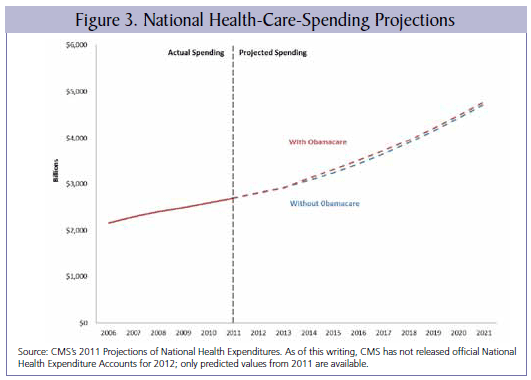
And how much will Obamacare save Americans overall? The answer: nothing. Or more accurately, Americans can expect to pay more for health care in total because of “Obamacare” than if the law . . . was never enacted. (Emphasis mine.)

Today, Americans spend well over $2 trillion — close to 18 percent of GDP — on health care, and U.S. health-care costs have grown much faster than either income or GDP growth over the last several decades. However, despite the best intentions of its supporters, Obamacare will not make much of a dent in these trends. The Centers for Medicare and Medicaid Services (CMS) projects that between 2012 and 2021, America will spend $36.8 trillion on health care. Absent Obamacare, CMS estimates that spending would be $36.3 trillion — a difference of just $500 billion over ten years. In other words, without Obamacare, Americans would spend less on health care.

The chart:

Folks, our political betters actually bent the cost curve up, not down.

Why will costs rise? Because the ACA did not fix the cost problems; as I told the St. Louis Beacon in a story published this morning, the law doubled-down on them. Instead of applying market pressures to get the cost of care down, the law just shifted how we pay for care. From the Manhattan Institute (emphasis mine):

As noted earlier, the law shifts health-care costs from individuals to government, with the overarching goal of reducing the share of health-care spending borne by low- and middle-income uninsured consumers. The problem is that evidence strongly suggests that when out-of pocket spending is lower, health-care spending actually rises.

Why would anyone implement an “affordable care act” that was anything but?

Grundy County Shenanigans

In conducting some research over the past year, we encountered a regrettable example of government keeping basic public information hidden. We asked for a breakdown of the total assessed value of each county by land and improvements. (Improvements are any structure on the land.) All we wanted was county totals, not individual parcel data. We did not think this was a complicated request, and all of this is public information.

Unfortunately, many counties do not track the land and improvement data separately in their software systems, so they were unable to provide us the requested info. (I think they should be required to track the data in that manner, but that is another issue.) Some counties that do track those valuations separately in their software quickly sent over the requested information for free. Other counties requested small amounts of money for the work. No problem there.

So far, so good. I was disappointed in the success rate of the information request, but at least every county was straight with us or sent us a reasonable estimated bill. Every county, that is, except Grundy.

The Grundy County Assessor demanded $9,000.

It was $9,382, to be exact. One dollar per parcel in that north central Missouri county, even though we did not want parcel data, just cumulative data. We pointed out to the assessor that we are a research institute and requested that he waive the fees. He declined and wrote, “I have a very large investment to protect.” And then it got good.

We noticed that most of the counties that provided us with the information used the same software, and the software company’s name was at the bottom of those replies. We went to that company’s website looking for public customer lists, etc. (This was not about Grundy County at this point. We realized that we needed to find all the counties that used this assessment software so we could make sure we at least had their assessment data.) The software company’s website lists client testimonials, and who do you think was listed among their clients? That’s right, Grundy County.

So, the Grundy County assessor was demanding more than $9,000 to provide us with public information that he could have gathered from their software in a matter of minutes, if not seconds.

About a dozen Missouri counties using this system provided us with the public information we requested quickly and at no charge. When we pointed this out to the assessor, and asked him to justify the demand for $9,382, he got angry and wrote, “I don’t want to do business with you anyway,” and added that we should “get the information you need somewhere else.” This, of course, ignored the fact that we are a charitable research organization, not a business, and that there is no place to get Grundy County assessment data except from the Grundy County assessor’s office. Also, just whose investment did the assessor think he was protecting?

Our initial request was on June 4, 2012. We filed a Sunshine Law violation complaint with the Missouri Attorney General’s office on July 2. Over the ensuing months, we heard some vague promises that we would get the information. To their credit, the AG’s office stayed on it. Finally, we received it, for free, on Tuesday — March 19, 2013. Even though the original project we wanted it for has been completed for a long time, the data is still helpful for another project I am working on. Plus, it was the principle of the thing . . .

It took more than nine months for us to receive a simple request of public information that probably took the office 2 minutes to send us once they realized they had no choice. The Sunshine Law is important. Keeping public information hidden by obscene fees is immoral and wrong. Apparently, Grundy County Assessor Don Stotts does not feel that way. Thankfully, however, he (or at least his assistant who sent us the data) finally changed his mind.

By the way, 25 percent of the assessed valuation in Grundy County is land, and 75 percent is improvements. This entire nine-month controversy was about us being able to write the preceding sentence.

Want to Help Science Start-ups? Cut Their Taxes. While We’re At It, Cut Everyone’s.

Last year, I wrote about a Missouri circuit court’s finding that the Missouri Science and Innovation Reinvestment Act (MOSIRA) — a package of incentives for tech companies that the Missouri Legislature passed in 2011 — was unconstitutional as passed. On Tuesday, the Missouri Supreme Court agreed.

MOSIRA had strong support of St. Louis-area biotech groups, and it was the lone accomplishment of the fall 2011 legislative session that was devoted to economic development. But lawmakers voted to approve MOSIRA that fall contingent on passage of a broader tax credit reform measure, which never happened. That led to a lawsuit by Missouri Roundtable for Life – which is concerned that MOSIRA could lead state funds to be used for stem cell or cloning research – and the program’s being overturned before ever launching.

In their opinion Tuesday, the justices wrote that the 2011 bill’s contingency clause violated the “single subject provision” of state law, and that the contingency clause could not be severed from the larger legislation, as it likely would not have passed without that clause in place.

Trivia: Do you know the bill upon which MOSIRA’s implementation was contingent? The answer: A package of tax credit legislation that included . . . the highly controversial Aerotropolis project. As went Aerotropolis, so went the 2011 session . . . and now, MOSIRA. Which is to say, nowhere.

Of course, there is an easy solution to avoid court fights such as this. Why not eliminate business taxation for all of Missouri’s companies? Stop picking winners and losers and set up a system of tax collection that incentivizes all businesses to stay in or come to Missouri. If the state wants to diversify its “investments” and support existing and emerging industries, why not tell all businesses, here and elsewhere, “We want you to invest in Missouri”? If the state did that, Missouri would, for once, force other states to respond to our pro-growth taxing proposals, rather than the other way around.

Unfunded Pension Liabilities And Car Analogies

At one point or another, we are all guilty of it . . . making bad analogies. This time, the bad analogy award goes to Gary Findlay, executive director of the Missouri State Employees Retirement System (MOSERS). According to the St. Louis Post-Dispatch’s David Nicklaus, Findlay believes using a risk-free discount rate to calculate the state’s unfunded pension liabilities is akin to taking a “zero-risk approach to traffic accidents — by banning cars.”

Findlay’s analogy was in response to a recent Show-Me Institute paper on Missouri’s unfunded pension liabilities. The author of the policy study, Andrew Biggs, demonstrates that Missouri’s unfunded pension liabilities are much higher than the state has reported when we accurately account for the risk of the investments.

Biggs, on the Show-Me Daily blog, and Jason Richwine, of the Heritage Foundation, have criticized Findlay’s remarks. In his post, Richwine states: “From an economist’s perspective on costs, Findlay is free to pursue whatever level of risk he wants with the Missouri pension fund. What he cannot do is pretend that more risk comes at no cost to the state’s taxpayers, who must make up for any funding shortfalls.”

I cannot help but heap more criticism on Findlay. His analogy would be accurate if Biggs had suggested we take a zero-risk approach to pensions by banning pensions. Of course, that is not what he suggests. Rather, Biggs argues that pension liabilities should be calculated with a low-risk discount rate. In non-economist speak, that means when you are gambling with taxpayer money, it is wise to hedge your bets.

If we want to stick with the car theme, a better analogy would be that calculating pension liabilities with a low-risk discount rate is akin to purchasing auto insurance. Like driving, our investments have risks embedded in them. I believe it is important for Missourians to adequately plan for that risk before we let our unfunded liabilities come back to rear-end us. (How is that for a car analogy?)

Support Us

The work of the Show-Me Institute would not be possible without the generous support of people who are inspired by the vision of liberty and free enterprise. We hope you will join our efforts and become a Show-Me Institute sponsor.

Donate
Man on Horse Charging