TIF Is The Arch-Enemy

On Tuesday, people in both Saint Louis City and County will vote on an increased parks sales tax to support changes to the Arch grounds and increased funding for local parks. In my opinion, the various arguments for and against it are all washed away by one fatal flaw in the proposal. The state legislature, when it authorized the tax to go before the voters, did not exempt TIF funds from the sales tax. That means in most — if not all — of Saint Louis City and County, the almost 200 TIF districts will be able to keep half of the new sales tax revenues — supposedly going to parks and the Arch — and use it for themselves.

The infuriating thing is that when the legislature passed the bill allowing this tax last year, they also passed the enabling legislation for a new parks tax in Kansas City as part of the very same bill. And for that KC tax, they exempted the new sales tax from TIF. So this was not some oversight by legislative supporters of the tax in Saint Louis. If they knew to exempt the KC tax from TIF, they could (and should) have done so for the Arch tax. The fact that they did not can only be seen as an effort to help developers and other consistent TIF users by adding this new tax to the pot of money available for subsidies. That alone makes this new tax a bad idea for Saint Louis.

Part Three: The Smallness Of The Potentially ‘Hip’ Core

Last week, Kevin McDermott of the St. Louis Post-Dispatch‘s Political Fix blog wrote briefly about the “hip development” debate we have discussed here and asked this about Saint Louis’ recent downtown redevelopment projects: “Economic engine or not, does anyone really think that area was better, in any sense of the word, 15 years ago than it is now?” Yes, the area around Washington Avenue obviously looks nicer. There are also more people living there. But this is a classic example of seen benefits with unseen costs.

Below is a map of tax credits that the Missouri Department of Economic Development issued in Saint Louis City spanning the years 1999-2011. The legend is denominated in dollars of credit issued. The larger the circle, the larger the credit awarded.

You can find the statewide distribution spreadsheet here. You can also hover over the dots to view some details on individual projects, and you can zoom the map out to see tax credit projects in other parts of the state. (To drag the map with your mouse, hold the shift key first.)

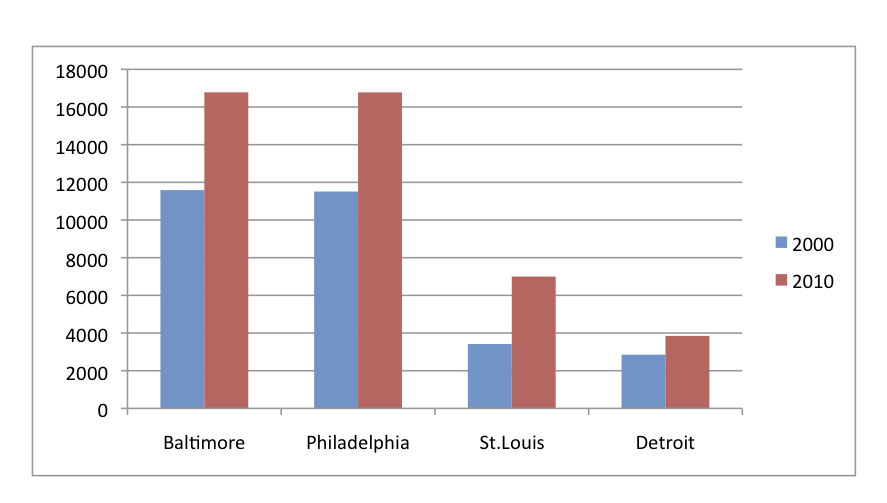
Dump hundreds of millions of dollars anyplace and something sure as heck better happen there. Washington Ave. is a good example of this. State tax credits have blanketed the central corridor of Saint Louis City over the last decade, and indeed, the population has risen in the area. But by how much? In a blog post titled “The Heavy Hand of Demographic Change” for the blog Rooflines, Alan Mallach of the Brookings Institute compared Saint Louis’ downtown growth to that of other cities.

Saint Louis’ downtown population rose from just shy of 4,000 people in 2000 to about 7,000 people in 2010, a net increase of more than 3,000 people and nothing to sneeze at. But outside the downtown area? Saint Louis City’s overall population fell from 347,000 people in 2000 to 319,000 in 2010, a net loss of about 28,000 people. The state dropped hundreds of millions of dollars into the heart of Saint Louis’ downtown through tax credits and moved the population needle some; meanwhile, thousands of residents outside the city’s central corridor were heading for the exits. Some “creatives” have come, but development “coattails” clearly did not.

That is a development paradigm that is simply not working. Empower individual innovation, not government “experts.” Trust city residents, not hip developers. It may be less “cool” to redevelop our cities this way, but it will probably be far more effective.

Do Not Give Me That Blaine Old Excuse

In the late 19th Century, James Blaine, a noted Republican politician, led the charge against government support of sectarian (read Catholic) institutions. As a result of his efforts, 39 states adopted provisions in their constitutions placing restrictions on state dollars flowing to religious organizations. These provisions are known today as Blaine amendments.

The Missouri Constitution contains several provisions that place restrictions on public dollars flowing to religions institutions. The most prominent states:

That no money shall ever be taken from the public treasury, directly or indirectly, in aid of any church, sect or denomination of religion, or in aid of any priest, preacher, minister or teacher thereof, as such; and that no preference shall be given to nor any discrimination made against any church, sect or creed of religion, or any form of religious faith or worship.

The Blaine amendment in Missouri’s Constitution has led many to believe that a private school voucher plan could not pass constitutional muster. It seems that the Blaine excuse may be just that, an excuse.

Florida, Georgia, Indiana, Ohio, Oklahoma, Utah, and Wisconsin all have Blaine amendments and the legislature in each of those states has passed a voucher program. Of course, voucher opponents invariably challenge these programs in the courts. As we have just seen in Indiana, it is possible for these programs to be upheld in spite of a Blaine amendment.

On March 26, 2013, the Indiana Supreme Court ruled unanimously that the state’s far-reaching voucher program is in fact constitutional. The justices concluded:

[T]he voucher program expenditures do not directly benefit religious schools but rather directly benefit lower-income families with schoolchildren by providing an opportunity for such children to attend non-public schools if desired.

The justices were absolutely correct. School choice programs are not designed to benefit schools; they are designed to give families options. Indiana was not the first state to uphold a voucher bill. Previously, 10 of 14 cases regarding vouchers in states with Blaine amendments have been decided in favor of school choice.

Blaine amendments vary by state and there is no guarantee that a voucher would be constitutional in Missouri, but it is about time to stop giving the Blaine excuse for not providing students with educational options.

North Kansas City Hospital Getting Very Interesting Very Fast

Things seem to be moving very quickly in the debate about the future of the North Kansas City hospital. Lawsuits, amendments to bills, new trustees, late-night rule changes . . . the only thing missing is the Turk trying to finish off Don Corleone. This is unfortunate, because the discussion about the potential future sale, transfer, or privatization of the hospital is extremely important.

Needless to say, rushed changes to the board rules and amendments added to bills after public hearings are completed does not make for good public policy. A judge upheld the right of the city to add new members to the hospital board, but I have heard that the current board members changed the board rules to require a super-majority vote on certain actions before the new members could be appointed. That might be clever, but it is hardly admirable.

Legislation taking the hospital away from the entity that has owned it for decades would be a very dangerous  precedent, terrible policy, and wrong, all combined. Maybe it is just me, but I think taking away ownership of the hospital from the city is, you know, a bad idea. The city owns the hospital. It has always owned the hospital. The city should be able to do what it wants with the hospital, be that sale, privatization, closure, expansion, whatever. (Let’s be clear, however: under every legitimate scenario, the hospital is going to continue operating.)

I am no lawyer, but I have to imagine the courts will continue to side with the city here. That makes legislative changes the best option for hospital activists opposed to any structural changes. It would be extremely unfortunate if a pro-free- market legislature made an exception in this case and blocked the city from even considering something such as privatization, which most members of the legislature would usually support.

Part Two: The Smallness Of The Potentially ‘Hip’ Core

On Monday, I hit the idea of “hip” development pretty hard, but let me be clear about one thing: To me, that a district is off-beat, historically interesting, or otherwise unique is a net positive. Every city has enclaves and community identities that make wonderful contributions to how a city feels. It is part of the reason I like living in cities. But those city and community identities are best developed organically, not artificially.

Why? Because governments are terrible at figuring out how development dollars should be allocated — to entertainment? to bars? to factories? to homes? — and simply do not have the knowledge that is embedded in the marketplace to make many developments successful. The decisions of individuals, maximizing their own well-being, are why most cities came to be. They are why good cities became great, and great cities became world-class. It is why cities that have fallen on hard times can be great again, if the government will stop meddling.

On a personal note, I was raised in the Northeast area of Kansas City, which for the last 100 or so years has been a heavily immigrant community. It is not necessarily “hip,” but it is real. Inexpensive housing plus ready employment made it an ideal place for a newcomer to the States to, sometimes literally, set up shop and grow a family. It is why my mother’s Italian family came there, why Jewish families came before them, and why Hispanic and Vietnamese families came after them.

“Old Northeast,” as it is often called, has a meaningful and enduring story, I think, because its history emerged naturally. Its story is a story of people, not of government or government-sponsored “big ideas.” It is a story about authenticity, not artificiality — about the uniqueness of the Kansas City experience. One chapter closes, another opens, and the story continues, but it is a story built by people, not by development experts that the city or state enlist to “revive” an area’s fortunes. Part of the problem that Missouri and her cities have is that instead of harnessing the potential of all their citizens and diversifying their growth opportunities, they are too often just tinkering with one government-subsidized development after another.

Check back later this week for Part Three. Rest assured, we will be adding meat to these broad philosophical bones.

DESE Should Consider District Level Waivers

Let’s recap. In 1965, the United States Congress passed the Elementary and Secondary Education Act (ESEA) as part of Lyndon Johnson’s War on Poverty. The act must be reauthorized every five years. The most recent authorization took place in 2001. Since then, most people know ESEA as No Child Left Behind (NCLB). NCLB required states to implement a system of test-based accountability. The ESEA has not been reauthorized since 2001.

As part of the American Recovery and Reinvestment Act of 2009, the United States Department of Education (U.S. DoE) created a competitive grant process called Race to the Top. The Race to the Top application encouraged states to adopt college- and career-ready standards.

The Missouri Department of Elementary and Secondary Education (DESE) applied for a Race to the Top grant in January of 2010, promising to adopt college- and career-ready standards.

In 2012, the U.S. DoE began awarding waivers to No Child Left Behind. DESE applied for a waiver in February of 2012, again promising to adopt college- and career-ready standards. They received the waiver in June of 2012.

DESE, without approval from the legislature, set Missouri on a new course by adopting the Common Core State Standards. Essentially, DESE committed Missourians to a set of national curriculum standards.

The Common Core State Standards have been met with a considerable amount of consternation.  Bills have been introduced in the Missouri House and Senate that would halt the implementation of the new standards. I have submitted written testimony to the committees and written elsewhere about the impact of these standards.

Now we are finding out that individual districts in states that did not receive waivers from the U.S. DoE are able to apply for waivers. What I want to know is, when will DESE begin awarding waivers to school districts that wish to opt out of Common Core? After all, the state was able to opt out of a federally binding law and now individual school districts may have that ability. Shouldn’t DESE give local schools the ability to opt out of these new state standards if they can demonstrate that they have a comprehensive local system of accountability in place?

Reminder: A Strong Majority Of States ‘Remain Either Defiant Or Undecided’ About Expanding Medicaid

The Associated Press kind of buried the lede this weekend in a story about state legislatures supposedly wanting to “make a deal” with the federal government to expand their Medicaid programs. The story pretty well captures supporters’ movement from the “economic development argument” for a Medicaid expansion to the “inevitability argument” — that it is just a matter of time before Affordable Care Act opponents are forced to expand their Medicaid programs. But if you read down, you will find this tidbit six paragraphs deep. (Emphasis mine.):

Officials in about 30 states that are home to more than 25 million uninsured residents remain either defiant or undecided about implementing Obama’s Medicaid expansion, according to an Associated Press survey.

In other words? A majority of states have not yet implemented the Medicaid expansion, and many are vehemently rejecting it. The Missouri Legislature has repeatedly rejected expansion proposals, for good reason: The “Affordable Care Act” is patently unaffordable, and it seems that most states — Missouri included — are not exactly chomping at the bit to bring many of the law’s burdensome provisions back home.

Inevitable? Far from it.

Kansas City Seeks To Extend Health Levy

In 2005, city leaders in Kansas City sought and received a temporary property tax levy to fund health services. Eight years later, as the nine-year tax is set to expire, city leaders and health care executives want to extend it. Kansas City’s Northeast News reported that the levy helps fund:

. . . two hospitals, Truman Medical Centers and Children’s Mercy, along with six area non-profit health care providers like Samuel U. Rodgers Health Center, Northland Health Care Access, KC Care Clinic, among others, to offset the cost of indigent health care. In addition, approximately $10 million of the levy goes toward the city’s ambulance service. Truman Medical Centers receives the bulk of the levy, about $26.4 million.

The tax, amounting to about $43 on each $100,000 of assessed property, is in addition to an existing health care tax that runs about $94 on each $100,000 of assessed property. However, The Kansas City Star reports that the tax may not be necessary because of the Affordable Care Act. The Star reported earlier this year that Obamacare:

. . . is supposed to improve health coverage for thousands of the city’s poor, they say. By next year, most Americans must carry health insurance or face a tax penalty, a mandate that should mean Truman and the health centers will get an infusion of cash from newly insured patients.

The city is probably correct to be skeptical that Obamacare will live up to its ambitions — it seems to be falling short on its promises — but Kansas Citians are hardly able to foot the bill for a long and growing list of taxes.

Voters’ mailboxes are being filled with mailers about why we should vote to extend the tax. Perhaps that money could be spent on an audit that identifies how to more efficiently spend existing funds. Instead of spending $10 million in tax dollars on ambulances, perhaps some of that service can be privatized, as is the case elsewhere in Missouri. Without being “smarter with the money,” does anyone doubt that in nine years the city will seek to extend this temporary tax again?

The Worst Kind Of Science

St. Louis Post-Dispatch columnist David Nicklaus, in his column “Missouri tax cuts aren’t a magic formula for economic growth,” cites a report by Leachman, Mazerov, Palacios, and Mai that the Center on Budget and Policy Priorities published. In the report, the authors present evidence and then interpret it as indicating that changes in income tax rates are positively correlated with economic growth.

First, the evidence is that six states enacted large personal income tax cuts in the years before the Great Recession. Three of these six states reported economic growth rates that were lower than the nation’s growth rate while the other three reported growth rates that exceeded the nation’s growth rate. The three faster-than-nation states were major oil-producing states, benefiting from the sharp run-up in oil prices that occurred after the tax rate changes were implemented.

Leachman et al. are correct in pointing out that multiple events affect each state’s economic growth rate. But the analysis is so perverted that it is more politics than economics.

Let’s try to be objective about the effects associated with a reduction in the income tax rate. First, the partial effect of a decrease in the income tax rate means that the after-tax returns to factors of production will increase. In other words, the return to workers and to those people taking risks as entrepreneurs and business owners. As the after-tax returns increase, the aggregate supply increases at a faster rate. This is how lower income tax rates, holding everything else constant, result in faster income growth. Leachman et al. do not present a new economic model that overturns this reasoning, so this point is indisputable.

What they must have in mind is the next round of effects associated with smaller state budgets. In the near term, state spending shrinks because the product of the tax rate and the tax base initially shrinks when the tax rate is reduced. The Leachman et al. argument is essentially that the government spending is on public goods — infrastructure, schools, and other capital investments — that offer a higher average return than private citizens could possibly realize from investing on their own. Honestly, this may be true. However, states purchase lots of things that are not about infrastructure, schools, and other capital investments. It may be a hard choice, but if there are fewer resources poured into state coffers, then the state must allocate those to the public projects that offer the highest return to its citizens.

The other part to this dynamic analysis is what happens when income grows faster because of the lower income tax rate. Because of this effect, over time, the state budgets will also grow faster, meaning that the path of state government future spending will exceed the high-tax-rate path. Leachman et al. do not even consider this.

Now, back to the evidence. Their interpretation is the worst kind of science. Ideally, a scientist would like to run a controlled experiment, isolating the treatment that they are considering and then compare results from the control group with the treatment group. Leachman et al. start off by recognizing that no such controls exist. Then they pervert their analysis by using the absence of the controls to argue that oil-producing states benefited only from their oil. Shame on them!!! What they cannot tell you is whether the non-oil producing states would have grown even slower if the income tax rates had been left at their higher levels. Now that would be a comparison.

There are other objective ways to rip their analysis. For example, they focus on a short time horizon. No growth theorist relies on data less than a decade old to try to infer what the growth-rate effects are. Yet Leachman et al. boldly assert the causality from just a few years of data.

You do not have to trust me. You can read the literature on factors affecting economic growth. At the state level, it is important to spend resources on public goods that are most valuable to people living within those boundaries. The next objective is to collect taxes from these people in the way that does the least harm; that is by creating the smallest distortions. Such taxing principles will result in higher living standards and happier people than for one group to nakedly claim their sense of fairness is the right tax structure.

The debate is too important to not carefully think about the best approach. Let’s think carefully.


Support Us

The work of the Show-Me Institute would not be possible without the generous support of people who are inspired by the vision of liberty and free enterprise. We hope you will join our efforts and become a Show-Me Institute sponsor.

Donate
Man on Horse Charging