Questions for the Kansas City Public Schools Master Plan

The Kansas City Public School’s new master strategic plan has already attracted its fair share of controversy.  Closing Southwest, a school that has been in operation for 90 years, is going to grab headlines. Closing two other schools, Crispus Attucks and Satchel Paige, will get people fired up as well.  So will altering attendance boundaries so as to change the school of around 2,000 students. 

The plan is still in its public comment period, so I’d like to offer the questions that I have:

1. Is the district serious about reining in administrative bloat?

The Department of Elementary and Secondary Education publishes administrator/student ratios for every district in the state.  For 2015, Kansas City had significantly more administrators on a per pupil basis than surrounding school districts, and even more than St. Louis. By a lot.

District

Students per Administrator

North Kansas city

276

Liberty

261

Independence

251

Lee’s Summit

241

St. Louis

201

Kansas City

172


Those extra administrators represent serious money that could be spent in the classrooms that actually educate children.  To its credit, the plan calls for reducing administrative costs by $750,000/year, which is a good start.  But getting down to Liberty or North Kansas City levels of administrators would involve even deeper cuts than that.

2. How much smaller can the district get?

As the Star reports, the district has shrunk to only 14,228 students.  That doesn’t even put it in the top 10 districts in the state by enrollment.   Peak enrollment (in the early 1970s) was almost 73,000.

3. Students are fleeing in droves to attend public charter schools. Are we going to rethink the organization of the district in response?

As I detailed earlier this week, 41 percent of students within the boundaries of the Kansas City School District attend public charter schools, and enrollment is only growing.  There might be a not-too-distant date in the future when the vast majority of students attend public schools in Kansas City that are not operated by the Kansas City Public Schools.  Taxpayers still have an interest in these schools, and our community should play some role in their governance, but what should that role be?  New Orleans offers an interesting possible future for the city.

4. Does this plan come anywhere close to meeting the needs of the district and the children who live in it?

Probably the most striking thing that I took away from reading the report is just how little it actually wants to do.  Moving a couple of attendance boundaries, closing a high school, creating new programs within existing schools . . . these are things districts have to do all the time to adjust to student movement and community change.  Given the exodus of students, the woeful performance of schools, and the hollowing out of the tax base from tax increment financing, how can that possibly be enough?

Killing the Golden Goose: How Walmart’s Left-Wing Critics Destroy Job Creation

Under three different CEOs, Wal-Mart has done all kinds of somersaults to appease left-wing critics. In 2005, Lee Scott set goals of “zero waste” and “100 percent” conversion to renewable energy. In 2009, Mike Duke, the next CEO, took on Obamacare – as an outspoken supporter of the unpopular health care bill. This was “a stunning metamorphosis,” the Wall Street Journal declared in a company profile. Wal-Mart had gone from being “a whipping boy to the political left to corporate leviathan now welcomed with open arms by a Democratic White House.”

This February, Doug McMillon – the current CEO – agreed to raise the hourly wage at Wal-Mart to no less than $9 an hour in April and to $10 an hour (or 33 percent above the current federal minimum wage) in early 2016.

How is the sharply elevated internal “minimum wage” working out for the world’s largest retailer and (by a wide margin) the nation’s largest private employer?

So far, not at all well.

In announcing the company’s third-quarter results this Tuesday, McMillon acknowledged that the wage hike had been “by far the biggest driver” in causing a 13.3 percent reduction in corporate earnings over the first nine months of its current fiscal year (ending on Jan. 31, 2016). Higher wages have added $1.2 billion in annual costs in this fiscal year and will add another $1.5 billion in costs next year.

Net income at Wal-Mart hit an all-time high of $17.0 billion in calendar 2012 (fiscal 2013, ending in January 31, 2013). According to Value Line estimates, it will drop to $14.8 billion at the end of this year and to $12.6 billion next year, which would be the lowest annual earnings for Wal-Mart in a decade.

That is no big deal to critics like Robert Reich, who served as Secretary of Labor under President Clinton. Reich pointed to Walmart and McDonald’s in a petition that he launched on MoveOn.org in 2013 urging the biggest employers to increase wages so workers can finally “get a fair share in this economy.” “Your typical employee is now earning $8.25 to $8.80 an hour,” Reich wrote. “They [Walmart and McDonald’s] can easily afford to pay [workers] $15 an hour without causing layoffs or requiring price increases.”

In regarding any profit as proof that a company can afford to pay more to its workers – without doing harm to its customers – that viewpoint disregards the realities of a competitive marketplace.

For one thing, Wal-Mart competes with other public companies in striving to maximize returns to shareholders. To say that Wal-Mart has been getting hammered in this regard is something of an understatement.

Wal-Mart’s shares have lost a third of their value since the beginning of this year – falling from a high of $90 a share in January to $60 at the close of business on Nov. 17. Meanwhile, its biggest rivals have done substantially better. Costco has climbed from $140 a share to $159, and Amazon.com has more than doubled in price.

In July, Amazon passed Wal-Mart to become the most highly valued company in the retail sector and it has shot further and further ahead since then. It now has a total market capitalization of $308 billion, compared with $195 billion for Wal-Mart.

Wal-Mart lags far behind both Amazon and Costco in productivity – measured in sales per employee, with Wal-Mart at $219,000, Costco at $565,000, and Amazon at $578,000. It is clear that Wal-Mart is intent on closing the gap by slowing the growth of bricks-and-mortar stores while putting much greater emphasis on e-commerce. As McMillon put it in his presentation on Tuesday:

We will be the first to deliver a seamless shopping experience at scale. No matter how you choose to shop with us – through your mobile device, in a store or a combination – it will be fast and easy. Online retailers are testing physical store experience because they recognize the same customer desire that we do. There’s a race to do this right.

But consider the impact on total employment at Wal-Mart if the company were to close the productivity gap between itself and Amazon by 25 percent over the next three years while also achieving its stated objective of growing annual sales from about $485 billion to $530 billion or more.

In this situation, Wal-Mart would need a global workforce of 1.7 million associates, compared to the 2.2 million it has now – a loss of approximately 500,000 jobs. That would entail a loss of about 320,000 associates out of the U.S. workforce of 1.4 million associates.

While those numbers are speculative, they clearly point to the conclusion that Wal-Mart will no longer be the great job-creation machine that it was years past, which is something that self-declared champions of working class should be thinking about in agitating for higher wages. Paying higher wages has made the company more focused on achieving higher levels of productivity.

At the same time the company may water down if not abandon its historic commitment to serving less affluent shoppers with rock-bottom prices across a vast array of merchandise. The late founder Sam Walton said his dream was “to serve the under-served.” That is less of a priority today. “Globally, we know growth will come from middle- and upper-income households in years ahead,” McMillon stated at an analysts’ meeting in October.


Stand Up KC Organizes Misguided Fast-Food Worker Strikes in Kansas City

A group called Stand Up KC is organizing strikes at fast food restaurants in Kansas City. The organization believes that fast-food workers should be paid more money. The problem is that Stand Up KC is putting a lot of effort into organizing workers, but—based on their website and statements to the public—little to no effort into improving the value of the workers themselves. In the long run, this will hurt workers more than help them.

A business hires an employee because that employee will add value to the business. If you force businesses to pay more for each individual employee without increasing the value of the employee’s services, you’re encouraging businesses to find a way to get by with fewer low-skilled employees. Stand up KC’s tactics—calling strikes, advocating a local minimum wage hike, and agitating for a statewide $15 minimum wage—all seek to increase pay without increasing the value of services rendered.

The picture above is a McDonalds in Rolla. At this location you can order your meal from a user-friendly touchscreen computer. These computers are never late, they don’t go on strike, and they’re getting cheaper every year.

If Stand Up KC successfully drives up the cost of low-skilled labor, we’ll probably see a lot more restaurants with computers like this.

What I Saw at the Stadium Hearing

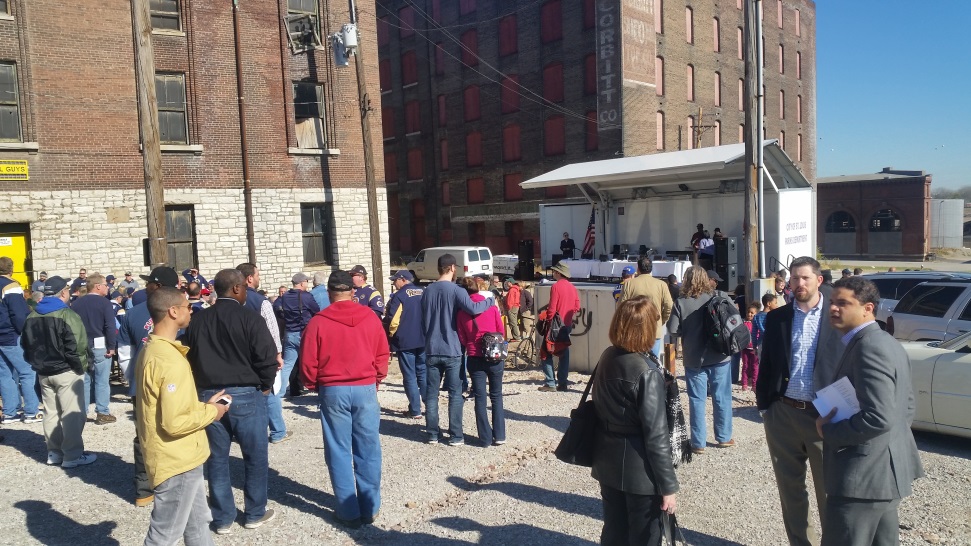
On Saturday, the Saint Louis Board of Aldermen’s Ways and Means Committee held a public comment session on the Near North Riverfront. The topic was a plan to publicly fund a new stadium in hopes of keeping the Saint Louis Rams in town. From start to finish, it was a rambunctious affair.

People on both sides booed, cheered, and tried to shout each other down. The following is a list of impressions that I took away from the meeting:

1.       Stadium supporters are still delusional about the benefits of a riverfront stadium.

We’ve talked about this before, but it was very clear that many aldermen and stadium supporters in the public believe, despite decades of studies from economists (and the experience with the Edward Jones Dome), that a stadium will make the city money. The people who already believe that a stadium is a great idea quickly latched on to dubious revenue projections from the mayor’s office and the Saint Louis Regional Chamber. They continue to ignore what is the consensus among economists: NFL stadiums do not create growth, spur development, or greatly increase tax revenue.

2.       Many city residents are against the plan, and especially want a vote.

The vast majority of city residents who spoke were skeptical of the stadium plan. But what city residents heavily criticized, again and again, was the idea that Board of Aldermen might approve the stadium funding plan without a public vote.

3.       The city-county divide was on display.

The first speaker in favor of the stadium plan was from Saint Louis County, and some in the audience tried to shout him down because he didn't live in the city. The committee chair appropriately defended the right of those not from Saint Louis City to speak, but over the course of the session a pattern established itself. Most of those speaking in favor of the stadium plan lived in the county (or Illinois), and most of those opposing the plan were city residents.

4.       The session became more rally than public hearing.

At any normal public hearing, the Board of Aldermen meets in a hearing room or auditorium. Aldermen ask questions of speakers, and anyone who disrupts the meeting is escorted out of the room. For whatever reason, the Board of Aldermen decided to hold the public meeting outdoors, where the proposed stadium would be built. As a result, speakers constantly faced harassment from the audience for their views. One speaker pointed out that, in order to speak, she had to publicly declare herself as pro or con, something she would not have to do if she had the privacy of the voting booth. I would add that she wouldn’t have had to brave the jeers of Rams’ superfans either.

To see our take on the city’s plan, read our testimony here.

Million Student March Proposes Free College and Debt Forgiveness

Nearly one in five students who attend community college in Missouri will default on their student loans within three years, according to data from the Department of Education.

Nationally, student debt totals $1.3 trillion—and more than one-fifth of borrowers are unable to make payments. According to Million Student March leader Keely Mullen, the solution is progressive taxation.

Free college! A $15 dollar minimum wage for campus workers! No more student debt! Thanks, one percent. . . . wait—where did you go?

There are realistic solutions to the rising cost of obtaining a college degree, but they don’t include simply pouring more tax dollars into a broken system.

One solution would be to lower the cost of college altogether. Both massive open online courses (MOOCs) and competency based education (CBE) offer opportunities for states trying to do just that.

Many courses that students are required to take are offered online in the form of MOOCs. MOOCs are courses offered over the internet to a large group of people without charge. Websites like Coursera offer classes in history, math, science, and engineering at low cost (and sometimes free). Allowing students to use free or low-cost services, especially when some of these classes would be big, impersonal lectures anyway, would reduce the number of courses for which students must take out loans.

Competency based education has similar potential to reduce the cost of college. Rather than basing course credit on the amount of time a student sits in class, CBE grants credit for courses when students demonstrate that they have mastered the coursework. This helps students progress more quickly through content they already know or can learn easily, and ultimately reduces the amount of time students need to complete their degrees.

Public institutions like the University of Missouri should embrace these alternatives. The best way to decrease student debt is to reduce the cost of the education itself, so students don't need to borrow so much in the first place. 

Debate Comment Sparks Discussion about Vocational Education

During last Tuesday’s Republican presidential debate, Marco Rubio joked, “For the life of me, I don’t know why we have stigmatized vocational education. Welders make more money than philosophers. We need more welders and less philosophers.” Some have questioned the accuracy of his statement (yes, philosophy majors earn more on average, but there are a lot more jobs in welding than there are in philosophy), but in any case, he did push us to think about the value we place on vocational and technical preparation in schools. Is Missouri doing enough to prepare students who want to be welders? Are our schools too focused on trying to make students into philosophers?

In Ascension Parish, Louisiana, high-school students don’t have to wait until college to access technical education—they can take courses through their traditional public schools, as The Foundation for Excellence in Education depicts in a recently released a video titled “Course Access: Expanding Access & Equity in Louisiana.”

Course access (or “course choice”) allows students to direct funding to approved course providers outside of their traditional public school and to receive credit for classes they successfully pass. This allows students to customize their education while remaining in their home districts. Enrolling in welding courses has put students like Stormi Honeycut (shown in the video) on the path to high-paying careers without ever having to pay thousands of dollars to a technical college.

According to www.tech-schools.us, 69 colleges offer technical programs at 91 locations in Missouri. Some tech programs cost as much as traditional university education. Ranken Technical College in St. Louis, for example, costs $14,000 per academic year, which is impractical for many students.

If Missouri adopted a course access program, students could enroll in courses through approved technical programs at no additional expense to the students or taxpayers while still in high school. Funds would simply be redirected from what the school district already uses. By the time they graduated, students could be well on their way to a solid career in a trade.

When I first started at the Show-Me Institute, I told the story of my experience teaching in a low-income school district. I wrote:

…one day, I noticed a child staring out the window at the construction site adjacent to the building.  The student mumbled to himself, “if only school was doing construction work, then I’d have an A-plus.”

As a teacher, I learned that if students want to be welders, schools that want to make them into philosophers won’t help them, no matter how effective the teachers are. Imagine the reverse—we would surely oppose trying to make students who want to be philosophers into welders. Why don’t we recoil when folks try to make welders into philosophers? For students more interested in a vocational career than a philosophy degree, course access offers a path forward.

Straight Talk about the Loop Trolley

The Loop Trolley is officially over budget. There was speculation earlier this year that the project could not be completed with its original $43 million budget, but for months officials rejected the idea. But as the Post-Dispatch recently reported, costs have now risen to $51 million, an 18% increase over the initial budget.

So who pays for the overrun? As we’ve written before, the Loop Trolley’s financing plan left virtually no room for error. Any cost overrun, be it $1 million or $100 million, would have sent the trolley planners out with a begging bowl. In this case, the trolley project needs an additional $8.4 million. To get that sum, Saint Louis County will have to spend $3 million of its dedicated transit funds to match $5.4 million in federal dollars, all of which could have been spent on other regional transit improvements had the Trolley kept to budget.

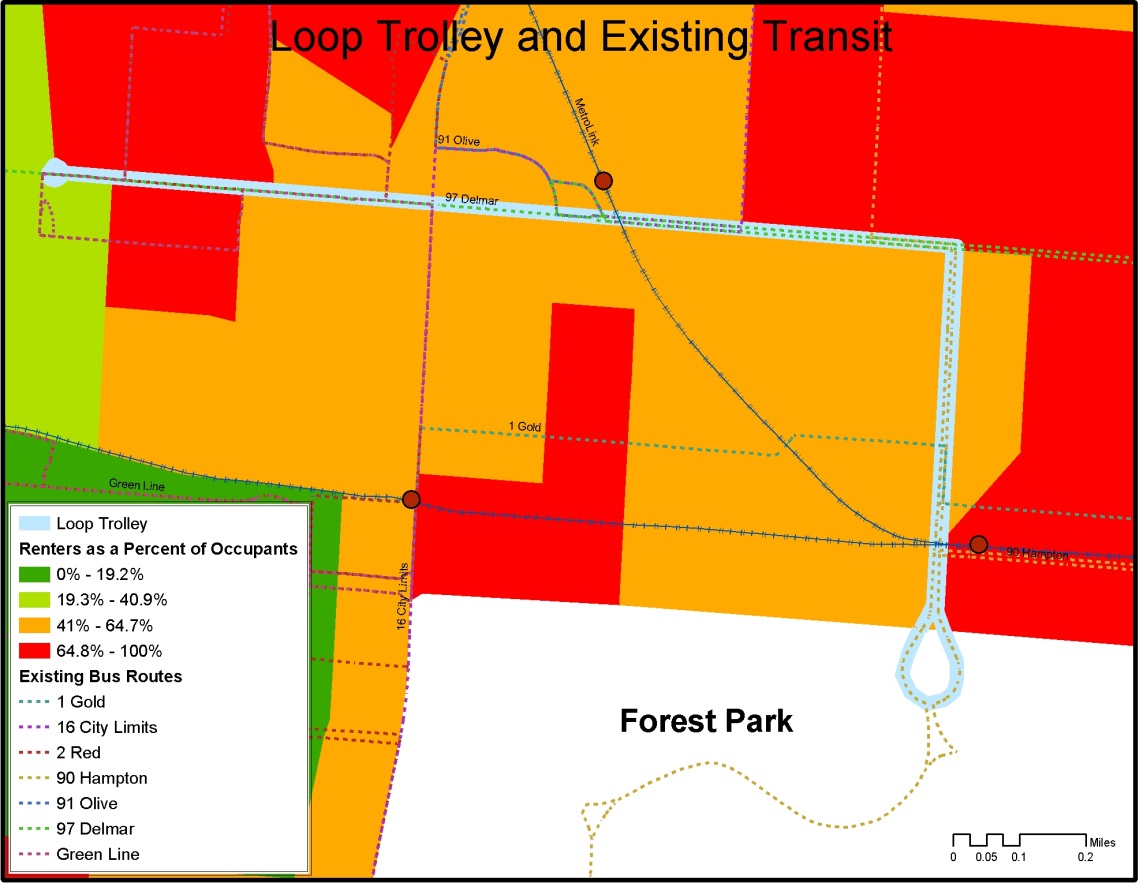
The rising expense of the trolley has prompted a reevaluation of its merits, both in terms of transportation and urban revitalization. Let’s be clear: if viewed as a transportation device, the Loop Trolley has no merits. As we wrote last year:

“…the Loop Trolley’s path is intersected by seven MetroBus routes and passes within a few meters of two MetroLink stations. The trolley, if it is built, will be redundant for nearly all conceivable transit trips.” [see the map above]

The project’s slow (10–15 mph average), antique trolley cars are easily outclassed in terms of speed and range both by buses and light rail. And at $23 million a mile, it is certainly not (contra Mr. Edward’s claims) the way of the future for Saint Louis transit. At that cost, recreating the streetcar system of 1902 (with roughly 1/3 the reach of the current bus system) would cost about $13 billion. Streetcars’ only future will be in boutique sections of cities with more money than sense.

The stronger case for the Loop Trolley, and streetcars in general, is that they may spur development. Whether or not streetcars actually create new development is a matter of debate, and the evidence used by proponents is usually weak. However, it is possible that the quaint look of the trolley will draw people to the Loop, and more businesses to area around the tracks. The effect could be similar to having attractive park running down the middle of a street. $51 million is an extremely expensive park, but then the federal government isn’t handing out more than $30 million in transportation grants for local parks.

However, as the Post-Dispatch reported, the construction of the trolley is having a damaging effect on local businesses as potential visitors avoid the chaos. But problems may not end with construction. The slow-moving trollies will operate in mixed traffic in much of the Loop, and aside from creating more congestion, car-on-trolley collisions are just a matter of time. It may be that interest in the trolley will overcome the hassle it creates, but as micro streetcar lines running through kitschy entertainment districts become more common, the Loop Trolley may lose its cache. And that’s something to worry about, because the permanence of a streetcar line can be a double-edged sword.


Learning from New Orleans

Yesterday I highlighted a recent report that showed just how big a part of Kansas City’s education system charter schools have become. The #1 district in that report, with 93 percent of students enrolled in charter schools, is New Orleans, Louisiana. Given that Kansas City’s charter enrollment only appears to be growing, it’s looking like our school system is going to more closely resemble that of New Orleans in the coming years.

That brings me to this report, authored by Neerav Kingsland, one of the central architects of New Orleans’ education system. In it, he describes how the system works and looks at preliminary results. I recommend reading the whole thing, but my quick reactions are as follows:

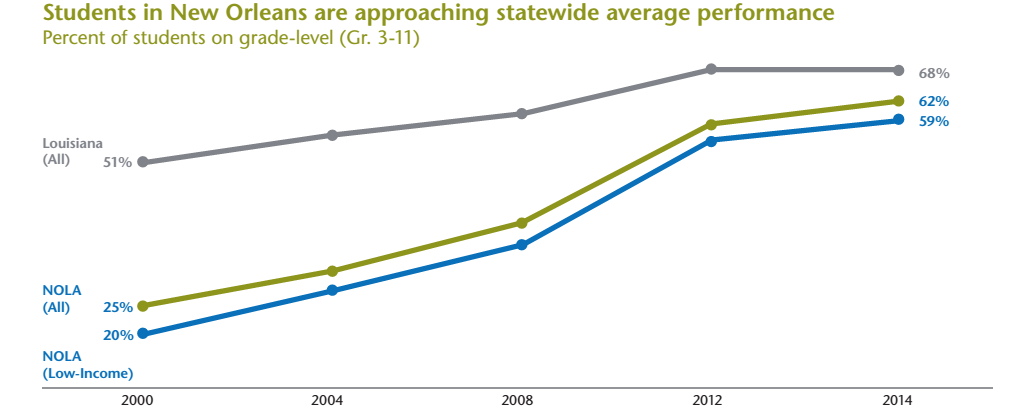
  1. The academic results are really encouraging. The graph above (from page 3) shows the progress that New Orleans has made, nearly closing the gap between the city and the rest of the state. I can’t think of any big-city system anywhere that comes that close to the state’s average. Can you imagine if Kansas City or St. Louis achieved at the same level as the state as a whole? Clearly this system can drive improvement.
  2. That said, Kingsland is open about the fact that New Orleans is far from perfect. Just getting closer to the average of one of the lowest performing states in the union is not good enough. New Orleans still has a long way to go toward becoming a world-class system of schools, and to his credit, Kingsland is honest about that.
  3. On another note of caution: New Orleans has a lot of things going for it that might be hard to replicate. As Kingsland points out, a constellation of nonprofits, advocacy groups, educators, civic leaders, and others have come together to help make this system work. There was also a huge infusion of social capital post-Katrina; individuals moved there specifically to help rebuild and improve the city. We have not seen similar levels of comity and commitment in the Show-Me State.
  4. Missouri would have to make several key shifts to make our big city systems look like New Orleans’. The majority of schools in New Orleans are overseen by a statewide Recovery School District that functions very differently from your standard school district. It does not operate schools, or at least does not want to operate schools over the long term. It is designed to be a funder and a regulator, with independent charter organizations operating the schools themselves. There has been an unsuccessful effort to create such a district in Missouri, but it would be possible to try and pivot a shrinking school district like Kansas City into a regulator-funder like the RSD. If charter schooling spreads outside of Kansas City and St. Louis, given the number of small districts that it might disrupt, some kind of state-wide district model might be necessary.

All in all, New Orleans is a hopeful example. It was able to move a district that was one of the worst in the nation meaningfully forward. No one would say it is anywhere close to where it needs to be, but it appears to be on the right track, which is more than we can say for most districts (including those in our own back yard).

The Convention Hotel Deal May Cost Kansas City Conventions

On June 25, we described how the convention hotel deal agreed to by Kansas City officials made the city less attractive to conventions. In short, because the city moved us from open catering, where conventions can seek bids on feeding attendees, to a closed deal where they must use the Hyatt for food service, there was less opportunity for conventions to save money. Yesterday, at least three event planners who have worked in Kansas City wrote to members of the City Council saying that the deal might cause them to go elsewhere. We've reprinted their letters here.

First, from the Evangelical Free Church of America:

Greetings,

I have recently become aware that there are discussions about changing the Kansas City open catering policy at the convention center.  As an event planner, I want to express my concern over this potential change.

In 2014, I brought a week-long event to Kansas City for 5,500 students. This event utilized over 8,000 hotel rooms, over $740,000 in catering to the convention center and various other economic impacts. Having an option to select from a list of caterers was the tipping point for choosing KC. In fact, we had such a good experience, we have already signed to return to KC for the same event in 2018.

We would love to make KC our home for this event every 4 years. However, if the open catering policy changes, we will definitely have to revisit our plans. This is a unique feature that makes KC different in a sea of convention centers across the country.

I am asking that you please work to keep your open catering policy.

Should you have any questions or wish to speak with  me further, please contact me using the information listed below.

Blessings,

Laurie Seay

Event Director

EFCA

Second, from Educational Testing Service:

Dear Council Members,

ETS and The College Board have found Kansas City to be a wonderful location for our Advanced Placement Readings since 2008.  One of the things we like best is the open catering policy at the Convention Center.  The opportunity to competitively bid catering services has been not only financially favorable, it has allowed us to ensure that the quality of food and beverage and related services meets our standards.  In 2015, our catering spend was just short of $2.3M to a combination of three KC local caterers, so you can see that the impact of not being able to competitively bid out this work could be considerable.

ETS is very concerned about the potential for allowing the proposed new hotel to have exclusivity for catering in the Grand Ballroom and Convention Meeting Space.  We hope that you will consider the fact that such exclusivity is described in a non-binding portion of the signed Memorandum of Understanding, and we urge you to consider not moving forward with a binding agreement.

Thanks for your consideration.

Patric Close Mills

Educational Testing Service

And finally, from The Menonite Church USA:

City Council of Kansas City

I’m writing to you representing an organization that recently held it’s national convention at the Kansas City Convention Center. We had a great experience. The convention center staff (including Matt Cunningham and Walter Moore and Steve Lesher) were great to amazing with. The CVB staff (including Juanita Crowder and Esther Walker-Young and Kim Dooley) were phenomenal to work with. Our participants spoke very highly of everyone they came in contact with during our event (vendors, hotel staff, restaurant staff, security guards, etc.). All this is to say that Kansas City has a good thing going!

The main reason I am writing today is to voice concern about the potential change to the open catering policy at the convention center. As someone that has planned large conventions for over 18 years, I can tell you that very few convention centers have open catering policies. I can also tell you that having an open catering policy was one of the selling points of bringing our convention to Kansas City. Having the opportunity to look at multiple caterers and have them bid on our business helped us control our costs. We were able to provide our convention participants with good meals at decent prices. As a non-profit organization, it is hard to go into a convention center with one catering option and have any bargaining power. Your open catering policy allowed us to ensure that we got competitive pricing. I would encourage you to keep the open catering policy as is.

Please do not hesitate to contact me if you have any questions. I would be more than happy to share more of my views on this issue.

Have a great day.

Scott Hartman

Convention Planning Coordinator

Mennonite Church USA

These are legitimate concerns. Kansas City taxpayers have every reason to suspect the wisdom of the deal, and members of the City Council should proceed cautiously before investing public funds in a deal that risks so much.

Support Us

The work of the Show-Me Institute would not be possible without the generous support of people who are inspired by the vision of liberty and free enterprise. We hope you will join our efforts and become a Show-Me Institute sponsor.

Donate
Man on Horse Charging