On October 5, David Stokes joined The McGraw Show on The Big 550 KTRS to provide an update on the Douglas Hill Development in Webster Groves.

On October 5, David Stokes joined The McGraw Show on The Big 550 KTRS to provide an update on the Douglas Hill Development in Webster Groves.
Colorado Governor Jared Polis recently took a (perhaps surprising) stance against income taxes. At the Steamboat Institute’s Freedom Conference, Polis said that Colorado’s state income tax should be zero. Governor Parson (and governors across the country) should take note.
Colorado’s governor defended his call for an income tax rate of zero with basic economic theory. When you tax something, you make it more expensive and discourage buying or doing it. With sin taxes such as cigarette taxes, the tax is added to do just that—make the price of cigarettes higher and discourage cigarette smoking.
But is that really what we want to do with income taxes? Do we want to discourage people from earning income? Show-Me Institute researchers have asked these questions for years as they’ve written about Missouri’s income tax and the earnings taxes in St. Louis City and Kansas City. The individual income tax accounted for more than 26 percent of Missouri’s total revenues in 2020 (Colorado’s 4.63 percent individual income tax contributed almost 20 percent of the state’s revenues in 2020). Given the adverse incentives created by income taxes, it would be in Missouri’s best interest to rely less on this harmful tax.
Missouri legislators have taken steps to lower the state income tax, perhaps indicating a general acknowledgment of the negative effects of income taxes. For example, the online sales tax bill from earlier this year includes mechanisms to incrementally lower the top state income tax rate to 4.8 percent. This is a great step in the right direction, but we are still far from zero. As Polis said: “We can find another way to generate the revenue that doesn’t discourage productivity and growth . . . and we should.” I agree, and I hope that Missouri lawmakers share this sentiment and continue to lower income taxes in our state.
Susan Pendergrass speaks with Gerard Robinson, Fellow of Practice and Vice President for Education, Advanced Studies in Culture Foundation.
Show-Me Institute Analyst Jakob Puckett responds to some of the comments he received about his recent report, Improving Missouri’s Transportation System through Tolling.
On Tuesday, September 28, Patrick Ishmael joined Pete Mundo on KCMO Talk Radio to discuss a Missouri State diversity official’s recent comments asserting that CRT is “not being taught in the public schools, it’s not even being trained in the public schools.”
Our friends at the Illinois Policy Institute have a new report out on education spending in the Land of Lincoln. The numbers are gobsmacking.
In the 2021–22 school year, 39 percent (yes 3-9 percent) of education dollars will be spent on pensions. While education spending has grown 17 percent since 2000, teacher and administrator pension costs have risen 458 percent. 458 percent!
When the pension part of the state spending pie grows, the other slices of the pie shrink. That means that money that could be going to today’s teachers is going to yesterday’s.
Pensions are a perfect storm for governmental jiggery-pokery. The bill for bad decisions doesn’t come due for years after most of the people making decisions are out of office. The benefits are clear to those receiving them but are opaque to taxpayers (who tend to focus on metrics like teacher salaries, not total teacher compensation). Legislators can hide behind actuarial alchemy to obfuscate the magnitude of their decisions. Everyone wants teachers to have a safe and solid retirement, so quibbling with how much is spent can come off as teacher bashing.
Thankfully, Missouri is not nearly in the dire straits that Illinois is. Now, Missouri pensions are unfair. They invest in riskier assets to chase higher returns when they are underperforming. And, they are a bad deal for most teachers. But Illinois still serves as a cautionary tale for us.
And ballooning pension costs are bad for everyone (except, to be fair, those who are receiving them). It is bad for current teachers and students, who miss out on funding that could be used to support them. It is bad for current legislators, who have less money to spend on higher education, healthcare, roads and bridges, and more. And it is bad for future teachers, students, and legislators, who will be hemmed in by the decisions that their forebears made.
The great political philosopher Edmund Burke argued that the social contract is “a partnership not only between those who are living, but between those who are living, those who are dead, and those who are to be born.” Irresponsible pension policy violates that social contract and should be roundly criticized. Well done to the good folks at Illinois Policy for doing so.
Wes Pratt is the chief diversity officer of Missouri State University, and late last week Mr. Pratt gave a presentation on black history in Springfield and his own memories growing up there. As reported by the Springfield News-Leader, Mr. Pratt discussed a wide array of issues, several of which sound very interesting. But per the article, Pratt appears to have asserted in his talk that “[critical race theory is] not being taught in the public schools, it’s not even being trained in the public schools.”
Mr. Pratt is plainly wrong on both counts.
As the Kansas City Public School District has admitted and as we’ve demonstrated repeatedly over the last few months, critical race theory (CRT) and its associated concepts are appearing in curricula and teacher trainings across the state. The Columbia Public School District can misrepresent what it is teaching all it wants. The Springfield and St. Louis Public School Districts can hide what they’re teaching all they want. But we know these materials are showing up in classrooms across the state—in both big districts and small districts—and in diversity, equity and inclusion training materials with many teachers.
It is bizarre that a Missouri State diversity official would assert that CRT is “not being taught in the public schools, it’s not even being trained in the public schools.” Like I would for anyone interested in exploring CRT issues, I would be happy to sit down with Mr. Pratt so he can see the sorts of materials we’re finding. It may not be helpful to the audience he told otherwise, but finding out the facts late is better than never.
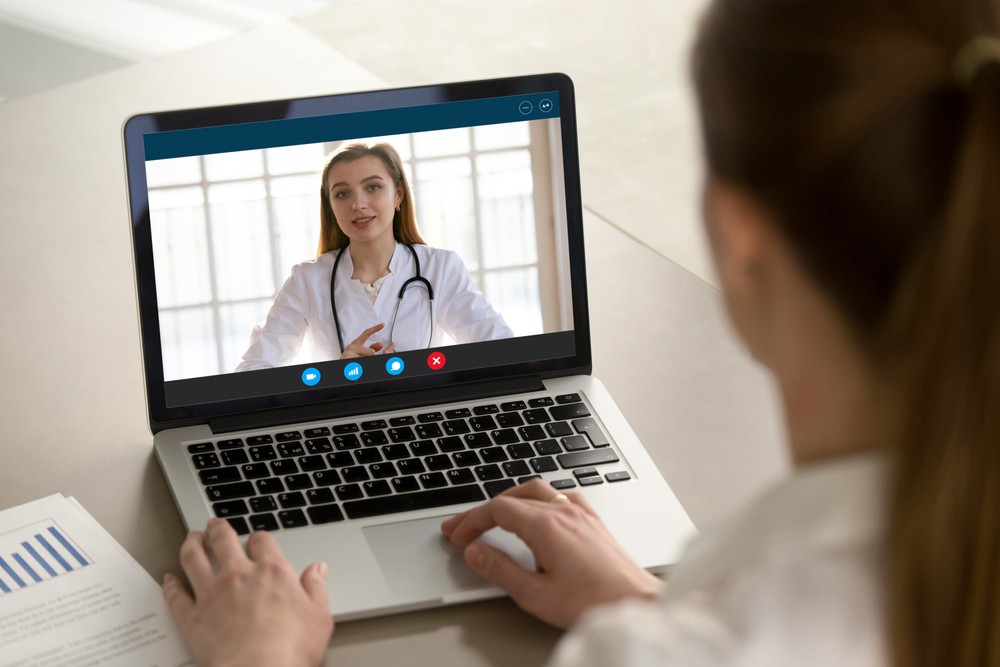
Late last month, Governor Parson issued an executive order extending Missourian’s expanded access to telemedicine services through the end of the year.
The governor’s move extended the regulatory waivers on various telemedicine restrictions that have been in place since the COVID-19 pandemic began. Over the past 18 months, I’ve written repeatedly about the importance of keeping these waivers in place, which were set to expire on August 31st. But while the extension was a wise decision, it also raises an important question: if the waived regulations were burdensome enough to warrant their continued suspension, why should they return once COVID-19 has been defeated?
Of course, the past year and a half has been unprecedented, but there are still valuable lessons that can be learned from the experience. What began as an effort to help Missouri’s hospitals and clinics from becoming overwhelmed has now grown into one of the most popular ways to receive non-emergent care.
Prior to the pandemic, telemedicine was a growing but sparsely used option. This was due in large part to various laws and regulations that made accessing providers remotely far too difficult. Regulations limited who could provide services, where those services could be delivered and received, and how services could be paid for. Two of the most egregious examples: a prohibition on telemedicine providers that weren’t physicians already licensed in Missouri, and a requirement that a provider must have physically seen a patient in person before they could treat them remotely.
Fortunately, responding to COVID-19 required our government to quickly reconsider the ways in which the status quo was stifling health care access. With cases of COVID-19 rising and serious concerns about Missouri’s hospitals having adequate capacity to treat those infected, allowing Missourians with other health care needs to stay at home and avoid contracting the virus by virtually interacting with their providers made a lot of sense. But it should be just as easy to access health care services outside of a global pandemic as well.
Missouri has come a long way over the past 18 months, as the state’s legislature has adopted license reciprocity to allow out-of-state providers to work in our state. But the coronavirus is still here and access to health care will remain a serious concern long after the virus is gone. For now, the remaining telemedicine restrictions are only held at bay by the governor’s executive order. Going into next year’s legislative session, it’s time for the legislature to finally take action and remove the barriers to telemedicine permanently.
Every few years, a new state audit or some report by a progressive group comes out criticizing Missouri for allowing businesses to keep a portion of the sales taxes they collect or the income taxes they withhold. The way it works is that if businesses remit the sales or income taxes they collect and withhold on time, they get to keep a portion of the taxes. The amount they can keep is two percent for sales taxes. For income taxes, the amount starts at two percent and declines as the amount increases.
There are two good reasons for this program, which many, but not all, states have some version of. Reason one is that incentives matter, and if you provide incentives to businesses to get these taxes in on time, they will be more likely to do so. Reason two is that if you are going to force businesses to serve as tax collectors for the government, you should compensate them for it. It is not free for a business to calculate, collect, and remit these taxes to the government. The cost for a behemoth like Walmart may be far less than two percent, but it is not zero. Between the cost of doing the work for the government in the first place, and then providing an incentive to do it properly and on time, I think the sales and income tax timely filing discounts are perfectly reasonable and should be kept as they are.
The recent audit states that Missouri’s sales tax credit is more generous than other states. (I don’t know how the income tax withholding credit compares.) I presume the audit is correct on this, and to that I say, “Good for Missouri.” It’s nice to be number one in something beyond booze, BBQ, shoes, stools, and fountains.
As the saying went, “First in shoes, first in generous levels of sales tax remittance timely credit allowances, last in the American league.”