Senate Bill 88 and Licensing Restrictions

Show-Me Institute researchers have been vocal proponents of reducing government barriers to workers, including hair braiders, park photographers, and many others, and have written on licensing issues for over a decade. We were also supporters of the recent adoption of an interstate licensing regime, which allows individuals who have had an license in a different state for at least one year to have applicable licensing requirements waived in Missouri. While this was a good start, it allows for an excessively long wait time (up to six months) between when an applicant requests a waiver exempting them from a licensing requirement and when the relevant oversight body must either grant or deny the request. Many applicants simply can’t afford to wait six months before beginning work in their chosen field.

A bill introduced in the Missouri Legislature, Senate Bill 88, would build on improving past successes in the occupational licensing sphere. It would strengthen prior licensing reciprocity legislation by reducing the maximum wait time for oversight bodies to waive requirements from six months to 45 days. This bill would also make it possible for Missouri licensing requirements to be waived for workers in states without such requirements provided they have at least three-years of applicable experience.

Ness Sandoval, a professor from St. Louis University, has written that Missouri is in a demographic winter—more people are dying in Missouri than are being born. Pair this finding with declining student enrollment in the state, one can see the need for Missouri to attract workers from out of state rather than put barriers in their path.

Against the substantial cost of licensing requirements we need to weigh the potential benefits to the quality and safety of products/services, but evidence of such benefits is underwhelming. The Mercatus Center at George Mason University conducted a meta-analysis of 19 different studies in Florida directly related to licensing and product quality. In 16% of these studies, researchers observed positive relationships between licensing and product quality, in 21% they observed a negative relationship, and in 63% they observed no relationship.

The Institute for Justice has identified nine occupations that Missouri licenses but are not licensed by at least 15 states throughout the country. For example, Missouri is one of 22 states that require a license to work as a sign-language interpreter—which entails $442 in fees, 60 credit hours of education, and two exams. Under current statute, if a sign-language interpreter with three years of experience from Kansas, Tennessee, Texas, Oklahoma, Florida, or Ohio wanted to move to Missouri, they would have to spend the time and money to acquire a license before they could work here. The same would be true for an experienced veterinary technician from one of the 15 states that don’t require a license.

Occupational licensing increases costs to consumers, limits competition, and by its nature involves government in the free market. In some cases (e.g., physicians), such costs may be justified in order to ensure the safety of the public. But policymakers should look for ways to limit the burden of licensing to cases in which it is absolutely necessary. Embracing the policies embodied in Senate Bill 88 would be a step in this direction,


On Property Taxation

Of all the positions I hold, the one that probably surprises people the most is my opposition to changes to the property tax system that would cap the rate of increase in home values, particularly the proposals that would favor senior citizens over everyone else.

This year in Jefferson City (as with every year) there are numerous proposals to implement such changes.

We have an example of this in California. In 1978, the state passed Proposition 13, which limited the increases in property assessments and taxes (although, to be clear, Proposition 13 went further than the proposed changes in Missouri would). Proposition 13 has certainly had its intended effect of making it easier for California residents to stay in their own homes. However, it has also reduced mobility, dramatically increased alternative taxes, limited homeownership opportunities, and caused substantial tax disparities for similar properties with similar services. I would not say that it has been an overall win for the state.

I support changes to our reassessment and tax system that keep assessments accurate while addressing the tax rate aspect of property taxes, as Senate Bill (SB) 711 did in Missouri about fifteen years ago. That bill required real estate tax rates to roll back no matter where the rate was in relation to its voter-approved rate cap, and that was a beneficial change. It is time now to expand the roll back provisions to personal property taxes, county commercial surcharges, and property taxes levied by the Kansas City school district.

A much more radical change I would like to see is an end to reassessments of individual properties. This is a costly and cumbersome process that is not needed in the days of Zillow. We could change the entire process to:

  • Set home values at sale price (assuming a fair market transaction).
  • During the biennial reassessments, determine the average increase for an area, such as a county, and raise or lower everyone’s assessed value by that amount, leaving an option for appeals in unusual cases and additional increases for home improvements, etc.
  • Then—and this is key—roll back everyone’s taxes by the same percentage to offset the assessment increase. This eliminates the unfair tax hit that people whose assessments go up more than average currently face.
  • Reset values at sale, as happens now.

This proposal doesn’t favor seniors over others, doesn’t lead to dramatic differences in property assessments and taxes for similar homes, and keeps the base broad. As I like to say, assessments should be as accurate as possible and the tax base should be as wide as possible so that the tax rate can be as low as possible for everyone to fund the necessary functions of local government.

As for senior citizens, funding the existing property tax “circuit breaker” program to help low-income seniors stay in their homes with targeted tax refunds is a better way to achieve this goal.

That about sums it up for me.

Education Choice in Rural America with Jason Bedrick

Susan Pendergrass speaks with Jason Bedrick.

Jason Bedrick a research fellow in the Center for Education Policy at The Heritage Foundation, where he focuses on policies that promote education freedom and choice, religious liberty, classical education, and restoring the primary role of families in education.

Read Jason’s full report here: herit.ag/3JMFLDA

Listen on Apple Podcasts 

Listen on Stitcher 

Listen on SoundCloud

Produced by Show-Me Opportunity

The Kansas City Earnings Tax Tortoise Versus the St. Louis Earnings Tax Hare

When the pandemic struck and remote work took over, two city tax policies diverged in an asphalt jungle. Kansas City decided, as it should have, to continue refunding non-residents their earnings tax money for work performed outside of the city, which quickly became a lot of money. St. Louis City decided to illegally alter its earnings tax policy and continue to collect the earnings tax from people working outside of the city for a business located in the city. This decision was terrible for a number of reasons, and a judge recently ruled in favor of taxpayers who contested it. The city should change its policy now, though one member of the board of aldermen advises the city: “[A]ppeal it [the judge’s ruling] for the next 1,000 years.”

Even though all Kansas City did was follow the law, I still praised the city multiple times for its policy when compared to St. Louis. But now it appears that Kansas City may have a trick up its sleeve. Instead of denying taxpayers their proper refunds for remote work—which would be illegal—perhaps you just try to make it really, really hard to claim the refund in the first place. Instead of “you can’t have your refund,” it is now, “you can have your refund after you jump through this flaming hoop with a leg of mutton in your mouth.” Kansas City’s new ordinance now applies the state rules for property tax appeals and refunds to the earnings tax. There was no need for Kansas City (or St. Louis) to do that; city leaders simply want to keep more of the money.

There are important differences between property tax and earnings tax appeals. With property tax protests, the government must put the money aside and can’t spend it. For earnings tax refunds, the city government already has the money (from withholding) and people are seeking to get some of it back. Most disturbingly, based on my reading of the Kansas City ordinance (68.393),  it seems that taxpayers will have to file a lawsuit if they want to get their lawful refund (correct me if I’m wrong). If Kansas City law says you must follow the state procedure, and state procedure requires a lawsuit, then you must file a lawsuit.

From RSMo 139.031(2):

Every taxpayer protesting the payment of current taxes under subsection 1 of this section shall, within ninety days after filing his protest, commence an action against the collector by filing a petition for the recovery of the amount protested in the circuit court of the county in which the collector maintains his office.  If any taxpayer so protesting his taxes under subsection 1 of this section shall fail to commence an action in the circuit court for the recovery of the taxes protested within the time prescribed in this subsection, such protest shall become null and void and of no effect.

There is nothing wrong with Kansas City clarifying its refund procedure considering the dramatic increase in remote work. But the old process worked just fine. If refunds took a little longer in 2021 and 2022, that is understandable. Hopefully Kansas City will create rules like the informal property tax appeal system in St. Louis County to simplify the overall process for everyone’s benefit.

But if Kansas City really is trying to dissuade taxpayers from applying for a refund by making it so difficult and expensive to go through the process for what would usually be a modest amount of money, that is unconscionable. The St. Louis rabbit got trapped in a court case and appears to be losing. I guess the Kansas City tortoise is trying a different strategy.

It just goes to show that you should never say anything complimentary about local government in Missouri. They always prove you wrong in the end.

Show-Me Minute: Land Banks Must Be Defeated


The state legislature in Missouri is currently considering legislation to dramatically expand the authority to institute land banks to municipalities across the state (the state legislature must approve all new land banks in Missouri). The state legislature should reject this legislation. If such legislation is enacted, counties and municipalities should reject the establishment of land banks. Land banks may sound good in theory, but in political and practical reality they have been a major failure.

The Promise of ChatGPT with James Pethokoukis

Susan Pendergrass speaks with James Pethokoukis about why advancements in A.I. are cause for optimism, not hysteria.

James Pethokoukis, a columnist and an economic policy analyst, is the Dewitt Wallace Fellow at the American Enterprise Institute, where he writes and edits the AEIdeas blog and hosts a weekly podcast, “Political Economy with James Pethokoukis.” He is also a columnist for The Week and an official contributor to CNBC.

Listen on Apple Podcasts 

Listen on Stitcher 

Listen on SoundCloud

Produced by Show-Me Opportunity

We Need LETRS, ASAP

Governor Parson discussed in his state of the state address the importance of serving our future generations with educational policies. With only thirty percent of Missouri fourth graders scoring proficient in reading, it’s clear that Missouri needs to do better.

Thankfully, Senate Bill (SB) 681 was passed last year in part to help target foundational reading for students K-3. The bill required comprehension reading examinations to begin in kindergarten instead of third grade in order to more quickly identify children who are struggling, and also provides training for teachers in “evidence-based reading,” or phonics. Additionally, the bill requires that schools provide any student diagnosed or at risk for dyslexia with evidence-based reading instruction.

The program used to train teachers is called Language Essentials for Teachers of Reading and Spelling (LETRS). LETRS builds off of recent literature illustrating the importance of phonics in reading. Experts in linguistics, neurology, and psychology have highlighted the differences in a child’s ability to learn to speak and to learn to read. A child naturally learns how to speak, as human brains are hardwired to be able to learn a language at a young age. However, the same does not translate to reading. Think of history: literacy rates were around 12 percent worldwide in 1820; in modern times it has flipped, with illiteracy rates around 14 percent.

LETRS is designed to connect sound recognition with visual components (letters in words) and capitalizes on the ability of phonetic instruction to pair a child’s natural, hardwired skill of speaking with a complex and unnatural skill of reading (phonemic awareness).

The KIPP Victory Academy in St. Louis had started emphasizing phonics prior to the passage of SB 681 with the goal of boosting reading. According to a recent report from the St. Louis University Prime Center, KIPP enjoyed the highest ELA growth scores in the state between 2018 and 2021.

Given the evidence in the literature and the promising results from schools such as KIPP, one question lingers: why are we not placing even greater emphasis on the issue? Any K-5 teacher is eligible to undertake the LETRS training program, and the state has allocated funding for 15,000 Missouri teachers. Yet, only 9,000 teachers have begun training—and we don’t know how many of those 9,000 actually completed the training. There are an estimated 23,000 K-5 teachers in Missouri. I acknowledge that many teachers may already employ similar strategies and do not want to waste 160 hours completing the LETRS program. I also acknowledge that the rewards for completing 160 hours of training may seem a bit meager to some—you can earn up to $2,000 for completing the entire program, which comes out to $12.50 per hour of training.

From a budget standpoint, if you gave all 15,000 teachers the maximum $2,000 reward for completing the LETRS training program, it would cost $3 million. Conversely, if most of the recommendations from the recent blue ribbon commission were implemented—raising teacher salaries to $38,000, funding the career ladder program, and tuition assistance—the cost would be $91.5 million. Why are we not talking about investing more in a program that we know helps kids learn how to read instead of talking about spending nearly $100 million on unproven wish-list items that are not directly tied to better outcomes for Missouri students?

School Closings Shed Light on an Important Principle

Recently, the La Salle Charter School in North St. Louis announced its decision to close. As a state-funded and privately operated middle school, La Salle set out to “educate and support the whole child” and set them up for success in high school. Unfortunately, La Salle was not able to achieve the standardized test scores required by the sponsor, the Missouri Charter Public School Commission. When asked what went wrong, the school explained that it was hit by the perfect storm: students arrived at La Salle grade levels behind where they should have been, and the COVID-19 pandemic only made things worse.

A few months ago, the Archdiocese of St. Louis announced the closing of two high schools in the fall, citing a lack of funds to remain open. Being very fond of the education these schools provide, students, parents, and alumni rallied together to save their schools and were able to secure the funding needed to remain open, independent of the archdiocese.

The closing of a school is almost always heartbreaking news that nobody wants to hear. However, I do believe that school closures shed light on an important principle that is (in some cases) being enforced: students deserve to go to high-quality schools, and only those schools that offer the best value and fulfill their students’ needs will survive.

Through market forces, this happens organically at a private school—parents will not pay to send their kids to a school that isn’t meeting their academic or social needs. If enrollment declines sufficiently, the school will eventually see no other option but to close. Charter schools also face closures, as schools that aren’t performing well will likely experience declining enrollment and will not continue to receive funding from the state. Because of the possibility of closure, private and charter schools have an incentive to improve academically and fulfill the needs of students.

Traditional public schools, on the other hand, have very little incentive to improve academically. Unless the situation becomes truly dire, public schools continue to receive funding despite their failures, and many students are left behind in the process.

Show-Me Institute analysts recently developed a piece of model legislation that would help address the incentive problem for public schools by allowing parents to send their kids to any public school in the state. Creating a true marketplace in education is one of the best ways to ensure our schools improve and kids in Missouri get the best education possible.

The Latest GDP Report: What Does It Mean for 2023?

While Washington, D.C., is seized by speculation surrounding debt ceiling showdowns and the specter of government default, other recent news—namely, the latest report from the Bureau of Economic Analysis on the nation’s gross domestic product (GDP)—provided some welcome but qualified good news on the economy. According to the report, inflation-adjusted (real) GDP grew by 2.9% on an annualized basis in the fourth quarter of 2022, which modestly exceeded consensus expectations. Moreover, unlike the third quarter data—which showed growth despite a large decline in private domestic investment—each of the topline spending categories showed growth in the fourth quarter, albeit meager growth in some cases.

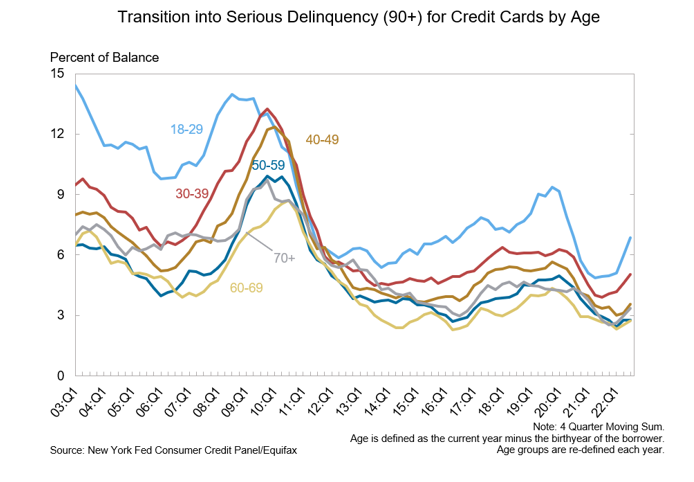
First of all, consumer spending is holding up. After only growing by 1.3% in the first quarter of 2022, it ended the year growing at a 2.1% clip—hardly robust, but clearly in positive territory. Consumers have been slammed by high inflation and eroding purchasing power for the better part of two years, but the steady job market and still-elevated checking account balances of households have managed to keep them afloat. Unfortunately, so too has rapid growth in credit card utilization, which may act as a source of financial vulnerability for consumers going forward as they grapple with continued interest rate hikes. Transitions into credit card delinquency are already on the rise, driven especially by households in the 18–29 and 30–39 year age ranges.

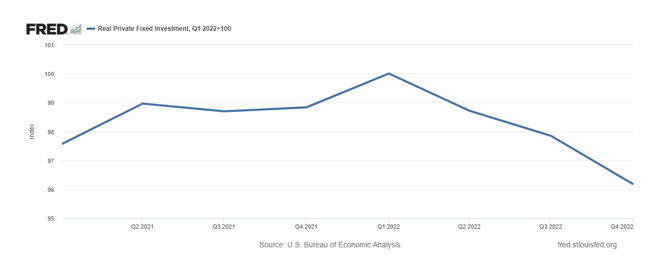
Switching gears, gross private domestic investment declined notably in the third quarter of 2022 (9.6% on an annualized basis) but increased by 1.4% in the fourth quarter. On the surface, this turnaround is good news. However, peeking beneath the hood reveals some reasons to be cautious. Most strikingly, residential investment fell by 26.7% as the housing market gets pummeled by the rapid rise of mortgage rates over 2022. In the first week of January 2022, the average rate for 30-year fixed-rate mortgages sat at 3.2%. In the last week of December, it was at 6.4%. Such a huge increase in rates translates to a jump in monthly payments of over $800 for someone buying a $400,000 house with a 20% down payment—making it more difficult to qualify for a loan.

Looking beyond the housing market, nonresidential fixed investment increased by an anemic 0.7% on an annualized basis in the fourth quarter after growing by 6.2% in the third quarter, a sizable deterioration. As a result, fixed investment overall fell by 6.7% on an annualized basis in the fourth quarter, which is even worse than the 3.5% decline in the third quarter. So how is it, exactly, that private investment still increased by 1.4% overall? The answer: inventories increased, which is far less important for economic growth in 2023 and beyond than businesses confidently investing in new factories and capital.

So what does all this mean for 2023? Unfortunately, not much. The good news is that the economy is not crumbling—at least not yet. And there are also reasons to be hopeful that the Federal Reserve’s interest rate hikes are finally breaking the back of inflation despite the federal government’s fiscal profligacy since the beginning of 2021. However, interest rates are still on their way up, consumers are borrowing more, gas prices are on the rise again, and the housing market is stalling out, with very real prospects of modest to moderate house price declines in at least certain pockets of the country. None of these trends bode well for consumer sentiment or small business optimism. But there’s still a chance that the Federal Reserve can manage to thread the needle, and divided government in Washington, D.C., means that more blowout inflationary spending packages are less likely. It’s certainly something worth crossing our fingers about.

Support Us

The work of the Show-Me Institute would not be possible without the generous support of people who are inspired by the vision of liberty and free enterprise. We hope you will join our efforts and become a Show-Me Institute sponsor.

Donate
Man on Horse Charging