Cherry-picked Data Can’t Hide the Truth about Missouri’s Workforce

A version of the following commentary appeared in the St. Louis Post-Dispatch.

A couple of weeks ago CNBC released its annual list of the Top States for Business 2023. Missouri was an unimpressive 32nd out of the 50 states plus the District of Columbia. Wondering what pulled us down? Well, this year CNBC decided that workforce quality would get the most weight of the 10 components of the index. And in that category, Missouri ranked 49th. We must not stack up too well against other states when it comes to the percentage of workers with college degrees or even industry credentials. Apparently, we also don’t compete well on the outmigration of educated workers, or on worker training programs, or on worker productivity.

So, imagine my surprise when the governor had a press conference just days later to announce a long list of Missouri’s “top” rankings. On some list we rank first in on-the-job-training. That would be for the number of participants, not quality or outcome, but still. There’s a list out there where we’re ranked second for apprenticeships and one where we are fourth for small-business jobs. The list of rankings is described as “incredible statistics that prove why Missouri is the Show-Me state.” Incredible indeed. Sadly, the governor’s list doesn’t include any source information, so we can’t tell who is saying all these complimentary things about our state.

As someone who follows the Missouri K-12 education system pretty closely, I’m not that surprised by the CNBC ranking. Education in the state is in a downward spiral. Last year, 70 percent of our fourth-graders scored below grade level on a nationally administered test. These children are moving on to the reading-to-learn years, and they haven’t learned to read. Middle school isn’t any more promising. Less than one-quarter of our eighth-graders can do math at grade level, according to the latest (2022) national assessments, and just 28 percent have grade-level reading skills.

When students start high school without having mastered the skills they need to succeed, the effects are predictable. Last year, just 60 percent of our 2022 high school graduates met the Missouri Department of Elementary and Secondary Education’s (DESE’s) criteria for being college or career ready. It’s hard not to feel sorry for the 40 percent who walked across the stage and were handed a diploma even though they were unprepared for the next stage of their lives. Since we’re looking at rankings, did you know that last year Missouri ranked 43rd for the percentage of high school students who took a college-level Advanced Placement (AP) test in high school? We’re not talking about passing an AP exam; only one in five high school students even took one. Also, less than 8 percent of graduating high school students completed the Career and Technical Ed (CTE) certificate program.

What are the consequences of the poor job we’re doing of preparing our students for life after high school? According to the St. Louis Federal Reserve, the percentage of Missourians with bachelor’s or master’s degrees has been declining in recent years. Not by much —just from 31.9 percent for bachelor’s to 31.7—but is that the direction we want it going? There’s a similar trend line for graduate degrees, which had been increasing every year until a couple of years ago, when they began to decline.

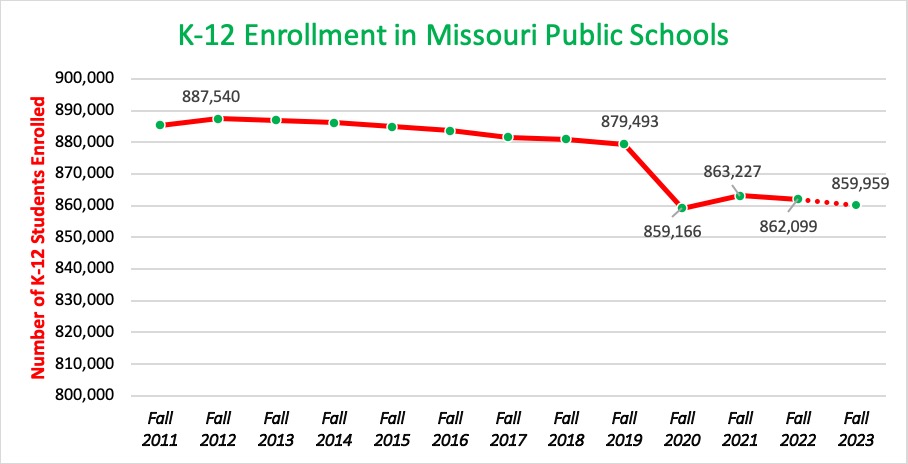
We seem to have a workforce problem, and it appears to be getting worse. Our K-12 enrollment has been declining since before the pandemic and will continue to decline based on the size of recent kindergarten classes. And within those smaller groups of students, the percentage of kids who are at grade level is declining. Smaller percentages of smaller high school graduating classes will be ready for the next stage in their lives. We need leaders who are ready to confront those facts and do something about them. The future of the state depends on it.

These leading indicators may signal what’s next for our work force, but it’s not too late to turn things around. States all around Missouri are letting parents pick where their children attend school—public or private—and having state education money follow them. Families in these states can tailor the education of each of their children, even when those needs differ within the same family. Neighboring states are implementing aggressive early literacy programs, with Mississippi being a standout, and rethinking high schools. Innovation and true accountability are happening . . . elsewhere. Meanwhile, Missourians are being handed a cherry-picked list of statistics that we’re supposed to get excited about.

Oppenheimer Is Not the Only Interesting Thing in Nuclear this Summer

With the recent release of Oppenheimer (which I saw—it was awesome), it feels like an appropriate time to talk about a different (and non-explosive) form of nuclear technology—advanced nuclear reactors. Last Friday, the Accelerating Deployment of Versatile, Advanced Nuclear for Clean Energy (ADVANCE) Act passed out of the United States Senate (86-11) as part of the 2024 National Defense Authorization Act. The goal of this bipartisan bill is to lower regulatory barriers for advanced nuclear reactors. The chief obstacle to increased nuclear energy is the immense construction costs associated with satisfying regulatory requirements. Before understanding how the ADVANCE Act would help, we need a deeper understanding of the current problems.

Advanced nuclear reactors are pre-fabricated (constructed off-site, which allows them to maintain the efficiency of a production line), so when reactor designs are approved, the same design can be used in numerous projects. By contrast, traditional reactors are typically custom-designed on-site. Private entities have been competing to develop the best reactor designs. However, many of these private entities struggle to acquire the necessary cash to propose a potential reactor design to the Nuclear Regulatory Commission (NRC). NRC agents currently charge a billing rate of $290 per hour, with a review taking upwards of 18,000 hours, resulting in a typical review cost of $5,220,000! These costs place private developers in a difficult situation, as spending an immense amount of money on designing a reactor and paying regulators (who might reject the design) is a great risk. For example, Oklo Power (an American startup) submitted an application for a 1.5 MW microreactor, and had it denied after 22 months of review from the NRC.

The ADVANCE Act would shift responsibility for supervisory and nonsupervisory support costs, travel costs, training costs, and the administrative costs of  different government offices that provide logistical support to the NRC. These costs currently fall on the nuclear developer. In the current state of the bill, the federal government would compensate the NRC for these additional costs in connection with advanced nuclear reactors. Taxpayers should of course be wary of any proposal to subsidize private nuclear power providers, but in this case the money would be going to defray the expenses incurred by our government as the result of a truly burdensome set of federal regulations.

The ADVANCE Act could also expedite the conversion of brownfield sites (land formerly used for industry), particularly former (or closing) fossil fuel facility sites, into nuclear power sites. Pre-fabricated reactors are adaptable and well-suited to these sites; on the other hand, traditional nuclear plants need to be uniquely constructed to match the terrain where they will be located.

Lastly, the ADVANCE Act would provide additional funding (mainly to facilitate a new nuclear traineeship program) to the NRC in order to speed up the review process. In this industry, time truly is money, and costs soar when delays occur.

So the ADVANCE Act would make it easier to build out our nuclear capabilities. Why is that important? Increased nuclear power would help achieve three key goals: increasing power supply in the United States, increasing our country’s energy independence, and increasing the supply of reliable, emissions-free energy.

As a state-based think tank, we don’t often discuss bills in Congress. But if nuclear energy is going to make a resurgence in our country, reform at the federal level will be necessary. Whether the federal government passes this law or not, Missouri could capitalize on the bipartisan desire for clean, reliable nuclear energy and become a leader in the industry.

Welfare Cliffs, Special Elections, and Nuclear Reactors

David Stokes, Elias Tsapelas, and Avery Frank join Zach Lawhorn to discuss Missouri’s new transitional benefits law, Chesterfield discussing the use of eminent domain in their legal battle against Dillard’s, the future of nuclear reactor construction, and more.

Listen on Apple Podcasts 

Listen on SoundCloud

Produced by Show-Me Opportunity

The Budget-busting Cost of Waiting

I can describe Missouri’s current Medicaid situation in three words: Time is money.

As I wrote last month, our state lagged much of the country in resuming its Medicaid eligibility redetermination processes following the COVID-19 pandemic. Instead of starting in April as many states did, Missouri began processing redeterminations a month ago on July 1. Now that there are three months of data from across the country to look at, a new report from the Paragon Institute estimates just how much Missouri’s foot-dragging might cost.

For a quick refresher, during the pandemic, the federal government barred states from checking whether Medicaid enrollees remained eligible to receive services as they normally would. As a result, Missouri’s program set new records for enrollment and spending. But the catch is that likely more than 20% of those enrolled today aren’t eligible for coverage, so once the federal government allowed redeterminations to resume on April 1, states had significant financial interest in rightsizing their program rolls as quickly as possible.

No, this rightsizing doesn’t mean removing people from the program who are still eligible to receive services. What it means is that states typically pay health plans monthly for each Medicaid enrollee, so if 20 percent of those enrollees are ineligible, just using Missouri’s current enrollment of 1.5 million, that means taxpayers could be paying the health care costs of 300,000 people they shouldn’t be. And that’s really expensive!

So how can Missouri clean up the program’s rolls as quickly and accurately as possible? And how much will it cost if they don’t? That’s what the Paragon Institute report tries to answer.

First, the report estimates how much is being wasted per month on ineligible enrollees. For Missouri, if 20 percent of program enrollees are in fact ineligible, that means more than $120 million is wasted every 30 days. The federal government is giving states 12 months to process all of their redeterminations, but since so much is wasted per month, and since the share of these costs paid by the federal government will be declining each quarter, the sooner the eligibility checks can be completed, the better. The report suggests that if Missouri were to process all 1.5 million redeterminations in 6 months instead of the 12 months allowed, approximately $364 million could be saved.

Additionally, not all current enrollees are equally likely to be ineligible. Paragon suggests states should be prioritizing the redeterminations of the recipients who are most likely to be removed in order to maximize the savings. All told, if Missouri were to follow all of Paragon’s suggestions (other than the ones that can’t be done because it’s too late), our state could end up saving $729 million. That’s no small amount of money.

The Paragon Institute report shows us how much money Missouri’s overpopulated Medicaid rolls are costing the state, and considering how our state Medicaid agency started processing redeterminations three months later than necessary, I’m worried taxpayers are about to watch their money burn. If time really is money, Missourians should keep their eyes peeled for at least the next 12 months.

Just the Fax, Ma’am: Dubious “Rankings” Press Release Emphasizes Importance of Transparency (part 2)

In part one of this post, I discussed a document posted to Governor Mike Parson’s webpage containing some claims that I suspected were too good to be true. The document lacked citations, and I struggled to find sources corroborating its claims, so I was compelled to submit a Sunshine request asking for the information. Using the archaic method of faxing, I sent a letter to the governor’s office and awaited a response.

Several days later I received a reply by, of all things, email! Thankfully, the Governor’s office sent just what I wanted: the statistics and sources behind its claims. I must note that the original graphic was updated after I sent the Sunshine request (e.g., the word “low” was removed from “Low Cost of Doing Business”). Also, while each of the office’s claims does correspond to a study, index, or ranking in the real world, your mileage may vary regarding their persuasiveness.

Some citations used by the governor are very subjective. Several of the statistics, such as “On-the-Job Training” and “Apprenticeships” were from Missouri Government agencies, which doesn’t strike me as the most unbiased source of information. The document I received also—somewhat—answers my question from the last post and clarifies the statistic as “New Apprenticeships,” but the website’s graphic remains unchanged in that regard.

In some cases, the claim is ambiguous; the second-place ranking for state-level veteran benefits is based on the number of distinct benefits offered but does not consider that one benefit may be much more or less valuable than another. Again, a very subjective ranking.

And even when the statistics could be represented more favorably for the governor, they remain misleading. The “Fourth for Personal Income Tax” is certainly not measuring the lowest or highest personal income tax rates. There are eight states with no income tax (nine if you include New Hampshire), and Missouri isn’t one of them. It turns out that the governor’s office was relying on a report that ranks governors, not states. The “personal income tax” metric is derived not only by the level of income tax, but how much it has changed over each governor’s term—the governor can thank his special session last October for getting him so highly ranked on this metric.

I do appreciate that the governor’s office didn’t drag its feet with my request and provided sources for each of the claims, but I shouldn’t have had to submit a Sunshine request in the first place. It should be standard practice for the government to include sources for the claims in the documents they produce and, more to the point, practice transparency without hiding behind a fax machine. Thankfully, there are organizations like the Show-Me Institute that employ summer interns who can hold our government accountable.

*pats self on back*

If you are interested in checking out the sources yourself, click here to see the .pdf file I received from the governor’s office.

Just the Fax, Ma’am: Dubious “Rankings” Press Release Emphasizes Importance of Transparency (part 1)

Last month, Governor Mike Parson’s office posted the following infographic on its website to minor fanfare:

Unsurprisingly, this document found its way onto my desk with a request that I—a Policy Intern of two months—was basically bred for: fact checking. And fact check I did.

My first challenge was that the governor’s office didn’t “show its work” by citing sources for its claims. A Google search allowed me to infer where some of the rankings came from, but others were harder to verify.

Indeed, I found several online sources that issued rankings that were similar but not identical to the governor’s claims.  Here, for example, Missouri is listed as sixth in cost of living, not third. Some were further off the mark; here not only is Missouri not number two for “low cost of doing business,” we’re not even on the list. And with some claims, I was completely lost. What does it even mean to be “third for apprenticeships?” Is it referring to the number of current apprenticeships? Completed apprenticeships? Apprenticeship applicants? What organization even collects that data?

After consulting longtime staff members here at the Institute, I learned a Sunshine request was probably my best way forward. Sunshine requests legally require Missouri government employees and officials to provide the requested information, provided that they actually have it. Send a request to the correct official—requests tend to bounce around like a customer service call—and if all goes well they will send back the correct records. In some cases, however, you’ll be told that the information does not exist or that there will be a charge for the collection of the information you requested.

So, I typed up a Sunshine request and went to the Governor’s website in search of a contact email to send my letter to. Instead of an email, I saw only this at the bottom of the page:

It’s 2023. Where is the email address? After browsing the website to some length, I concluded that if an email contact point existed for Sunshine law purposes, it was very well hidden. And without an email address, I had to fax it.

Dear reader: if you’re under the age of 35 there’s a good chance you have never had to send a fax before and may not even know what a fax machine is. In short, think of text messaging, but with printers.

While awaiting a response, I pondered the situation. If the Sunshine law didn’t exist, I would have been hunting snipes in my quest for the truth. Yet I felt disheartened by the need to use a Sunshine request. Not every Missourian knows how to do a Sunshine request, or even that they exist—I certainly didn’t before my time at the Institute. It is good practice in any field to cite your sources. Are governments exempt from that expectation? Citizens of Missouri value government transparency and accountability and our governor should respect that value: Show-Me your work.

Several days after I sent the fax, I received a reply. Part two of this blog discusses the response I received from the governor’s office.

So, What Exactly Should Missouri Do about Property Taxes and Assessments?

Property assessment increases are driving people crazy throughout Missouri. People love it when their homes increase in value, except when they hate that their homes increase in value. High inflation means that local governments will not have to roll their rates back this year as much as in prior years, so the combo of high assessment increases and small rate rollbacks will likely mean substantial tax increases for many Missourians later this year. Obviously, politicians want to address this high-profile issue.

Wanting to do something to address higher property assessments and taxes should not mean doing the wrong thing, though, and doing the wrong thing is where we are headed. Giving one population group a tax or assessment freeze, as state law allows counties to do this year and which many are considering, is wrong for reasons you can read here. A more comprehensive limit on the rise in assessed valuations or taxes, similar to what California famously did with Prop 13 in 1978, is also the wrong thing to do. Proposition 13 has certainly had its intended effect of making it easier for California residents to stay in their own homes. However, it has also reduced mobility, dramatically increased alternative taxes, limited homeownership opportunities, and caused substantial tax disparities among similar properties receiving similar services. This is not what we need for Missouri.

The easiest way to address that—for local governments to voluntarily roll their tax rates back more than legally required (as St. Charles County did in 2022)—is unlikely to happen in most places and especially unlikely for school districts, which make up the bulk of your tax bill. So, what else can we do about property taxes and assessments?

There are things people and government can do in the short term to make the overall process better. Right now, people should be pressuring their local officials to roll tax rates back, especially the Kansas City school district which is the only taxing body in the state exempt from rate rollbacks. Removing that constitutional exemption for KCSD should also be a high priority. That would involve amending the state constitution, but it should be a high priority to get that on the ballot in the next legislative session.

While we are addressing short-term impacts and constitutional changes, adding personal property to the tax rate rollback requirements should absolutely be done. In 2021 and 2022, many local governments enjoyed a windfall from increased used car values. That is not how the system is supposed to work.

Finally, did you know that a few counties require certificates of value to be filed with the assessor when property is sold but most do not? We should require them statewide to help make assessments more accurate, especially in rural areas.

In my next post, I’ll discuss what we can do in the long run to make our property tax and assessment system better.

Support Us

The work of the Show-Me Institute would not be possible without the generous support of people who are inspired by the vision of liberty and free enterprise. We hope you will join our efforts and become a Show-Me Institute sponsor.

Donate
Man on Horse Charging