Transparency in Municipal Government Should Be Mandatory

Longtime readers are familiar with the wide array of transparency projects that the Show-Me Institute has undertaken over the last few years. In fact, our Show-Me Checkbook Project has helped prod two separate “checkbook” portals in state government since its introduction six years ago, but participation in those state portals is largely voluntary for local governments. Missouri should change that and require that, as a condition of being able to take money from people through force (which is what taxation is), local governments generally and cities especially should be reporting their spending to the state regularly and with specificity.

There are two key ways of doing this reporting. The first way is by embracing something along the lines of House Bill 2242 from 2019, which included mandatory municipal transparency language. The second way is by tweaking Missouri Revised Statutes §§37.1090 to 37.1098 by replacing the voluntary “may” language with mandatory “shall” statements.

Making local government transparency mandatory in Missouri would be an enormous leap forward in government accountability in the Show-Me State. Transparency can empower people, build trust in government, and ensure public resources are used in the best way possible.

The Parents’ Bill of Rights: Its Time Has Come

We have long said that if the government can take your money, it needs to account for it, and whether that money is taken by state government or local governments, the obligations remain the same. This is especially true when it comes to our schools and school districts. That’s why we introduced the Missouri Parents’ Bill of Rights in 2021: to give parents more control over their children’s education and ensure that they have a say in the classroom. It’s also why the Legislature needs to (finally) pass it in 2024.

The Parents’ Bill of Rights focuses on five key areas: curriculum transparency, school choice, parental involvement, data privacy, and district accountability. High among those objectives is the establishment of an online portal where district curricula can be viewed by parents so that they are fully informed of the instruction happening in their schools. We discussed these issues at length before Missouri’s U.S. Civil Rights Commission Advisory Committee earlier this year.

The core of the problem, as we’ve revealed over the last few years, is that the current setup for finding out what’s going on in schools requires either a forthright district (or school) or a district that’s compliant with the letter and spirit of Missouri’s Sunshine Law. In essence, taxpayers have to ask about how their money is being spent – rather than simply receive or see it without having to beg for it. The potential result of the current law is straightforward, with districts playing games with responses or attempting to charge outrageous sums for the information.

Now it’s time for this important policy to become law. By empowering parents, improving educational outcomes, promoting school choice, enhancing transparency and accountability, and protecting student data privacy, the adoption of a Parents’ Bill of Rights could have an important impact on the state’s education system—and improve the relationship between parents and the schools they fund.

Kansas City’s “Source of Income” Housing Rule Is an Abuse of Government Power

A version of this commentary appeared in the Courier-Tribune.

In an attempt to increase the supply of affordable housing in Kansas City, the Mayor and council have passed, with various amendments over time, requirements that developers seeking city tax incentives set aside some units for lower-income residents. There have been arguments over the exact details of the law, but overall the requirement is valid because it is, to a large extent, voluntary. Developers don’t have to seek tax subsidies. However, if they choose to seek them, they have to play by certain rules. So far, so good.

The latest proposal to support affordable housing in Kansas City, however, is the opposite of voluntary. The city council is considering a requirement called a “source of income” rule. This rule would prohibit landlords from refusing to rent to tenants who pay with housing vouchers or other types of government assistance. The most familiar of these programs is called Section 8. This proposal is a violation of the individual rights of landlords and a dangerous expansion of city government’s role in the economy and housing market. Beyond that, it is simply infuriating that local officials think they have the right to do this.

The Section 8 housing voucher program, along with the other programs run by the Department of Housing and Urban Development (HUD), is a federal government program. It has always been voluntary for landlords to participate. That voluntary nature is one of the program’s strengths, and there is no shortage of landlords who choose to take part in it. The most recent estimate we know of stated there were around 695,000 landlords nationwide who participated as of 2016. Many of those are large, property-management businesses with numerous units.

There are many examples of government social programs in which participation is voluntary. Doctors are not forced to accept Medicaid payments, yet many do. Grocery stores are not required to accept food stamps, yet many, if not most, do. That is how the Section 8 housing voucher program has successfully worked for many years. Imposing a local mandate in Kansas City will force landlords either to join the program against their will, creatively find other reasons to deny high-risk renters, or sell their properties to larger landlords. Each of these results is bad.

Denying high-risk renters is made more difficult by other aspects of the bill, which take the proposal beyond tragedy to farce. The bill states landlords cannot reject applicants based on things like poor credit scores, past eviction history, or criminal record. It is essentially forcing landlords to rent to anyone who applies, no matter their financial state or criminal history. Are laws requiring school bus companies to hire drunk drivers and pre-schools to hire sex offenders coming next?

It is fair to question the presumption that something needs to be done about Kansas City’s supply of affordable housing in the first place. The Kansas City metropolitan area was ranked the 13th most affordable housing market in the country in one survey. Another very recent survey ranked Kansas City 27th out of the 100 largest metro areas in total affordability, where housing was an important part of the calculations. Among the many other worthy objections to this source-of-income rule is the fact that it’s a solution in search of a problem.

If Kansas City wants to do something that might actually help lower-income people find more affordable housing, it could rezone parts of the city, especially those near transit stops, to allow for more multi-family housing units. Increasing the supply of housing of all types is the best way to lower the cost of housing. Minneapolis dramatically reduced its zoning requirements in 2018 to allow more apartments and condominium developments. Since that time, median rental rates in Minneapolis have increased by just one percent—the lowest in the nation—due to increased housing supply. The law of supply and demand remains undefeated, no matter how much members of the Kansas City Council may prefer addressing this issue by ordering people around.

Landlords and developers can meet this demand for housing if they are allowed to—authoritarian mandates are not required. This council can let the free-market work for housing in Kansas City, as it has done very effectively for decades.


The Worst Law in Missouri

Municipal annexations have been back in the news. An unincorporated area near Manchester (in St. Louis County) overwhelmingly rejected that city’s annexation bid, and the dispute over local marijuana taxes has brought to mind that it is too easy for cities (outside of St. Louis City & County) to annex commercial areas.

All this makes for a great opportunity to bring up the most important annexation-related change we need in Missouri, which is to get rid of the special rules regarding annexations and fire districts in St. Louis County. I am generally not in favor of annexations. We have too many small cities as it is, and municipal annexations should be more difficult (again, outside of St. Louis). I generally support the special rules for new incorporations and annexations within St. Louis County, except for the one involving fire districts.

Statewide, if a city with a fire department annexes an area within a fire district, the city has to pay the lost property taxes to the fire district on a declining basis for five years. That is fair. The district may have issued bonds based on the larger populations, and the five-year phaseout is a reasonable way to address that. But in St. Louis County, RSMO §72.418 allows fire districts to essentially force cities to pay their taxes forever, as long as the original fire district still provides fire protection for the newly annexed part of the city—even if the residents of the newly annexed part want services to be provided by the city’s fire department, not the old fire district.

Hazelwood and Crestwood have found this out the hard way, as both cities – particularly Hazelwood – have been raked over the coals (pun intended) by the Robertson and Affton fire districts respectively. The Robertson case was so egregious it finally spurred a recall of the fire board, which for the previous two decades had been raising taxes to a confiscatory level. How could they do this? Because a tiny number of voters in April elections could elect a board that then raised the tax rates Hazelwood was required to pay under its “agreement” with the district, knowing that the entire city of Hazelwood had to pay the tax, not just the residents within the crossover parts. How much was spending out of control? According to The Robertson Report:

While searching for an explanation for this high cost per call, Valley Park Fire Protection District (VPFPD) was identified as the most proportional fire district to Robertson FPD. Between 2016 and 2020, both maintained two firehouses, two ambulances, one pumper/rescue and one ladder truck, responded to almost equal number of emergency calls (VPFPD 2246 vs RFPD 2455 annually) and took roughly the same percent of commercials calls with an average 8.8% difference. A comparison of financial audits during these years revealed Valley Park FPD had spent $18.8M in total expenses (an average of $3.7M annually) to operate while Robertson FPD had spent $45.6M (average of $9.1M annually) for the exact same EMS and fire service. This is a total spending difference of $26.8M within 5 operating years. [emphasis added]

Special laws like RSMO §72.418 shield fire protection districts from municipal competition for local tax dollars and harm taxpayers. This law needs to be removed. The law is highly beneficial for the fireman’s union, and bad for everyone else, especially taxpayers. If residents and voters want to have municipal annexations or incorporations that include fire protection by municipal fire departments, then that’s what they should get.


Mehlville School District Reaps Windfall at Public Expense

A version of the following letter appeared in the Oakville Call.

There has been much discussion in this newspaper and elsewhere about how the Mehlville School District reacted to the substantial increase in assessed valuations that came about after voters had approved a property tax increase for the district.

Here are the facts: In April, voters approved the tax increase of up to 31 cents per $100 of assessed valuation. The district’s assessed valuation then went up 18 percent, much more than in other reassessments. Then, in September, the board voted to raise the tax rate by 29 cents, which was less than what voters had authorized—but only barely. According to reports, applying the 29-cent tax rate hike to the higher assessed valuations will lead to at least $5 million more in tax revenues than originally expected.

These machinations may not violate the law or the letter of the Hancock Amendment, but they certainly break the spirit of the amendment and, more importantly, the trust of the residents. The Mehlville school board should have approved a tax rate that would have raised the revenues expected by the voter approved increase. Instead, they have double-dipped on both assessment and rate increases, and taxpayers are feeling the pain of it.

TIF Decisions Should Be Made at the County, Not City, Level

The simplest thing Missouri can do to improve the decision-making process for tax increment financing (TIF) is move the responsibility for it to the county level. Cities in Missouri are only too happy to give up the small amount of property tax they receive to get more sales taxes. This leads to a crisscrossed incentive system by which cities make choices that might be good for them, but clearly hurt the larger region.

Taxing bodies that depend entirely on property taxes get crushed by the choices that cities make. Often, voters in those taxing bodies don’t live within the city that makes the decisions and cannot punish or reward elected officials with their votes. The most obvious example of this was in Shrewsbury, but it happens all over the place. With county TIF commissions, voters can hold elected officials responsible for the subsidy choices that they make.

Five counties currently have county TIF commissions: St. Louis, Clay, Cass, St. Charles, and Jefferson. Counties that use the county TIF commission mechanism have been more careful and judicious in the use of TIF than counties where municipalities dominate the decision-making process. This is particularly true in St. Charles and Jefferson counties, but even in St. Louis it has been better overall. St. Louis County thankfully rejected the odious Maryland Heights proposal, but it has also approved other bad subsidies (e.g., the Chesterfield TIF). Clay County and Cass County are fairly new to this list, so it remains to be seen if they will be better or not.

The exact statutory language is in RSMO: 99.820.3(1). Personally, I think that Greene, Platte, Franklin, Boone, and Camden counties should be the next five added to this list. Earlier this year in Osage Beach (Camden County), I testified at a hearing where all 6 members of the TIF Commission from the city instituted a TIF over the objections of the representatives from the county and school district. That is how TIF works, and it is terrible.

Missouri Public-School Enrollment Continues to Fall

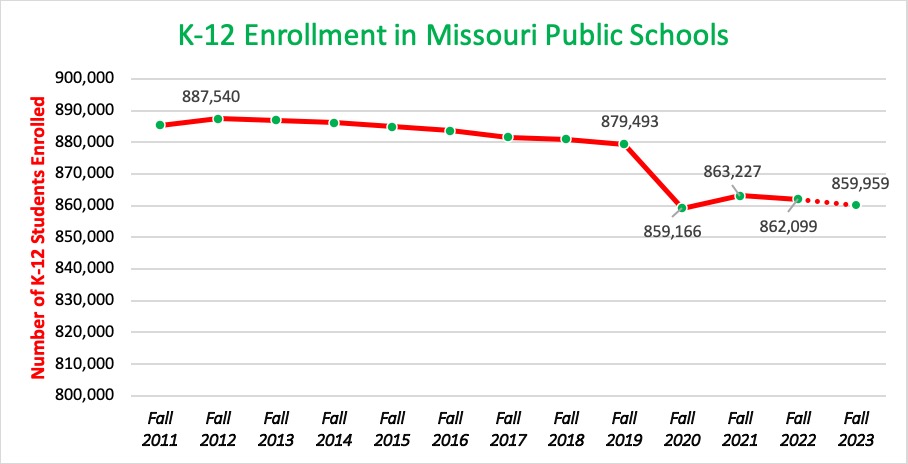
K-12 enrollment in Missouri’s public school system has been falling for more than a decade. Today, Missouri has about 30,000 fewer students enrolled in public schools than it had 11 years ago—and with kindergarten cohorts getting smaller and smaller, this negative trend is not showing signs of reversing course.

COVID-19 appeared to accelerate this student loss, as Missouri saw a decline in enrollment of 20,000 students in the fall of 2020. When enrollment rebounded slightly the following year, it was fair to wonder if Missouri could eventually regain the 20,000 who had left. However, according to recent enrollment data from the Department of Elementary and Secondary Education (DESE), enrollment is trending downward once again.

Below is a graph that maps Missouri’s K-12 public school enrollment since fall 2011 (the 2011–2012 school year):

Source: Department of Elementary and Secondary Education (DESE)

*Fall 2023 has a dashed line because the enrollment figure is preliminary and not final. *

It’s possible that the students we lost during the pandemic simply aren’t “coming back,” as Missouri enrollment resumed its pre-pandemic decline in both of the past two years. With this in mind, we need to evaluate policy options in light of a shrinking student body.

As I have discussed before, the general trend of declining student enrollment and rising teacher employment reveals that the proclaimed “teacher shortage” is due to specific deficiencies in the teacher pipeline—not a growing student body.

School districts also need to evaluate which classes and services they can provide to their student body. As I discussed recently, declining enrollment and participation led to Brentwood being unable to field a football team. As a result, the district merged its football team with Clayton, which led to a solid playoff run.

These kinds of policies will be needed as enrollment continues to decline. Districts may need to share classes with each other. Some districts may need to go a step further and pool their resources. There are many costs associated with meeting federal and state regulations in a school district, and merging two shrinking districts into one could increase the amount of funding devoted to instructing students.

The K-12 enrollment decline isn’t what we want, but it appears to be what we’re getting. Policymakers at the state and district levels need to plan accordingly.

What Can Missouri and Tennessee Learn from Each Other?

I’ve been working up the strength to write about Missouri’s absolute thrashing of Tennessee a month ago. My colleague, Elias Tsapelas, had not forgotten what I smugly said following Tennessee’s emphatic victory last year: “The Tigers should be taking notes [from Tennessee] on how to run an elite offense.” Well, it appears the Tigers did in fact learn how to run an elite offense. Cody Schrader looked like Christian McCaffrey, and there was simply nothing we could do.

Nevertheless, while I guess it is Tennessee’s turn to learn from Missouri on the football field, there is a valuable education policy in the Volunteer State that Missouri could learn from—a potential universal voucher program.

Tennessee currently has a voucher program that offers low- and middle-income students in Shelby (Memphis area), Davidson (Nashville area), and Hamilton (Chattanooga area) counties around $8,100 to help cover private and parochial school tuition or pay for other preapproved expenses such as tutoring (91% of participating parents are satisfied with the program). Currently, funding is set aside for a maximum of 5,000 students who reside in those three counties. In the coming year, Governor Lee wants to expand the program to 20,000 students—with 10,000 slots for low-income or disabled students and the other half for any student in the state. By 2025–2026, Governor Lee is proposing universal eligibility for any student entitled to attend a public school. If applicants exceed public funding for the proposed universal program, priority will be given to low-income, public school, and returning scholarship students.

This universal program is a great idea, and one that Missouri could learn from. The funding mechanism and demographic restrictions for Missouri’s MOScholars Program constrain the program’s potential effectiveness. You can read a full breakdown of the needed changes here.

Students deserve the opportunity to go to a school that meets their needs. Wouldn’t it be better if families were at schools because they wanted to be there, and not because their zip code requires it? In conclusion, I have three hopes: that Tennessee’s proposal finds success, that Missouri can follow Tennessee’s path, and that Tennessee beats Missouri in football next year.

One Way to Actually Do Something about Kansas City Property Taxes

Between now and the start of the legislative session, all of my blog entries, social media posts, radio interviews, holiday conversations with family and friends, and random encounters at the mall with total strangers will be dedicated to focusing on ways we  can improve municipal policies in Missouri.

I am going to take these one at a time because, frankly, this stuff is so hot I doubt you all can take any more than that. Let’s start with one of the most pressing issues where the voters are actually in charge.

As a relic of Kansas City’s famous school desegregation case, Kansas City 33 School District’s (KCSD) tax rate is managed by the constitution, not statute. Under the Missouri Constitution, article 10, section 11(g), KCSD is exempt from property tax rollbacks when assessments increase, leading to dramatic tax hikes on Kansas City residents in recent years. Trust me when I say that the KCSD has reveled in this fact and ostentatiously kept rates high despite enormous assessment increases during the past three (at least) reassessment cycles.

Here is the exact language:

Operating levy for Kansas City school district may be set by school board. — The school board of any school district whose operating levy for school purposes for the 1995 tax year was established pursuant to a federal court order may establish the operating levy for school purposes for the district at a rate that is lower than the court-ordered rate for the 1995 tax year.  The rate so established may be changed from year to year by the school board of the district.  Approval by a majority of the voters of the district voting thereon shall be required for any operating levy for school purposes equal to or greater than the rate established by court order for the 1995 tax year.  The authority granted in this section shall apply to any successor school district or successor school districts of such school district.

Voters need to repeal this section entirely. That means we need a ballot measure approved either by initiative petition or by the legislature allowing us to vote on a repeal. By repealing this constitutional provision, KCSD’s tax rate would be governed by the same rules as all other taxing jurisdictions in Missouri. That’s all. As assessments increase, rates would roll back at least in part to offset the tax hikes. Voters in the district could, of course, raise the rate if they chose to.

We should care about property tax rates for everyone, not just wealthy suburbanites. The residents of KCSD don’t deserve these constant tax increases. This provision may have been useful a while ago when the desegregation case was ending, but it is no longer needed.

Support Us

The work of the Show-Me Institute would not be possible without the generous support of people who are inspired by the vision of liberty and free enterprise. We hope you will join our efforts and become a Show-Me Institute sponsor.

Donate
Man on Horse Charging