The $22 (An Hour) Question

U.S. Sen. Elizabeth Warren (D-Mass.) wonders why we do not pay workers a minimum wage of $22 an hour (hat tip: The Corner). Regarding that $22 an hour, Sen. Warren probably is referring to this study by the Center for Economic and Policy Research (CEPR) that showed what the minimum wage would be if it had kept up with increases in worker productivity. However, one key thing that Sen. Warren fails to notice is the source of that increase in productivity.

The study linked to above talks about average productivity. Average workers do not earn the minimum wage. This study does not track changes in the productivity of workers who make at or below the minimum wage. Isn’t it possible that the largest increases in productivity have been among more skilled employees who already earn above the minimum wage?

Also, if workers do not feel that they are being fairly compensated, they are free to look for employment elsewhere.  In non-monopolies, employers have to compete for workers and thus offer a competitive wage in order to attract and keep talent. Christina Romer, President Barack Obama’s former chair of economic advisers, made this point in her analysis of increasing the minimum wage: “Robust competition is a powerful force helping to ensure that workers are paid what they contribute to their employers’ bottom lines.”

Minimum wage laws simply amount to “compulsory unemployment,” as they make it illegal to hire a worker below the prescribed minimum. At an hourly minimum of $22, an employer loses money if he or she hires anybody who produces less than $22 of value an hour. One Missouri small business owner stated that he “would fire one employee, maybe two” if the minimum wage increases to $22. That is quite a lot, given that he only employs three people. Politicians understand all of this, which is why they typically propose only modest increases. After all, if the forgoing economic critique is flawed, why not raise it to $100 an hour?

Raising the minimum wage is an attractive idea to many voters (at least on the surface). Yet, it really is not an effective way to help poor families. According to David Neumark, in his 2012 study for the Show-Me Institute, “. . . minimum wages may do little or nothing to help poor and low-income families.” People from both sides of the ideological spectrum have issues with raising the minimum wage, and increasing it all the way to $22 an hour would just be silly. Let’s focus on ways to truly help the poor.

Do Not Mandate The Middleman

I have nothing against middlemen nor beer distributors. In fact, I rather like beer distributors. I intend to consume their product at Blueberry Hill for my birthday tonight. I love Guns ‘n Hoses and have had a great time when I have attended. Heck, I even have a Googleganger in the industry. (Note, providing a link to the Googleganger totally defeats the substance of having one.)

That said, I just cannot believe that the latest attempts to preserve the three-tiered alcohol system by further tightening the regulations will be productive. Missouri Senate Bill 412SB 365, and House Bill 759 will involve the government further in the alcohol industry, and I do not think that is necessary. Look, we can all agree that there should be some government regulation of the alcohol industry: age limits, DWI laws, basic liquor licenses. However, I think that preventing a producer from having even a small interest in a distributor goes way too far, as do the rest of these proposed legislative changes. Producers should be able to, more or less, have the same freedom to get their product in front of final consumers as any other business. As the title suggests, the government should not mandate the use of a middleman.

All that said, I have no doubt that most producers will still continue to use distributors in this industry. The distributors have the contacts, the relationships, the networks, and the equipment to get the product to the market. However, the choice to use a distributor should be a voluntary activity as part of a free-market economy, not a government mandate.

Two Thumbs Down on the So-Called ‘Arch Tax’

Voters in Saint Louis City and County will go to the polls on Tuesday, April 2 to decide the fate of the so-called “Arch Tax.” In fact, more than 70 percent of the proceeds from the proposed tax (amounting to 3/16th of 1 percent on every $1 of sales of goods sold in the city and county) would be used to fund projects that have nothing to do with the Gateway Arch. There are several reasons why voters should reject this ill-conceived tax, but the most important reason is what the proposal does not do.

What the proposal did not do under the authorizing legislation in Jefferson City is exempt the new sales tax dollars from Tax Increment Financing (TIF). Because they did not exempt the Arch tax from TIF, a large portion of the revenues are likely to be diverted to the 176 (at least) TIF districts around Saint Louis City and County.

You may think you are voting to support the Arch and parks. However, a significant sum of the new sales taxes people pay will go to the many ludicrous subsidies implemented under TIF in recent decades. Many of the retail shopping districts in our area will now be able to keep half of the new Arch tax for themselves. You read that right. Existing TIFs will be able to “capture” half of the new Arch taxes generated within the TIF district and use it for private purposes. In other words, much of the revenue may not go to the parks . . . or the Arch . . . but to developers, municipal investors, and private retailers.

It was not a simple oversight allowing TIFs to capture the Arch sales taxes. Just a few years ago, the legislation authorizing a sales tax increase for MetroLink specifically exempted the tax from TIF. What is worse, in the very same legislation that authorized the new Arch tax (2012 HB 1504), the Missouri Legislature also authorized a new parks sales tax in Jackson County (Kansas City). Would you believe that they exempted the new Jackson County sales tax from TIF capture, but allowed the Arch tax to be taken by private developers within any TIF in the area? No, it was not an oversight. It was a choice, and voters deserve to know about that choice.

The second objection — as a quite separate matter — is another question that must be raised: Why are city and county residents being asked to support a federal monument — the Gateway Arch — with local tax revenue?

We do not hear of the residents of cities and towns in Wyoming, Montana, or Idaho being asked to support Yellowstone National Park with local sales taxes. Why should Saint Louis residents be asked to provide such support for the Arch?

Officials at the National Park Service have acknowledged that they do not know of any similar situation in which a local tax has been used to improve a national park or monument.

All in all, the Arch tax is a terrible idea on several counts. It deserves a resounding “no.”

Andrew B. Wilson is a resident fellow and senior writer and James A. Bosnick III is a policy extern at the Show-Me Institute, which promotes market solutions for Missouri public policy.


TIF Is The Arch-Enemy

On Tuesday, people in both Saint Louis City and County will vote on an increased parks sales tax to support changes to the Arch grounds and increased funding for local parks. In my opinion, the various arguments for and against it are all washed away by one fatal flaw in the proposal. The state legislature, when it authorized the tax to go before the voters, did not exempt TIF funds from the sales tax. That means in most — if not all — of Saint Louis City and County, the almost 200 TIF districts will be able to keep half of the new sales tax revenues — supposedly going to parks and the Arch — and use it for themselves.

The infuriating thing is that when the legislature passed the bill allowing this tax last year, they also passed the enabling legislation for a new parks tax in Kansas City as part of the very same bill. And for that KC tax, they exempted the new sales tax from TIF. So this was not some oversight by legislative supporters of the tax in Saint Louis. If they knew to exempt the KC tax from TIF, they could (and should) have done so for the Arch tax. The fact that they did not can only be seen as an effort to help developers and other consistent TIF users by adding this new tax to the pot of money available for subsidies. That alone makes this new tax a bad idea for Saint Louis.

Part Three: The Smallness Of The Potentially ‘Hip’ Core

Last week, Kevin McDermott of the St. Louis Post-Dispatch‘s Political Fix blog wrote briefly about the “hip development” debate we have discussed here and asked this about Saint Louis’ recent downtown redevelopment projects: “Economic engine or not, does anyone really think that area was better, in any sense of the word, 15 years ago than it is now?” Yes, the area around Washington Avenue obviously looks nicer. There are also more people living there. But this is a classic example of seen benefits with unseen costs.

Below is a map of tax credits that the Missouri Department of Economic Development issued in Saint Louis City spanning the years 1999-2011. The legend is denominated in dollars of credit issued. The larger the circle, the larger the credit awarded.

You can find the statewide distribution spreadsheet here. You can also hover over the dots to view some details on individual projects, and you can zoom the map out to see tax credit projects in other parts of the state. (To drag the map with your mouse, hold the shift key first.)

Dump hundreds of millions of dollars anyplace and something sure as heck better happen there. Washington Ave. is a good example of this. State tax credits have blanketed the central corridor of Saint Louis City over the last decade, and indeed, the population has risen in the area. But by how much? In a blog post titled “The Heavy Hand of Demographic Change” for the blog Rooflines, Alan Mallach of the Brookings Institute compared Saint Louis’ downtown growth to that of other cities.

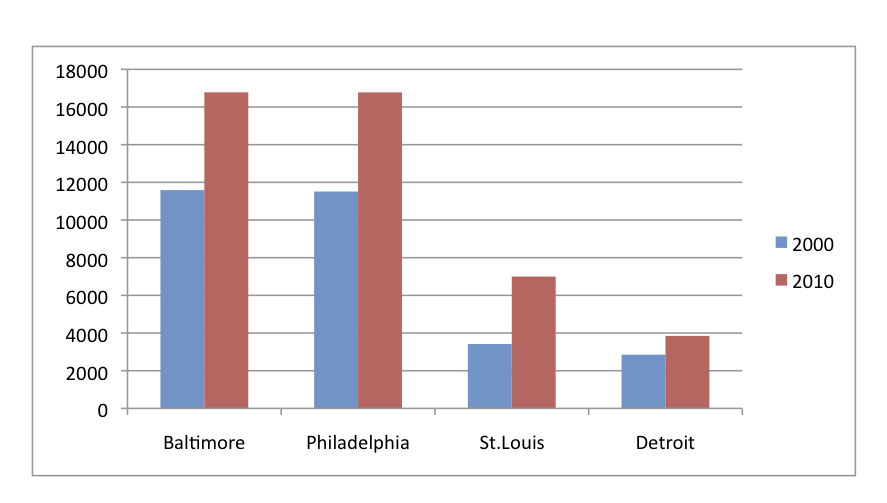
Saint Louis’ downtown population rose from just shy of 4,000 people in 2000 to about 7,000 people in 2010, a net increase of more than 3,000 people and nothing to sneeze at. But outside the downtown area? Saint Louis City’s overall population fell from 347,000 people in 2000 to 319,000 in 2010, a net loss of about 28,000 people. The state dropped hundreds of millions of dollars into the heart of Saint Louis’ downtown through tax credits and moved the population needle some; meanwhile, thousands of residents outside the city’s central corridor were heading for the exits. Some “creatives” have come, but development “coattails” clearly did not.

That is a development paradigm that is simply not working. Empower individual innovation, not government “experts.” Trust city residents, not hip developers. It may be less “cool” to redevelop our cities this way, but it will probably be far more effective.

Do Not Give Me That Blaine Old Excuse

In the late 19th Century, James Blaine, a noted Republican politician, led the charge against government support of sectarian (read Catholic) institutions. As a result of his efforts, 39 states adopted provisions in their constitutions placing restrictions on state dollars flowing to religious organizations. These provisions are known today as Blaine amendments.

The Missouri Constitution contains several provisions that place restrictions on public dollars flowing to religions institutions. The most prominent states:

That no money shall ever be taken from the public treasury, directly or indirectly, in aid of any church, sect or denomination of religion, or in aid of any priest, preacher, minister or teacher thereof, as such; and that no preference shall be given to nor any discrimination made against any church, sect or creed of religion, or any form of religious faith or worship.

The Blaine amendment in Missouri’s Constitution has led many to believe that a private school voucher plan could not pass constitutional muster. It seems that the Blaine excuse may be just that, an excuse.

Florida, Georgia, Indiana, Ohio, Oklahoma, Utah, and Wisconsin all have Blaine amendments and the legislature in each of those states has passed a voucher program. Of course, voucher opponents invariably challenge these programs in the courts. As we have just seen in Indiana, it is possible for these programs to be upheld in spite of a Blaine amendment.

On March 26, 2013, the Indiana Supreme Court ruled unanimously that the state’s far-reaching voucher program is in fact constitutional. The justices concluded:

[T]he voucher program expenditures do not directly benefit religious schools but rather directly benefit lower-income families with schoolchildren by providing an opportunity for such children to attend non-public schools if desired.

The justices were absolutely correct. School choice programs are not designed to benefit schools; they are designed to give families options. Indiana was not the first state to uphold a voucher bill. Previously, 10 of 14 cases regarding vouchers in states with Blaine amendments have been decided in favor of school choice.

Blaine amendments vary by state and there is no guarantee that a voucher would be constitutional in Missouri, but it is about time to stop giving the Blaine excuse for not providing students with educational options.

North Kansas City Hospital Getting Very Interesting Very Fast

Things seem to be moving very quickly in the debate about the future of the North Kansas City hospital. Lawsuits, amendments to bills, new trustees, late-night rule changes . . . the only thing missing is the Turk trying to finish off Don Corleone. This is unfortunate, because the discussion about the potential future sale, transfer, or privatization of the hospital is extremely important.

Needless to say, rushed changes to the board rules and amendments added to bills after public hearings are completed does not make for good public policy. A judge upheld the right of the city to add new members to the hospital board, but I have heard that the current board members changed the board rules to require a super-majority vote on certain actions before the new members could be appointed. That might be clever, but it is hardly admirable.

Legislation taking the hospital away from the entity that has owned it for decades would be a very dangerous  precedent, terrible policy, and wrong, all combined. Maybe it is just me, but I think taking away ownership of the hospital from the city is, you know, a bad idea. The city owns the hospital. It has always owned the hospital. The city should be able to do what it wants with the hospital, be that sale, privatization, closure, expansion, whatever. (Let’s be clear, however: under every legitimate scenario, the hospital is going to continue operating.)

I am no lawyer, but I have to imagine the courts will continue to side with the city here. That makes legislative changes the best option for hospital activists opposed to any structural changes. It would be extremely unfortunate if a pro-free- market legislature made an exception in this case and blocked the city from even considering something such as privatization, which most members of the legislature would usually support.

Part Two: The Smallness Of The Potentially ‘Hip’ Core

On Monday, I hit the idea of “hip” development pretty hard, but let me be clear about one thing: To me, that a district is off-beat, historically interesting, or otherwise unique is a net positive. Every city has enclaves and community identities that make wonderful contributions to how a city feels. It is part of the reason I like living in cities. But those city and community identities are best developed organically, not artificially.

Why? Because governments are terrible at figuring out how development dollars should be allocated — to entertainment? to bars? to factories? to homes? — and simply do not have the knowledge that is embedded in the marketplace to make many developments successful. The decisions of individuals, maximizing their own well-being, are why most cities came to be. They are why good cities became great, and great cities became world-class. It is why cities that have fallen on hard times can be great again, if the government will stop meddling.

On a personal note, I was raised in the Northeast area of Kansas City, which for the last 100 or so years has been a heavily immigrant community. It is not necessarily “hip,” but it is real. Inexpensive housing plus ready employment made it an ideal place for a newcomer to the States to, sometimes literally, set up shop and grow a family. It is why my mother’s Italian family came there, why Jewish families came before them, and why Hispanic and Vietnamese families came after them.

“Old Northeast,” as it is often called, has a meaningful and enduring story, I think, because its history emerged naturally. Its story is a story of people, not of government or government-sponsored “big ideas.” It is a story about authenticity, not artificiality — about the uniqueness of the Kansas City experience. One chapter closes, another opens, and the story continues, but it is a story built by people, not by development experts that the city or state enlist to “revive” an area’s fortunes. Part of the problem that Missouri and her cities have is that instead of harnessing the potential of all their citizens and diversifying their growth opportunities, they are too often just tinkering with one government-subsidized development after another.

Check back later this week for Part Three. Rest assured, we will be adding meat to these broad philosophical bones.

Support Us

The work of the Show-Me Institute would not be possible without the generous support of people who are inspired by the vision of liberty and free enterprise. We hope you will join our efforts and become a Show-Me Institute sponsor.

Donate
Man on Horse Charging