The anti-school choice position is usually framed as a defense of public education. But at its core, what it really does is defend a particular way of assigning students to schools: where you live determines where your children go to school.
The strongest opponents of school choice oppose vouchers, charter schools, and interdistrict open enrollment. In effect, they argue it is best if families have only one option: the public school assigned to them by their residential address.
The problem with this argument is that it ignores a simple fact: many families already exercise school choice by choosing where to live. Parents routinely pay higher housing costs or relocate to neighborhoods with schools they prefer. When a school develops a poor reputation, a nearby charter school is not required to siphon off enrollment—families with the means to move often do exactly that.
School choice is alive and well in the U.S. education system; it simply operates through the housing market.
The real question, then, is not whether school choice should exist—it’s which families get to participate. Families with financial resources already buy access to different schools through the housing market. Families without resources are frozen out.
Policies such as charter schools, vouchers, and open enrollment do not create school choice. They expand school choice opportunities to families who cannot participate via the housing market. Seen this way, the anti-school choice position becomes much harder to defend. Opponents are not preserving a world without school choice—they are preserving a world in which meaningful school choice is available to some families, while remaining out of reach for others.
I’m not anti-public school. On the contrary, I want high-quality public schools to thrive. But I do not believe traditional public schools should be protected from competition by denying lower-income families the choices that wealthier families already enjoy.
J.C. Bradbury, professor of economics at Kennesaw State University, joined Patrick Tuohey, guest hosting Mundo in the Morning on KCMO Talk Radio, to discuss his forthcoming book This One Will Be Different and why publicly funded stadiums almost never deliver on their promised economic benefits.
Patrick Tuohey (00:00)
Good morning, Kansas City. This is Patrick Tuohey, Kansas City’s second favorite Patrick, sitting in on the Pete Mundo Show for the whole morning. If you have read anything in the Kansas City papers about either the Royals Stadium or the Chiefs Stadium, the chances are that you are familiar with my next guest. J.C. Bradbury, a professor of economics at Kennesaw State University, has been studying the economic impacts of building stadiums, tearing down stadiums, getting teams, and losing teams. He’s got a book coming out at the end of next month called This One Will Be Different. I’ll get to the book in a second, JC, but my first question is: why do you hate baseball?
J.C. Bradbury (00:43)
Hi Patrick, thanks for having me on. I get that question a lot because I bring a lot of bad news, or uncomfortable truths, let’s say, about baseball. But I study these things because I love baseball. I’m a huge fan. I grew up an Atlanta Braves fan, but I follow baseball generally and all sorts of sports. I was an Atlanta United season ticket holder for many years. That’s why I do this — because I enjoy it.
Patrick Tuohey (01:09)
It’s funny — years ago somebody recommended Moneyball. It’s a fantastic book. The movie is just as good. I rewatched it the other day, and if you haven’t seen it or haven’t seen it in years, it really holds up. I think of that because baseball claims to be so statistics driven that you’d think fans would be more amenable to the kind of economic analysis you’re doing. But maybe it’s just love of the game and fandom that clouds their reason.
J.C. Bradbury (01:44)
There’s some of that. There are many people who are baseball fans, sports fans, who understand what I’m arguing — and I’d argue it’s more than you’d realize. But most of the people vocally speaking out about stadium issues and public finance are largely blinded by their own fandom. I deal with people on social media all the time who respond to things I say about stadiums and tell me I don’t understand the public finance — and they’re just totally incorrect. They don’t even bother to check it. It’s religion to some people. I say most people would give up their religion before they’d give up their subsidies to their sports teams.
Patrick Tuohey (02:27)
If you don’t already follow J.C. Bradbury on Twitter, I recommend it — JC underscore Bradbury. If you’re a fan of baseball, economics, or The Simpsons, you’ll love his account. So JC, tell me about your book, This One Will Be Different, which comes out at the end of July.
J.C. Bradbury (02:44)
I’ve been studying stadium subsidies and publicly funded stadiums for a very long time. I fell into it accidentally because the Atlanta Braves Stadium opened in Cobb County, a few miles from where I live — just outside Atlanta, where my family has been for generations. I had a lot of interest in how the stadium was built and funded, with three hundred million dollars in subsidies. I was familiar with a lot of the economics behind stadiums, and when I tried to share this research with other people, I was heavily rebuffed. So I began to study the issue more, and before I knew it, I had a very long book about the economics of stadiums. My idea was to explain public finance issues in stadiums using simpler methods. I use sound research methods, but I try to explain it through the narrative story of the Braves coming to Cobb County — here’s what happened, here’s what people argued, here’s what actually happened, let’s look at some of the financial numbers, and let’s understand the general intuition of why stadiums get built even though economists say they’re a bad deal. I look at the politics of it too. And one of the things I find is that these stadiums are mostly built by insider coalitions — chamber of commerce types, folks who are going to sit in the owner’s box and enjoy cocktails, or people with season tickets. They’re the large beneficiaries of the subsidy. They push these advocacy campaigns and try to get them passed as quickly as possible without going to voters if they can. That’s why we get these deals.
Patrick Tuohey (04:35)
One of the things that frustrates me about this whole issue — and I’d be curious if you agree, though I hate when TV and radio hosts make a statement and then ask the guest if they agree, and here I am — is that when St. Louis was considering funding a Major League Soccer stadium, or here in Kansas City with the Royals or the Chiefs, what I wish they would do is just say, “Hey everybody, we are a sports town. We think it’s important to have a sports team here, so we’re going to spend hundreds of millions of dollars to build something.” And just leave it at that. It would be a defensible argument. You could argue whether it’s worth the expenditure, but at least everybody would be honest. But they don’t do that. They go the extra step and say, “And we’re going to make money doing it.” That’s where they mess everything up. That’s where they get the numbers wrong. Is it as simple as that, or am I missing something?
J.C. Bradbury (05:31)
Absolutely. I wish there was some honesty in these debates. The reality is that a lot of people who argue these things don’t actually believe the phony economic impact studies they put out. They do it for a couple of reasons. Number one, politically, it’s a winning issue — if you tell someone it’s good for them economically, they’re more likely to support it. But also, if you just argue it’s good for the community and we’re a sports town — okay, how much does it cost? A billion dollars. How much does that increase taxes? Three hundred dollars. Well, hold on, we’re not that much of a sports town. Think about how you make your own decisions. What kind of car do you want to drive? I want a Ferrari. Great. But to drive a Ferrari, you’d need to move into a two-bedroom apartment, never travel again, and eat ramen noodles. You know what — I’ll get the base model sedan. People make those kinds of decisions, and that’s one of the reasons they use false economic benefits — because once you start talking about social benefits, people look at the costs more closely, and it makes a lot less sense.
Patrick Tuohey (06:40)
I had your colleague Victor Matheson on a few weeks ago and we talked about this, specifically with the World Cup. I’ve also asked Neil Damas this question. In your experience, how good are journalists at reaching out to you and your colleagues to vet the numbers they’re being told by chambers of commerce or the city? Where are we now, and are we getting better?
J.C. Bradbury (07:14)
I think the situation is getting worse, and a lot of it is accidental. Newsrooms have gotten smaller and younger, so there’s less institutional knowledge. People don’t remember the last stadium being built, and they’re told to go cover this stadium story. They call a few local sources — who of course are members of the local chamber — and those people say it’s great. At best, they call a local economist who says it’s bad, and it ends up being a tie. But often they don’t even call the economist. That’s part of the nature of the news business, which is one of the reasons I think it’s so important to use social media and other mediums to get the word out. Even journalists trying to do their best often fall short. And journalists deserve some blame here — when I reach out to try to help them, they often get very defensive, and I think that needs to stop. I’m not just angry at journalists. Both my parents were journalists, and my first job was in a newsroom. I understand what’s going on.
Patrick Tuohey (08:19)
The previous segment, I talked about World Cup reporting. Local people put out outrageous economic development claims a year and a half ago, nobody questioned them, and journalists just repeated them — even though past experience hadn’t lived up to those claims. So what can we do to encourage journalists to reach out, or maybe just give them a primer on what economic impact studies look like and where the flaws are? Whether I’m looking in St. Louis, Kansas City, or around the country, they are all flawed in the same way.
J.C. Bradbury (08:56)
It’s important to always speak up. It’s easy to get tired and think you can’t keep doing it. When someone asks me to look through one of these studies, I tell them it’s not a real study — it’s a fake study. I try to spread that message. Part of the problem is that the big number is the story, and that’s what they want out there. The fact that it’s wrong later doesn’t matter. And sometimes people get mad at me because I’ll call out bad reporting. I do it not because I dislike journalists, but every time I’ve tried to be nice about it, I get told I don’t know what I’m talking about or that they don’t want to tell their boss they need a correction. I think it’s important for journalists to know that if they get it wrong, they’re going to get called on it — not to be mean, but to set the standard.
Patrick Tuohey (09:54)
And do a better job because policymakers and business owners are making decisions based on the numbers you’re putting out there. We see this with the World Cup — people were expecting much bigger crowds than they got. It’s not just a matter of being right. It’s a matter of being right so that people make decisions based on real information, not just projections. JC, I’m grateful for your time this morning. Thank you so much. We’ve been talking to J.C. Bradbury of Kennesaw State University. His book, This One Will Be Different, comes out at the end of July. We’ll be right back.
The movie The Odyssey is being released next month, and that’s appropriate for the Jackson County assessment district because the county is truly between Scylla and Charybdis now. The reassessment process in Jackson County has been a disaster for over a decade now. The only thing I will say in defense of the county and the assessor’s office is that Jackson County was underassessed for a long time. (My explanation as to why that was can be found here.) The process to accurately assess property within Jackson County was never going to be easy or fun, but the county has failed at the overall process by any measure.
Jackson County has begun attempting to correct its poorly conducted reassessments in 2023 and 2025. It will do this by retroactively rolling back property assessments for some property owners, sending refunds to other taxpayers, and withholding future tax funds from other taxing entities, such as fire districts, to make up for the overpayments by taxpayers in 2023 and 2025. The county has to withhold future payments because counties collect all the property taxes within the county, but then distribute almost all of that money to other taxing districts. Jackson County does not have a large pot of its own money it can make amends from. Not surprisingly, some of those taxing entities are suing over the withholding of their future tax payments.
The problem is, those school districts and other taxing entities were not the ones who caused the problems in 2023 and 2025. They followed the rules, set their tax rates, received their tax money, and spent it. Now they are being told they have to give some of it back.
So, I understand the objections by the taxing districts, but I have much more sympathy for the taxpayers who were victimized by a poor process over the past few reassessments. The Jackson County assessor’s office, among other problems, failed to provide taxpayers with the rights of appeal and relief they were entitled to during the process. So, yes, some taxpayers were overcharged because they did not have their full opportunity to appeal their taxes.
In short, the new Jackson County leadership team deserves credit for changing course and finally trying to correct the problems and refund money to some taxpayers. I think the taxpayers deserve these refunds—and the entire process needs wholesale changes.
I have no idea how the courts will rule in this lawsuit. I’ll be following it closely. Hopefully this controversy and similar, recent issues in Platte County can lead to massive changes in how we conduct property reassessments in Missouri.
Susan Pendergrass speaks with Andrew G. Biggs, senior fellow at the American Enterprise Institute, about the Social Security trustees’ latest report and what it means for the program’s future. They discuss the projected 2032 insolvency of the retirement trust fund, why the trustees’ birth rate assumptions may be too optimistic, the proposed Moreno-Warren plan to eliminate the payroll tax ceiling, the Cassidy-Kaine plan, and why pension experts oppose it, what would actually happen if the trust fund ran out, and more.
Susan Pendergrass (00:00):
I feel fortunate to have grabbed some of your time. Andrew Biggs from the American Enterprise Institute, I appreciate you coming on to talk to us. Social security has been nothing but in the news recently, and you know more than anyone else. So thank you for taking the time.
Andrew Biggs (00:14):
That’s why I’m so cheerful. The more you know about Social Security, the happier you are. But thanks for having me, Susan. It has been busy. I’m really happy to be with you today.
Susan Pendergrass (00:16):
I’m in my sixties. I see something about Social Security running out of money and I pay attention. So just to bring us all up to speed: in the last week, there was a news flash that Social Security is going to run out of money sooner. What does it really mean?
Andrew Biggs (00:39):
Every year the Social Security trustees, which is mostly members of the cabinet, the Secretary of the Treasury, the Social Security Commissioner, and so on, come out with a report projecting the program’s financial health, both in the short term and the long term. That happens every year, and it’s been getting worse every year. In this year’s report, they projected that the retirement trust fund will go insolvent, or run out of money, in 2032. They also projected a significantly larger long-term funding gap in the years thereafter, and this is worth explaining.
When the trust fund runs out, it doesn’t mean there’s zero money to pay benefits. As long as we’re paying a trillion dollars a year in payroll taxes, there will be money to pay benefits. But when the trust fund runs out, it means benefits will be cut, and their projection is somewhere around 22%. The size of that long-term funding gap dictates how big the cuts are going to be in the years thereafter. The trustees lowered their projections for birth rates, and they found that the One Big Beautiful Bill has worsened Social Security’s finances. A variety of things made this long-term funding gap worse. It’s really hard to paint a happy picture. The trust fund can be running out in about six years, and the funding gap and the benefit cuts in years thereafter are going to be larger. It’s a sobering picture.
Susan Pendergrass (02:16):
I’m not trying to pile on, but I think I saw that they extended the time when they expect birth rates to bounce back. Is that true? Because I have not seen anything anywhere, and I’ve spoken to some demographers, to suggest birth rates are ever going to bounce back.
Andrew Biggs (02:35):
Here’s the interesting thing. If you look at the Congressional Budget Office or the US Census Bureau, right now the fertility rate is about 1.6 children per woman on average, and both the CBO and the Census project that’s going to remain pretty much steady, declining a little bit over coming decades. Social Security had a very different picture. As of last year, they thought the birth rate, which is 1.6 now, was going to immediately start rising and go back up to 1.9 children per woman in the next several decades. That makes Social Security’s finances better. More kids being born means more people paying into the system. What they did in this year’s report is moderate a bit on fertility. They said, okay, it’s not going to rise back to 1.9, it’ll rise back to 1.75. So they are still over-optimistic. I’ve talked to some demographers and economists who’ve really focused on the birth rate, and they described the trustees’ assumptions as, quote, fanciful, meaning they just weren’t plausible. Now they’re somewhat more plausible, but they still tend
Susan Pendergrass (03:32):
Okay.
Andrew Biggs (03:48):
to be more optimistic than other agencies. And to me, frankly, this is a concern. You really want the people who are the scorekeepers, the umpires, to be playing it as straight as they possibly can. We know that these guesses are going to be wrong because this stuff is impossible to predict with certainty, but most demographers think the best guess is we’ll stay around 1.6 going forward. You’ve seen a decline, and a good predictor of birth rates is religiosity, the level of religious belief in a country. The US has typically been much more religious than Western Europe, and that’s played into fertility. There has been a big decline in religious belief, particularly among younger Americans, along with all the other pessimism you see among younger people. When people are pessimistic, they tend not to have a lot of kids. So the best guess is we’re going to stay about where we are.
I wrote something the other day saying the bad news in this trustees report is even worse than last year’s, but it could have been even worse. They project a long-term funding gap above 4.4 percent of payroll. What that means is if you took the 12.4% payroll tax today and raised it immediately and permanently by 4.4 percentage points, from 12.4 to 16.8, that would in theory keep the trust fund solvent for 75 years. But a better guess would be a funding gap of around 4.8 to 5 percent. This is real money. For years, people on the left have said, well, okay, we know Social Security has a solvency problem, but it’s a manageable issue. They were saying that when the funding gap was 2% of payroll. Now you’re looking at four to five percent. That’s a lot of money, at a time when a lot of other things are making claims on the budget. We have some difficult choices to make and we really have to start thinking hard about this.
Susan Pendergrass (06:09):
Okay, so what about this idea that’s been floated in the last week of getting rid of the payroll cap? First of all, explain the payroll cap, and then this idea of getting rid of it.
Andrew Biggs (06:17):
Sure. Social Security has a 12.4% payroll tax, half paid by you and half paid by your employer. That applies only to wages up to $184,500. That’s called the payroll tax ceiling, or the tax max. That dollar figure goes up every year, but this year it’s $184,000. You only pay taxes on those wages, and you also earn benefits only on those wages. People say, well, Bill Gates doesn’t pay more taxes than that. But he doesn’t earn any benefits either. So you’re capping both the taxes and the benefits.
To fast forward a little bit: there’s an op-ed in the Washington Post this week from Senator Bernie Moreno, a Republican from Ohio, and Elizabeth Warren, a Democrat from Massachusetts. They say it’s just common sense to eliminate that cap and tax all earnings for Social Security. The interesting thing is how uncommon that would actually be. Our payroll tax ceiling is $184,000. Almost every other country has a ceiling on their payroll taxes for their pension system, and in almost every other country that ceiling is lower. In Canada, you only pay taxes and earn benefits up to around $60,000 in earnings. In the UK it’s about $70,000. In Germany it’s about $70,000. We are already an outlier for how high up the income ladder we tax people. To eliminate the cap entirely is a big deal. It’s effectively a 12 percentage point increase in the top marginal tax rate. I pulled an example of somebody living in New York City. A high-income person already pays 37% in federal income taxes, plus regular Medicare taxes, the additional Medicare tax, state taxes, and city taxes. If you add another 12 percentage points on top of that, their marginal tax rate would be in the mid-60s. And that’s before we’ve fixed Medicare or done anything else. The federal budget is still broke, and you’ve taxed these people as high as you possibly can. So these things that look like common sense, why don’t we just tax everybody,
Susan Pendergrass (08:37):
Right, right.
Andrew Biggs (08:46):
look, there are reasons for that.
Susan Pendergrass (08:49):
And were they suggesting that if I make $300,000 and I pay my 6.2 percent, totaling 12.4 with my employer, on my entire salary, that my Social Security benefit one day would be higher? Are they talking about capping the benefit or just getting rid of the cap on contributions?
Andrew Biggs (09:06):
They haven’t been very specific. They say Social Security would continue to be an earned benefit, which kind of implies you would continue to earn benefits on the additional taxes you would pay. Let’s say if we uncap the payroll tax and base your taxes on your total earnings, you’d also base your benefits on your total earnings. What you get then is, okay, you’re getting all this money from people in the short term, but you have to pay them higher benefits in the long term. That offsets some of the savings. And this morning I was running some numbers looking back to the 1970s. We had a huge run-up in benefit levels from Social Security in the 1970s. The benefit formula we have today is not the one FDR invented. It really happened in the 1970s, where they jacked up benefits in a really foolish way, and then to help pay for it, they increased the payroll tax ceiling. Right now you pay taxes on earnings up to $180,000. If we had just kept the tax max from 1970 and indexed it to wages, it would have been only $95,000. So they essentially doubled the wages on which you pay Social Security taxes. But what happens is they also doubled the wages on which people earn benefits. I’ve highlighted the point that if you have a high-income
Susan Pendergrass (10:38):
Mm-hmm.
Andrew Biggs (10:43):
couple retiring today, they could get almost $100,000 in total benefits, which is absurd. There’s no reason a government program should be paying anybody that amount. If you want that kind of income in retirement, you save more in your 401k. It’s better for you, better for the economy. But it was a result of this short-term step they took in the 70s. They said, hey, we raised benefits too high, let’s jack up the tax max. And they didn’t worry about the fact that in the future you’d have to pay benefits on that. Well, the future is today.
Susan Pendergrass (11:05):
Okay.
Andrew Biggs (11:13):
Now we’re broke again, we need extra money again, and these guys say, well let’s just jack up the tax max. But then you’ll pay extra benefits in the future. It becomes this chasing-your-tail kind of thing.
Susan Pendergrass (11:16):
Yeah. Yeah.
Andrew Biggs (11:25):
And the problem when you do it is there’s no country on earth paying $100,000 a year from a social insurance program, except for us. And the reason we do is these stupid historical decisions. If you’ve got this high-income couple in the US retiring today, they can get almost $100,000 from Social Security. If they lived in Canada, they’d get like $35,000. And that’s perfectly fine. Nobody’s starving to death in Canada in retirement. They just save more on their own.
Susan Pendergrass (11:35):
I’ll say.
Andrew Biggs (11:55):
The irony is that we think of ourselves as a free-market, small-government country, and our Social Security program is enormous, primarily because we’re paying benefits to people that other countries say, yeah, we don’t need to pay benefits to these guys.
Susan Pendergrass (12:11):
And yet people say, I put my money in, I get my money out.
Andrew Biggs (12:14):
Yeah, and I understand it. When I say we shouldn’t be paying $100,000 a year to a high-income couple, you get the email saying, well, I paid in. And if you paid in, you feel you have this moral claim on benefits. The problem is Social Security is still broke. We still need higher taxes or lower benefits. The idea that you’re just going to get your full benefits with the taxes you paid doesn’t work because the system can’t afford to do it. So you have to make the choice: do I want to pay higher taxes or get lower benefits? I’ve got to pick my poison. Most high-income people would prefer to get lower benefits. They care more about their taxes than their benefits. But people are still living in this dream world where this system, which is $30 trillion in the hole, is somehow going to pay them everything they’ve been promised and just screw somebody else. Everybody thinks they’re the guy who’s going to get everything and somebody else is going to get screwed.
Susan Pendergrass (13:14):
Yeah. I definitely hear people saying today, maybe I should go ahead and take it early and then I’ll get grandfathered in and my benefits won’t get lowered.
Andrew Biggs (13:26):
It probably won’t make a difference. In general, the Social Security benefit formula works based on your birth cohort, the year in which you’re born, not really the year in which you claim benefits. And people who are going to do Social Security reform understand the incentives. They don’t want to make it easy for people to game the system. So Social Security reform will probably work itself out in such a way that
Susan Pendergrass (13:42):
Right.
Andrew Biggs (14:03):
you can’t get some big advantage by claiming early. I could think of some conceivable possibilities, but I still would not encourage people to claim early.
Susan Pendergrass (14:14):
Okay, I want to talk about two more things I read in the last week. One was a letter from Tim Kaine about his idea with Senator Cassidy. What’s that idea for fixing it?
Andrew Biggs (14:24):
The interesting thing is people say Social Security reform has to be bipartisan. So we have two bipartisan ideas. We have Moreno and Elizabeth Warren, a Republican and a Democrat. They’ve got one idea, eliminating the payroll tax ceiling.
Susan Pendergrass (14:39):
Third rail.
Andrew Biggs (14:49):
Cassidy, a Republican from Louisiana, and Tim Kaine, a Democrat from Virginia, they’ve got a bipartisan plan. And guess what? Their plan is also terrible. If there’s any lesson from this, it’s that bipartisan doesn’t mean good.
Susan Pendergrass (15:00):
Bipartisanly terrible.
Andrew Biggs (15:04):
Yeah. Look, ultimately Social Security reform is going to have to be bipartisan, given the way the political system works. On the other hand, there is some lesson that if both Republicans and Democrats can agree on something, it might be a terrible idea. With Cassidy and Kaine, they are explicitly, and Cassidy said this, solving a political problem. The political problem is that neither Republicans nor Democrats want to vote for either tax increases or benefit cuts. You’d think Democrats want to raise your taxes and Republicans want to cut your benefits. The reality is they don’t want to do either of those things because they realize both are politically unpopular, which is why we’ve gone 40 years literally doing nothing. So their solution is that we don’t have to make these difficult votes. Instead, the federal government will borrow about $2 trillion, invest that money
Susan Pendergrass (16:02):
Tough.
Andrew Biggs (16:04):
in stocks and private equity, high-risk, high-return stuff. Then they claim they’re going to hold this fund for 75 years so it can build up value. In the meantime, when Social Security’s trust fund runs out in 2032, the federal government will borrow against the assumed gains on this investment fund.
Susan Pendergrass (16:06):
Right. Mm-hmm.
Andrew Biggs (16:29):
They say the borrowing will be at a lower rate because it’s the federal government. And they say after 75 years, all the gains in this investment fund will pay back all the borrowing and we’re all good. And let me count the ways there are problems with that. If you work at the state level,
Susan Pendergrass (16:45):
It’s just kicking the can.
Andrew Biggs (16:52):
state-based think tanks almost know more about this than federal people. A lot of underfunded state pension systems do things called pension obligation bonds. Their pension system is underfunded, they don’t want to raise contributions or cut benefits, so they borrow and invest in the stock market and hope it works. The pension obligation bond is the hallmark of a poorly funded, poorly run pension system. Think New Jersey, Illinois, things like that.
Susan Pendergrass (17:21):
Yeah.
Andrew Biggs (17:23):
There’s a national group of state budget officers that has come out and basically said as an institution, don’t do this. Borrowing for your pension is a bad idea. So it really is fitting for the times that the Cassidy-Kaine plan says, let’s take this worst idea from state and local government
Susan Pendergrass (17:45):
Yeah.
Andrew Biggs (17:47):
employee pensions, which has been condemned as bad practice, and put it on steroids and do that for Social Security. And what it really gets to is they just don’t understand the finances of it. And to be frank, they won’t listen. They have talked to every pension expert I know, and this Social Security world is pretty small. We all know each other on both sides. We may not agree on everything. Literally every pension expert I know says this is a terrible idea.
Susan Pendergrass (17:54):
Yeah.
Andrew Biggs (18:17):
But their political considerations are more important than policy, and that’s the problem with all of them.
Susan Pendergrass (18:24):
I mean, it feels free. They’re basically saying it’s like a timeshare. It just feels free right now. We just borrow the money. Okay, so
Andrew Biggs (18:31):
It’s been pointed out to them that if you can fund Social Security this way, you could fund the entire federal government this way and never collect any taxes. At one point Senator Cassidy was quoted in a newspaper article saying, well, yeah, sure, in theory you could. And I’m like, if something implies there’s a free money machine, maybe you need to question your assumptions.
Susan Pendergrass (18:38):
Sure. Okay.
Andrew Biggs (18:54):
I could give you a whole variety of reasons why this doesn’t work, but one macro point that’s come to me: I’ve been doing Social Security for a long time. I worked in the Bush administration in 2005 when they tried and failed to do Social Security reform. One of the problems we face today is that your elected officials understand Social Security policy much less well than they did 20 years ago. They just don’t understand how the system works. Going back to the Moreno-Warren idea of applying the payroll tax to all earnings,
Susan Pendergrass (19:22):
Yeah.
Andrew Biggs (19:37):
okay, you’re adding 12 percentage points to your top tax rate. There’s a reason Sweden and France and others don’t do this anymore. They used to have incredibly high tax rates. They don’t now. We would end up in many cases with a higher tax rate than most European countries. We have some philosophical dedication to small government and things like that. They don’t. And so if they’re not doing it,
Susan Pendergrass (19:43):
Yes. Yeah, yeah.
Andrew Biggs (20:02):
it’s because there’s a practical reason this isn’t a good idea. The same applies to wealth taxes. That’s been tried in Europe. They’re like, yeah, we’re not doing that anymore because it doesn’t work. But your average senator now
Susan Pendergrass (20:14):
It is happening around the country, the billionaire tax. What happens in 2032 if no one is either brave enough or smart enough to take this on in the next six years?
Andrew Biggs (20:17):
They’re just not aware of these policy issues, and that’s a real problem. It’s like having a guy fix your car who doesn’t know how to fix cars. 2032 is the date. If you have a recession, it might be 2031. It’s not certain, but it is certain it’s happening soon.
Susan Pendergrass (20:47):
Yeah. Okay.
Andrew Biggs (20:53):
There’s a literal reading of the law, which is that Social Security can’t pay out benefits it doesn’t have dedicated resources for. Once the trust fund runs out, the only dedicated resources are mostly the payroll tax, plus a little bit of money from income taxes levied on retirement benefits. And those were cut as part of the One Big Beautiful Bill. So if the trust fund runs out, they’d have to rely on the money they have on hand, which implies around a 22% benefit cut.
A lot of times people assume that benefit cut has to be across the board. If you did it that way, you’d throw a lot of people into poverty. I did some work a year or so ago with a lawyer in DC named Kristen Shapiro, and what we found is that the legal precedent shows the executive branch, meaning the president working through the Social Security Commissioner, would have some discretion. What we found is you could maintain full benefits for about 50% of people, the poorest 50% of seniors, and then cap benefits above that. If you cap the maximum benefit at about $24,000 per year for a single person or $48,000 for a couple, that is enough to make Social Security solid without raising taxes. So the point is simply you have some discretion.
The reality is Congress isn’t going to allow big benefit cuts, for political reasons. On the other hand, are they willing to have the size of tax increases needed, all in one go, to keep Social Security paying full benefits? I don’t think they want that either. So the reality is probably they’re going to borrow a lot of the money. And that’s where you get to the issue of how much more borrowing the financial markets will swallow. We effectively borrow from the public to repay the Social Security Trust Fund, but there’s an end to that. You say, okay, 2032, we have to do something. We have to raise taxes or cut benefits. If in 2032 the stated policy of the federal government is, well, we’re just going to keep borrowing to pay Social Security even though we have no prospect of paying it back, you wouldn’t blame some big market players for saying, yeah, I’m out, because you don’t want to lend money at low interest rates to someone who says they can’t pay it back. Then you start getting a couple of things. One is more federal borrowing squeezes out capital in the rest of the economy, and so interest rates naturally rise.
Susan Pendergrass (23:18):
Right.
Andrew Biggs (23:31):
But then there’s a second element: if you’re afraid the federal government can’t pay you back, over and above that natural increase in the interest rate, you’d apply a risk premium to treasury debt. You’d say, look, Treasury is not this rock-solid investment anymore. It’s more like a junk bond, or like borrowing from Illinois, and you make them pay a premium. That’s going to drive up
Susan Pendergrass (23:43):
US government borrowing. Yeah, yeah, yeah.
Andrew Biggs (24:01):
interest rates, and that makes it tougher not just for the federal government but for everybody. If you want to buy a car or a house, all your interest rates rise. There’s also going to be real temptation to inflate away the debt. The federal government doesn’t want to default on its debt, but
Susan Pendergrass (24:24):
Yeah, yeah.
Andrew Biggs (24:25):
historically the way you deal with this is inflation. Think about all the debt we took on during COVID, shoveling money out the door to everybody, and then we had massive inflation after it. A lot of those people who bought treasury debt didn’t get a good deal, because if you get 20% inflation on
Susan Pendergrass (24:34):
Absolutely. Yeah.
Andrew Biggs (24:47):
a treasury bond with a nominal fixed interest rate, that’s a real problem. So inflation becomes increasingly tempting. You look at this scenario and you’re like, can’t anybody here play this game? Every other country is not going bankrupt. We just have to do what they do.
Susan Pendergrass (24:51):
Yeah, yeah. So could we, if we really got our heads around it and started today or next year, incrementally raise the 12.4%, or incrementally get people used to lower benefits after a certain income or wealth level?
Andrew Biggs (25:18):
Sure. Yes. The way I think about it, there are two ways people think about it: the wrong way and my way. The wrong way is, let’s just pick from this menu of options to make Social Security solvent. We can raise the payroll tax a bit, raise the retirement age a bit, cut cost-of-living adjustments a bit, raise the tax cap a bit, and do these things until the system is solvent.
Susan Pendergrass (25:34):
Yes. Yeah.
Andrew Biggs (25:54):
That’ll get you a solvent program, but it won’t be a program that particularly works very well or is good for the economy. A more effective way is to ask, what do we want this system to do? If you talk about Social Security reform, what you hear is that it’s a social insurance program, a safety net, an anti-poverty program. Okay, it has to do that. And that part is really very cheap, because we don’t literally have that many poor seniors, their benefits aren’t very high, and it’s not a problem to maintain benefits for low-income seniors. When you ask what Social Security should do, nobody is saying we need to be paying high-income seniors $100,000 a year. There’s no public purpose for it. Nobody thought it out in advance. It was simply an unintended consequence. So if you’ve got things that are really costing a lot of money and have no public purpose, and those people can save for retirement on their own, you start scaling that back. The distinction I’m making is between policy changes simply for the purposes of keeping Social Security solvent, and policy changes for the purpose of making Social Security do what it needs to do, the real public purpose, and not doing things that serve no public purpose. My point is the things I’m talking about are things you should do whether Social Security is insolvent or not.
I’ll give you an example: Australia’s retirement system. Australia is a lot like us, not particularly more conservative or liberal, just sort of normal. Their Social Security program essentially is targeted at eliminating poverty in old age. It’s actually a better safety net than Social Security provides, but the benefits decline down to zero once you get above the poverty level. And to help people above that level save for retirement, everybody is enrolled in a 401k-type account. What that says is, if everybody’s participating in retirement plans as they should, the government’s job becomes easier. Their Social Security system costs about two percent of GDP. Ours costs about six percent. It’s a third as costly, provides a better safety net, and it comes because they’re actually thinking about what they’re doing.
Susan Pendergrass (28:18):
Mm-hmm.
Andrew Biggs (28:26):
We’re literally not thinking about what we’re doing. There’s a saying in business: the worst reason to do something is because we’re already doing it. That is literally how Social Security policymaking works. Nobody knows why our benefit formula is what it is or why the tax max is what it is. It’s all just stuff we inherited from the 1970s from people who were not in any way thinking clearly about what they were doing. It was people in the 70s trying to win elections, and we end up with the bag.
Susan Pendergrass (28:52):
Speaking of 2005, there was an attempt to offload a small portion of people’s contributions into the market, right? That failed.
Andrew Biggs (29:09):
That was the Bush proposal. I was in the White House then, kind of in a number-cruncher role, so I knew that stuff pretty well. I did a lot of events with President Bush around the country. When we came up on the 20th anniversary of Bush’s proposal in 2025, I started thinking to myself, what if his plan had passed? What would have happened? So I built a model. Back then they were saying, okay, you’re going to have some reductions in traditional Social Security benefits for middle and high-income people, and then you’re going to have a personal account where you can invest part of your existing payroll tax in stocks and bonds. The total benefit you get at retirement is a combination of those two. People were speculating. Well, we don’t know what the stock market’s going to do. But 20 years later, we’ve got some data, so let’s just see what happened. The results were that for people
Susan Pendergrass (30:01):
Now we do.
Andrew Biggs (30:07):
retiring today, low and middle-income people would have had higher total benefits by a little bit. The very highest-income people, their benefits would be down by a couple percent because the cuts to their traditional benefits would be larger than the gains from their personal account. But even they would be fine; it’s not a big deal. Going forward, it looked like people would do a little bit better with the Bush plan than with the traditional system. But here’s the important thing: the traditional system is broke. We just talked about how it goes broke in 2032, with huge deficits. The Bush proposal wouldn’t have made Social Security totally solvent, but it would have addressed half or two-thirds of the long-term funding gap. So you’d get a system that would have paid you benefits around the same as, or maybe a little bit better than, Social Security, but would be in much more solid financial shape. Today the times are different, and I don’t think personal accounts are really viable. But the point is, if they had done something back then, everything could be easier today. But members of
Congress were just too afraid. Republicans were afraid of taking the political hit. For Democrats, it was too tempting to give the political hit. They knew they had to do something, but they couldn’t swallow hard and say, look, let’s just go in on this thing together. They didn’t want to give Bush the win because by that point Iraq was going badly and they really didn’t like him. So they beat him up. But the problem is Bush served his term and is happily retired in Texas. The people who really got screwed were the ones who depend on Social Security, because we didn’t fix it. And you just hope that’s not what we do again.
Susan Pendergrass (31:42):
Yeah. Somebody not us in 2045 could be having the same conversation, right? Like, if only in 2025 or 2026 we’d gotten serious. And I do think people mix up the trust fund with the whole program. A lot of people think all of Social Security is going to be bankrupt in six years, versus the reality that we’re still taking in a trillion dollars, we just need about 22% more than what we’re taking in.
Andrew Biggs (32:14):
Yeah. If you go back 20 or 25 years, there were all these arguments about whether the trust fund is real or fair or whatever. The trust fund is essentially IOUs written from one side of the government to the other. I thought at the time the trust fund is not real in an economic sense. It doesn’t make it easier for the government to pay Social Security benefits. It is a pledge that we will pay them, but it doesn’t make it easier to pay them. But here’s the interesting thing:
Susan Pendergrass (32:25):
Right. Al Gore. The lock box.
Andrew Biggs (32:50):
if having a trust fund doesn’t make it easier to pay benefits, then not having a trust fund doesn’t make it harder. The trust fund runs out, we still have taxes coming in, we can still pay 80% of what is owed. If we retarget that, you can maintain the safety net. It’s not like you’re totally insolvent or broke. All those long debates over whether the trust fund is real get resolved because the trust fund itself is gone in six years. So that doesn’t matter very much anymore. But I do hope that, as you said, we’re not in 2045 looking back on a solution of just borrowing $500 billion a year or whatever it’s going to be. People in 2045, when the federal government is bankrupt, the dollar is dropping, and all these financial crisis things we think only happen to other countries are happening to us, they would look back and say, I wish those people were more responsible. The Social Security problem, in a sense, if we went back 25 or 30 years ago, was a manageable problem. The real issue is not the demographics or the benefit growth or whatever. The real issue is just poor stewardship of this program by Congress and respective presidents. It is absolutely a governance problem. It is not a problem of economic or demographic fundamentals. All of that can be handled.
Susan Pendergrass (34:19):
Everyone wants to be Santa Claus, right? No one wants to be the Grinch.
Andrew Biggs (34:22):
It’s very true, but leadership is about giving people bad news. Good news kind of tells itself. Bad news has to be told and people have to be convinced that this is going to hurt, but we’ve got to do it. And we just didn’t have the willingness. President Clinton in the late nineties tried to do some stuff, but he didn’t deliver much bad news because we had surpluses. President Bush was willing to tell people, okay, look, you’re not going to get every penny you’ve been promised. Beyond that, the level of leadership has been very poor.
Susan Pendergrass (35:01):
Hasn’t been good. All right, well, next year when the trustees report comes out, come back and give us more bad news.
Andrew Biggs (35:09):
Yeah, until then, things are looking up. But no, it’s something people want to be aware of, and I think that’s the key thing.
Susan Pendergrass (35:13):
Well, I think one of the more important things you said is that no one understands it. People are upset and arguing over something they don’t understand the mechanics of. I do know people who think they have an account with their name on it that their Social Security taxes went into, and they’re just going to start taking the money out.
Andrew Biggs (35:23):
I have some bad news for that. Your taxes go into Social Security and go straight out the door to pay for your grandmother’s benefits. If you want to know where your taxes are, they’re in your grandmother’s bank account. So go ask her.
Susan Pendergrass (35:45):
That’s right. That’s right. All right, thank you so much. I really appreciate the time.
Andrew Biggs (35:51):
Thank you, Susan. It’s a pleasure to be with you.
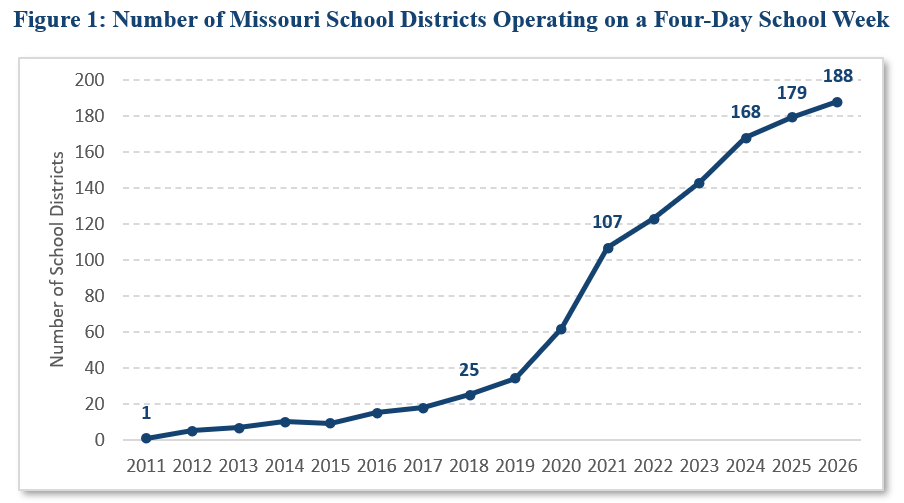
The Missouri Department of Elementary and Secondary Education (DESE) reports that 188 of 518 school districts will be operating on a four-day school week (4dsw) during the upcoming school year.
The figure below shows the rapid growth of the 4dsw since the 2010–11 school year.
Source: DESE
Missouri is not alone in this phenomenon. The 4dsw is increasingly popular across the country, especially in rural districts. Even though 36 percent of Missouri school districts use a 4dsw, they cover only 13 percent of students because rural districts are smaller. However, it is notable that the Independence School District in Kansas City, with over 13,000 students, is also on a 4dsw.
Districts typically adopt a four-day calendar in hopes of improving teacher recruitment and retention and, in some cases, reducing costs. In 2024, Senate Bill 727 included a modest financial incentive for districts to have at least 169 instructional days to encourage districts to remain on a five-day schedule. Nevertheless, the use of the 4dsw continues to expand.
My colleague James Shuls and I authored a series of papers examining the effects of the 4dsw on academic achievement, district finances, teacher retention, and parental satisfaction:
Across these reports, we found that the 4dsw was harmful for student achievement, with stronger negative effects for non-rural students. We found that the 4dsw either had no meaningful effect on finances, or that a decrease in costs was almost entirely offset by a decrease in revenues. For teacher retention, the results were mixed. We found that parents had a slight preference for the five-day school week (with those using a 4dsw as the strongest supporters, and those concerned about childcare as the strongest opponents).
Since our papers were published, several newer studies have been published, though the number of rigorous, quantitative studies on the effects of the 4dsw is still limited.
A 2024 study from the Center for Analysis of Longitudinal Data in Education Research (CALDER) found “small negative or statistically insignificant effects on teacher recruitment and retention outcomes.”
Similarly, a 2025 CALDER study used Missouri data and “found no evidence that the 4dsw improves teacher recruitment or retention,” despite educators and school leaders believing it does. My colleague, Cory Koedel, was one of the study’s coauthors and wrote about the findings in greater detail here.
The 4dsw is not a loophole that saves money and improves teacher retention at no cost to students. In fact, the available evidence suggests that, on average, it is harmful to students while nothing changes for retention and finances.
This does not mean that a 4dsw could never be successful. A district that adopts a 4dsw as part of an innovative educational model could potentially unearth new benefits. However, that is not why most districts switch. School leaders and policymakers should familiarize themselves with the research and approach the continued expansion of the 4dsw with greater skepticism.
Personal property taxes are the taxes levied on your car, boat, livestock, business equipment, farm equipment, and more. (Thanks to data centers, the business equipment part has become much more important in the past year or so.) Missouri indeed taxes personal property more than most other states. I am perfectly fine with eliminating the tax. But people should understand that if personal property taxes were eliminated, the Hancock Amendment would allow local governments to then raise real property taxes by the amount lost in personal property taxes.
So, if the state eliminated all personal property taxes statewide, it would likely end up as a revenue-neutral switch where we taxed land and buildings slightly more and taxed mobile assets not at all while removing a tax that most people find particularly annoying. I think that would be a modestly beneficial switch; I just don’t want to sell it as a tax cut.
But could counties on their own eliminate personal property taxes? Yes, every county and taxing district in the state could eliminate personal property taxes if they wanted to. They just don’t want to and I understand why.
Currently, St. Louis County is the only county that is required to set different tax rates for different classes of property. RSMo §137.073 requires every local government within St. Louis County (including cities, school districts, streetlight districts, etc.) to set a property tax rate for each subclass of property. This means that there are different tax rates for residential, commercial, agricultural, manufacturing, and personal property. The requirement to break down the tax rate by subclass was originally intended for the entire state, but eventually the rest of the state was given the opportunity to opt out if their county commission chose to, which every county in the state did. As a result, the rule currently only applies within St. Louis County and (for an unknown reason) the city of Gladstone in Clay County.
In the rest of Missouri, every government with property tax authority sets one tax rate, which is then applied to all subclasses of real and personal property. There are a few exceptions to this (primarily cities that have never taxed personal property, such as Independence), but almost all governments outside of St. Louis County set the same rate for all real and personal property. But here is the key: Any county in Missouri can adopt different tax rates for different property classifications whenever it wants to.
County officials could require all the taxing entities within their county to set different rates, and then county officials could set the county rate for personal property at zero. But county officials could not tell other taxing districts within the county to apply those new, variable rates. Would any of them choose to set the personal property tax rate at zero? Well, let’s just say that since this switch was made in St. Louis County, I know of no taxing entity that has voluntarily set the personal property tax rate at zero (other than some municipalities that don’t have property taxes at all, such as Chesterfield, or had never set a personal property tax, such as Westwood).
What would happen if a county set its personal property tax rate at zero and no other governments followed? In St. Louis County, the county portion of the tax bill is about five percent. It is a largely similar percentage around Missouri (varying slightly, of course). If St. Louis County government set its personal property tax rate to zero tomorrow, the average car and boat owner would see a five percent reduction in their annual car or boat tax bill. That assumes no other local taxing districts got approval from voters to raise their rates at the same time, which would more than offset it.
The fact is that unless school districts agree to also lower personal property tax rates, any attempt by counties to end personal property taxes will produce underwhelming results. I still think it would be a good thing. We should tax fixed assets like land and buildings instead of mobile ones like cars. It would be a general improvement in tax policy and remove a minor annoyance for most people (i.e., their annual car tax payment).
Let’s just not pretend it would be a large tax cut.
House Bill (HB) 2872, which contained important early literacy reforms, was on the move during the 2026 Missouri legislative session, but did not ultimately become law.
If passed, HB 2872 would have created a mandatory third-grade retention policy for students who could not read effectively and established an enforcement mechanism to align Missouri’s teacher preparation programs with the science of reading.
One of the reasons cited by opponents of the bill was that we needed to wait and let Missouri’s 2022 early literacy reforms take “full effect.” The earlier legislation had some positive aspects, but HB 2872 would have filled important gaps that are clearly seen in a new 2026 report from the National Council on Teacher Quality (NCTQ).
The NCTQ report evaluates colleges and universities across the United States on how effectively their curriculum addresses the five core components of the science of reading: phonemic awareness, phonics, fluency, vocabulary, and comprehension. It also considers whether programs teach practices found to be ineffective, such as the three-cueing method.
Among the 50 states, Missouri ranks 44th in addressing the core components of the science of reading, with an average of just 2.3 out of 5.0 components. Half of all states scored 4.0 or higher, while often-praised Mississippi scored 4.7.
Even more alarming, Missouri ranks 2nd in the nation, behind only Maine, in teaching ineffective reading practices. Our participating programs taught almost four times more ineffective practices, on average, than the national average.
These results suggest Missouri cannot afford to simply wait for our prior literacy reforms to “take effect.” Today’s students in Missouri’s teacher preparation programs are the teachers of tomorrow’s children, and many are not learning how to teach reading correctly.
Nearly half of the universities in Missouri evaluated by NCTQ received an “F” in teaching the science of reading, including Northwest Missouri State University, Truman State University, and Missouri Southern State University. By comparison, 73% of Mississippi’s programs received an A and none earned an F.
It’s also concerning that 52 percent of Missouri’s programs either refused to participate, provided heavily redacted materials, or were otherwise unresponsive to the survey. These institutions partner with the state to prepare future teachers, and there should be transparency about how they train teachers.
The success stories of early literacy reforms are well known. Mississippi, Louisiana, Tennessee, and Indiana have posted meaningful gains in reading achievement after implementing reforms, while Missouri continues to slide in national rankings. We fell from 27th to 38th in fourth-grade reading on the National Assessment of Educational Progress between 2013 and 2024.
In 2023, Indiana required teacher preparation programs to be aligned with the science of reading and prohibited the use of the three-cueing method. Any unaligned program loses the right to be called “accredited.” In a previous NCTQ report from 2023 based on data from before Indiana implemented reforms, 33 percent of Indiana’s programs received an A+ or an A. In 2026, 96 percent received an A+ or A.
The reforms in HB 2872 were modeled on Indiana’s policy and would have helped ensure that future Missouri teachers are trained in the science of reading. Early literacy reform would have built on past successes and helped more students become confident, capable readers. All we can do now is try again next year.
Kansas City Mayor Quinton Lucas is talking in circles.
The city is suffering under a $55 million operating deficit. The mayor pointed out in a 2023 budget letter that “The demands of a City this size in square miles and infrastructure age far exceed affordable options for residents and available resources.”
What to do? The answer is obvious: dedicate more public tax dollars to private corporations. And not just baseball, but women’s soccer, too!
Kansas City leaders are once again proposing public subsidies for a sports facility. This time, the beneficiary is the Kansas City Current and the continued development of the Berkley Riverfront.
According to reporting by The Kansas City Star, the city may create a new tax-increment financing (TIF) district and issue up to $235 million in bonds to support expansion of CPKC Stadium and surrounding development. The project would increase stadium capacity from 11,500 to 18,000 seats and add parking, retail, and mixed-use development to the riverfront.
Why? Why is it the responsibility of taxpayers to fund this? Projects like this can be good. They can even be great! But it’s not on par with, say, public safety or infrastructure, or education—which will all lose money because of the subsidy.
Supporters of the proposal point to the team’s success. Lucas told Fox4 that Kansas City must position itself for future events such as a potential Women’s World Cup and noted that there are limits to what an 11,500-seat stadium can host. He also emphasized that the proposed financing would not come from the city’s general revenue fund.
Let’s be careful about that last point. TIF does not create money out of thin air. Without a deal, the Current owners would pay taxes on their development—just like you and me. The proposal is to change that and let them keep that money. Money that we are told the city doesn’t have enough of.
Perhaps the most revealing thing is that Lucas can’t even be bothered to make a coherent defense of this spending. When asked about public subsidies for the Current, he told Fox4, “We’ve been through this before with another professional team that plays in Kansas City.”
But in an April 17, 2026, live interview with the Kansas City Stack Substack, Lucas said about public financing for a Royals ballpark: “this is like the incentive arrangements that we’ve done in other places. Probably the most stadium-like discussion is the stadium we built on the riverfront for the Kansas City Current. That, of course, was an incentive arrangement where you had votes at city council at one of our incentive agencies, that being the Port Authority, and you had state participation. I expect that to be the same.” [3:36 mark]
In other words, we’re giving public money to the Current because we’re giving money to the Royals because we gave money to the Current. That’s his argument.
I was reminded recently of other reporting from Fox4 in which Lucas defended himself for accepting secret gifts from the Royals, among others, to pay for tuxedos and trips to the Super Bowl. He said, “my goal is always to save taxpayer dollars.”
Lucas may have lots of reasons for accepting gifts. But given his willingness to spend public funds on stadiums, it’s hard to believe he cares about saving taxpayer dollars.
As an adult, I don’t have much trouble adjusting my sleep schedule when I need to wake up early. I just go to bed earlier the night before.
Teenagers, however, don’t seem to work that way. Adolescent sleep patterns are biologically different, making it difficult for them to compensate for early wake-up times. As a result, one of the most effective policies for improving student outcomes in middle and high school is delaying school start times. A recent NBER study provides the latest evidence. The authors examine a California law requiring middle schools to start no earlier than 8:00 a.m. and high schools no earlier than 8:30 a.m. Most schools were affected. After the policy was implemented, total sleep duration increased by an average of about 40 minutes, and the share of students sleeping at least eight hours per night increased by 13 percent.
The effects on academic achievement were substantial. Math and English test scores increased by 0.08 to 0.10 standard deviations—roughly the difference between having a highly effective teacher rather than an average one. These gains are larger than what we would expect from any feasible class-size reduction in middle or high schools.
The study also examined mental health outcomes. While those estimates are less precise, the results suggest improvements in mental health, particularly for boys.
This new NBER study is not an outlier. It adds to a large body of well-identified research reaching the same conclusion: when schools start later, teenagers get more sleep and perform better.
The policy implications are straightforward, though implementation is not always easy. One concern is that parents cannot always shift their work schedules, especially when younger children need supervision before school. But for families facing this challenge, before-school programs can help fill the gap.
Another concern is transportation. Many districts stagger start times so buses can serve multiple schools, meaning some students must start early. Yet this is ultimately a scheduling problem. Districts could shift the entire school day later, allowing students to start and finish later while still leaving plenty of time for after-school activities and family dinners.
The evidence is clear that teenagers benefit greatly from delaying school start times. Missouri school districts should carefully weigh the trade-offs and consider practical adjustments to give our kids more time to sleep.
Support Us
The work of the Show-Me Institute would not be possible without the generous support of people who are inspired by the vision of liberty and free enterprise. We hope you will join our efforts and become a Show-Me Institute sponsor.