Is Kansas City A ‘Low Tax’ City?

The conventional wisdom seems to be that Missouri is a “low tax state,” but to come to that conclusion, you almost have to ignore how taxes are actually levied and collected in practice here. Indeed, I believe that a closer examination of Missouri taxes produces a very different conclusion. Consider, for instance, Kansas City:

  • Kansas City has a top marginal income tax rate of 7 percent — the state’s 6 percent income tax, plus the city’s 1 percent earnings tax. Kansas has an income tax of 4.9 percent. In 2018, it will be 3.9 percent. No earnings tax. We’ve said it before and we’ll say it again: Income taxes hurt growth, penalizing productivity and deterring greater investment. And this is to say nothing, of course, of the 100 percent deduction Kansans get for non-wage pass-through income. For Kansas businesses organized as LLCs, S-corporations, and sole proprietorships, the tax rate is effectively 0 percent. (And as we all know, 0 percent is also a lower tax rate than 7 percent.)
  • Not counting its special taxing districts (TDDs, CIDs, etc.), Kansas City’s sales tax ranges from 8.1 percent to 8.85 percent, depending on the county. Those are pretty comparable to the rates charged on the Kansas side of the metro area — generally between 8 percent and 9 percent on sales, also not including special taxing districts. Not a huge difference. But what if we include special districts? Kansas City’s “1200 Main/South Loop TDD and DT Streetcar (KC Live!)” area — in other words, the Power & Light District — has the top sales tax in the bi-state area, with a whopping 12.35 percent tax on the sale of prepared food. (Click that last link to see the rates not only of the city, but also of the special districts. I found them startling.) One special tax costing a fraction of a cent may not seem like much, but put a few together and — as we’re seeing across the city — it adds up to real money. And the new, and bad, sales tax ideas keep coming.
  • As our own David Stokes would note, apples-to-apples property tax calculations are tough to come by because property valuation norms can vary wildly from jurisdiction to jurisdiction. If I’m charged a 5 percent tax on a property valued at $100,000 by one set of assessing criteria, or a 6 percent tax on the same property valued instead at $83,333 using different criteria, I’m still paying the same amount in taxes ($5,000) regardless of the legislated property tax rates. Kansas property taxes, driven in Johnson County by taxes for schools, generally sit at higher rates, yet that doesn’t say a great deal on its own. What is notable on this front is that both Kansas and Kansas City have a bad habit of concentrating their property taxes on fewer and fewer taxpayers with special incentives. Check out the latest example on the Kansas City side; I’ll have more to say about that project later.

And we won’t even go into the city’s hotel taxes, rental car taxes, water and sewer fees, which are all high. Kansas City is one of the highest-taxed cities in the region, and Kansas Citians are the first to tell you as much. Especially after Kansas’ tax reforms, is it credible for Kansas City, Mo., policymakers to suggest the region has been or is tax competitive with its Jayhawk neighbors? Do they really believe the city’s businesses, particularly its small businesses, don’t know what’s happening in Kansas and won’t consider moving under these circumstances?


I’ll Gladly Cost You Your Job On Tuesday For My Pay Raise Today

On Aug. 29, hundreds of fast-food workers in dozens of cities across the United States (including Saint Louis) walked off their jobs in protest. The focus of their discontent is the minimum wage, currently $7.25. Arguing that this wage simply isn’t enough, they demand that their employers increase the entry-level wage to $15.

Economists of all stripes recognize the impacts that imposing such a wage on these employers would have. Most notably, it would reduce the number of jobs available for entry-level, unskilled workers. Dean Baker, co-director of the Center for Economic and Policy Research, a left-leaning think tank that labor unions partly fund, noted on NPR’s Marketplace, “I’m sure you would see a lot of jobs lost.” Even a liberal economist agrees: Raising wages above that which market forces determine is a recipe for job loss.

How do Baker and others of similar views assuage their conscience at this prospect? When a hypothetical job loss of 20 to 30 percent was suggested, Baker responded that the remaining workers would “take home twice as much pay. They’re still way better off.” However, at the higher, artificial wage, fast-food employers will sensibly opt to keep the most productive workers. For the rest, well, they’ll just have to find employment elsewhere or be driven to rely on government assistance.

This episode and liberal support for it recalls an argument that economist John Stuart Mill made almost 150 years ago. Mill staunchly supported the rise of Unionism in England. Mill viewed union workers as the best representatives of the “upright and public spirited working man.” Mill argued that by excluding the “ignorant and untrained” part of the working class, unions benefited society. He believed that “We do them [the unskilled masses] no wrong by intrenching ourselves behind a barrier, to exclude those who competition would bring down our wages, without more than momentarily raising theirs.” Unions, in other words, would drive the unskilled and poor to the wall, reducing their numbers. And with a smaller labor force, there would be no downward pressure on wages overall.

Haven’t we learned anything over the past 150 years? Mill was just as wrong then as supporters of raising the minimum wage or mandating living wages are today. If everyone agrees that imposing wages that exceed those based on mutually beneficial decisions of workers and employers alike leads to increased unemployment for those who need work the most — the poor and the unskilled — how can responsible civic leaders call for further increases in the minimum wage?

On Tax Policy And Iocane Powder

Last week, our friend and fellow blogger Dave Helling at the Kansas City Star wrote a critique of my post about how much accumulated income has left Kansas City and Saint Louis since 1992. Missouri’s urban out-migration, he argues, has less to do with economic environments than it does macro trends of suburbanization and warm-weather retirement. “Inconceivable” assertions on his part? Not at all. But that doesn’t really address the actual policy problems — past and present — that have led people to leave Saint Louis and Kansas City.

Suburbanization, whether between or within states, doesn’t happen in a vacuum. Lots of factors are considered when people decide to move, and among those considerations is taxes. And to be clear, tax policy matters not just when taxes are reduced or repealed, but also when bad tax policies persist. And a bad, bad tax that both Kansas City and Saint Louis have had for a long time is the earnings tax. As our own Joe Haslag concluded in a policy study way back in 2006:

[T]he growth rate in [the modeled] economy where there is no city earnings tax is 1.72 percent, while the growth rate in the economy with a city earnings tax is 1.66 percent. Thus, a city earnings tax results in the growth rate falling by 0.06 percentage points on an annual basis.

That might seem small, but it can result in large differences in the size of the economy. Suppose that the initial value of the economy’s income is $78 billion. (This is the 2002 personal income level in the Missouri part of the St. Louis metropolitan area). After a generation (25 years), the no-tax economy would be $1.78 billion larger than the economy with a one percent tax rate. That is a difference of 1.5 percent.

Indeed, tax policy can be a contributing (rather than motivating) factor in where people live and grow their businesses. Even small tax policy mistakes can be economically destructive for a city — just more quietly and over a longer horizon. If you hurt your city’s capacity to grow economically, you truly hurt your city’s future.

Alas, unlike Iocane powder, it’s very difficult to build up an immunity to destructive taxes over time. And obviously, suburbs developed around Kansas City on the Missouri side as they did on the Kansas side. But the fact that Jackson County lost “only” a half billion dollars of Missouri income to Johnson County before Kansas enacted significant tax cuts in 2012 (and 2013) should be cold, cold comfort to Missouri tax cut opponents. Tax policy was a factor considered in moving from Missouri to Kansas before; it may be the preeminent factor considered today. Where people retire is a thornier proposition bound up with both economic and non-economic considerations, but one thing is certain — Kansas Citians haven’t moved, and won’t be moving, en masse to Olathe, Kan., for its sun-kissed shores. Will they move there for its tax climate? Quite possibly. And that’s the problem.

On a more personal note: I have heard from businessmen and businesswomen across Kansas City about the pressure longtime-Missouri businesses are under to consider a move to Kansas — motivated almost entirely by the new taxing environment there. Businesses already are asking the question, “Is it time to leave Kansas City?” I cannot stress enough how serious their concerns are. How long can Kansas City and the state of Missouri afford to ignore them before risking a plunge off the Cliffs of Insanity?

Steve Kraske’s Quality Of Life

In today’s Kansas City Star (last item), Steve Kraske listed our Sept. 17 Kansas City Policy Breakfast, “Is it Time To Leave Kansas City?” It is the first of our series in Kansas City, and we are eager for people to attend and learn more about the Show-Me Institute and the policies that affect them. To that end, we are grateful that Kraske mentioned us.

However, Kraske’s post includes a little dig. Here is his offering in its entirety (emphasis his):

•  “Is It Time to Leave Kansas City?” — the title of a mid-September program sponsored by the conservative Missouri-based Show-Me Institute. The institute has recommended big tax cuts in Missouri to allow the state to, in its view, better compete with Kansas.
Talk about a gathering with a loaded agenda. Just guessing there won’t be much talk about why people choose to live in KC. Can you say “quality of life?”

First, Kraske pretends that the issues with which Kansas City struggles — crime, education, high taxes, ineffective government — do not impact quality of life. They most certainly do. Second, he leaves out that Kraske himself lives in Kansas. I don’t know if Kraske ever lived in Missouri. But if he did, at some point he asked himself, “Is it time to leave Kansas City?” and answered that it was.

Kraske would not be alone; hundreds of Missourians ask themselves this question all the time. Not everyone chooses to leave the state, but many leave the city. The Show-Me Institute merely wants to shed light on the process.

We look forward to seeing Kraske at the event. And we welcome learning his own reasons for leaving, or at least not living in, Missouri.

You Can Call Them Buzzards, But That Makes Missouri The Carcass

Another day, another governor courting — or as some are saying, “trying to poach” — Missouri’s businesses. This time, it’s another Rick: Florida Gov. Rick Scott.

Gov. Rick Scott is teaming up with a fellow Republican governor this week in urging businesses based in Missouri to head to states with better business climates.

With Gov. Jay Nixon vetoing $700 million in tax cuts earlier this year, Scott is calling for businesses to move from the Show Me State to the Sunshine State….

Scott’s office sent a letter to Missouri businesses earlier in the week, highlighting Florida’s business climate. So far this year, Scott has sent similar letters to businesses based in California, Colorado, Connecticut, Illinois, Maryland, Massachusetts, Minnesota and New York. Like Missouri, all of those states have Democratic governors.

You may not like The Ricks, but the fact of the matter is that when you look at where Missouri’s money is moving these days, Florida is high on the list of its destinations. Like Texas, it is a serious threat to Missouri’s economic future.

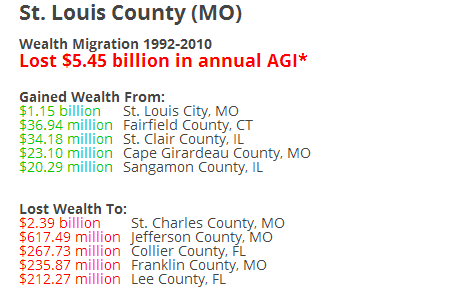
How do we know that? Let’s start with Saint Louis County as an example, from the website How Money Walks. Where has the wealth from Missouri’s largest county been moving since 1992? (Graph omitted for space.)

Two of the top five counties that Saint Louis County lost wealth to are in Florida, although the County’s neighbors — particularly Saint Charles — got in on the action as well. (Note also that Saint Louis County’s main source of inbound wealth was … Saint Louis City.)

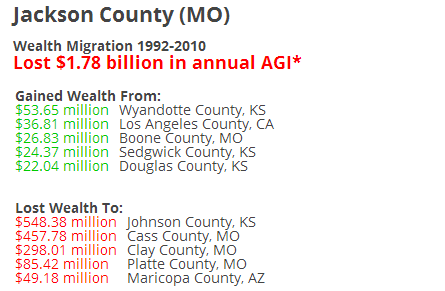
Of course, Florida isn’t the only threat. Which state is an obvious threat to the wealth of Jackson County, our second-largest county? (Again, graph omitted.)

No. 1 destination: Kansas, specifically Johnson County.

Missouri is not powerless in all this. We should be actively seeking ways of making the state a better place to live, work, and play — not a better place to grow government. Frankly, it’s frustrating to hear politicians with a penchant for false bravado act like this cash exodus isn’t happening. For once, policymakers, try empowering Missourians to grow this state rather than turning them into Texans, Kansans, and Floridians through your inaction. Stop the excuses. Enough is enough.

Show-Me Minute: Tax Subsidies

The Show-Me Minute is a short radio advertisement to inform listeners about the work of the Show-Me Institute in a particular policy area. In this Show-Me Minute which first aired on KWTO 560AM in Springfield, MO, we discuss the alphabet soup of tax subsidies.

Transcript:

Remember alphabet soup when you were a kid and trying to make the letters into words? Lawmakers like to play with letters, too, with tax subsidies: TIFs, EEZs, TDDs…

The list goes on and on, but they all have one thing in common. They give corporations our tax dollars.

Take TIFs for example: Tax Increment Financing. Because of a TIF, Independence tax payers have paid 8 million dollars on top of the original subsidy to support a Bass Pro store.

You may think any new business is good no matter the tax break, but studies have found that TIFs cost areas billions of dollars without achieving economic growth.

Let’s say “goodbye” to the alphabet soup of tax subsidies like when Lee’s Summit rejected an EEZ and focus on real economic growth.

This has been the Show-Me Minute. Learn more about the Show-Me
Institute, where liberty comes first, click on our website at ShowMeInstitute.org.


Free Enterprise, Taxpayer Subsidies – Bass Pro Gets Best Of Both

As first appearing in the Springfield Business Journal on August 27, 2013:

“Bass Pro Shops could only have happened in America – the home of the free enterprise system.” Those were the words of Bass Pro founder Johnny Morris in a recent Bloomberg News article.

Bass Pro has become a household name throughout America, synonymous with the great outdoors, and undoubtedly is an exceptional business.

It has completely changed the nature of sporting retail with its Walmart-size stores filled with unimaginable stocks of outdoor equipment, aquariums, wildlife displays and gun libraries.

Morris clearly benefited from a free enterprise system in America. However, one cannot overlook the fact that much of Bass Pro’s success and expansion are due to taxpayer-funded subsidies.

Many of those subsidies are from tax increment financing. TIF districts originally were created to spur economic development in portions of cities deemed economically depressed or blighted. Yet, cities across the country have long used a very loose definition of what constitutes a “blighted” area. The wealthy St. Louis suburb of Des Peres once declared a local shopping mall blighted because it lacked a Nordstrom’s.

Bass Pro has routinely received at least some amount of public assistance with many of its stores. According to the Public Accountability Initiative watchdog group, Bass Pro had received $500 million in taxpayer subsidies as of 2010.

The outdoors megastore sells itself to suburban communities as a destination retail attraction, capable of bringing in customers from hours away and even across state lines. To local leaders, bringing in a store the caliber of Bass Pro seems like a surefire way to increase local property and sales taxes.

However, Bass Pro does not always live up to its promise as an economic kick-starter and job creator. Many of the stores fail to raise the tax revenue that cities imagined, as happened in Mesa, Ariz. Bass Pro projected the Mesa store would produce $5.7 million a year in sales tax revenue for the city; instead, it has only managed an average of $1.7 million in four years.

In Missouri, Independence witnessed a similar result with the TIF it passed for a Bass Pro store.

What city officials fail to realize is that a large, new store does not give people more money to spend on fishing poles or waders.

Often, Bass Pro Shops only consolidates the market of outdoor supplies by killing smaller competitors, which negates the total growth that the development added.

Local leaders across the country are desperate to take credit for creating jobs and bringing a marquee brand to their community. In this desperation, they may dole out overly generous taxpayer subsidies for a few select businesses, which puts local, smaller businesses at an immediate disadvantage.

Big box retailers like Bass Pro often are built in affluent areas that could attract businesses without subsidies. We do not need the government picking winners and losers.

Bass Pro can build its stores on its own, as it did in Columbia, just north of Interstate 70. Instead of conjuring up incentives to bring businesses to their town, local leaders should focus on creating a pro-business atmosphere for all. That means lowering taxes and reducing regulations. If cities create a business-friendly environment, the rest will take care of itself.

Will Reynolds, an Ozark native, is an intern at the Show-Me Institute promoting market solutions for Missouri public policy.

Support Us

The work of the Show-Me Institute would not be possible without the generous support of people who are inspired by the vision of liberty and free enterprise. We hope you will join our efforts and become a Show-Me Institute sponsor.

Donate
Man on Horse Charging