
Allegiant Shows How Kansas City’s Airport Benefits from Low Costs

Recently, Kansas City International Airport (MCI) hailed the arrival of a new air service. The new airline, Allegiant, will operate flights from Kansas City to various destinations in Florida. More flight options are good for Kansas City, and it is likely that MCI’s low costs helped bring Allegiant, a low-cost airline, to the airport.

Allegiant’s business model  is to provide the cheapest possible flights for travelers going from Northern climates to warmer destinations in the South and on the West Coast. To maintain cost-competitiveness, the airline charges a low base price and then adds extra charges for various amenities passengers can decide to buy. This makes Allegiant typical of Ultra Low Cost Carriers.

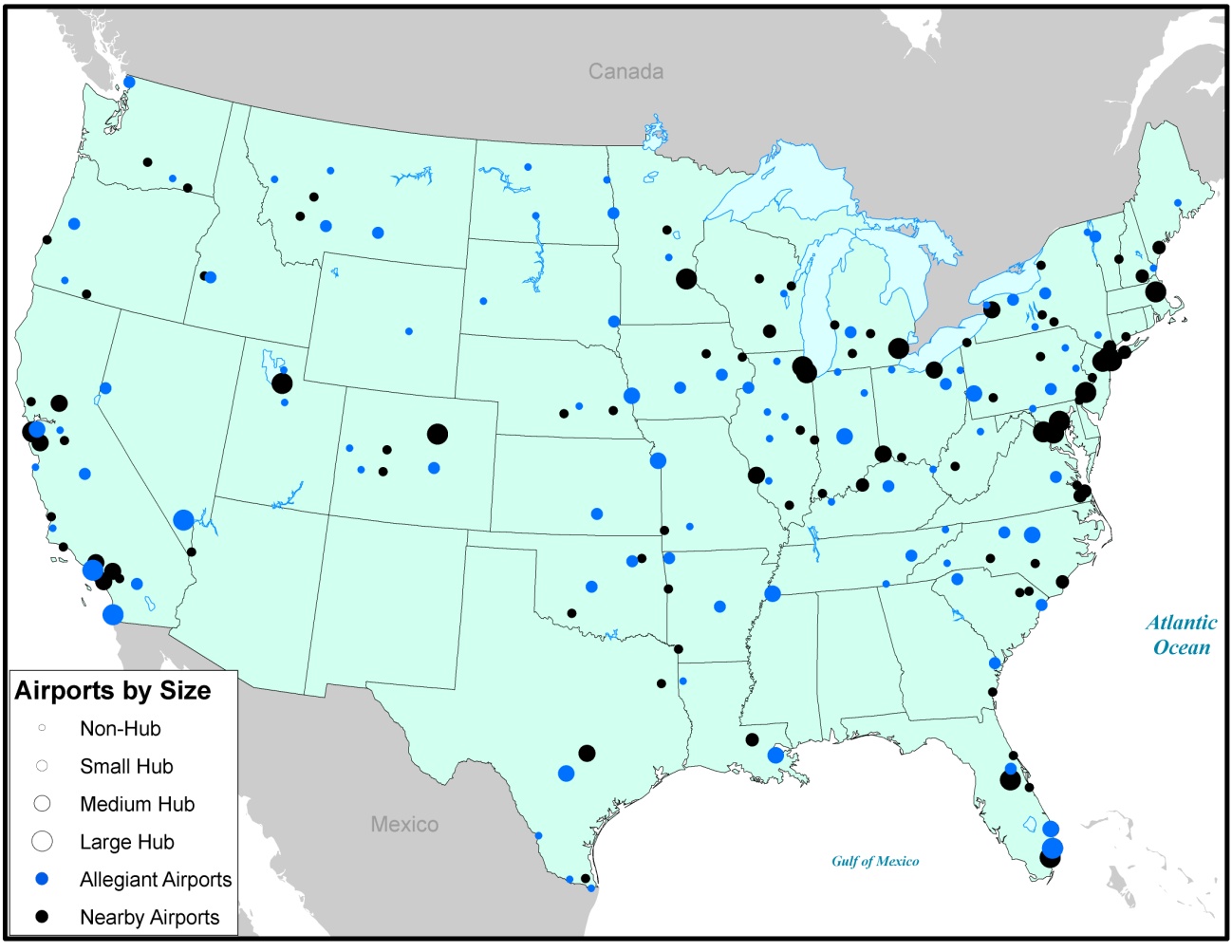
But the attention to costs does not stop there. Allegiant often eschews larger airports for smaller, secondary airports in metropolitan areas. For instance, instead of flying out of Saint Louis International Airport, Allegiant flies out of Belleville, a little-used airport some miles distant. These secondary airports have lower costs than large hubs, and Allegiant can use that advantage to stay cheaper than the competition. Aside from its primary holiday destinations, Allegiant avoids the nation’s largest airports. As the map above shows, it even avoids busy medium-hub airports where possible.

How then did MCI, a busy, medium-hub airport, entice Allegiant? Part of the answer is likely low price: whereas most medium-hub airports cost an airline more than $10 per passenger, at MCI the cost is only $7.75 per passenger. Not only is that much cheaper than most airports of its size, it’s cheaper than most small- and non-hub airports, as the chart below shows:


Median Cost Per Passenger (2014)


Allegiant Airports

National Average

Large Hub

$9.44

$12.06

Medium Hub

$7.89

$10.29

Small Hub

$7.15

$7.97

Non-Hub

$5.58

$8.23

The low price makes it more affordable for Allegiant to take a chance serving MCI. In fact, holiday destinations aside, MCI is the busiest airport that Allegiant serves.

The addition of Allegiant to MCI underscores the reality that at airports, like everywhere else, costs matter. While expensive improvement projects may excite local leadership or spruce up the city’s front door, higher costs make an airport less competitive in its main mission: providing airline service. Residents and city leaders should remember that as they plan terminal improvements at MCI. 
Standing Up to Hardball Tactics

Jennifer Parrish, who operates a daycare business out of her home in Minnesota, was first approached by the Service Employees International Union (SEIU) in her own home. In 2006, an uninvited man showed up at her doorstep, walked inside when she opened the door, and asked her to sign a petition calling for the state to provide a health plan to daycare providers. According to Jennifer, it became clear after a few minutes that this man was not going away until she signed the petition. She told him she would take a copy and sign it after she read it. Reluctantly, he left.

At the time, SEIU was trying to organize Minnesota’s child care providers. When Jennifer got around to reading the petition, she realized that that it wasn’t about a health plan, as the man had told her, but part of a union organizing drive. Jennifer had been lied to.

Jennifer refused to play ball. Sometimes organizers tried to intimidate her. She recounts organizers following her to her car in an effort to show her that she was being watched. However, after she spoke out, most of the intimidation stopped. Eventually the Supreme Court affirmed the right of private care providers not to be forced into SEIU with the Harris v. Quinn decision.

In Missouri, we’re seeing similar stories coming out of SEIU organizing campaigns.

Take Mark Manteuffel, a biology adjunct at Washington University. St. Louis Public Radio reports this story about an SEIU organizer showing up at Mark’s doorstep and approaching his wife:

“They were just very pushy and rude,” Manteuffel said of the union representatives, “demanding my cell phone number. And they didn't introduce themselves first off, they just approached her and asked for me. So she stood back and asked them who they were and why they were looking for me. And she said that I would contact them if I was interested after they introduced themselves.

“The second time, the person said that they would show back up again, and she said no, he will contact you if he's interested. And they kind of huffed and puffed and said again that they would show up, and she said no, you're not listening to me, if you show up again, I will call the police and have you removed. Then the gentlemen seemed to get it.”

The campaign to organize Missouri’s in-home health care attendants is another front where SEIU has been active in our state. In 2010, the SEIU-backed Missouri Home Care Union won the right to represent all home care attendants despite receiving votes from less than 16% of attendants. Since then, the union has sought support from attendants who aren’t already members.

I’m hoping that the tactics used in Missouri don’t get as bad as they’ve been in other places. However, SEIU is not a member of the AFL-CIO and doesn’t always play by the same rules as an AFL-CIO union. For people who feel they’ve been targeted or persecuted for resisting SEIU’s organization drives, speaking out might be the best defense.

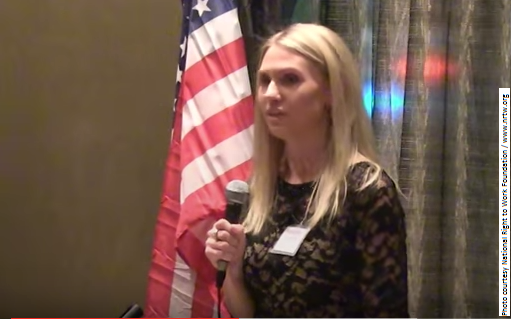
(Ms. Parrish is pictured above telling her story at an event sponsored by the National Right to Work Foundation. You can watch her presentation here.) 

The Ferguson Commission: A Bridge to Nowhere

As first appearing in the St. Louis Post-Dispatch:

The Roman philosopher Cicero once said, “Advice is judged by results, not by intentions.” It is hard not to think of these words when reading the final report of the Ferguson Commission.

The signature priorities, “justice for all,” “youth at the center,” and providing individuals the “opportunity to thrive,” could not be more noble. Unfortunately, we cannot judge the Ferguson Commission’s report on good intentions alone. We must examine the probable results. It is certainly too early to understand all of the long-term implications of the policies that the report advocates; however, based on the evidence, the prospects are bleak.

For example, the commissioners call for an end to poverty. Who can argue with that? But to eliminate poverty, they urge the adoption of a $15 an hour minimum wage. The commissioners admit that “debate exists over the short- and long-term economic implications of raising the minimum wage.” Yet they ignore this debate and selectively cite a report in support of the higher wage. This may be to the detriment of the people the commission is attempting to help. As Nobel-winning economist Milton Friedman once said, “The minimum wage law is most properly described as a law saying that employers must discriminate against people who have low skills.” The people most in need of entry-level jobs will suffer the most.

The commissioners outlined a plan to “enhance college access and affordability,” but gave short shrift to the greatest impediment standing in the way of a college education for disadvantaged students—subpar academics. The average ACT score for the Normandy school district was a paltry 16; not even high enough to gain admittance to most four-year state institutions. Less than seven percent of students scored above the national average. It isn't funding that is keeping these kids from going to college; it is their abysmal K-12 preparation.

The report, which is ostensibly about improving the outcomes for low-income African-American students (who make up more than 80 percent of the Ferguson-Florissant School District and more than 96 percent of students in Normandy), includes a plank granting access to state scholarships to undocumented students brought to the United States as young children. We can debate the wisdom of that policy another day, but what on earth does it have to do with improving outcomes in North Saint Louis County?

The commission did offer some helpful suggestions for making the inter-district transfer program sustainable, but they stopped short of calling for greater freedom of choice for the parents of children trapped in underperforming schools. Rather than confronting the issue, the commissioners punted and simply called for the creation of an “education design and financing task force.”

In the end, the K-12 education proposals amount to a call for more of the same. The state needs to “invest” in a universal pre-K program and move the compulsory education age down to 5 from 7. Note, not, “create a pre-K system that doesn’t suffer from the same problems of the current one,” but simply append another grade onto K-12 schools that are not meeting the needs of low-income and African-American students.

This is not to say that the commission report was altogether wrong. Indeed, the commissioners offered many suggestions that were on point and, if enacted, could lead to improvements in the Saint Louis community. But unfortunately, when the commission veered away from policies focused on the issues at hand toward tired planks of political opportunists—like increasing the minimum wage, expanding Medicaid, creating a universal pre-K program, and getting scholarships for undocumented kids—it lost sight of the problems it was set up to solve.

Arch Ground Already Costing Saint Louis More than Promised

                Recently, the Post-Dispatch reported that Great River Greenways, a regional, taxpayer-funded organization, could be on the hook for millions of dollars more than expected in the Arch Grounds project. Great River Greenways has long been part of the funding basis for “ArchRiverCity,” with dedicated funds coming from a sales tax passed expressly for that purpose (Prop P). But it turns out now that operating costs are exceeding what was originally budgeted.

To keep the Arch improvements on track, the director of Great River Greenways committed the organization (unilaterally) to cover half of the additional expenses (an extra $1.3 million a year). The organization will likely have to divert money from other sources to cover new costs. But those sources were supposed to advance trail construction and maintenance in the region, which might now be short-changed.

If all this seems convoluted, that’s by design. Perhaps out of fear that giving residents a reasonable estimate of costs—and a cautious estimate of benefits—might raise questions among the public, regional planners and politicians play shell games. Capital costs are understated and sliced up between levels of governments, or shunted off to quasi-governmental taxing districts (Great River Greenways, Downtown STL, etc.). Ancillary, but often necessary, parts of the development get moved to other parts of city budgets or ignored. Consistently, operation and maintenance is improperly budgeted for. All this so the local leadership can tell the public that they will receive a huge economic boon from a project they won’t have pay much, or anything, to get.

This leaves projects like ArchRiverCity, or the Loop Trolley, or the Kansas City Streetcar, or the Edward Jones Dome, or the Riverfront Stadium plan, with unrealistic budgets that leave everything to chance. When something goes wrong in construction (like delivery delays/cost overruns), or when maintenance expenses outstrip revenue sources, the projects have mini-heart attacks and taxpayers are on the hook. In the case of the Arch grounds, taxpayers will end up paying more through taxes diverted by Great River Greenways, a contingency that was neither discussed nor agreed to by any voters or any elected officials. With the number of extra-governmental taxing districts like Great River Greenways growing by the year, it is ever easier for residents’ money to be shunted from project to project with little public oversight.

Sustainable and efficient civic improvement programs rely on transparency and maintaining the trust of residents. One would like to assume good motives, but leadership in Kansas City and the Saint Louis region often seem willing to back convoluted funding plans (with obscured costs/benefits) in order to get a yes vote from a confused public. In doing so, they reduce transparency, which results in a cynical electorate. This is a recipe for dysfunction and waste.

Commenting on ArchRiverCity funding, one Great River Greenways board member stated flatly,

“I don’t feel like I’ve been sandbagged…This isn’t the only project that we don’t have enough money to do maintenance on.

Saint Louis residents should take that as a warning. 

Prompted by Regulators, Truman Medical Closes Psychiatric Emergency Room

Last month, Kansas City residents found out that Truman Medical Centers would be closing its Behavioral Health Emergency Department, "effective immediately," and moving those services to another emergency room in the area. Mental health advocates are understandably bothered by the loss of this dedicated mental health resource, especially since public officials promised when the clinic was taken over by Truman six years ago that the operations of the psychiatric ER would not be affected.

So what forced the psychiatric emergency clinic to shut down? If you guessed government meddling, you guessed right.

Truman took over operation of the behavioral health emergency room from the state in 2009, when it was known as the Western Missouri Mental Health Center. It has served about 30,000 patients in the past six years.

Truman decided to close the ER after state and federal regulators said it would have to staff and equip the facility as a full-service medical emergency room, Truman spokesman Shane Kovac said.

“That’s a big challenge,” Kovac said. “It just made more sense to shut this down.”

The clinic's closure is a blow to the interests of mental health patients and advocates. To be clear, consolidation of medical services is not necessarily a bad thing, especially when separate operations are inefficient and wasteful. But here, government-imposed regulatory burdens created the inefficiency by requiring a clinic tailored to psychiatric patient needs to operate like a regular emergency room instead. The result: now there's no psychiatric ER at all.

It's yet another example in a long line that supports the old Ronald Reagan quip: "The nine most terrifying words in the English language are: I'm from the Government, and I'm here to help." Patients deserve better.

KCATA Makes Changes to Improve Bus Service

Kansas City's Northeast News reported on Tuesday that the Kansas City Area Transit Authority (KCATA) will be combining several bus stops in the region to "improve passenger satisfaction."

On Oct. 4, 2015, six routes will be affected, including 24-Independence and 30-Northeast. Stops being removed will have Rider Alerts posted at each location. In a press release from the KCATA, the biggest factor in removing a stop is low ridership at a specific location, which will provide a smoother ride and help keep buses on time.

This is good news: a sign that the KCATA is reviewing their ridership information and making changes where necessary. But they can do more than just make changes to where buses stop, as this latest plan does. In the past, KCATA has issued bulletins about changes in service. Some are temporary responses to construction or large events, and some are more permanent changes in routes. As populations shift, KCATA is able to assess need and make changes to routes, route frequencies, and the number and location of stops. This is a good thing, and underscores the exact reason why modern bus transit is superior to light rail and streetcars. Not only can fixed rail not be rerouted to account for changing population needs, the train cars themselves cannot even change lanes to avoid broken down vehicles or other train cars.

As has been said before, trains don't take you were you want to go, they take you where developers and urban planners want you to go. KCATA's recent actions demonstrate exactly why buses are a better transit choice.

Naming and Shaming Corporate Welfare Queens

A mayor in Maine has made the news for wanting to publicly list welfare recipients on the town's website.

I don't share his policy view on this matter, but I would like to see the same "naming and shaming" program applied to corporations who accept public subsidies from municipal government. And I am not alone. My colleague Patrick Ishmael recently wrote about new standards from the Government Accounting Standards Board (GASB), In short, the new standards increase the amount of information that local governments have to publicly report about the number and type of tax abatements.

One shortcoming of the new standards is that they do not require localities to list the various subsidies by company. This would be an additional measure of government transparency that localities could adopt on their own through city ordinances. It would tell us which companies are the welfare queens of crony capitalism.

The Latest with Licensing Landlords

The saga of landlord licensing continues in Saint Louis County. With government finding more and more things to regulate, landlords might find themselves the next victims of government’s “do something” mentality.

Last week, I wrote about how Saint Louis County was considering a bill that would require landlords in unincorporated parts of the county to apply for licenses in order to rent out property. Proponents of the measure claimed that this bill will only affect those landlords who don’t keep their property up to standards. However, due to push-back on the bill, the sponsor has made amendments to make it more palatable. Yet these changes do little to actually improve the situation for landlords in the county.

The main problem with this bill is that it still makes landlords responsible for the actions of their tenants. If a renter received a felony conviction for one of a long list of offenses (selling drugs, gambling, and prostitution are included), and if even one of these incidents happened on the rental property, the landlord would be obligated to evict the tenant. If the landlord failed to do so, his or her license would be revoked.

Such a provision harms both landlords and their tenants. It harms landlords because it denies them flexibility in dealing with tenants. For example, what if a tenant is convicted of dealing drugs, but his wife was not guilty of any felony? Is the landlord supposed to evict the entire family because of the actions of one person? The law is unclear, but it seems to me that as long as the rest of the tenants keep up their end of the lease agreement, the landlord should have the option of letting them stay.

This bill would also harm some renters because this provision encourages landlords to discriminate based on the possibility of some future illegal activity. Why enact a law that gives cover to this sort of discrimination? It doesn’t make sense.

Putting aside this provision, the fact that landlords need to jump through yet another bureaucratic hoop in order to lease property makes it less likely that landlords will enter the market, thus hurting consumer choice. Nobody wants substandard housing, but licensing landlords is not the way to address this problem in Saint Louis County.

Default Rates among Missouri Colleges and Universities

The table below (data from the U.S. Department of Education) displays default rates for Missouri colleges and universities over a three-year period. The default rate for 2012 is calculated by dividing the number of students who had defaulted as of December 2014 by the 2012 cohort total. The difference over the three-year period is displayed in the fourth column. Across the state, many default rates have decreased since 2010. The highest default rates occur among public 2-year community colleges. The highest default rate in the state is Three Rivers Community College at 28.2 percent.

Default Rates in Missouri (percentages)

Public 4-Year

Default Rate 2012

2011

2010

Difference

University of Missouri

4.2

5.5

6.1

-1.9

University of Missouri–Kansas City

7.2

9.7

9.7

-2.5

Missouri University of Science and Technology

3.1

3.8

5.3

-2.2

University of Missouri–St. Louis

7.6

8.6

10.3

-2.7

Harris-Stowe State University

25.6

29.6

27.9

-2.3

Lincoln University

20.7

25.4

27.2

-6.5

Missouri Southern State University

11.6

15.8

14.1

-2.5

Missouri State University

7.3

7.9

8.5

-1.2

Missouri Western State University

15.7

16.5

22.0

-6.3

Northwest Missouri State University

7.8

9.5

9.7

-1.9

Southeast Missouri State University

10.1

11.6

13.3

-3.2

Truman State University

3.9

3.8

3.7

0.2

University of Central Missouri

8.8

10.1

9.2

-0.4


Private 4-Year

Default Rate 2012

2011

2010

Difference

Avila University

6.8

7.9

9.6

-2.8

Central Methodist University

8.4

10.6

12.3

-3.9

Columbia College

14.3

13.3

11.6

2.7

Culver-Stockton College

8.1

10.0

13.2

-5.1

Drury University

15.2

17.1

16.7

-1.5

Evangel University

6.4

7.0

6.9

-0.5

Fontbonne University

6.1

8.1

11.2

-5.1

Hannibal-LaGrange University

7.9

8.0

6.5

1.4

Lindenwood University

3.4

4.0

4.9

-1.5

Maryville University

5.5

6.0

5.6

-0.1

Missouri Baptist University

5.9

7.8

8.6

-2.7

Missouri Valley College

15.6

10.0

15.2

0.4

Park University

7.9

9.8

11.5

-3.6

Rockhurst University

3.6

5.7

5.6

-2.0

Saint Louis University

4.3

4.7

3.8

0.5

Southwest Baptist University

8.9

9.9

11.5

-2.6

Stephens College

6.0

8.4

9.8

-3.8

Washington University in St. Louis

1.4

3.0

2.0

-0.6

Webster University

5.1

5.6

8.8

-3.7

Westminster College

10.1

9.1

8.9

1.2

William Jewell College

5.6

5.2

5.8

-0.2

William Woods University

3.5

4.8

5.3

-1.8


Public 2-Year

Default Rate 2012

2011

2010

Difference

Crowder College

18.4

21.5

23.5

-5.1

East Central College

20.5

21.3

19.2

1.3

Jefferson College

22.5

21.8

22.5

0.0

Metropolitan Community College

18.2

18.0

20.7

-2.5

Mineral Area College

23.3

24.3

25.5

-2.2

Missouri State University–West Plains

18.9

23.1

24.0

-5.1

Moberly Area Community College

16.6

22.6

20.9

-4.3

North Central Missouri College

18.7

21.8

22.6

-3.9

Ozarks Technical Community College

21.1

22.3

20.2

0.9

St. Charles Community College

13.3

14.2

14.1

-0.8

St. Louis Community College

14.0

13.2

12.0

2.0

State Fair Community College

26.1

28.0

23.9

2.2

State Technical College of Missouri

7.6

12.1

10.0

-2.4

Three Rivers Community College

28.2

21.8

24.7

3.5


Private 2-Year

Default Rate 2012

2011

2010

Difference

Cottey College

7.8

11.7

6.1

1.7

Ranken Technical College

9.5

15.4

17.8

-8.3

Wentworth Military Academy and College

12.7

20.0

25.6

-12.9


Special Focus

Default Rate 2012

2011

2010

Difference

A. T. Still University

1.6

3.1

2.0

-0.4

Kansas City Art Institute

10.2

12.8

17.1

-6.9

Kansas City University of Medicine and Biosciences

0.8

1.3

1.4

-0.6

Logan College of Chiropractic

2.3

2.9

1.2

1.1

St. Louis College of Pharmacy

1.0

1.6

1.3

-0.3


Support Us

The work of the Show-Me Institute would not be possible without the generous support of people who are inspired by the vision of liberty and free enterprise. We hope you will join our efforts and become a Show-Me Institute sponsor.

Donate
Man on Horse Charging





