Saint Louis Transportation Planning Prioritizes Public Transportation, MetroLink

Saint Louisans depend on a functioning transportation system to do practically everything in their lives, from getting to work to enjoying a night on the town. But keeping transportation infrastructure—be it road, rails, or buses—in good shape takes regular investment. The way a city makes those investments now will affect residents’ daily lives in years to come. However, a look at the recent investment plans of the Saint Louis area reveals a growing disconnect between the systems Saint Louisans use and where the money is going.

The first thing to note about Saint Louis’s transportation system is that it is highly dependent on the highway and street system. In Saint Louis City, Saint Louis County, and Saint Charles County, about 89 percent of commuters either drove or carpooled in 2014. Only 3.4 percent used public transportation. More than half of those who did used buses, which also depend on streets and highways. In terms of the flow of goods, almost 70 percent of freight traffic moves by truck (and hence by road) in the Saint Louis area.

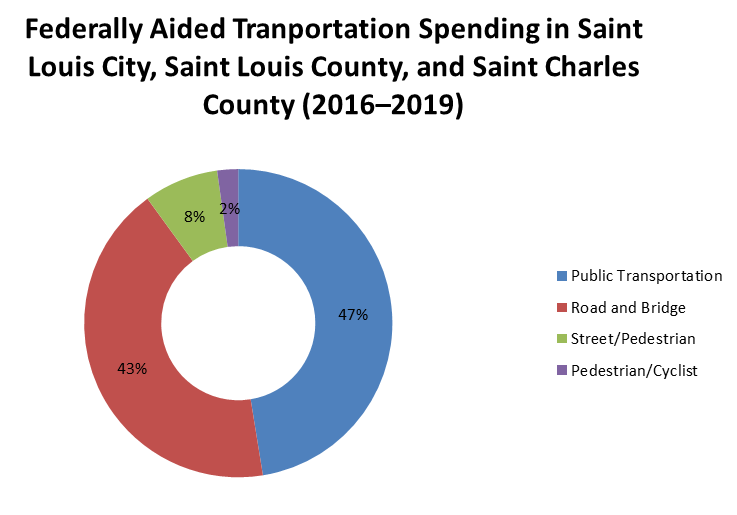
Regional transportation investments for the near future do not reflect these realities. Of the $1.2 billion in federally aided transportation projects slated to move forward in Saint Louis City, Saint Louis County, and Saint Charles County (including multi-state and multicounty projects, the vast majority of which tend to benefit Saint Louis City and County) from 2016 to 2019, 47 percent will be spent on public transportation improvements (see the graph above).

Breaking down the numbers further, investments by Metro (the regional transit agency) will outstrip road & bridge projects made by the Missouri Department of Transportation (which maintains state highways) by more than 30 percent:
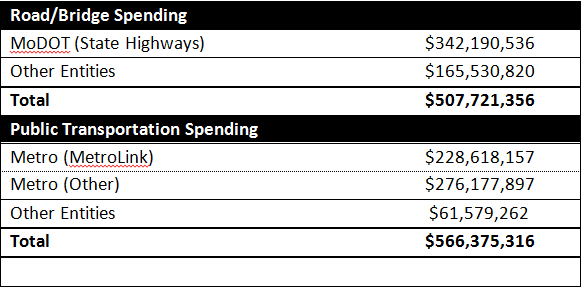
Table: Road spending vs public transportation spending

Metro will spend about $230 million (45 percent of investments) on the MetroLink, the region’s light rail. This does not include large-scale MetroLink extension plans (aside from a new $13 million station near Grand Ave.), but instead is mostly intended for maintenance and rehabilitation. In all, somewhere between 15 and 20 percent of federally aided transportation investments benefiting Saint Louis City, Saint Louis County, and Saint Charles County will be spent maintaining light rail.

Perhaps increased spending on public transportation will cause residents to get out of their cars and onto the bus or rail. However, anything more than a modest increase in public transportation’s total travel share is unlikely, given the experiences of other cities. That being the case, systematically favoring transportation systems that few residents and no freight companies use over the one that quite literally moves the metropolitan area is asking for trouble.

Missouri Jobs Increase at Slow Pace

The Bureau of Labor Statistics recently released its current snapshot of labor markets across states. While jobs in Missouri have increased since last October, the rate of increase is quite slow.

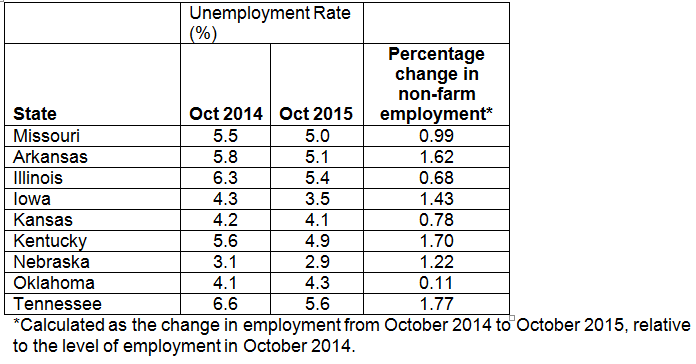
The table below reports three pieces of information pertinent to assessing the job picture in Missouri. The first two columns of data report the unemployment rate in October of 2014 and 2015. In Missouri, the unemployment rate has fallen, dropping from 5.5 percent to 5.0 percent, the same value as the national average. How does this compare to our neighboring states?

All states in the table below (except Oklahoma) also experienced a decline in their unemployment rate over the past year. What is notable is that some states, such as Iowa, Kansas, Nebraska and Oklahoma, have achieved very low rates of unemployment. These values signal very robust labor markets in those states.

The Bureau’s recent release also provides more direct information about job growth. In the last column in the table below I report the percentage change in jobs over the past year (October 2015 data are preliminary.)

This calculation shows that job growth in Missouri has been slow over the past year, increasing at only about a 1 percent rate. Three other neighboring states—Illinois, Kansas, and Oklahoma—have experienced slower job growth, though Kansas and Oklahoma already have achieved very low unemployment rates. In the remaining states, job growth is notably faster than in Missouri.

Regional unemployment data 2014-2015

How Long Have Saint Louis Planners Known About Loop Trolley Cost Overruns?

In a previous post, we discussed the climbing costs of the Loop Trolley project, a 2.2 mile trolley line that will run from the St. Louis History Museum to the Delmar Loop. The project will now cost $51 million rather than the original budget of $43 million. Saint Louis County taxpayers are on the hook for the unexpected overrun. However, while the public may have been unaware of the higher cost of the Loop Trolley until last week, Saint Louis planners have likely known that the project would cost more than billed since mid-July.

                The East-West Gateway Council of Governments, which is responsible for coordinating transportation spending in the Saint Louis region, releases a transportation improvement program (TIP) every year. That program contains all scheduled transportation projects receiving federal aid for the next four years. The latest TIP, approved on July 29, shows the costs of projects (including the Loop Trolley) from 2016 to 2019.

                Despite the fact that the program was released months before the public was told that the Loop Trolley would be over budget, and Saint Louis County residents knowing they were on the hook for the those overruns, the latest TIP accurately puts the Loop Trolley’s cost at about $51 million. When the TIP was proposed (and commented on), the trolley’s cost was still only $44 million. But on the day the TIP was approved (July 29), the East West Gateway board approved a final additional project, sponsored by Saint Louis City, to improve “Delmar, DeBaliviere, and Loop Trolley Infrastructure.”

                The funding for that project comes from a $5.4 million federal STP-S grant, requiring a $1,350,000 local match. That grant should sound familiar, because that’s precisely the grant Saint Louis County is now being asked to match, which will cover cost overruns on the Loop Trolley.

                Given the timeline, it is almost certainly the case that regional planners have known about cost overruns on the Loop Trolley since mid-July. Indeed, they appear to have planned for dealing with problem by committing more federal funds (and the Saint Louis County match) to the trolley. However, they clearly did so before the county government, or county residents, had signed off on the plan. Those funds will come from county’s mass transit sales tax and could have been used to fund any number of other projects in Saint Louis County. No one should be under the illusion that Saint Louis only gets federal STP-S grants for streetcars; in the next 4 years the county is slated to receive 96 such grants.

                Might planners have known about the cost overruns before trolley construction began in the spring? Was this an attempt to make to the additional funding for the Loop Trolley a fait accompli once residents found out about it? We don’t know, but it is clear that the trolley funding process has not been as transparent as Saint Louis County residents could hope.

Missouri Pensions Reward Some, Punish Others

Defined-Benefit public employee retirement systems are terrific for those who stay their full career in a single system. We all can agree on that. But there are a lot more people paying into, and receiving benefits from, the pension system than just individuals who stay their whole career in a single system. This was highlighted as I read a piece on Missouri teacher pensions by KOMU reporter Megan Judy. The article offers quotes from Kathy Steinhoff (a Hickman High School math teacher), Steve Yoakum (executive director of the Public School Retirement System of Missouri), and the Show-Me Institute’s Mike McShane. 

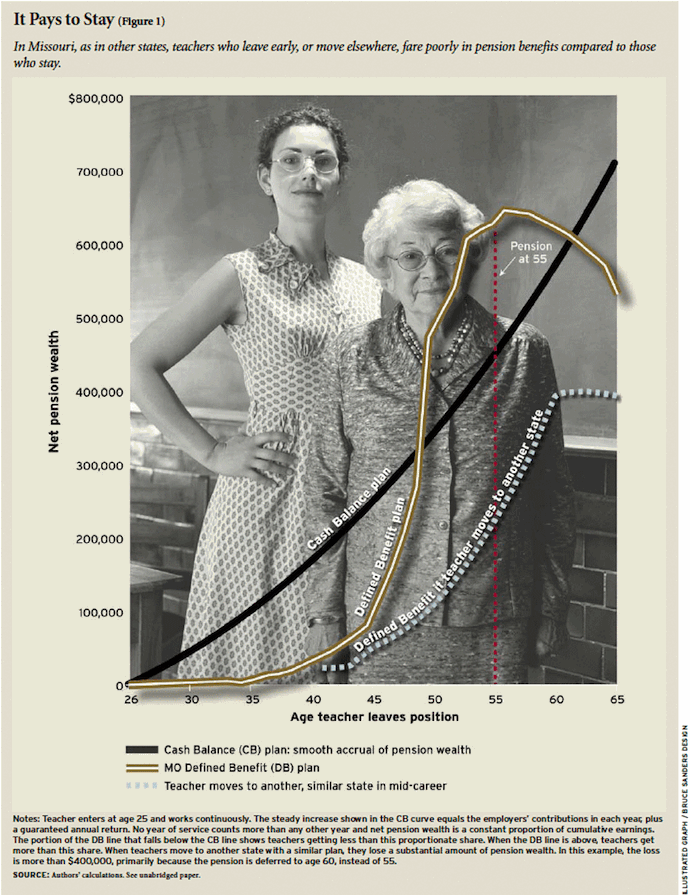
Full graph--Missouri teacher pension benefits

Based on Steinhoff and Yoakum’s comments, I’d like to make three points:

Point #1: Pensions Take From Some to Reward Others

The generous teacher retirement benefits for those who stay in the system for their full career are made possible by the contributions of those who leave the system early. According to Yoakum, “The retirement system is designed to provide a career employee in Missouri schools with roughly the same standard of living they had.” The key phrase there is “career employee.” Workers who leave early face a severe financial penalty.

As McShane pointed out in the article (and as I’ve noted before on the Show-Me Institute blog), benefits from the teacher pension system do not exceed a teacher’s contributions until they have worked for 28 years. 28 years! As a report from the Urban Institute noted, 62% of Missouri teachers do not stay for that long. The majority of teachers are not benefiting from the pension system, but are instead subsidizing the benefits of others.

Point #2: Retirement Benefits are an Ineffective Way to Recruit Teachers

Yoakum contends that the pension system is helping recruit teachers to Missouri. This is a poplar refrain among pension supporters. At first glance, the argument makes sense—better benefits attract more people. The problem is that people, especially young people, typically don’t pay much attention to their retirement benefits. This is illustrated by the quote from Steinhoff, “It is the best kept secret even within the profession because, for most teachers, it doesn’t come on their radar until they’re teaching for about 25 years.” I fail to see how a well-kept secret helps recruit teachers.

As a National Bureau of Economic Research report notes, employees value current pay much more than they value deferred compensation into a pension system.  Thus, a better way to recruit and retain teachers might be to pay them more now, rather than promise them more later.

Point #3: Pensions Pull Some to Stay, Push Others Out

OK, maybe pensions aren’t the best way to recruit new workers, but they do help keep teachers in the system, right? As Yoakum said, “From the employer standpoint, it does provide golden handcuffs to a certain extent. When a teacher has accumulated a certain years of service, it’s very hard for them to leave. This helps our school districts retain those very good teachers.”

This “Golden Handcuffs” phenomenon is discussed by economists Robert Costrell and Michael Podgursky in an Education Next article with the same name (see their excellent illustration above). The yellow line is the value of Missouri’s teacher pension system, while the black line represents a smooth-accruing cash balance plan. This shows how teachers who leave early are worse off under the current system. As a result, Costrell and Podgursky agree with Yoakum that the back-loaded nature of PSRS pulls teachers to stay until full retirement—but at a cost. First, there is no indication that the “pull” is felt only by the “very good teachers” to whom Yoakum alluded. Indeed, there may be some teachers who are burnt out and want to retire, but feel compelled to stick it out until they reach full retirement. How is that good for kids? And after a teacher reaches their peak pension value, the system punishes them and pushes them out. Thus, beyond a point, the system acts as a disincentive for veteran teachers to stay.

We cannot accept the merits of defined-benefit pension systems simply because they provide a terrific benefit to a fraction of our teachers. Rather, we should consider whether the system is designed to provide fair retirement support for every teacher in Missouri. Clearly it is not. 

Questions for the Kansas City Public Schools Master Plan

The Kansas City Public School’s new master strategic plan has already attracted its fair share of controversy.  Closing Southwest, a school that has been in operation for 90 years, is going to grab headlines. Closing two other schools, Crispus Attucks and Satchel Paige, will get people fired up as well.  So will altering attendance boundaries so as to change the school of around 2,000 students. 

The plan is still in its public comment period, so I’d like to offer the questions that I have:

1. Is the district serious about reining in administrative bloat?

The Department of Elementary and Secondary Education publishes administrator/student ratios for every district in the state.  For 2015, Kansas City had significantly more administrators on a per pupil basis than surrounding school districts, and even more than St. Louis. By a lot.

District

Students per Administrator

North Kansas city

276

Liberty

261

Independence

251

Lee’s Summit

241

St. Louis

201

Kansas City

172


Those extra administrators represent serious money that could be spent in the classrooms that actually educate children.  To its credit, the plan calls for reducing administrative costs by $750,000/year, which is a good start.  But getting down to Liberty or North Kansas City levels of administrators would involve even deeper cuts than that.

2. How much smaller can the district get?

As the Star reports, the district has shrunk to only 14,228 students.  That doesn’t even put it in the top 10 districts in the state by enrollment.   Peak enrollment (in the early 1970s) was almost 73,000.

3. Students are fleeing in droves to attend public charter schools. Are we going to rethink the organization of the district in response?

As I detailed earlier this week, 41 percent of students within the boundaries of the Kansas City School District attend public charter schools, and enrollment is only growing.  There might be a not-too-distant date in the future when the vast majority of students attend public schools in Kansas City that are not operated by the Kansas City Public Schools.  Taxpayers still have an interest in these schools, and our community should play some role in their governance, but what should that role be?  New Orleans offers an interesting possible future for the city.

4. Does this plan come anywhere close to meeting the needs of the district and the children who live in it?

Probably the most striking thing that I took away from reading the report is just how little it actually wants to do.  Moving a couple of attendance boundaries, closing a high school, creating new programs within existing schools . . . these are things districts have to do all the time to adjust to student movement and community change.  Given the exodus of students, the woeful performance of schools, and the hollowing out of the tax base from tax increment financing, how can that possibly be enough?

Killing the Golden Goose: How Walmart’s Left-Wing Critics Destroy Job Creation

Under three different CEOs, Wal-Mart has done all kinds of somersaults to appease left-wing critics. In 2005, Lee Scott set goals of “zero waste” and “100 percent” conversion to renewable energy. In 2009, Mike Duke, the next CEO, took on Obamacare – as an outspoken supporter of the unpopular health care bill. This was “a stunning metamorphosis,” the Wall Street Journal declared in a company profile. Wal-Mart had gone from being “a whipping boy to the political left to corporate leviathan now welcomed with open arms by a Democratic White House.”

This February, Doug McMillon – the current CEO – agreed to raise the hourly wage at Wal-Mart to no less than $9 an hour in April and to $10 an hour (or 33 percent above the current federal minimum wage) in early 2016.

How is the sharply elevated internal “minimum wage” working out for the world’s largest retailer and (by a wide margin) the nation’s largest private employer?

So far, not at all well.

In announcing the company’s third-quarter results this Tuesday, McMillon acknowledged that the wage hike had been “by far the biggest driver” in causing a 13.3 percent reduction in corporate earnings over the first nine months of its current fiscal year (ending on Jan. 31, 2016). Higher wages have added $1.2 billion in annual costs in this fiscal year and will add another $1.5 billion in costs next year.

Net income at Wal-Mart hit an all-time high of $17.0 billion in calendar 2012 (fiscal 2013, ending in January 31, 2013). According to Value Line estimates, it will drop to $14.8 billion at the end of this year and to $12.6 billion next year, which would be the lowest annual earnings for Wal-Mart in a decade.

That is no big deal to critics like Robert Reich, who served as Secretary of Labor under President Clinton. Reich pointed to Walmart and McDonald’s in a petition that he launched on MoveOn.org in 2013 urging the biggest employers to increase wages so workers can finally “get a fair share in this economy.” “Your typical employee is now earning $8.25 to $8.80 an hour,” Reich wrote. “They [Walmart and McDonald’s] can easily afford to pay [workers] $15 an hour without causing layoffs or requiring price increases.”

In regarding any profit as proof that a company can afford to pay more to its workers – without doing harm to its customers – that viewpoint disregards the realities of a competitive marketplace.

For one thing, Wal-Mart competes with other public companies in striving to maximize returns to shareholders. To say that Wal-Mart has been getting hammered in this regard is something of an understatement.

Wal-Mart’s shares have lost a third of their value since the beginning of this year – falling from a high of $90 a share in January to $60 at the close of business on Nov. 17. Meanwhile, its biggest rivals have done substantially better. Costco has climbed from $140 a share to $159, and Amazon.com has more than doubled in price.

In July, Amazon passed Wal-Mart to become the most highly valued company in the retail sector and it has shot further and further ahead since then. It now has a total market capitalization of $308 billion, compared with $195 billion for Wal-Mart.

Wal-Mart lags far behind both Amazon and Costco in productivity – measured in sales per employee, with Wal-Mart at $219,000, Costco at $565,000, and Amazon at $578,000. It is clear that Wal-Mart is intent on closing the gap by slowing the growth of bricks-and-mortar stores while putting much greater emphasis on e-commerce. As McMillon put it in his presentation on Tuesday:

We will be the first to deliver a seamless shopping experience at scale. No matter how you choose to shop with us – through your mobile device, in a store or a combination – it will be fast and easy. Online retailers are testing physical store experience because they recognize the same customer desire that we do. There’s a race to do this right.

But consider the impact on total employment at Wal-Mart if the company were to close the productivity gap between itself and Amazon by 25 percent over the next three years while also achieving its stated objective of growing annual sales from about $485 billion to $530 billion or more.

In this situation, Wal-Mart would need a global workforce of 1.7 million associates, compared to the 2.2 million it has now – a loss of approximately 500,000 jobs. That would entail a loss of about 320,000 associates out of the U.S. workforce of 1.4 million associates.

While those numbers are speculative, they clearly point to the conclusion that Wal-Mart will no longer be the great job-creation machine that it was years past, which is something that self-declared champions of working class should be thinking about in agitating for higher wages. Paying higher wages has made the company more focused on achieving higher levels of productivity.

At the same time the company may water down if not abandon its historic commitment to serving less affluent shoppers with rock-bottom prices across a vast array of merchandise. The late founder Sam Walton said his dream was “to serve the under-served.” That is less of a priority today. “Globally, we know growth will come from middle- and upper-income households in years ahead,” McMillon stated at an analysts’ meeting in October.


Stand Up KC Organizes Misguided Fast-Food Worker Strikes in Kansas City

A group called Stand Up KC is organizing strikes at fast food restaurants in Kansas City. The organization believes that fast-food workers should be paid more money. The problem is that Stand Up KC is putting a lot of effort into organizing workers, but—based on their website and statements to the public—little to no effort into improving the value of the workers themselves. In the long run, this will hurt workers more than help them.

A business hires an employee because that employee will add value to the business. If you force businesses to pay more for each individual employee without increasing the value of the employee’s services, you’re encouraging businesses to find a way to get by with fewer low-skilled employees. Stand up KC’s tactics—calling strikes, advocating a local minimum wage hike, and agitating for a statewide $15 minimum wage—all seek to increase pay without increasing the value of services rendered.

The picture above is a McDonalds in Rolla. At this location you can order your meal from a user-friendly touchscreen computer. These computers are never late, they don’t go on strike, and they’re getting cheaper every year.

If Stand Up KC successfully drives up the cost of low-skilled labor, we’ll probably see a lot more restaurants with computers like this.

What I Saw at the Stadium Hearing

On Saturday, the Saint Louis Board of Aldermen’s Ways and Means Committee held a public comment session on the Near North Riverfront. The topic was a plan to publicly fund a new stadium in hopes of keeping the Saint Louis Rams in town. From start to finish, it was a rambunctious affair.

People on both sides booed, cheered, and tried to shout each other down. The following is a list of impressions that I took away from the meeting:

1.       Stadium supporters are still delusional about the benefits of a riverfront stadium.

We’ve talked about this before, but it was very clear that many aldermen and stadium supporters in the public believe, despite decades of studies from economists (and the experience with the Edward Jones Dome), that a stadium will make the city money. The people who already believe that a stadium is a great idea quickly latched on to dubious revenue projections from the mayor’s office and the Saint Louis Regional Chamber. They continue to ignore what is the consensus among economists: NFL stadiums do not create growth, spur development, or greatly increase tax revenue.

2.       Many city residents are against the plan, and especially want a vote.

The vast majority of city residents who spoke were skeptical of the stadium plan. But what city residents heavily criticized, again and again, was the idea that Board of Aldermen might approve the stadium funding plan without a public vote.

3.       The city-county divide was on display.

The first speaker in favor of the stadium plan was from Saint Louis County, and some in the audience tried to shout him down because he didn't live in the city. The committee chair appropriately defended the right of those not from Saint Louis City to speak, but over the course of the session a pattern established itself. Most of those speaking in favor of the stadium plan lived in the county (or Illinois), and most of those opposing the plan were city residents.

4.       The session became more rally than public hearing.

At any normal public hearing, the Board of Aldermen meets in a hearing room or auditorium. Aldermen ask questions of speakers, and anyone who disrupts the meeting is escorted out of the room. For whatever reason, the Board of Aldermen decided to hold the public meeting outdoors, where the proposed stadium would be built. As a result, speakers constantly faced harassment from the audience for their views. One speaker pointed out that, in order to speak, she had to publicly declare herself as pro or con, something she would not have to do if she had the privacy of the voting booth. I would add that she wouldn’t have had to brave the jeers of Rams’ superfans either.

To see our take on the city’s plan, read our testimony here.

Support Us

The work of the Show-Me Institute would not be possible without the generous support of people who are inspired by the vision of liberty and free enterprise. We hope you will join our efforts and become a Show-Me Institute sponsor.

Donate
Man on Horse Charging