Financial Literacy in Missouri Needs Improvement

Do you know what compound interest is and how it works? What about interest payments on a 15 and 30-year mortgage? If you’re unsure of your answers, you are not alone.

The recently released National Financial Capability Study (NFCS) indicates that the average individual in the United States is not very financially literate. Based on responses to a six-question quiz on basic financial concepts (take it here), the average adult scored a whopping 3.16 correct answers. Some good news is that adults in Missouri are slightly less financially illiterate: We answered an average of 3.25 questions correct.

The financial literacy quiz is designed to see how well adults understand basic financial relationships, such as the role that interest rates play in making savings decisions, how interest rates and inflation are related, and how mortgage payments work. As pointed out in the Council for Economic Education’s 2016 “Survey of the States, not knowing how your money grows when put into savings increases the chances that you will not save enough for the future. And if you do not know the relationship between interest rates and inflation, you are more likely to make poor investment decisions that could cost you dearly in the long run.

Studies find that financial literacy education outside the home improves scoring on the quiz. In Missouri, unlike many other states, K-12 students are exposed to personal finance education, especially in high school coursework. While the most recent results indicate a lot of ground to make up in financial literacy, at least Missouri is headed down the correct path.

If you are curious how Missouri’s score compare to others, the table below reports the survey results for the nation, Missouri, and its neighboring states. Though most of the scores are pretty close (and low), Missouri did better than the national average and five of its neighbors.

Results of 2015 Financial Literacy Quiz


Average Responses (out of six)


Correct

Incorrect

Don’t Know

United States

3.16

1.25

1.54

Missouri

3.25

1.23

1.49

Arkansas

3.06

1.33

1.53

Illinois

3.17

1.26

1.50

Iowa

3.56

1.13

1.30

Kansas

3.33

1.19

1.38

Kentucky

3.04

1.29

1.63

Nebraska

3.47

1.11

1.37

Oklahoma

3.10

1.25

1.58

Tennessee

3.13

1.30

1.54

Source: National Financial Capability Study.

A Common Definition of Public Education

In the pages of the St. Louis Post-Dispatch, I recently made the claim that the same opportunities given to public schools should also be given to parents. Public schools partner with private organizations to provide services to children—they outsource. As I argue in the piece, school choice is a similar arrangement:

Time and again we see benefits from outsourcing public services to private companies. Yet, many fail to see how private school choice programs, such as vouchers or tax credit scholarships, could yield the same benefits. Indeed, the same principles apply to both situations

After my piece ran in the paper, I received an email from a former public school teacher who didn’t much care for what I had to say.  In his email, he asked me an important question: “What is the purpose of public education here in Missouri?”

In response, I had to ask him a question: Can you define public education for me?

Before we can begin to discuss the purpose of public education, we have to know what public education is. Our words have to have the same meaning. My suspicion is that the gentleman who emailed me would define public education as synonymous with public school districts. As I wrote in my piece “Redefining Public Education” a few years ago, that is not the case. School districts are not public education; they are a delivery method. Public education is simply an idea, that everyone has a right to an education financed at public expense. How we deliver that education can vary.

 A school choice system, in which parents get to direct public dollars to the school that they want their child to attend, is perfectly in line with this definition of public education.  

For Better Health Care Access, Pursue Interstate Licensing

Imagine you got a nasty cut that needed stitches while you were vacationing in Florida this summer. Apart from putting a damper on your trip, would you be concerned that you wouldn't be able to see a Missouri-licensed doctor? Probably not. After all, a doctor based in Orlando is trained the same way as a doctor based in Kansas City; where she's licensed to practice medicine is an afterthought for most patients. Whether the doctor was based in Florida, California, or some other state, we’re usually confident in the care we'd receive.

This fact is important when we talk about the menu of health care reforms that policymakers should be pursuing. After the passage of Obamacare, much of the health care discussion has focused on demand—on the insurance that we buy for our health care and its cost. But another significant source of our health care problems is our limited and artificially restricted supply of physicians.

To make health care in this country better, we need to make the supply of doctors a priority— doctors who are physically present in a state, but also doctors who can reach patients through telemedicine.

Central to achieving this end is the liberalization of interstate licensing for American physicians. Medical licenses should be more like driver’s licenses; a doctor in good standing to practice in one state should be able to provide care to anyone in the country without unnecessary interference from the government.

But with only a few exceptions, American doctors are substantively constrained in their practice by our state lines. State medical boards set the rules for who can practice and how, even though most doctors are trained in exactly the same way. Geography has little to do with the type of training an MD receives, and differences among the requirements of various state licensing boards are usually minor. For underserved Missourians, expanding the number of physicians who can help them would be a significant improvement in their access to care.

Under this reform, physicians could physically come to the state and more freely provide care in person, not unlike the way out-of-state doctors can currently provide care for free under Missouri’s Volunteer Health Services Act. Under the VHSA, doctors whose licenses were issued in other states can give free medical services to Missouri's neediest patients.

Interstate licensing would also give patients more access to telemedicine services, since doctors would be able to cater to Missourians’ needs without having to go through the burdensome process of relicensing.

The need for true interstate licensing reforms has become more urgent as many medical boards are attempting to cement their power and ensure that doctors have to obtain licenses in every state where they might practice—restricting competition for patient services in favor of maintaining a near-cartel market environment for these boards.

This has to change. Missourians already use, with confidence, licensed doctors in other states; it's time our own laws reflect that reality. Our policymakers can put the state on the leading edge of free-market health care reform by pursuing substantive interstate licensing reforms that expand patients' treatment options.

Streetcars: Suddenly a (Poorly Performing) Transportation Service

Despite consistently arguing that streetcars are economic development—not transportation—projects, transit advocates have recently claimed the Kansas City streetcar “really is a transportation project.” But strictly in terms of transportation, how has it performed?

Not as triumphantly as its advocates might hope (or try to suggest).

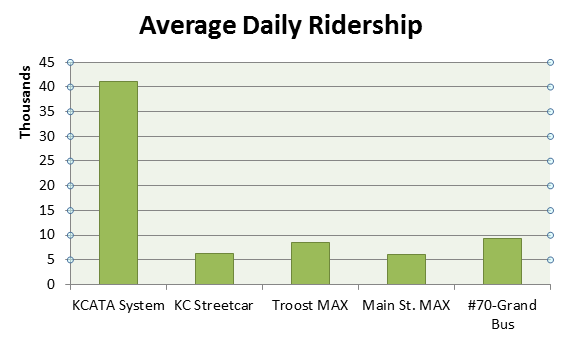
On an average day in 2015, over 41,000 trips were taken on KCATA’s system. Since its opening in May, the Kansas City streetcar has had an average daily ridership of 6,365, or 15% of total transit ridership. That’s a significant number of boardings, but still substantially lower than a busy bus route (the #70-Grand in St. Louis has over 9,000 boardings a day) and many times more expensive.

Buses outperform the streetcar in others ways, too. First, the streetcar is primarily moving passengers who are already near their destination downtown; it isn’t usually getting people from home to work, etc., like buses currently do. More importantly, the streetcar route has been served by MAX bus-rapid-transit service and local bus service for years. And the streetcar travels in traffic, at the same speed as buses. From a transportation perspective, the streetcar is redundant and unnecessary.

“But streetcars have a greater capacity than buses!” rail advocates reply. Streetcar vehicles can purportedly hold up to 150 passengers; however, articulated buses, with over 50 seats and standing room, can accommodate 75 passengers. The City could simply run two buses for each streetcar to match capacity and enjoy significant cost savings (an articulated bus costs 18% of what Kansas City paid for each streetcar vehicle).

In essence, the streetcar offers a more expensive way to move people along a short, 2.2-mile route that Kansas City’s bus system already serves. Is this really the best use of taxpayer money?

Researchers Estimate Effect of Scandals on University Enrollment

By the latest estimates, enrollment at Mizzou this fall is slated to be down by some 2,600 students. This means $36.3 million less in tuition revenue and an overall budget shortfall of $46 million. The university has already instituted across-the-board cuts and has shuttered whole dorms.

By all accounts, the lion’s share of this decline is due to the protests that roiled the campus last school year. Those events were covered in short and long form in local and national press over the course of several weeks. The charging and ultimate dismissal of professor Melissa Click continues to keep the story alive.

Interestingly, just last month, researchers at Harvard Business school estimated the enrollment impacts of scandals at the nation’s top 100 universities. While they narrowly defined “scandals” as sexual assaults, murders, cheating, and hazing incidents, it’s easy to imagine large-scale protests of alleged racism and professors assaulting students as functioning similarly.

The researchers found that, on average, a scandal that gets long-form news coverage will decrease university enrollment by about 10 percent in the following year, which they say is roughly equivalent to losing 10 spots in the US News and World Report rankings. While schools that have experienced scandals are less likely to have another in the five years following one, the damage is done.

Quantifying these effects underscores the importance of solid management of our universities. Yes, some of these instances are out of the university’s control, but how they handle them will determine how the media, and prospective students, respond.  

Getting Less out of More: Kansas City’s Declining Tax Base

The use of incentives such as TIF and abatements appears to be eroding Kansas City’s tax base.

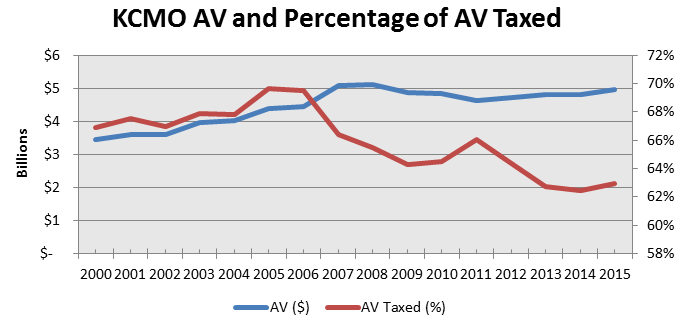
In the chart below, the blue line shows the total assessed value of real property in Kansas City, Missouri. The red line shows the percentage of that property value that is taxed. Clearly, the two measures are heading in different directions; as more and more real estate is developed in the city, a lower and lower percentage of property value is taxed.

The excessive use of tax incentives appears to be leading to a decoupling of assessed value (AV) and taxable value (TV). That is, as the city experiences more and more growth, its tax base stagnates. Normally, TV would rise (or fall) at the same rate as AV.

The gap between the two has been steadily widening since the mid-2000s. In 2000, AV was 49% greater than TV, but in 2015, it was 59% greater. And that 10% isn’t chump change. If TV tracked AV at a constant rate, in 2015 there would have been an additional $200 million on the tax rolls. That means the city, school district (KCPS), library (KCPLS) and other jurisdictions are missing out on tens of millions of dollars each year. In 2015 alone, the city, KCPS, and KCPL together lost out on nearly $36 million in revenue. Instead of funding education and essential services, those dollars went to wealthy developers—developers with no real need for public financial assistance.

So, despite the claims of developers and officials, the use of incentives in Kansas City is contributing to a hollowing out of its tax-base. Even though there are more and more shiny new buildings, the city is collecting taxes on an ever-shrinking percentage of them to support essential government functions.

Kansas City Streetcar Failing by Its Own Standards

On July 12, the Kansas City Downtown Council posted an item on its blog in which the Streetcar Authority marketing director was quoted as saying,

“Streetcars do more than simply improve mobility,” said Donna Mandelbaum, marketing officer for the KC Streetcar. “In Kansas City, the entire community is looking to the Downtown Streetcar to fuel economic growth by promoting development, raising property values, attracting businesses and residents, and helping to redefine our city, streetcars benefit everyone.”

Let’s examine these claims one by one:

What Kansas City did was spend $51 million per mile to build a streetcar. It’s neat to ride, and ridership is higher than predicted for now. But then that was true elsewhere before ridership numbers tanked. Voters may decide that spending hundreds of millions more on an expansion is a good idea, but it certainly isn’t because the streetcar is driving development, improving transit, or attracting business and residents.

Outsourcing Public Education

We ask a lot of our public schools. We ask that they not only educate children, but also transport them and feed them. Many provide before- or after-school care for students. We expect schools to serve students regardless of their learning needs. They must maintain buildings, parking lots, and playing fields. When a teacher is sick, they have to find temporary staff to fill the gap.

Many public schools are unable to do all of this. To meet the needs of students, they often—to borrow a word from the business world—“outsource” jobs. Just like your paycheck gets printed by an outside company or your office is cleaned by an independent janitorial service, schools often hire a private company to manage the district’s bus services, to provide before- and after-school care, to cook children’s meals at lunch time, and to clean the buildings. Schools contract with outside healthcare professionals or private schools to meet the needs of students with special needs. A district can even contract with an outside management firm to run the school if they want. Some schools are even outsourcing who teaches your children, at least when they have a substitute teacher.

Filling all of the vacant classrooms when teachers are absent can be a challenge for school district officials. Some districts hire full-time aides who act as floating subs, filling in here and there as needed. Others employ a cadre of retired teachers, individuals looking to gain experience in the profession, or others simply looking for part-time work. The process of recruiting, hiring, and placing substitute teachers can be cumbersome. Rather than hire an assistant superintendent or other central office staff member to take on this responsibility, some schools have begun outsourcing this job to a private company.

In Saint Louis, for example, Kelly Educational Staffing provides this much-needed service to several school districts. As Dale Singer of St. Louis Public Radio reports, the privatization of substitute teachers has been a success. In Normandy, a district that has had many struggles in the past few years, “the rate of filling classrooms with substitutes had been in the 55–60 percent range”; with Kelly, “that figure rose to around 90 percent.”

Time and again we see benefits from outsourcing public services to private companies. Yet, many fail to see how private school choice programs, such as vouchers or tax credit scholarships, could yield the same benefits. Indeed, the same principles apply to both situations.

When a public school chooses to outsource services, they make a voluntary decision. Companies compete for their business and district administrators choose the company that they believe will best meet their specific needs. If the company fails to perform, the representatives of the school district can choose to take their business elsewhere. The same can be said for school choice. When parents have options, they are able to choose the school that will meet their needs. That’s the beautiful thing about a market—it allows people to voluntarily get the services they need.

We should celebrate when public schools find a way to better deliver public education by collaborating with the private sector. Similarly, we should celebrate when parents are given the ability to choose their child’s school.

While Missouri currently allows public schools to outsource just about everything, it does not extend that opportunity to parents. It is time for that to change. Parents should be given the opportunity, through vouchers or tax credit scholarships, to enter into the educational marketplace and contract with the school that is going to best meet their child’s needs. 

Support Us

The work of the Show-Me Institute would not be possible without the generous support of people who are inspired by the vision of liberty and free enterprise. We hope you will join our efforts and become a Show-Me Institute sponsor.

Donate
Man on Horse Charging