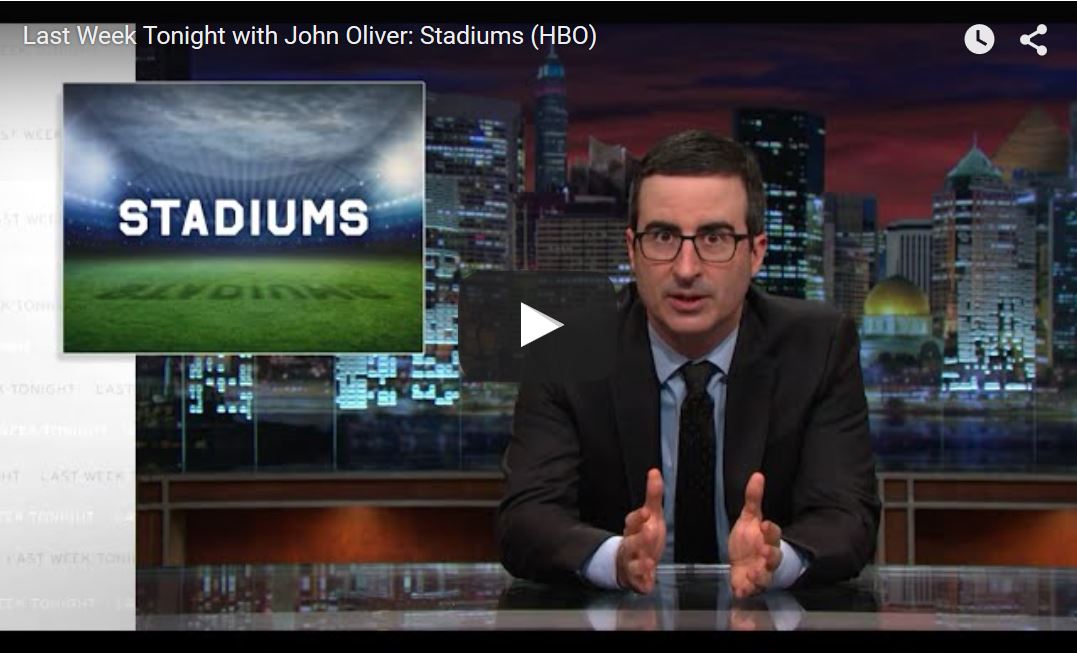
Subsidized Downtown Stadiums, Forever and Always, a Bad Idea

The Kansas City Star editorial board rightfully condemned even idle talk of building a sports stadium downtown.  And while most of the editorial was sound, it ended on a disappointing note:

For now, though, downtown baseball is and should be off the to-do list. The region must deal with more urgent priorities first.

Subsidizing sports stadiums is a bad idea regardless of the timing. Recently, Saint Louis has spent an inordinate amount of time and money trying to force taxpayers to do exactly this. First, there was an effort to build a new riverfront stadium for the Rams. When that plan failed, there was a sprint to build a soccer stadium in hopes of luring an Major League Soccer team to town. Stadiums are said to generate jobs in their construction (they don’t), and drive economic development once they are built (they don’t). At best, they divert people’s disposable income from one activity to another. Stadiums only create wealth for the team owners—who don’t have to share their profits with the taxpayers underwriting their team’s overhead. (In Wyandotte County, Kansas, taxpayer subsidies likely just postpone the inevitable closing of a baseball park.)

These aren’t just the musings of free-market, small-government cranks, either. There is a robust body of research from organizations left and right and in-between that shows stadium handouts are a waste of public resources. Nor do we need to rely on academic studies. The dome formerly known as Edward Jones failed to attract the economic development or population density its boosters promised. Anyone who doubts this should just look at aerial photos of Truman Sports Complex. Much of the land around two stadiums lays un- or under-developed.

Subsidizing sports stadiums, wherever they are built, is bad public policy. Not because of timing, or because there are other more pressing matters in Kansas City, which is true. It’s bad because diverting tax dollars to help big businesses build their own buildings is wasteful of limited public resources intended to provide basic services.

Chesterfield’s Corporate Welfare House of Cards

Missouri’s development house of cards is all too often built upon a shaky foundation of corporate welfare. It looks as though Chesterfield may be stacking the cards higher and higher.  

If you drive along I-64/40 in western Saint Louis County, you’ve likely seen three competing shopping malls: Chesterfield Mall, Taubman Prestige Outlets, and Saint Louis Premium Outlets. You can’t tell just by looking at them, but the two outlet malls are subsidized through various special taxing districts. Yes, that means the public is helping to pay for two competing malls less than five miles apart. And no, the bad policy doesn’t stop there.

Chesterfield Mall, around long before either outlet mall, has been in steady decline, and was recently foreclosed on. Unsurprisingly, the mall’s owners claim business declined significantly after the outlet malls opened roughly five years ago. (Other failing malls in the region make similar claims.) While competition is good for consumers, the government subsidizing some market participants at the expense of others isn’t something to cheer about. It is no more than government picking winners and losers.

And things get worse still.

Public officials and developers are now cooking up ways to bring new life to Chesterfield Mall. One proposal would convert the mall into a mixed-use facility, incorporating office, residential, and retail uses. This is an exciting idea, and could keep a long-standing community fixture in use. The issue isn’t with what the mall might become, but how its rebirth might be funded. Chesterfield’s department of economic development has a troubling idea: create a special taxing district (in particular, a transportation development district) to help subsidize a conversion. Sound familiar?

Government interference seems to have helped put the mall in the spot it is today. But if government subsidies didn’t work the first time—or only worked for some at the expense of others—why use them again? Why not let the market work? If the mall doesn’t prove to be a good investment, why should taxpayers have to bail it out?

It’s unfortunate to see a major community development languish. But it is even more unfortunate that taxpayers could be asked, yet again, to remedy what could be a government-induced development collapse. 

Man versus Machine in Saint Louis

We’ve written about the encroachment of machines into the workforce previously. From fast food kiosks to the advent of workplace computers, the march of technology remains constant. This week we learned that Schnuck’s in Saint Louis has roaming robots to check stock on the shelves and verify prices.

Maryland Heights-based Schnuck Markets, which operates 100 stores in five states, on Monday will begin testing its first Tally at its store at 6600 Clayton Road in Richmond Heights. The pilot test is expected to last six weeks. A second Tally will appear in coming weeks at Schnucks stores at 1060 Woods Mill Road in Town and Country and at 10233 Manchester Road in Kirkwood.

The race between man and machine is a fixture of popular culture, from John Henry to Yoshimi Battles the Pink Robots. In most stories, robots represent the movement of technology replacing man: of cheaper, stronger, more efficient labor. It’s not surprising then that in most folklore, the machines are depicted as sinister. But that isn’t the case for consumers.

All of this is an effort by producers to provide better, faster and cheaper service, and to that end it is a good thing because it drives down prices for everyone. It should be a wake-up call to activists who think they can affect positive social change merely by increasing the minimum wage—in which only a few benefit at the cost of many. Making labor more expensive not only makes technology more attractive, but it puts smaller businesses who cannot afford the investment in technology at a competitive disadvantage.

Why Haven’t We Fixed This Law Yet?

Whatever our policy inclinations, we should all agree that government ought to be for the public good, transparent, and accountable. Unfortunately, some of Missouri’s community improvement districts fail to satisfy these uncontroversial, common-sense requirements of good government.

CIDs are special districts that levy extra sales, property, and other taxes to fund various, supposedly public, improvements and services. The law governing CIDs makes it possible for landowners—or a single landowner—to form a district and impose sales taxes often without residential voter approval.

Unsurprisingly, CIDs sometimes direct taxpayer funds toward projects aimed at achieving private, rather than public, goals. In Kansas City, the luxurious InterContinental Hotel charges an extra 1% through a CID to help pay for the renovation of its guestrooms. In Saint Louis, the Cardinals established a CID to help fund construction of the second phase of Ballpark Village, and in Chesterfield the stores of St. Louis Premium Outlets charge extra taxes to cover help cover the cost of their development. What business would turn down an additional 1% profit? 

And the pennies add up. According to reports filed with the State Auditor’s office, CIDs across the state have collected more than $146 million since 2014. As Missouri’s CID law has been on the books since 1998, CIDs’ toll on the public may be in the billions.

And as bad as that sounds, it significantly understates the impact CIDs have on Missouri’s tax burden. Because of poor reporting on CIDs, reports for many years are missing or filed months or even years late (if at all). In fact, the original plans for CIDs are seldom posted publicly online, so their cumulative impact on taxpayers is hard to pin down. The transparency issues are obvious. Funding improvements with a CID can be much like using a company credit card and never submitting your receipts.

The source of the problem with CIDs is a lack of accountability, particularly in districts with no residents. In these districts, developers can impose a tax without allowing consumers any say in the matter. When a CID’s only constituents are the developers it’s benefiting, there is no independent check on revenues and expenditures. Throw in a lack of state oversight and CIDs become a too-good-to-be-true opportunity for politically savvy developers and business owners. It’s no wonder the number of CIDs across the state has exploded from one in 2000 to 275 in 2016. During this period, 99 CIDs were established in Saint Louis City and County alone, most of which are still operating.

So what can we do? Apart from eliminating CIDs altogether, the first step is to tighten CID reporting standards so data on revenue and spending are easily accessible to the public. The State Auditor or Department of Revenue could compile and publish the information annually. The second is to prohibit landowners from imposing sales taxes on an unsuspecting public. The current law authorizes private interests to tax the public with little or no accountability.   

Common-sense reforms like these could help stop the needless abuse of taxpayers that Missouri law currently authorizes. 

KC Convention Hotel Still Coming Up Short?

A piece in The Kansas City Business Journal suggests that the efforts  of Mike Burke and his development partners to raise the private money needed to build a convention hotel might be cause for concern. It is difficult to tell, however, because the developers have hardly been forthcoming about the project. Given the public involvement and assistance with this project—and our history with big, subsidized projects negotiated in secret—shouldn’t taxpayer investors know more? 

The piece in question is about how Hyatt learned only recently that they would not be the hotel operator and includes the following:

[Hyatt senior vice president of development, David] Tarr said he also had been surprised to learn a few months earlier [than June 21] that KC Hotel Developers was coming up $30 million to $40 million short on equity.

“When we partner with a development group, we like to know that they have the most meaningful portion of the equity (in a new hotel project),” Tarr said. “That’s our preference in most situations, and in this particular situation, we came to the table with this group because we felt that they had the wherewithal to assemble the capital to do the project and that our equity was not required.

Tarr was wrong. According to The Kansas City Star, “Tarr said Hyatt was approached by KC Hotel Developers for additional equity in the project.” Hyatt declined, and on June 21 found out that after years of work that they had been cut out of the deal. Tarr suspects the developers may have gone to the market looking for additional equity, “but may have settled for significantly less than that.”

Just over a month ago I wrote that, despite their claims to the contrary, the developers didn’t have the financing in place. Now we learn from Hyatt that the developers had a $30 to $40 million gap. Was Loews, the company chosen to operate the hotel, offering to make up the difference? A June 21 Star piece suggests this was the case:

Burke said Hyatt is a terrific operator “but at the end of the day, our obligation was to get a convention hotel financed, built and operating. We believe that partnering with Loews gives us certainty,” he said. “That’s most important. This deal has been kicked around for six years.”

Unfortunately, we can’t be sure. According to the Star, “Burke and [Lowes CEO Jonathan] Tisch declined to provide details of how much money Loews is investing in the project, which has had a total estimated cost of $311 million.”

It’s worth asking whether Loews—a smaller company than Hyatt and which does not appear to operate any other convention hotels—is in a position to put up the $36 to $48 million that Hyatt elected not to contribute. Until City Hall starts demanding transparency from the developers, taxpayers won’t have any way of knowing the risks involved. Even if only investors lose on a venture, another failed convention hotel would be a blight on the KC skyline.

Is It Good for the Children?

Dave Helling of The Kansas City Star noted a while back that every ordinance approved by the City Council of Kansas City, must address a simple question: “Is it good for the children?” The vast majority of time it is answered with a one-word, “Yes.” The appearance of the question ranges from the somewhat defensible (capital improvements to Starlight Theatre) to the absurd (collective bargaining pay scales and convention and visitors center contracting).

This legislative afterthought was brought to mind after reading Councilwoman Teresa’ Loar’s guest column in the Star last month. She wrote.

We have spent an inordinate amount of time on this issue [building a new single airport terminal] at City Hall. And while it is very important, we are neglecting areas that are critical. Two of those issues that greatly affect all citizens of Kansas City are the escalating homicide rate in our city — currently 30 percent higher than last year — and the impact on families of higher water and sewer bills.

Loar is right; so much political attention is being spent on issues that are not important to Kansas City families. As this is being written, there have been 85 homicides in Kansas City, 50% higher than last year, the highest so far in a three-year spike. What good is a new airport terminal or a convention hotel if Kansas City has a national reputation for homicide? What could be more important than getting a handle on murders?

Our mayor likes to complain that Kansas City is the only major city in the country that does not control its own police board. But the mayor is not without his own considerable power over policing. In addition to sitting on the Board of Police Commissioners ex officio, Mayor James has veto power over the city budget. Not a dime is spent by any Kansas City department—including the police department—without his tacit approval. There is no greater power any politician can have than the power of the purse. Yet this power isn’t exercised to tackle the hard problem of violent crime; no, it is spent pursuing civic luxury items our city neither needs not can afford.  

If the city officials at 414 East 12th Street have trouble focusing on their priorities, perhaps they ought to ask themselves with each ordinance, “How does this help reduce the number of homicides in Kansas City?” Would that be good for the children? Most definitely yes. 

How Missouri’s Special Taxing Districts Promote “Legal Plunder”

In the land of the blind, the man with one eye is king. When it comes to Missouri’s rapidly proliferating special taxing districts, one-eyed kings pick millions of dollars out of the pockets of unseeing and unsuspecting consumers / taxpayers.

Who preys upon the sightless with such cruel impunity? More often than not, it is leading citizens and business organizations, taking advantage of poorly conceived laws with the stated purpose of promoting economic development.

Under Missouri laws established in the 1990s, transportation development districts (TDDs) and community improvement districts (CIDs) operate as micro-governments that direct tax revenues to private interests to use for the supposed benefit of their local communities. A primary benefit of a TDD – from the viewpoint of a single property owner or a group of owners banding together to form a district – is the ability to impose a tax on people with no vote in the matter.

Over the past two decades, more than 200 TDDs and nearly 300 CIDs have sprouted up in big cities, small towns, and suburban enclaves across the state. In 2014 and 2015, TDDs collected more than $175 million in tax revenue, according to the Missouri State Auditor’s Office. “Given that TDDs have been operating this way for nearly 20 years,” Show-Me Institute Policy Analyst Graham Renz has observed, “their collective impact is in the billions.”

Before becoming a city councilman and later mayor of Neosho (pop. 12,000), south of Joplin, Richard Davidson served on the town’s school board from 2004 to 2008. He was shocked when supporters of a TDD sought an $800,000 contribution from the school district to support the building of new roads. “We educate kids,” he told the TDD proponents. “We don’t build roads.” Later he wrote a column for the Neosho Daily News titled, “TDD Spells Trouble for Our Schools.”

The Neosho TDD was set up in 2009 to fund $6.9 million in transportation projects, with a projected $4.5 million coming from a half-cent sales tax from businesses within the district and another $2.4 million from the Missouri Department of Transportation. Like many TDDs, this is a special taxing district with no residents. Within its boundaries, the 550-acre district includes the city’s golf course, wooded areas, and mostly uncropped farmland, along with a small commercial strip with a Wal-Mart, a Lowe’s, and some other shops and restaurants. Through the half-cent sales tax, customers of those businesses have paid in excess of $500,000 a year to support the TDD’s activities.

So far, those efforts have not stimulated any new business development. But who is to say that the millions of dollars spent by the TDD on roads and transportation won’t at some point turn woods and idle farmland into valuable commercial property?

Davidson, who served as mayor of Neosho from 2010 to 2016, regards the TDD as a clear case in which the end (not so much economic development as the enrichment of a small number of private property owners) does not justify the means (taxing unseeing and unsuspecting consumers).

Community improvement districts work in a similar way. Examples include the luxurious Intercontinental Hotel on Country Club Plaza in Kansas City and the Cardinals’ Ballpark Village in downtown Saint Louis. CIDs allow both of these commercial ventures to collect a one-percent sales “tax” from patrons, which is really just an artfully disguised part of the selling price.

It is time to jettison two-decade-old Missouri laws that promote taxation without representation and provide a textbook example of what the 19th-century economist Frederic Bastiat called “legal plunder.”

A Tax-Cut Change of Heart from the Post-Dispatch?

I read with interest the St. Louis Post-Dispatch‘s staff editorial, “Illinois’ economy stacks up to Missouri’s, despite Schmitt’s criticism.” Much can be said about the piece, but I found it particularly notable that the first item tallied in Illinois’ win column was, of all things, that Illinois has a lower personal income tax rate. From the Post-Dispatch:
 
Illinois’ personal income tax hike from 3.75 percent to 4.95 percent still leaves it lower than Missouri’s 5.9 percent. That nears 7 percent in St. Louis and Kansas City when the 1 percent earnings tax is added. Schmitt, as a state senator in 2014, sponsored a bill that is reducing Missouri’s income tax rate by 0.5 percent over five years.
 
That the Post-Dispatch, of all publications, would cast Missouri’s high income taxes as a mark against the state is priceless. In 2014, the same editorial board criticized Missouri’s extremely modest income tax cut, subject to revenue triggers, as “a knockout blow for Missouri’s future.” So it is good, albeit wholly unexpected, to see the Post-Dispatch finally come around to our position: that income taxes do indeed matter to economic growth, and that in Missouri, those taxes are too high.
 
To be clear, rates aren’t the only things that matter when it comes to economic development policy; tax brackets and exemptions matter, too, as do non-tax factors like infrastructure and workforce preparedness. To make Missouri great, all of these issues must be seriously studied and ultimately followed through on by our representatives. But the Post-Dispatch’s apparent 180-degree turnaround on the issue of income tax rates is an event worth applauding.
 
I hope legislators in 2018 will swiftly enact new income tax cuts that at least match Illinois’ rates and hopefully go beyond them, and examine anew the economic impact of Saint Louis’s and Kansas City’s local earnings taxes. We may not agree with the Post-Dispatch on much, but it’s good to see that on the destructive economic impact of income taxes, we may have found some common ground.

The Cost of Government Transparency in Missouri

Collecting data for a research project on Missouri city budgets—known for now as the “government checkbook project”—I have found inconsistencies across the state regarding how easy it is to get information about how different Missouri cities spend local tax dollars.

Kansas City and Saint Louis, for example, upload full spreadsheets of city expenditures on their websites for anyone to download at no charge. For many other cities, getting data was as easy as sending an email request and, occasionally, paying a small service fee.

On the other hand, some local governments ignored my request entirely or said their software does not have this reporting capability, as was the case with Independence. At the far end of the spectrum, a Jefferson City employee said the process would take about 40 hours and would cost $936.

The goal of the government checkbook project is to allow all Missouri residents the same level of access to information that those living in places like Kansas City and Saint Louis currently enjoy.

As it now stands, public records on city expenditures are not always kept in a way that can be shared easily. Though Missouri’s sunshine law requires state and local governments to disclose their documents upon request, it does not prevent these governments from charging fees, nor does it obligate them to generate new documents. As a result, what might seem like a simple request can result in fees of thousands of dollars when the data are not user-friendly, as analysts working on previous Show-Me Institute projects have discovered.

Is there any reason why a digital-age society that values government transparency and accountability should not make public information easily available?

Support Us

The work of the Show-Me Institute would not be possible without the generous support of people who are inspired by the vision of liberty and free enterprise. We hope you will join our efforts and become a Show-Me Institute sponsor.

Donate
Man on Horse Charging