Medicaid Enrollment Continues to Climb

Over the past six months, Missouri’s Medicaid rolls have grown by 15 percent. There are now more than 975,000 Missourians on the program, which is the highest enrollment has been since the beginning of 2018. Given the COVID-19 pandemic and associated economic downturn, an uptick in the size of Missouri’s Medicaid program is not necessarily surprising. The question is whether there is more to the story.

Prior to the coronavirus making its way to Missouri, our state had experienced nearly two years of steady Medicaid enrollment decline. As I wrote back in March, there was widespread concern about the drop-off. There was also fundamental disagreement in Jefferson City regarding what was driving the decline. One of the suspected causes was improved efforts on the part of Missouri’s Medicaid agency to ensure that each recipient was truly eligible to receive Medicaid-covered services.

By March, the downward trend had turned the other direction. In response to COVID-19, the federal government passed multiple relief packages that sent aid to states. One of the bills, the Families First Coronavirus Response Act, increased the share of Medicaid expenses covered by the federal government. But that funding came with strings attached. In fact, in order to receive the Medicaid relief funds, states had to agree not to terminate eligibility for any Medicaid participant unless the individual died, requested a voluntary termination of their eligibility, or moved to another state.

This guidance was contrary to prior federal requirements, which had stipulated that states verify the income of their Medicaid enrollees at least once per year to ensure continued eligibility. It should be no surprise that removing such a check would lead to a spike in enrollment. If someone loses their job and enrolls in Medicaid, they will no longer be removed from the program once they’re employed again (and no longer qualify) unless they go out of their way to inform the state they would like to terminate their coverage.

What began with the laudable goal of making it easier for Medicaid recipients to maintain health coverage during an unprecedented pandemic is now likely to make it harder to balance Missouri’s already cash-strapped budget. Instead of Medicaid enrollment rising and falling with the unemployment rate, the program will continue to grow even as more Missourians head back to work. For example, Missouri’s unemployment rate has dropped more than 3% since May, yet Medicaid enrollment is more than fifty thousand higher.

Make no mistake, even with the federal government agreeing to pay a higher share of Medicaid expenses, there is still a cost to Missourians. As state agencies prepare to release their budget requests on October 1, and the federal government debates further relief packages, it will be important to keep track of how the cost of responding to COVID-19 will impact Missourians for years to come.


St. Louis Is Shrinking. Let’s Reverse the Trend

The headline “St. Louis is America’s fastest-shrinking city” should set off alarm bells for St. Louis lawmakers and citizens. It’s true that St. Louis City has struggled to attract and keep residents for some time, but that shouldn’t numb us to the reality of this pressing issue. The city needs to be a more attractive option for businesses and citizens if we want to reverse this trend.

A recent report from business resource AdvisorSmith analyzes population data of cities with more than 250,000 residents. With a compound annual growth rate of −1.1 percent, St. Louis tops the list as the fastest-shrinking city. This means that St. Louis City’s population fell by an average of 1.1 percent each year from 2014 to 2019. That’s a huge difference from the fastest-growing cities; Henderson, Nevada, and Irvine, California, both grew by an average of 3.1 percent each year over the same period.

So why is St. Louis shrinking?

It’s probably a combination of many things. High crime   and poor school performance certainly play a part, but there are other problems. Policies that place onerous burdens on businesses and residents can prevent both economic and population growth. The city’s earnings tax means that city residents and workers lose an additional 1 percent of their income to taxes. Numerous special-taxing districts make sales taxes as high as 11.679 percent in some areas of the city. Stringent business regulations make it harder for businesses to operate and hire workers. Does this sound like an attractive place to live, work, or start your business?

Our city continues to make headlines for losing population. If we want to stop this trend and attract residents and businesses to St. Louis, action is needed. Addressing the crime rate and poor schools will be challenging, but other cities such as Indianapolis (with a strong school choice environment, some crime rates trending down, and a growing population) have done so. With respect to taxes and regulatory policy, repeal the earnings tax, cut red tape, and rein in special-taxing districts. With a focused effort on doing the basics well and getting government out of the way of business, St. Louis City might start to grow again.

A Win for Parents

Change can be hard. After many years of trying, in 2018 Missouri students finally got the legal right to access online public education through the Missouri Course Access Program (MOCAP), provided that they get permission from their district to do so. Pressure from legislators and those of us who believe this type of school choice can be critical for students with limited educational options prevailed over the status quo of school boards and superintendents who didn’t want to relinquish any of their power. Even after the law took effect, however, parents’ requests were denied without sufficient evidence, and lawyers had to be hired.

But those of us who pushed for this didn’t give up. Last summer the State Board of Education met and considered a proposed rule change to the MOCAP law. Instead of giving districts unlimited time to respond to parent requests to enroll their child in MOCAP, a 30-day time limit should be set. The proposed rule change was then posted for public comments that the Board could consider before they voted on it at their next meeting.

In the meantime, the Joint Committee on Education met and suggested that the need to get district permission to enroll in MOCAP should be waived altogether—particularly given the unique educational challenges presented by the pandemic. Again, those of us who support parental choice did our best to inform parents and the public that this obstacle needed to go. Parents across Missouri are figuring out what to do for their children this school year, and accessing the approved virtual education programs in MOCAP needs to be simple.

When the Board of Education convened in September, they had hundreds of comments to consider—including, according to the minutes, “numerous comments regarding the enrollment response time.” Ultimately, the Board voted unanimously to insert a decision time limit into the law and to make it 10 business days from receipt of a request to enroll in MOCAP. Parents not provided a decision within this timeframe get default approval. Further, if a district denies enrollment and a parent appeals, the district now has 72 hours to provide the full documentation used to make the decision.

To be clear: This is a win for Missouri parents. Many districts don’t like the MOCAP program, and some had previously indicated that they wouldn’t implement the law as written. Fortunately, the Board of Education did the right thing and shifted some power from district administration to parents, where it belongs. Did they feel some pressure from the persistent drumbeat of groups like the Show-Me Institute? Maybe. Did the shutdown of every school in the state make them realize that they need to work with parents and not against them? Probably. Is this a harbinger of a move away from the monopoly model of public education firmly established in the last century? I hope so.

Should Drivers Fear Privately Operated Toll Roads?

Are privately operated toll roads bad for drivers?

Not according to a new study from the Reason Foundation. The study highlights how residents can benefit from their state leasing a toll road and addresses many common concerns. As tolling is a potential solution to Missouri’s transportation funding woes, it is worth exploring this report.

How could Missourians benefit from a privately operated toll road? States usually sell toll road leases for several billions of dollars, and that money can be reinvested in other transportation projects. For instance, Indiana received $3.85 billion for its toll road lease, which was more than enough to fully fund a 10-year transportation improvement program to improve road quality. For a state like Missouri, with hundreds of millions of dollars in unfunded transportation priorities each year, granting a company a lease to operate a toll road could provide some of the revenue needed to maintain Missouri’s roads.

While this may be good for state revenues, individual drivers may have some concerns. For instance, couldn’t a private toll road company just keep raising rates? And who will guarantee that the road will stay in good condition? Both concerns are addressed during contract negotiations.

Lease agreements typically tie rate increases to an inflation index, and terms of potential increases are agreed to in the contract. Similarly, lease agreements usually include performance indicators that the operating company must achieve, such as meeting pavement quality and bridge condition standards, with a financial penalty for non-compliance. Many contracts also specify minimum levels of maintenance expenditures the leasing company must meet. There is typically a clause for the state to terminate the agreement and resume operations if such provisions are not met.

And what happens if the company operating the toll road goes bankrupt? This has happened before, with non-dramatic results. The road does not close, as the state still owns the road. For instance, the company operating the aforementioned Indiana toll road went bankrupt, and it simply sold the lease to another company that took over operations. A toll road company going bankrupt is hardly a foregone conclusion, though, as many toll roads have been privately operated by the same company for years.

While tolling is not yet a reality in Missouri, several bills have been introduced in the past few years to allow private companies to operate toll roads. The Reason Foundation study should help Missourians see the upsides of such a possibility.

Join us this Thursday for a Book Talk with Kevin D. Williamson

Join us on Thursday, September 24 at 11:00 AM for a special virtual presentation by National Review’s Kevin D. Williamson.

Kevin will be discussing his forthcoming book, “Big White Ghetto,” a collection of long-form reporting and essays on poverty, addiction, despair, and their influence on American culture and American politics.

Register here

Kevin D. Williamson is National Review’s roving correspondent and director of the National Review Institute’s William F. Buckley Jr Fellowship Program in Political Journalism.

He is the author of The End Is Near and It’s Going To Be Awesome: How Going Broke Will Leave America Richer, Happier, and More Secure, The Dependency Agenda, and The Politically Incorrect Guide to Socialism. He contributed chapters to The New Leviathan: The State Vs. the Individual in the 21st Century and Future Tense: Lessons of Culture in an Age of Upheaval. When he is not sounding the alarm about Fiscal Armageddon, he is the theater critic at The New Criterion.
This event is sponsored by the Show-Me Institute and National Review Institute

Local Kansas City Area School District Sues Jackson County Health Department – for Good Reason?

Big government is once again picking winners and losers. This time it is in the form of enforcement of county-issued guidelines for outdoor sporting events.

Blue Springs School District, a school district in Jackson County, sued the Jackson County Health Department after it was issued a notice of non-compliance with capacity limitation rules for its home opening football game.

What did Blue Springs do wrong? Attendance at the game exceeded the 100-person fan limit set by the county for outdoor events. The county is adamant Blue Springs cannot do that, threatening to ban all fans for the season and force the team to quarantine for two weeks if it happens again.

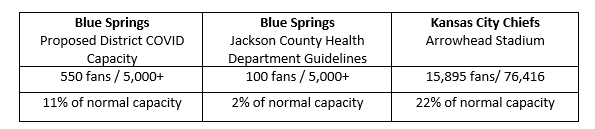
Blue Springs simply wants to allow for home football players, cheerleaders, and dance team members to give four tickets to their family members and two tickets to visiting team players—totaling 550 fans and 11 percent normal capacity. Yes, this exceeds the 100-person limit, but is the 100-person rule being enforced everywhere throughout the county?

Let’s compare this to the Thursday night opener for the Kansas City Chiefs. The county allowed roughly 16,000 fans, or 22 percent of Arrowhead’s normal capacity to attend.

Double standard? Absolutely. When the order was issued, the county intentionally exempted Kansas City, the city with the highest COVID case numbers in the county. Jackson County wants Blue Springs held at less than 2 percent of its stadium’s capacity while the Chiefs can have 22 percent. Shouldn’t Blue Springs be allowed to have the same percent capacity applied to its stadium?

Due to the limit set by the health department, Blue Springs decided that no visitor fans can attend games going forward. Even worse, with roughly 100 students on the active roster, each player/cheerleader/dance team member gets one ticket to give to their parents or guardians. Imagine a senior who has to choose between their mother, father, or grandparent attending their game. If one person from a “household” can attend, why can’t one or two more?

Jackson County defended the 100 person limit (2 percent capacity) for Blue Springs and 15,895 fan limit (22 percent capacity) for the Chiefs by saying, “Just because the Chiefs have the resources to do this in a relatively safe matter doesn’t mean that a high school stadium does.” But is this true? Blue Springs and the Jackson County Health Department developed a plan that health officials deemed safe for the school district to teach thousands of students each day indoors and in-person. The health department said Blue Springs has enough resources for that.

Wouldn’t the school district have enough resources to take a fraction of the people compared to the current school day and place them in a less risky area outdoors? I think so. The Jackson County Health Department should assist Blue Springs in implementing an 11 percent capacity plan instead of threatening to quarantine the players and ban its fans.

New Research Highlights Need to Modernize Transportation Funding

New research from the Tax Foundation corroborates what Show-Me Institute analysts have been writing for years—our transportation funding desperately needs an update.

The Tax Foundation study focuses on funding for America’s highways, and how road usage has been growing while the revenue to maintain them has been shrinking. This is true nationwide and for Missouri.

The bulk of Missouri’s highway funding (and that of many other states) comes from the federal Highway Trust Fund—which is funded by a federal fuel tax that has not changed since 1993. The tax is levied on vehicles that are increasingly fuel efficient. State fuel taxes supplement the federal funding; each state approaches its fuel tax differently. Some index the tax to inflation, some periodically raise it, and still others keep it constant, as Missouri has since 1996, with inflation eating away at its purchasing power.

This funding formula disparity will only get worse as fuel economy improves and no change is made to fuel taxes. In fact, the Highway Trust Fund, which sends money to states for road maintenance, is on the verge of insolvency by the end of next year unless the current funding formula is changed.

The study’s author promotes a charge on highway vehicle miles traveled as a potential solution. This charge would vary based on how much the vehicle weighs to account for the damage it does to the road. As the study notes, this highway formula “gets closer to capturing the externalities and approximating the road maintenance cost of each vehicle.”

In other words, toll roads.

The highway funding situation in Missouri will need to be addressed soon. Travel on Missouri’s interstates has increased 17 percent since 2008, and travel on other Missouri freeways and expressways has increased 20 percent since 2010 (the most recent year for which data for the latter category is available). Conversely, since 2008, the Missouri Department of Transportation’s (MoDOT) overall revenue has decreased by 15 percent, with state fuel tax revenue—the largest state-contributed source of funding—falling 0.5 percent.

Making MoDOT do more with less led to an average of $745 million in unfunded road and bridge priorities between 2014 and 2018. And some of the most traveled roads in Missouri—Interstates 44, 55, and 70—will need to be reconstructed soon.

With these pressing problems, shouldn’t Missouri lawmakers heed the advice of the Tax Foundation report and consider tolling?

It’s Time to Fund Everything for Every Student

One fascinating result of the COVID-19 school shutdown is that parents have taken their children’s education into their own hands. They’re leaving public school districts that are only offering virtual education and enrolling in private schools. They’re sending their children to karate academies or trampoline centers to do virtual schooling there. And, in one of the more interesting twists, they’re starting their own schools.

Micro-schools have been around for a few years, but they served a very specific niche. Now, they’re emerging as another in-person option for those who can find and afford them. According to a recent article in the St. Louis Post-Dispatch, micro-schools are popping up in the St. Louis region. Unfortunately, the micro-schools highlighted are charging between $500–$1,000 per month per student. What about the parents who can’t afford that?

Public school districts could join the effort. They could make space and teachers available to serve pods of students. The state could also join the effort. It could allow parents to access a portion of their children’s state education funding to either pay for attendance at a micro-school or to pool with other parents to create one of their own. We are undoubtedly sending substantial sums of money to public school districts for students who have already left. Allowing the funding to follow the child would change that.

There is a significant risk that achievement gaps between wealthy and poor children will get wider this year. As cool as it is to see parents of means figure out how to get their children the education they need, it clearly creates unequal access. Being trapped in a failing school that can’t or won’t provide the services that students need comes with a higher level of risk this year. We are facing a national education crisis and we should be funding every option for every kid.

Support Us

The work of the Show-Me Institute would not be possible without the generous support of people who are inspired by the vision of liberty and free enterprise. We hope you will join our efforts and become a Show-Me Institute sponsor.

Donate
Man on Horse Charging