

Aaron Hedlund, Susan Pendergrass and Patrick Ishmael join Zach Lawhorn to discuss the state of the economic recovery, the possibility of mask mandates for the upcoming school year and the recent CRT listening session in Jefferson City.
Are Missouri Schools Being Honest About What They’re Teaching?

Patrick Ishmael joined The Gary Nolan Show to discuss this week’s CRT hearing and provide an update on the Show-Me Curricula Project.
Missouri Bans Natural Gas Bans

Legislators in Jefferson City recently passed a law barring policymakers in cities and counties from banning the use of natural gas in homes and businesses.
The law technically prohibits cities and counties from banning the use of any fuel source, but natural gas has been a target nationwide for cities attempting to reduce fossil fuel usage. Cities including Denver, Seattle, and 42 municipalities in California have banned natural gas for various usages in new construction. Brookline, Massachusetts, voted to ban natural gas usage in new construction as well, although this was later struck down as violating state law. The purpose of these laws is to replace natural gas with electricity, although this is complicated by the fact that electricity generation often requires fossil fuels.
Outlawing natural gas comes at a great cost. Heating with electricity is twice as expensive as heating with natural gas. Roughly half of Missouri homes use natural gas for heating and heating is usually a households’ largest energy expense, so banning natural gas usage is an expensive proposition. While no city in Missouri has enacted such a ban, several cities do have their own environmental goals, so a future attempt to ban natural gas usage was conceivable.
Ultimately, localities may enact policies on matters where the state has not spoken clearly. But now that the state has spoken clearly to prohibit local natural gas bans, Missourians won’t be subject to natural gas bans.
Listen: More Tax Giveaways in St. Louis

David Stokes joined TCT on NewsTalk STL to discuss the current state of tax incentives in St. Louis and some recent development dealmaking.
Listen: Lee’s Summit School District wants $40,000 to Answer CRT Records Request
Patrick Ishmael joined Pete Mundo in the Morning on KCMO Talk Radio to discuss the Lee’s Summit School District’s response to his public records request to find out whether they are teaching critical race theory (CRT) or any of its related concepts, Monday’s hearing on CRT and more.

Listen: The Latest on CRT in Missouri Schools

On July 21, Patrick Ishmael joined The Vic Porcelli Show to discuss what he’s learned about CRT in Missouri schools after sending out thousands of records requests to schools across the state.
Listen to more of The Vic Porcelli Show on NewsTalk STL
HB 349 Creates Opportunity (For Some)

Some Missouri children will finally be able to sign up for tax credit–funded scholarships. But why not all?
Much has been written about the newly signed HB 349. For those who don’t know, HB 349 creates scholarships for families to use for their children’s education. The scholarships will be funded from taxpayer donations, and in exchange donors will get a credit on their state taxes. The scholarship funds can go toward private school tuition, books, tutoring, or other education-related costs. (The program basically works as a kind of Education Savings Account.) Legislators are realizing that education may need to be different for each student, and this program will give parents the resources to pursue the best education for their children in whatever unique form that might take.
But this opportunity is only available to Missouri citizens in cities with more than 30,000 people. Eligible students (low-income students and those with disabilities) in the City of St. Louis, St. Louis County, St. Charles County, Jefferson County, as well as the areas around Kansas City, Springfield, and Columbia will be able to benefit from this program. Not so for families living anywhere else in Missouri. Some critics argued in the St. Louis Post-Dispatch that “if the program was good for the state, it should apply to the entire state,” The implication being that since the program wasn’t adopted for every city, there must be something wrong with it.
But it’s not a bad program. There’s just more work to be done convincing other areas (especially rural communities) of the benefits of school choice. The Missouri Empowerment Scholarship Accounts program is good for the state, and it should apply to the entire state. All of Missouri’s families, urban and rural, should be given the opportunity to pursue the best education for their children.
It Doesn’t Work That Way

The St. Louis Board of Alderman just passed a symbolic resolution to ban any new schools (read charter schools) as long as enrollment in St. Louis Public Schools (SLPS) is declining. But banning alternatives to SLPS will not force families to stay. Just the opposite, in fact. Providing options may very well be what is keeping families in the city.
In the last 20 years, enrollment in SLPS has declined from nearly 46,000 students to just over 21,000. Meanwhile, charter school enrollment in the city has grown to over 11,000 students. This has led to a fairly steady public school enrollment of between 30,000 and 35,000 students in the city for almost 15 years.
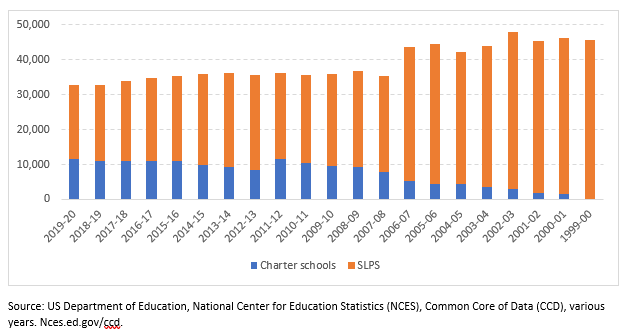
Soon, St. Louis children who qualify will also be able to apply for scholarships through the new Empowerment Scholarship Program, signed by the governor this week. This will open even more doors to families.
Ultimately, parents will stay in the city if they have several options for their children. Other cities that have created vibrant portfolios of school choices, such as Washington, D.C., provide proof of this fact. Enrollment in D.C. Public Schools declined from 71,000 students in 1999 to just over 44,000 in 2009. In the last ten years, it has increased to almost 52,000.
Resolutions to tie children to their one and only assigned public school seat are desperate attempts to protect a failing system. Wouldn’t it be better to consider all students in the city, both public and private, as precious resources that make St. Louis more livable? Wouldn’t it be better to provide every family in the city with at least a few choices? Don’t we want St. Louis to be a city where young families choose to stay and raise their children, rather than one that bans their demonstrated preferences?
It’s time for the adults to stop fighting over us versus them and to get busy building a portfolio of schooling options for every family.
Podcast: Missouri is Not Ready for the Next Recession – Corianna Baier & Elias Tsapelas

Susan Pendergrass is joined by Corianna Baier and Elias Tsapelas to discuss how prepared Missouri is for the next economic downturn.
