“Did You Get My Cheez Wiz, Boy?”

Early in the classic film The Blues Brothers, Elwood takes his recently paroled brother, Jake, back to his Chicago apartment. It’s a small room next to the “L” tracks, with kitchen and bathroom facilities shared with the other tenants. (I guess Elwood has his own toaster oven, but that’s hardly a kitchen.) Anyway, it’s the type of affordable room for rent that used to be common in American cities. Now, however, housing arrangements like that are illegal almost everywhere (with a few exceptions). St. Louis, Kansas City, and other Missouri towns should legalize them again. (Check out this example ordinance from the St. Louis County suburb of St. John which defines “rooming house,” or a “boarding house,” and clearly states no new ones are allowed in the city after 1963.)

This topic is in the news now because of a lawsuit against a St. Louis landlord illegally renting out very cheap homes to struggling people in St. Louis. This post is not a defense of that landlord. Many of the places she was renting were condemned, had no utilities, or had other problems. The court system will presumably deal with those issues.

But it is worth noting that these cheap homes—some of which did have utilities and were suitable for habitation, even if just barely—were being used for inexpensive shelter by previously homeless people. That’s a good thing. Have you noticed how cold it has been lately?

Yes, landlords should keep their buildings up to code, and things such as working utilities and sanitation systems are all properly part of various building codes. However, zoning laws almost everywhere (including in much of the City of St. Louis) require apartments to be rented out whole, meaning every unit must have its own kitchen, bathroom, etc. Obviously, that is how most people want to live. But we made it illegal in much of the country to have a cheaper option, like Elwood Blues had, to live in a large building where you rent by the room and share other facilities with the other tenants. The elimination of the housing market option for these types of facilities is one of the reasons for the increased homeless population in our country.

Nobody is saying rooming houses like these are nice (I also saw Taxi Driver). But they are an affordable option that some people will choose that is far better than being homeless. I am not suggesting that boarding house–type facilities should be allowed everywhere. But blanket zoning prohibitions against them in Missouri cities are harmful and should be repealed.

Education Spending: Where Does the Money Go?

As the 2024 legislative session gets underway, we will undoubtedly hear more about teacher pay in Missouri. A key question we should be asking is this—where does all the money go?

Using data from the National Center for Education Statistics (Table 211.50 and Table 236.55), I calculated how many students it took to pay for the average teacher’s salary. I calculated this by dividing the average salary by per–pupil operating expenditures. In 1960, it took 13.3 students to generate the equivalent amount of money as a teacher’s salary. That number dropped steadily over time. By 2000, it was 5.7, and in 2020 it was just 4.4 students.

You read that right: fewer than five students in a class is enough to cover a teacher’s salary today.

So where does all that money go? Ben Scafidi, an economist at Kennesaw State University, has some ideas. He noted that from 1950 to 2015, the number of administrators and other staff has increased by 709% nationally. In that same time period, the number of students went up 100% and the number of teachers went up 243%.

In more recent years, the number of students in Missouri has been declining. Yet the number of teachers is going up.

There is a very simple way to increase teacher pay, and it does not require any legislation. School districts can make different staffing decisions—hire fewer administrators and free up dollars to pay teachers more.

Free Bus Fare, Still a Bad Idea

Almost exactly four years ago, I wrote in this space that the move in Kansas City to reduce bus fare to zero was a bad idea—or at the very least ill-considered and not supported by substantive research. I argued the same in a guest commentary to The Kansas City Star:

Good policies go beyond good intentions. They serve a public need with as few negative consequences as is possible. Our national experience with large-scale, fare-free transit has been a bumpy ride. Kansas City needs to consider all the options and trade-offs before adopting such a significant policy change.

Unfortunately, those concerns were not heeded. At the time, the Kansas City Area Transit Authority (KCATA) CEO Robbie Makinen argued weakly, “Just because nobody else is doing it, that’s not a reason for us not to do it. What’s wrong with trying it? What’s the worst thing that happens? It doesn’t work, and Robbie gets fired.”

Now in 2024, after years of offering free bus service, the KCATA is wrestling with a $10 million gap in its operating budget. The service used COVID relief money to cover its operating losses, but those funds will run out by 2025.

As a result of the budget shortfalls, the new CEO has asked the transit authority’s board for permission to study reinstating fares to cover the shortfall. (The previous CEO cited above did seemingly get fired in July 2022.) One of the current KCATA board members, Michael Shaw, is at least asking the right questions, according to the Star:

“Have we done the homework and figured out what we need to do, what other resources and strategies are in place, before we say this is the policy decision that needs to be made?” Shaw said. “I don’t think we should look at solutions in silos. They have to be looked at collectively and I don’t think we’ve done that homework at this juncture.”

The chairwoman of the board, Melissa Bynum, pointed out what we already know: “Zero fare is not free – period. Somebody pays for it.”

The CEO of the KCATA should be congratulated for seeking such a study. Board members Shaw and Bynum are right to urge diligence and to point out that the money must come from somewhere.

Had the previous KCATA leadership wrestled with these questions a few years ago, the organization may not be in this mess now.

Land Banks: A Bad Idea Back for the 2024 Session

The state legislature in Missouri is again considering legislation to dramatically expand the authority to institute land banks to municipalities across the state (the state legislature must approve all new land banks in Missouri).

The state legislature should reject this legislation. If such legislation is enacted, counties and municipalities should reject the establishment of land banks. 

On January 17, Show-Me Institute Director of Municipal Policy David Stokes submits testimony to the Missouri Senate Emerging Issues Committee regarding expansion of Missouri’s land bank program. Click here to read the full testimony.

One of the Biggest Problems Facing Schools in 2024 with Nat Malkus

Susan Pendergrass speaks with AEI’s Nat Malkus about the problem of chronic absenteeism in America’s schools following the COVID-19 pandemic.

Listen on Apple Podcasts 

Listen on SoundCloud

Nat Malkus is a senior fellow and the deputy director of education policy at the American Enterprise Institute (AEI), where he specializes in empirical research on K–12 schooling. He is a national expert on a range of educational issues that affect students across the country—including Career and Technical Education, school choice, Advanced Placement, standardized testing, and how the nation’s schools responded to the COVID-19 pandemic.

Produced by Show-Me Opportunity

Royals Officially Probably Staying in Jackson County

With loyalty like this, who needs wins? After flirting for a new stadium with suitors like Clay County and even (reportedly) Kansas, the cellar-dwelling Kansas City Royals appear ready to settle down. Congratulations Jackson County! It looks like the Royals will probably stay with you—if you pay them for the next half century, location TBD:

The Kansas City Royals and Kansas City Chiefs released a joint statement Friday to stay in Jackson County, pending voters’ approval of a sales tax extension.

The statement comes amid the Royals’ plans to build a new $2 billion ballpark district as they look at locations in both Jackson County and Clay County.

The teams said Friday they are committed to staying in Jackson County — and provid[ing] over $200 million in economic benefits — if voters approve a 40-year extension of the 3/8th-cent sales tax in April.

The sales tax extension will help the Chiefs renovate Arrowhead Stadium at the Truman Sports Complex and assist with the Royals’ new stadium in downtown Kansas City.

It wasn’t news that the Chiefs planned to stay put. Driven in part by the Royals’ public relations disaster, the Chiefs had confirmed months ago they indeed intend to remain at Arrowhead (despite flirting with Kansas two years ago), and it was clear the football team was only waiting on the baseball team to make its decision. The Chiefs’ involvement at this juncture also puts a more popular brand in front. Frankly, the baseball team is probably better off with Chiefs superstar and Royals co-owner Patrick Mahomes leading the final charge to the ballot box rather than majority owner John Sherman, who’s helmed the Royals’ push to this point. I’m sure Sherman would agree.

Will taxpayers accept this rose? It won’t come for free. Now that the Royals have decided on Jackson County as their first choice, it will now (likely) be up to voters to decide in April whether to continue subsidizing not one, but two sports teams into 2071—that is, nearly to the 22nd century. Where will that baseball stadium be? Unlikely at its current site, where the taxpayer-financed and recently upgraded Kauffman Stadium seems destined for the wrecking ball. At least two new Jackson County sites are in contention, and a final site announcement may be weeks or months away, if it comes before the vote at all. In the meantime, we wait.

In the interest of balance, I will say that the Royals’ behavior—though misguided and wrongheaded—is consistent with the behavior of countless other private businesses, in and outside the professional sports industry, when it comes to tax incentives and public financial support. The Royals want something for free, regardless of whether they’re owed it. That’s their prerogative, and it’s up to taxpayers to finally say, “No, our tax dollars should go to legitimate public services and not to a private entertainment operation.”

But odds are that Jackson County taxpayers won’t say no—they’ll likely approve the tax extension for the Royals’ (and Chiefs’) benefit, even as other notable local challenges, like murder, remain unaddressed. Taxpayers can do better. I hope they do.

What if We Decided to Lean in to Testing?

The College Board’s Advanced Placement (AP) program teaches college-level coursework to high school students and then tests their knowledge with an AP exam. Missouri’s participation in this program lags behind the national average, both in test taking and test passing. Missouri’s high school students are missing an opportunity to get college credit without paying college tuition. Do we have an anti-testing culture?

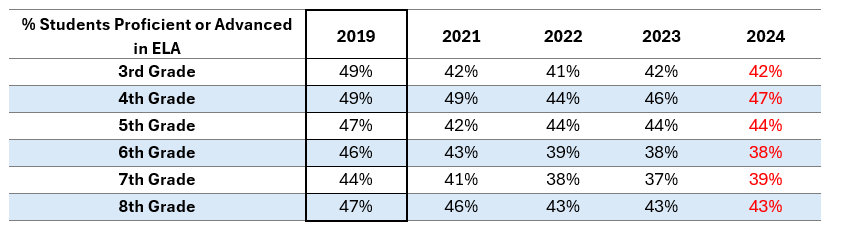
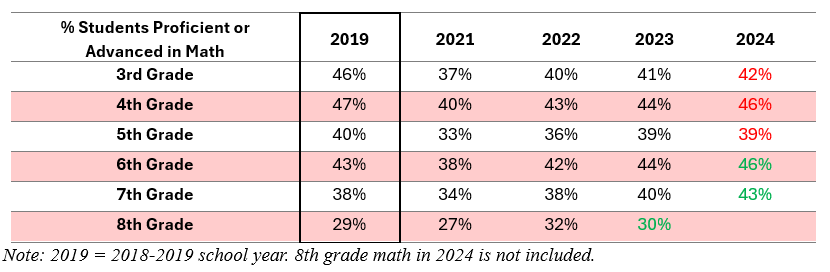
Missouri quietly released last year’s Missouri Assessment Program (MAP) scores for schools and districts recently. Because Missouri, like most states, currently has a chronic absenteeism problem and because Missouri chose the broadest rule for suppressing data due to privacy concerns, dozens of districts have no useable public test score data in either English/language arts (ELA) or math. How are these districts doing? I have no idea. But I do know that the average spending per student in the “no test score districts” was over $27,000 last year.

The state board of education’s reactions to last year’s statewide test scores, which were dismal, included the two standards—not enough teachers and not enough money. They threw in COVID and classroom behavior for good measure. And despite having multiple districts with fewer than 10 percent of students scoring at grade level on the MAP exam, the state board decided to keep designating 512 out of 518 school districts as fully accredited and have the remaining six be partially accredited—grade inflation at its best.

What if we leaned into testing to find out how we’re doing? What if we didn’t blame money or the kids? Success Academy, a well-known charter network in New York City that enrolls almost exclusively low-income students of color, had to rent an exhibition hall to accommodate students taking an AP exam this spring because there were so many of them. The academy’s founder and CEO, Eva Moskowitz said, “With rampant grade inflation and inconsistent state standards, AP and SAT tests are a critical tool . . . especially for low-income students of color.”

As the pandemic moves further into the rearview mirror, we need a clearer picture of the toll it has taken on Missouri’s children and their futures. We need more accountability, not less.

New Avenues for Price Transparency

Why is health care so expensive? In part, it’s because patients rarely have the opportunity to shop for a better deal. When you don’t know the price of a procedure before you receive it, how could you possibly weigh your options? While it is true that many patients have likely never considered shopping for savings on their health care, they’ve also never really been given a reason to. Fortunately, two states recently passed laws designed to encourage cost savings for patients and insurers alike.

A few months ago, laws went into effect in both Texas and Tennessee that provide patients with new avenues to avoid overpaying for health services. These laws offer a glimpse at one of the next steps for states in the effort to make prices more transparent. More specifically, these new “self-pay” laws allow individuals covered by certain health plans to receive deductible credit if they can find services cheaper than the rate their insurer negotiated.

Are there really that many services where patients could find cheaper prices than what their insurer has agreed to pay? Surprisingly, the answer appears to be yes. According to a recent report, when offering to pay cash instead of using insurance Josh Archambault found:

We recently made some phone calls in Nashville and found we could pay $541 in cash for a colonoscopy, far less than the $2,400 average rate the three largest insurers in the state negotiated. In fact, we found at least four providers in downtown Nashville that would charge less if we paid cash instead of using our insurance card.

In other words, it’s likely that many patients are currently overpaying for services when they use their insurance. And what these new laws do is allow patients to take the $541 option and require their insurer to count that spending toward their yearly deductible, as their insurer would do for any other spending on covered health services. For many patients, especially those with chronic illnesses, this change could result in significant cost savings.

As I’ve written before, price transparency isn’t a silver bullet for our health care system, but it will be key for lowering health care costs—if Missouri lawmakers ever decide to get serious on the issue. Going into this year’s legislative session, I hope our lawmakers decide to make tackling skyrocketing health care costs a priority. Following what’s recently worked for both Texas and Tennessee would represent a step in the right direction.

Support Us

The work of the Show-Me Institute would not be possible without the generous support of people who are inspired by the vision of liberty and free enterprise. We hope you will join our efforts and become a Show-Me Institute sponsor.

Donate
Man on Horse Charging