Collecting the Earnings Tax on Remote Work is Illegal. ‘Nuff Said

The St. Louis Post-Dispatch has had two recent columns criticizing the Missouri House for passing legislation that would further clarify that the City of St. Louis can’t collect the earnings tax from remote workers. I say “further clarify” because it shouldn’t be necessary at all. What the city did when it started charging the earnings tax for remote work at the start of the pandemic was contrary to the law. Anyone who can read the basic words of the statute can see that. Here is the statute as it is now and has been written for some time (emphasis added):

Salaries, wages, commissions and other compensation earned by nonresidents of the city for  work done or services performed or rendered in the city.

It says, “in the city.” Not “near the city.” Not “connected to the city by a phone line.” Not “in the city unless the city’s budget really needs the money in which case outside the city is fine.” In the city. For the record, a judge also ruled that what the city is doing violates the law.

Both columns admit to this to various degrees. Tony Messenger describes the city’s legal argument in the court case as “. . . probably a specious argument.” Members of the editorial board admit in their piece that the city’s legal argument “isn’t strong.”

But both pieces conclude that the state legislature should not be doing what it is now doing—further clarifying the law—because the city needs the money. The city’s budget problems, however, do not justify the city breaking the law in its tax collections.

That leads me to another point. The evidence from Kansas City is clear that if you refund earnings taxes for remote work, the sky won’t fall. Kansas City officials have stated this in hearings that I have attended. The amount of money refunded was not as large as they had feared it would be. In 2019 (all of these are fiscal years), Kansas City collected $272 million in earnings taxes. That fell to $245 million during the pandemic. It quickly rose to $289 million in 2021. And this happened while Kansas City was still refunding earnings taxes for remote work when requested.

There is no evidence the legislation passed by the House would “have a devastating effect on the city” as Tony Messenger says in his column. Even if the bill did have that effect, that wouldn’t justify city government ignoring the law.

We can all agree that getting rid of the earnings tax is harder than ever in St. Louis, with skyscrapers that sold for $200 million just over 20 years ago now selling for $3 million. It’s hard to depend on property taxes—like most cities in America do—in this scenario.

Decades and decades of bad policies combined with new, fiscally irresponsible “progressive” changes are making St. Louis look more and more like the new Detroit. It’s probably time to revisit the optimistic work from Institute analysts a decade ago.

Harsh Budgeting Truths

Just how broken is Missouri’s budget? Last week, Missouri’s House of Representatives finished work on its nearly $51 billion version of the state’s budget—and some lawmakers claimed this budget was a sign of fiscal restraint.

To be fair, if the House budget becomes law, it will be Missouri’s first budget in more than a decade that is smaller than the previous year’s budget. Not only is the House budget smaller than last year’s, it’s also approximately $2 billion smaller than what Governor Parson recommended for next year, which represents a small step in the right direction.

It should be noted that the budget process will now move to the Missouri Senate—the chamber more accepting of higher spending in recent years. It’s therefore still too early to tell if the state’s streak of record-breaking budgets is coming to an end.

The recent budget negotiations in Jefferson City also served as a reminder of how much things have changed for Missouri financially over the past several years.

  • Missouri’s total budget has nearly doubled since Fiscal Year (FY) 2019, growing from a little more than $27 billion to $53 billion this year (FY 2024).
  • General Revenues (mostly state income and sales tax collections) have increased by significantly less, going from approximately $10 billion to more than $13 billion over the same period.
  • The biggest driver of budget growth has been the temporary influx of federal funds associated with the federal COVID-19 pandemic relief and infrastructure packages.
  • The federal share of Missouri’s budget has grown from around 30% to closer to 50%.
  • While Missouri (much like the rest of the country) has dealt with record-breaking inflation in recent years, state spending growth has outstripped the increase in prices, and has even grown faster than the state’s population and economy.
  • Going into next year, the state will lose access to the billions of temporary federal dollars, all while state general revenues are expected to remain relatively flat or decline.

Keep in mind that the extraordinary state spending growth in recent years occurred even though Missouri’s constitution includes a balanced budget requirement—the requirement does not apply to federal funds.

There are myriad reasons to think the road ahead will be a tough one, and cutting spending will be a mandatory part of the equation. That’s why I’m happy lawmakers in the House took the measures they did to start turning the tide on state spending, even though I wish they’d gone further. I’m also looking forward to the Senate debating its spending plan in the coming weeks, with the hopes that members of the Senate also share the House’s view that spending should be reined in.

But with so many important spending decisions left to be made, and such dark clouds ahead in Missouri’s financial future, state taxpayers should join me in waiting until the budget makes it across the finish line before considering whether to celebrate any savings.

Watch: The Rise of the Four-day School Week in Missouri

The four-day school week (4DSW) has become increasingly popular in Missouri in recent years. As of fall 2023, 33 percent of all Missouri traditional public school districts have adopted this schedule. But how much do we know about its impact on student achievement, district finances, teacher recruitment and retention, or parental satisfaction? The short answer is: not as much as you might expect.

Learn more about what the available literature says about the impact of the switch to the 4DSW and what Missouri parents think about the four-day schedule.

Where Is That Populous Report on Kauffman Stadium?

On November 9, 2023, Kansas City public radio (KCUR) reported:

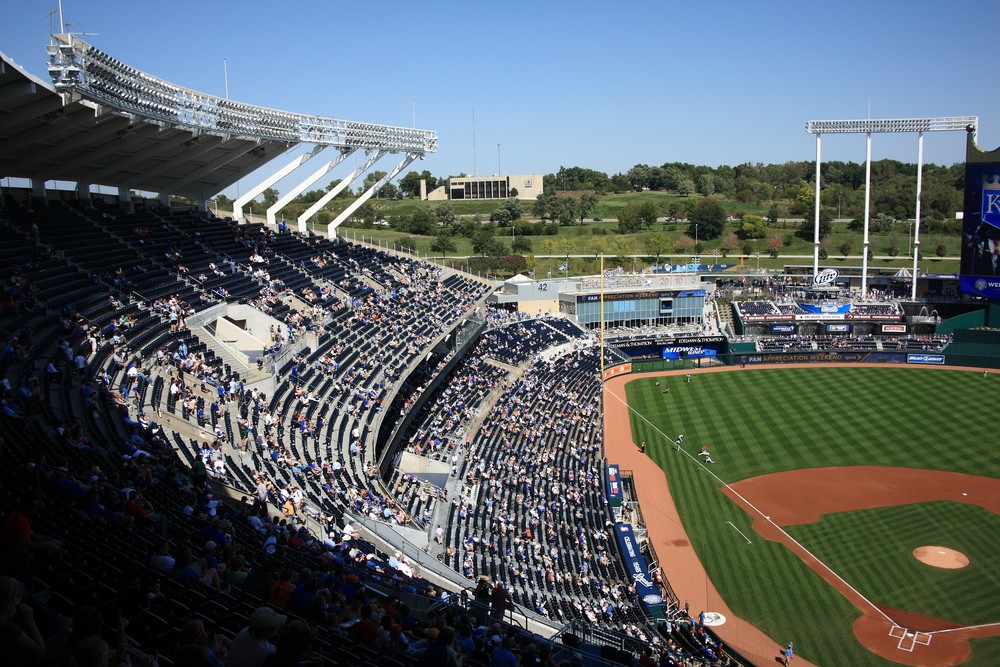
According to a report released by Populous in 2022, a stadium design firm that’s done work for nearly all MLB teams, The K suffers from severe structural issues that would cost more to fix than a new stadium would be to build.

The link included in that text, however, is no longer available. It now defaults to a splashy artists’ rendering of a downtown ballpark.

That report became an issue again when the Royals announced they wanted to leave Kauffman Stadium. The findings from the Populous report run counter to another publicly available engineering report that found Kauffman to be in satisfactory condition, with no mention of any significant concrete issues.  According to a January 31 story in The Kansas City Star:

When The Star asked a team spokesman about the discrepancy, the Royals issued a statement that said those annual assessment reports and the one Populous produced for the team are not comparable.

“The shortest and simplest answer is that these are two very different reports aimed at very different objectives. One is an annual repair plan and the other is about long-term viability,” the Royals said. “The study referenced in the public meeting came from a leading structural engineer of sports facilities. This firm knows our building well after working on the 2008 renovation. We asked them to evaluate long-term structural issues and the feasibility of extending the existing structure for 40 more years.”

Jackson County Executive Frank White asked the Jackson County Sports Complex Authority, which oversees the Chiefs and Royals stadia, to conduct an investigation. It declined.

At the March 19 library event, Mayor James held up a stack of paper when referring to a study of Kauffman Stadium. I asked for and received what he held up. Ms. Tourville, a spokeswoman for the Royals, previously referred to a report from 2007 “that has shown significant deterioration and concrete cancer.” Indeed, what Mayor James handed me are two reports dated 2007. (The scanned document is available here.)

But what about that Populous report mentioned in the media?

When Mayor James handed me the report, there were two brightly colored sticky notes on the report. On each was written “Populous studies.” (Photographs available here and here.) But the documents themselves were not the Populous study.

The Royals seemed to drop the claims of faulty concrete pretty quickly. On a March 27 discussion on Sports Radio 810, Royals President Brooks Sherman said, “We need a new stadium to be competitive with our peers” (found at 38:26 in the audio here). Later on that same program, Executive Director of the Jackson County Sports Complex Authority Jim Rowland said, of the teams, “They’ve kept the buildings in first class condition” (found at 1:13:35).

Hopefully the Royals will release whatever study Populous conducted on Kauffman in the name of transparency. If it found “severe structural issues” with Kauffman Stadium as claimed, it would be a significant development. Otherwise, this episode seems to be one of many examples of a poorly conceived and poorly run effort to get Jackson County voters to part with their money.

April 30: Insider’s Hour with Show-Me Institute in Columbia, MO

What’s happening as the session wraps up in Jefferson City? Missouri’s $50 billion budget, healthcare price transparency, and a proposed Taxpayer Bill of Rights. Get the latest information at the Insider’s Hour with Show-Me Institute and 93.9 The Eagle!

Join us for an open discussion with Chief Economist Aaron Hedlund and Director of State Budget and Fiscal Policy Elias Tsapelas from the Show-Me Institute.

Register Here

Where:

Country Club of Missouri

1300 Woodrail Avenue

Columbia, MO 65203

When:

Tuesday, April 30

11:30 a.m. doors open

12-1:00 Panel Discussion and Q&A

Cost: $20.00 (includes lunch and beverages)

Details of the Negotiations Between the Royals and Clay County

Given that Jackson County voters rejected the proposed 40-year 3/8 cent sales tax that would have funded a downtown baseball stadium, the team may decide to re-enter negotiations with Clay County. According to  documents I’ve highlighted below, those negotiations were put “on hold” by the Royals on January 16, 2024.

Linked here are documents regarding those negotiations received through an open records request:

“No” Vote Wins on the KC Stadium Tax, and a $50 Billion State Budget

David Stokes, Elias Tsapelas, and Patrick Tuohey join Zach Lawhorn to discuss:

– The KC stadium tax “No” vote victory
– Other election day results from across Missouri
– The latest on the $50 billion state budget that passed out of the House, and more.

Listen on Apple Podcasts 

Listen on SoundCloud

Produced by Show-Me Opportunity

Creve Coeur Engages in Panic Subsidizing

When someone buys and wants to develop one of the most valuable parcels of land in one of the wealthiest areas of Missouri, how should the city—in this case, Creve Coeur—respond? Well, if you are the politicians in Creve Coeur, you bend over backward to throw subsidies at the developers.

The new city motto should be: “Tax subsidies in Creve Coeur, just there for the asking.”

Honestly, the idea that the old Monsanto and Bayer site at Olive and Lindbergh needs tax subsidies is beyond ludicrous. The fact that the local officials in Creve Coeur seem to be enthusiastically supporting this instead of laughing the proposal out of the council chambers shows—once again—how far we have fallen from the idea of a level playing field for everyone.

Let’s state a few facts. Keep in mind the proposed development has both residential and commercial components.

This particular area has comparatively low taxes as it is. The Ladue School District has the lowest commercial property tax rate in St. Louis County and one of the lowest residential tax rates (go to page 2 in the 2023 tax book in the link for the data).

The Ladue School District is also one of the top school districts in the state. People want to buy homes or condos or rent apartments there.

The property is not some abandoned, vacant lot. The current owners are paying property taxes now. The idea that Creve Coeur is desperate here—that if they don’t approve this subsidy request some financial disaster will occur—is absurd

Here is the most important part: there is absolutely no evidence that the use of local tax subsidies helps economic growth. None at all. The short-term incentives of part-time politicians looking to “do something” while in office cause a great deal of harm.

If a parcel at the corner of Olive and Lindbergh in Creve Coeur needs tax subsidies (hint—it doesn’t), then any and every spot in our state needs tax subsidies.

Creve Coeur government officials should focus on creating a reasonable zoning and permitting process, modest local regulations where necessary, and maintaining as low a property tax rate as possible. That is all the developer of this location needs or deserves. The fact that local officials appear to be racing to give away the store is equal parts stupid and infuriating.

Support Us

The work of the Show-Me Institute would not be possible without the generous support of people who are inspired by the vision of liberty and free enterprise. We hope you will join our efforts and become a Show-Me Institute sponsor.

Donate
Man on Horse Charging