Who’s in Charge Here?

In the last several years, 10 states have passed universal school choice programs that allow all families to take their state education funding to the public or private school of their choice, including home schools. What many of these states have in common is governors committed to improving education in their state.

Governor Reynolds of Iowa publicly declared her dedication to elevating education for every student and actively built a coalition to make it happen.  Governor Sanders of Arkansas, in her first year in office, unveiled an education bill that she called “the most substantial overhaul of our state’s education system” in the history of the state. Governor Ivey of Alabama said last February that “passing an education savings account bill that works for families and for Alabama is my number one legislative priority.” Massive education reform happened in these states because governors led the way, much like Governor Jeb Bush of Florida and Governor Lamar Alexander of Tennessee did decades earlier.

That’s why I found it odd that the president of the state board of education in Missouri said that the outgoing commissioner of education deserves credit for surviving a governor’s attempt to shape education in the state, claiming she never “cracked under the pressure.” The former governor (Greitens) attempted to reconfigure the board of education into a more reform-minded board that could then bring in a commissioner willing to innovate. Ultimately, the strategy failed because that governor was forced out of office. But could, and should, a governor be able to challenge the education status quo in their state? Of course.

The current powers that be in Missouri public education disagree: “The idea that you had a governor that tried to influence the State Board of Education, tried to influence the selection of a commissioner, that wanted change for no other reason than political expediency.” He didn’t finish the sentence, but I assume he found the idea to be scandalous.

We will be electing a new governor this November. Let’s hope that whoever that person is, they will resist the entitlement of the existing power structure of public education in the state and lead the charge for students and families instead.

Homelessness and Housing Policy with Judge Glock

In this episode, Susan Pendergrass speaks with Judge Glock, the Director of Research and a Senior Fellow at the Manhattan Institute, and a contributing editor at City Journal, about the ongoing attempts to address homelessness through housing policy. They explore the effectiveness of current housing initiatives, the challenges in implementing effective policy solutions, innovative approaches to reduce homelessness, and more.

Listen on Spotify

Listen on Apple Podcasts 

Listen on SoundCloud

Produced by Show-Me Opportunity

St. Louis Is Finally Taking the Right Steps on the Earnings Tax

There was good news out of St. Louis on the earnings tax front earlier this week.

First of all, the city has finally agreed to allow earnings tax refunds to remote workers. The decision made by the city at the start of the pandemic to improperly apply the earnings tax to remote work was a terrible one. After losing two rounds in court, the city has finally done the right thing and started to once again do what the law requires—it will not collect the earnings tax for work done outside of the city.

Secondly, the mayor has created a new commission to study the long-term tax revenue situation for the City of St. Louis. That’s a fine idea. Hopefully, it will do a better job than a similar committee did for Kansas City over a decade ago. In Kansas City, the Citizens’ Commission on Municipal Revenue recommended repealing the city’s land tax—which was the best tax the city had from an economic perspective—in favor of higher sales taxes. In my opinion, that commission served more as a pretext for the politicians to do what they wanted to do. Hopefully, the process will be different here in St. Louis, but filling 6 out of the 12 commission positions with city employees isn’t a great look.

The PFM Group out of Philadelphia has given the city commission a detailed head start on revenue options. There are many options, but in the simplest terms the long-range plans for the city need to involve more reliance on property taxes combined with ending the tax incentives and subsidies the city so generously gives out. It’s easy, of course, to be generous with other people’s money.

The first true test for the city on the earnings tax is coming soon. When the city passed its senior property tax freeze last year, it only applied the freeze to city taxes and no other taxing districts, such as the school district. (The city deserves credit for that.) Now the legislature has made limiting the freeze like that illegal (assuming the governor signs the bill). So, the city has to choose between scrapping the senior property tax freeze entirely (which it should do), or applying it to all property taxes. Ending the senior property tax freeze would move the city in the right direction of less dependency on the earnings tax and more reliance on property taxes.

What the city does with the senior property tax freeze will likely be a good indication of how it will move forward with the entire commission process.

Teacher Retention and the Limits of Public Policy

Recently, I published a paper with a former graduate student in the Journal of Educational Leadership and Policy Studies on the topic of teacher retention. Teacher retention, teacher shortages, and teacher turnover have dominated education policy discussions in recent years. Fears surrounding teacher staffing were a primary driver of the salary increases and other provisions in Missouri’s recent, sweeping education bill (Senate Bill 727). While most discussions on the topic focus on out-of-school factors, such as pay, our paper focused on in-school factors. We were interested in exploring what school leaders themselves can do to improve teacher retention.

This is not to say that salary, benefits, and other factors are not important in keeping people in a job. Rather, we simply recognized that work conditions also matter. Generally, people are much more willing to stay at a job when they feel supported, they like their work, and they see opportunities for growth. The same is true in education.

In prior research, we identified five in-school factors that influence teacher retention: positive school culture, supportive administration, strong professional development, mentoring programs, and classroom autonomy. Through interviews with school principals, we explored how school leaders can leverage these five factors to improve teacher retention.

While our paper does not delve into the broader policy debates regarding the teacher labor force, it does raise an important idea that policymakers must keep in mind—government action is often limited in what it can accomplish. Let me explain.

The state can mandate higher teacher salaries, as it did in Senate Bill 727, but it cannot mandate better school culture. The culture must be established locally, by the leaders, the teachers, and the community of parents and students in the school. At best, government policies set the playing field for individual human action to take place, but the policies themselves cannot make a leader more supportive of faculty or improve personal relationships.

Given this reality, we must ask what conditions best promote positive school communities. What can legislators do to improve school culture? As I’ve suggested before, you do not drive excellence in academics, or school culture, via top-down policies. The best way to do this is through creating opportunities for excellence and for community to thrive. This is through choice. Through choice, leaders, teachers, parents, and students can choose the schools where they feel most accepted, supported, and encouraged to grow. Choice, of course, is not a silver bullet. There are no silver bullets. But it is the best mechanism we have that allows unique, happy, and successful school communities to flourish.

Bipartisan Momentum in Nuclear Energy Continues

Momentum for nuclear power continues to build—literally. In Wyoming, ground has just been broken for a new TerraPower advanced nuclear reactor (“advanced” means it does not use water for cooling the reactor, among other things).

This project marks the first time in about 40 years that a company has attempted to use an advanced nuclear reactor as a commercial power plant. Traditional light-water reactors have dominated the nuclear space, and they are usually characterized by enormous cooling towers.

The reactor being built in Wyoming can be ramped up to 500 MW when needed (enough to power 400,000 homes) and will cost around $4 billion to build. However, a decent chunk of those costs had to do with creating a design and getting the reactor itself approved by the Nuclear Regulatory Commission. If future projects use the same reactor design, they will not have to undergo that lengthy process, lowering the total cost.

Construction is supposed to take 5 years and the reactor is being built directly next to a decommissioning coal plant. The plan is to immediately transfer much of the existing infrastructure and manpower from the coal plant to the nuclear plant and create a seamless transition.

With a design like the one being built in Wyoming, the enormous cooling towers are not needed, as the reactor itself has a passive cooling system. On top of that, the reactor itself is smaller. In theory, this means that the design will be more easily replicable, as it is a smaller scale and can fit into more landscapes.

Construction is underway in Wyoming and momentum continues to build for the nuclear industry. Hopefully we can see Missouri take advantage of this trend in the near future—but to do that—we’ll need to straighten out our own state regulatory hurdles.

Open Letter to Governors Parson and Kelly Regarding Stadium Subsidies

Researchers at the Show-Me Institute have argued for years that economic development subsidies do little more than drain public funds while providing no real benefit to taxpayers. As the Kansas legislature considers offering tax incentives to the Kansas City Chiefs and Royals to build their stadia in Kansas, we join with the Kansas Policy Institute in urging Missouri Governor Parson and Kansas Governor Kelly to remain committed to the Border War truce (click here to read our open letter to governors Parson and Kelly). In fact, the truce should be expanded by the states’ respective legislatures and further reinforced by local governments in the region.

Longer Days and Fewer Hours with James V. Shuls and Avery Frank

James V. Shuls, and Avery Frank join Zach Lawhorn to discuss:

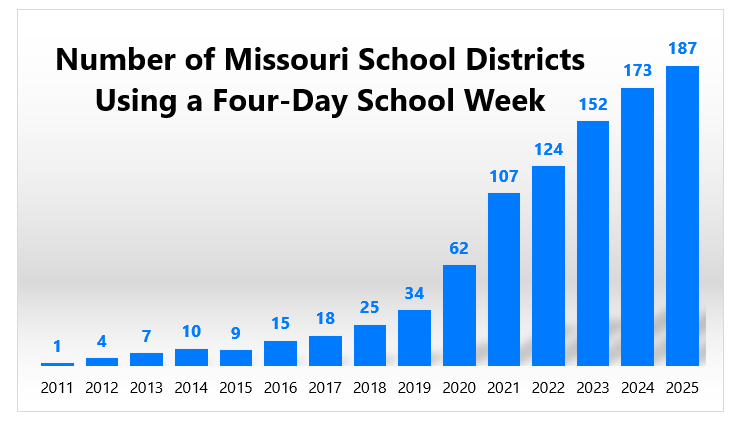
– Their new report, Longer Days and Fewer Total Hours: Examining the Four-Day School Week in Missouri
– The rise of the four-day school week in Missouri
– The impact on student achievement and teacher retention
– Parent opinion on the four-day school week, and more

Listen on Apple Podcasts 

Listen on SoundCloud

Produced by Show-Me Opportunity

Support Us

The work of the Show-Me Institute would not be possible without the generous support of people who are inspired by the vision of liberty and free enterprise. We hope you will join our efforts and become a Show-Me Institute sponsor.

Donate
Man on Horse Charging