A Milestone Reached

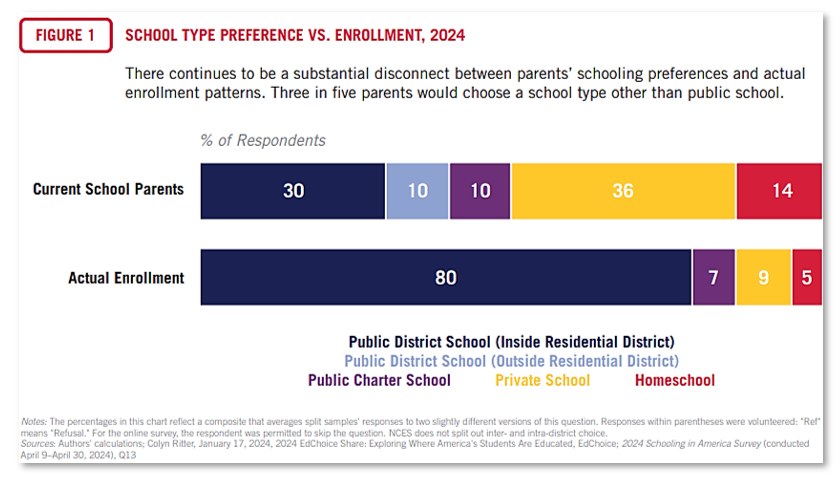
Nearly thirty years ago in Milwaukee, WI, a private school choice program was launched that gave vouchers to around 10,000 low-income students to attend a private school. This month, the number of children participating in a publicly funded private school choice program surpassed one million. Almost half of these students, including about 1,000 in Missouri, have education savings accounts (ESAs) that allow them to spend their state education dollars at the school of their choice or for homeschooling.

The single program started in Wisconsin in 1996 has grown to 75 school choice programs in 33 states, plus Washington, D.C., and Puerto Rico. And in just the last few years, 10 states have implemented universal school choice programs in which all or nearly all children in the state are eligible. These states are Arizona, Arkansas, Florida, Indiana, Iowa, North Carolina, Ohio, Oklahoma, Utah and West Virginia. Alabama and Louisiana will be joining the list next year.

When the one million private school choice students are added to the 3.7 million charter school students the result is that one in five children in the United States is receiving a publicly funded education outside of traditional public schools. What was once considered controversial has become mainstream.

The Four-Day School Week Won’t Quit

This past legislative session, Missouri officials addressed the four-day school week (4dsw) as part of the large education reform package, Senate Bill (SB) 727. These changes seem designed to curb the growth of the 4dsw, but I do not think either of these provisions will make a significant difference—and recent comments by the Independence 30 School District superintendent (the biggest 4dsw district in the state) strengthen my convictions.

But first, a refresher. How exactly did SB 727 target the 4dsw?

The first change mandates that larger districts must allow citizens to vote on whether or not they use a 4dsw for the 2026–2027 school year and later. This applies to school districts located wholly or partially in a charter county (currently St. Louis, St. Charles, Jefferson, Clay, and Jackson counties), or those wholly or partially located in a city with more than 30,000 inhabitants. According to my own analysis, this would apply to only 100 school districts and charters (about 20% of the statewide total). Of those 100, so far, only five are currently operating on a 4dsw—meaning the other 168 4dsw districts will be able to continue to operate without a vote from citizens.

The second provision is as follows:

Any district that goes to school 169 days or more will be given an aid bonus equivalent to 1% of their state entitlement (which grows to 2% by 2028).

If you operate on a 4dsw, you will not have more than 169 school days. Therefore, a district must move to a five-day schedule in order to receive this bonus.

Back in March, I argued, “It does not appear that SB 727 creates any significant incentive to buck that [4dsw] trend.” Particularly on the aid bonus, I said,

If the goal of this part of the bill is to begin moving the 173 4dsw districts back to a 5dsw, this provision will probably be ineffective. It is too little money for too big a change, and many districts may argue that the savings they receive from using a 4dsw is higher than the aid they could receive.

Fast forward to this past week, and we see that exact argument in action. The large Independence 30 School District is holding a vote to determine if it will remain a 4dsw district. The district’s superintendent said the bonus aid for moving away from a 4dsw would net out to about $500 per teacher—which he claimed is not significant: “The financial incentive is so small that it’s not going to keep a particular teacher in the profession.”

The fiscal note for this bill estimates that the state could end up paying districts $75 million per year via these bonuses. The Independence story makes it seem unlikely that the state will end up paying out anything close to that, but it’s still money that could have been better spent on something else, such as increasing funding for the education savings account program. Regardless, as 2024–2025 schedules are being released statewide, it will be interesting to see how resilient the 4dsw is.

St. Louis Is Finally Taking the Right Steps on the Earnings Tax

There was good news out of St. Louis on the earnings tax front earlier this week.

First of all, the city has finally agreed to allow earnings tax refunds to remote workers. The decision made by the city at the start of the pandemic to improperly apply the earnings tax to remote work was a terrible one. After losing two rounds in court, the city has finally done the right thing and started to once again do what the law requires—it will not collect the earnings tax for work done outside of the city.

Secondly, the mayor has created a new commission to study the long-term tax revenue situation for the City of St. Louis. That’s a fine idea. Hopefully, it will do a better job than a similar committee did for Kansas City over a decade ago. In Kansas City, the Citizens’ Commission on Municipal Revenue recommended repealing the city’s land tax—which was the best tax the city had from an economic perspective—in favor of higher sales taxes. In my opinion, that commission served more as a pretext for the politicians to do what they wanted to do. Hopefully, the process will be different here in St. Louis, but filling 6 out of the 12 commission positions with city employees isn’t a great look.

The PFM Group out of Philadelphia has given the city commission a detailed head start on revenue options. There are many options, but in the simplest terms the long-range plans for the city need to involve more reliance on property taxes combined with ending the tax incentives and subsidies the city so generously gives out. It’s easy, of course, to be generous with other people’s money.

The first true test for the city on the earnings tax is coming soon. When the city passed its senior property tax freeze last year, it only applied the freeze to city taxes and no other taxing districts, such as the school district. (The city deserves credit for that.) Now the legislature has made limiting the freeze like that illegal (assuming the governor signs the bill). So, the city has to choose between scrapping the senior property tax freeze entirely (which it should do), or applying it to all property taxes. Ending the senior property tax freeze would move the city in the right direction of less dependency on the earnings tax and more reliance on property taxes.

What the city does with the senior property tax freeze will likely be a good indication of how it will move forward with the entire commission process.

Teacher Retention and the Limits of Public Policy

Recently, I published a paper with a former graduate student in the Journal of Educational Leadership and Policy Studies on the topic of teacher retention. Teacher retention, teacher shortages, and teacher turnover have dominated education policy discussions in recent years. Fears surrounding teacher staffing were a primary driver of the salary increases and other provisions in Missouri’s recent, sweeping education bill (Senate Bill 727). While most discussions on the topic focus on out-of-school factors, such as pay, our paper focused on in-school factors. We were interested in exploring what school leaders themselves can do to improve teacher retention.

This is not to say that salary, benefits, and other factors are not important in keeping people in a job. Rather, we simply recognized that work conditions also matter. Generally, people are much more willing to stay at a job when they feel supported, they like their work, and they see opportunities for growth. The same is true in education.

In prior research, we identified five in-school factors that influence teacher retention: positive school culture, supportive administration, strong professional development, mentoring programs, and classroom autonomy. Through interviews with school principals, we explored how school leaders can leverage these five factors to improve teacher retention.

While our paper does not delve into the broader policy debates regarding the teacher labor force, it does raise an important idea that policymakers must keep in mind—government action is often limited in what it can accomplish. Let me explain.

The state can mandate higher teacher salaries, as it did in Senate Bill 727, but it cannot mandate better school culture. The culture must be established locally, by the leaders, the teachers, and the community of parents and students in the school. At best, government policies set the playing field for individual human action to take place, but the policies themselves cannot make a leader more supportive of faculty or improve personal relationships.

Given this reality, we must ask what conditions best promote positive school communities. What can legislators do to improve school culture? As I’ve suggested before, you do not drive excellence in academics, or school culture, via top-down policies. The best way to do this is through creating opportunities for excellence and for community to thrive. This is through choice. Through choice, leaders, teachers, parents, and students can choose the schools where they feel most accepted, supported, and encouraged to grow. Choice, of course, is not a silver bullet. There are no silver bullets. But it is the best mechanism we have that allows unique, happy, and successful school communities to flourish.

Bipartisan Momentum in Nuclear Energy Continues

Momentum for nuclear power continues to build—literally. In Wyoming, ground has just been broken for a new TerraPower advanced nuclear reactor (“advanced” means it does not use water for cooling the reactor, among other things).

This project marks the first time in about 40 years that a company has attempted to use an advanced nuclear reactor as a commercial power plant. Traditional light-water reactors have dominated the nuclear space, and they are usually characterized by enormous cooling towers.

The reactor being built in Wyoming can be ramped up to 500 MW when needed (enough to power 400,000 homes) and will cost around $4 billion to build. However, a decent chunk of those costs had to do with creating a design and getting the reactor itself approved by the Nuclear Regulatory Commission. If future projects use the same reactor design, they will not have to undergo that lengthy process, lowering the total cost.

Construction is supposed to take 5 years and the reactor is being built directly next to a decommissioning coal plant. The plan is to immediately transfer much of the existing infrastructure and manpower from the coal plant to the nuclear plant and create a seamless transition.

With a design like the one being built in Wyoming, the enormous cooling towers are not needed, as the reactor itself has a passive cooling system. On top of that, the reactor itself is smaller. In theory, this means that the design will be more easily replicable, as it is a smaller scale and can fit into more landscapes.

Construction is underway in Wyoming and momentum continues to build for the nuclear industry. Hopefully we can see Missouri take advantage of this trend in the near future—but to do that—we’ll need to straighten out our own state regulatory hurdles.

Open Letter to Governors Parson and Kelly Regarding Stadium Subsidies

Researchers at the Show-Me Institute have argued for years that economic development subsidies do little more than drain public funds while providing no real benefit to taxpayers. As the Kansas legislature considers offering tax incentives to the Kansas City Chiefs and Royals to build their stadia in Kansas, we join with the Kansas Policy Institute in urging Missouri Governor Parson and Kansas Governor Kelly to remain committed to the Border War truce (click here to read our open letter to governors Parson and Kelly). In fact, the truce should be expanded by the states’ respective legislatures and further reinforced by local governments in the region.

Longer Days and Fewer Hours with James V. Shuls and Avery Frank

James V. Shuls, and Avery Frank join Zach Lawhorn to discuss:

– Their new report, Longer Days and Fewer Total Hours: Examining the Four-Day School Week in Missouri
– The rise of the four-day school week in Missouri
– The impact on student achievement and teacher retention
– Parent opinion on the four-day school week, and more

Listen on Apple Podcasts 

Listen on SoundCloud

Produced by Show-Me Opportunity

Missouri School Districts Are Held Permanently Harmless

From the Missouri Revised Statutes, Chapter 163.031:

(2)  For districts with an average daily attendance of three hundred fifty or less in the school year preceding the payment year:

  (a)  For the 2008-09 school year, the state revenue received by a district from the state aid calculation under subsections 1 and 4 of this section, as applicable, and the classroom trust fund under section 163.043 shall not be less than the greater of state revenue received by a district in the 2004-05 or 2005-06 school year from the foundation formula, line 14, gifted, remedial reading, exceptional pupil aid, fair share, and free textbook payment amounts multiplied by the dollar value modifier;

  (b)  For each year subsequent to the 2008-09 school year, the amount shall be no less than that computed in paragraph (a) of this subdivision;

Not all of us are lawyers, so I’ll translate the above paragraph from the Missouri law on public education funding. The 184 (out of 517) school districts in Missouri that had an average daily attendance of fewer than 350 students last year either received state funding based on the foundation formula or the same amount of state funding they received nearly two decades ago, whichever is larger. These types of revenue protections are usually referred to as “hold-harmless provisions” and are meant to help districts transition from a prior formula to a new one. The 2006 Missouri Legislature decided to make that assistance permanent.

In 2023, in 138 of the 184 small districts, or 75 percent of them, the foundation formula calculation was run and then tossed out because the result was less than what those districts received the first year the formula was put into place—most likely because of declining enrollment. This means they received their 2004–05 (or 2005–06 figure if it was larger) funding at an additional cost of over $41 million in state funds than what the formula calculated for those districts last year. And they will continue to receive that amount forever, regardless of their enrollment.

When the time comes to reconsider how we fund public education in Missouri, it is imperative that legislators do not put permanent revenue protections into state statute. Doing so distorts enrollment trends, property value trends, and the distribution of taxpayer dollars. We need to make sure taxpayer dollars are spent as wisely and appropriately as possible.

2024 End of the Legislative Session Report

The 2024 Missouri Legislative Session was a mixed bag, and there is still a lot of work to be done. Below, you will find our 2024 End of the Legislative Session Report with more information on some of the reforms passed this session, both good and bad.

End of Session Report_2024-1

Download a copy of the report here.

Support Us

The work of the Show-Me Institute would not be possible without the generous support of people who are inspired by the vision of liberty and free enterprise. We hope you will join our efforts and become a Show-Me Institute sponsor.

Donate
Man on Horse Charging