

Hello, It Is Called A GPA

On Tuesday, the Missouri House of Representatives passed a bill that was originally intended to give letter grades to individual schools. The argument in favor of this is to give parents easily accessible information about how their school is doing.

The initial idea was to provide a single letter grade for the school, but that single letter grade was removed via an amendment. Mike Wood, associate executive director of government relations for the Missouri State Teachers Association, had this to say about the issue:

We support all the data being collected, which the bill calls for, but if your child comes home, he doesn’t get a grade for his whole school experience.

To this point I simply say . . . yes, he does. It is called a grade point average. Or, how about the A honor roll or the B honor roll? Any of these measures recognize a student for his or her overall performance, not for his or her performance in any single subject.

Wood goes on to say:

He gets a grade for everything, because in some areas he’s probably stronger than others. If a school does one thing very well and another thing not so well, is a letter grade going to reflect that?

Wood is missing the point of a single letter grade. The single letter grade is supposed to simplify the information so you can see how a school is doing overall. His argument is akin to saying we should not look at a baseball player’s batting average, because he may do well against fastballs, but not so well against curveballs.

While I agree that we need to look at a school’s performance from many different angles, I see a real benefit to providing an overall score for a school’s performance.

Is Missouri’s Economic Development Tax Credit Scheme Working For You?

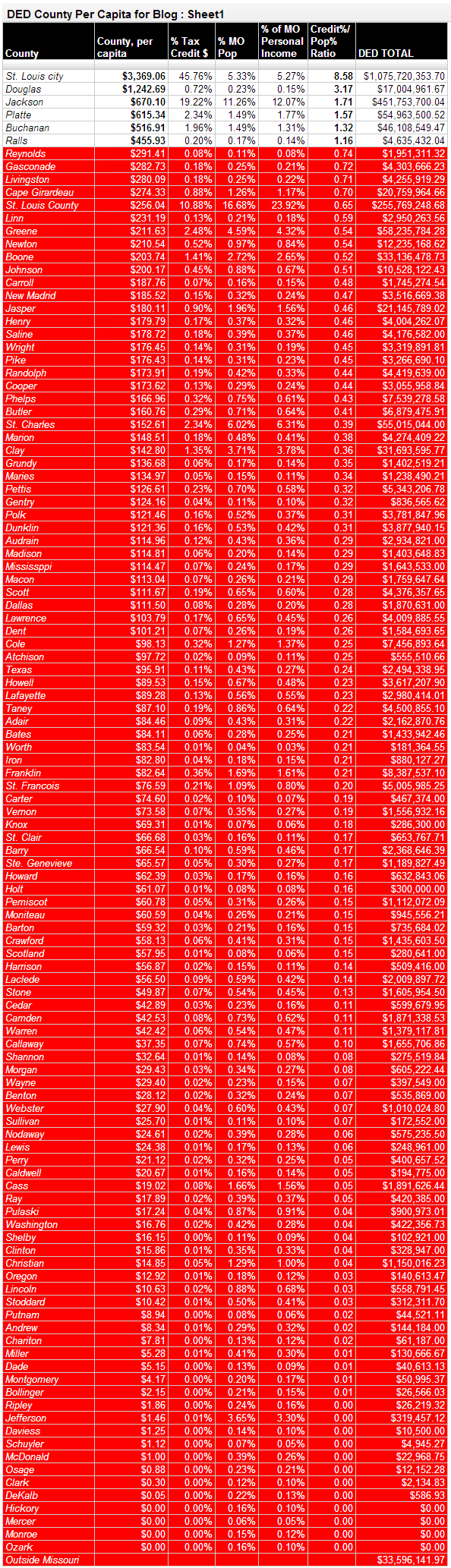
Two years ago, Bruce Stahl and I compiled tax credit data from the Missouri Department of Economic Development (DED), the state’s primary development agency, to determine how economic development tax dollars were distributed geographically. Now that the tax credit reform issue has returned to the legislative forefront, it is important for Missourians to understand that these incentives have not been distributed on anything approaching a geographic basis — the way in which a tax cut, generally speaking, would reveal itself.

The data below encompasses tax credit issuances from 1999 to 2011. If tax credits had been distributed in line with Missouri’s population, each resident would have received the equivalent of about $393 in tax credit issuances.

Six of Missouri’s 115 counties (114 plus Saint Louis City) received above this $393 per person figure. The remaining 109 — more than 90 percent of Missouri counties — received less than that average. A searchable version of this document is available here. To put it bluntly, it seems to me that a vast majority of Missourians are essentially picking up the economic development tax credit tab for projects in just a half dozen Missouri counties. The disparities between counties here would be far, far less pronounced if instead of focusing on distributing tax credits to some, we distributed tax cuts to all.

Light Rail Does Not Replace Cars

A new study about the effect of light rail on traffic was just conducted in England. According to an article in The Atlantic Cities, planners Shin Lee and Martyn Senior, of Cardiff University, “discovered that car ownership and car commute share often continue to rise in these corridors, and that ridership growth is often the result of travelers shifting over from buses ? — not cars.”

This is what has happened in Saint Louis and what would happen in Kansas City. Ridership from valuable and successful bus transit is depleted in favor of a much more expensive and much less flexible rail transit. In 1999, Tom Irwin, who was executive director of Saint Louis’ transit authority, the Bi-State Development Agency (now Metro), indicated that increases in rail ridership — in the face of a fare increase — seemed to come directly from bus ridership. From a 1999 St. Louis Post-Dispatch article:

The increase in light-rail riders is canceled out by the drop in bus ridership, meaning the agency’s revenue remains relatively flat, Irwin said. That’s because there are more bus passengers than rail riders, so each percentage point signifies a greater number of riders.

Years later, in 2008, Metro threatened to cut about half of its bus routes in Saint Louis if a sales tax, partially to expand light rail, was not approved. In other words, they would sacrifice efficient bus transit to pay for inefficient rail transit.

Kansas City voters have rejected light rail multiple times, so city officials contrived a special tax district in which only 300 affirmative votes were necessary to embark on a multi-million dollar city outlay. The line they propose will be along existing roads, and likely will not attract the traffic (or the convention business) to fill them. What is certain is that it will never be self-funding, but instead will require taxpayer subsidies in perpetuity.

Supporters of light rail will never be dissuaded from their vision. Economics will not do it, studies such as these will not do it, and in Kansas City, even repeated rejection from voters will not do it.

Taxpayer-Funded Lobbying: Government Lobbying Government

Most lobbyists who vie for tax dollars are privately funded. But some public entities — cities, public employee groups and others — hire lobbyists using taxpayer dollars, in order to lobby higher levels of government for even more tax dollars. Show-Me Institute Policy Analyst David Stokes discusses the concept briefly in this video, and at length in a recent paper.

One Step Closer

Facing a potential stampede of businesses heading across our western border, the Missouri Senate came one step closer to lassoing some of them back. The Senate Ways and Means Committee recently approved proposed legislation that would reduce individual and corporate income taxes by 1.5 percentage points. This is great to see. If a major tax cut bill can get out of committee, it has cleared a major obstacle toward becoming law.

My colleague Patrick Ishmael and I have written about the benefits for Missouri if corporate income taxes are cut. Considering that Senate Bill 26 (SB26) proposes reducing the corporate income tax, it seems the Senate Ways and Means Committee agrees with our assessment. Allowing businesses to keep more of their money will enable them to reinvest their earnings into expanding their facilities, hiring employees, or lowering their prices to consumers.

Patrick and I have also talked about the need for Missouri to respond to the Kansas tax cut. Lowering our tax rates will minimize the  advantage that Kansas has over us and potentially keep Missouri businesses from moving across the border. With other states moving toward serious tax reform, it is encouraging to see Missouri move in that direction as well.

SB26 is not a perfect piece of legislation. Like the Kansas law, it does not include any alternatives to offset the lost revenue from the tax cut. A previous version of the bill included a hike to the state sales tax. Capping or eliminating economic development tax credits would also serve to offset some of the lost revenue. However, the perfect should not be the enemy of the good.  The fact that the Senate has come this far in getting tax reform passed is encouraging and I hope some kind of tax cuts are enacted. Missouri cannot afford to wait.

Springfield School Choice Kerfuffle

On Feb. 17, the Springfield News-Leader published an article I wrote about private school choice. In that piece, I tell the story of parents who are not satisfied with the quality of education their child is receiving. They would love to have their child in another school, but that is not possible because Springfield lacks school choice options unless parents are willing to move, can afford private school, or can take part in the district’s intra-district choice program. The parents in the story applied for a transfer within the district, to no avail.

In the article, I mention that their child attends a school where only one-third of all students are reading on grade level. Today, the paper ran a letter from the school’s principal, Adam Meador, which takes issue with my statements. “[W]e use many tools to measure student success. . . . James Shuls chose to focus on only one — MAP data . . .,” Meador wrote.

I need to say two things about this:

1. My calculations were based on the only publicly available data that I have access to, the school’s performance on the MAP (Missouri Assessment Program). The MAP is a standardized test that was developed with input from Missouri teachers. The scores on the MAP represent what Missourians have deemed that students should know or be able to do. If there is an issue with that, it should be taken up with the Missouri Department of Elementary and Secondary Education.

2. This argument misses the point. The bottom line is not whether the school is doing poorly or well, but that the family is not satisfied. I have yet to see one argument against the actual crux of the article, that the private school choice programs can give parents the opportunity they deserve to send their child to a school that meets their unique needs at a cost savings to taxpayers and the public school district. By my calculations, the district could save more than $1.6 million if it contracts with private schools in the area.

Transforming Vacant Land

Usually, food on trains is nothing to brag about. A quick Google search showed that Amtrak actually has a chicken menu item called “Choo-choo Chewies.” They say it tastes like chicken. I hope they are correct.

Eating inside a cargo container sounds even less appealing than Choo-choo Chewies. (Unless it means I get to hang out with the Boxcar Children.)

As difficult as it may be to believe, there is a new project in Saint Louis that could make dining in cargo trendy and charming. Washington University in St. Louis and the City of Saint Louis named Bistro Box, “a small business incubator that transforms surplus cargo containers into a compact restaurant and culinary destination,” as one of the finalists in Washington University’s Sustainable Land Lab competition.

The Sustainable Land Lab competition invites teams to design innovative projects that transform vacant lots into assets. The City of Saint Louis owns more than 8,000 vacant lots that are just sitting there, deteriorating and underutilized. Show-Me Institute policy analysts have offered suggestions in the past about how the city can work to get more of those lots back into productive use. The Sustainable Land Lab competition is a great method to put these vacant parcels in the spotlight, and proves that innovators and entrepreneurs have exciting ideas to utilize this vacant land.

This is the first year of the competition. I hope that it will be successful in transforming vacant land and will shift the way Saint Louis treats that land. The best outcome of this project is that it would not only help improve blighted areas of the city, but encourage others to take on similar projects. Revitalization lies in the hands of eager residents who care about the community. In the past, the Saint Louis Land Reutilization Authority (LRA) has not been willing to allow development to occur organically, preferring to hold land for development that the agency chooses. But the government cannot predict what will be the best use of the land (remember Pruitt-Igoe?), nor will it come up with the most creative solutions.

Anything — including eating train-track chicken in an abandoned cargo container — is preferable to the city holding the land for decades.

Volunteer Health Services Act Returns To Legislature

We often write about innovative reforms on this blog, and last year, I highlighted the proposed “Volunteer Health Services Act,” or VHSA. The act would have ensured that licensed out-of-state doctors who wanted to provide Missourians with free health care could do so without unnecessary government interference. Missouri’s current licensing laws make such activities nearly impossible — keeping charitable groups such as Remote Area Medical out of the state. The VHSA, which would have reformed the law, was on track for passage until it was unexpectedly derailed in the waning days of the 2012 session.

The good news? The proposal is back. To be clear, this is a reform that allows doctors to make a difference in the lives of Missourians without unnecessary interference from state bureaucracy — and would not impose a cost on the state.

Suffice to say, I am following the trajectory of this bill with great interest and will update our readers on its progress.

February Book Club Recap – The Road to Serfdom

The Road to Serf City by Mary Chism
Drawing done for the February book club meeting by former SMI intern Mary Chism

Last night was obviously Snowmaggedon, and I hope everyone is staying safe out there as some of the roads are still nasty. The previous night, Wednesday, we hosted the second Show-Me Institute Saint Louis Book Club meeting of the year. We discussed the classic The Road to Serfdom, by Friedrich Hayek. The central theme of the book is that fascism is a natural outgrowth of socialist central planning. Hayek’s desperate wish was to warn the western nations, especially England and the U.S., not to pursue the path of central planning. Hayek believed that a descent into fascism was more likely than it seemed to his audience: the citizens of non-fascist western nations in 1944.

But all that just makes the book sound like a dated warning against something no one really advocates anymore, right? Well, the book has staying power because of two timeless features which are perhaps separate sides of the same coin: Hayek explains why the price system not only works, but is the best system possible for maximizing individual welfare while also making a strong case for individual liberty and limited government, which Hayek calls (using the connotation of his time), liberalism.

It was a wonderful meeting and a rousing discussion. Book club meetings start at 7 p.m. and usually wrap up about 8:30 or 9 p.m. But Wednesday’s meeting did not end until shortly after 9:30 p.m. — we all had so much to discuss. Here are some of the topics and ideas we discussed:

  • Whether a person’s concept of what is possible constrains their action.
  • The important distinction between freedom and power: what it is and why it is important that they not be confused.
  • This wonderful quote from Adam Smith (introduced roughly by Hayek): “[the regimentation of economic life puts governments in a position where] to support themselves they are obliged to be oppressive and tyrannical.”
  • Where Hayek drew the line on the proper role of government and how that might undermine his overall message of liberty.
  • Whether market competition is inherently violent (hint: it is not).
  • Whether a legal system is necessary for competition, and David Friedman’s “the discipline of constant dealings.”
  • The contradiction and ugliness of “competitive socialism.”
  • An extended interlude about “Little House on the Prairie.”

The reading for next month is The Machinery of Freedom, by David Friedman, another classic. Friedman is an economics and law professor with a Ph.D. in physics, and the son of free-market titan Milton Friedman. From the Amazon description: “This book argues the case for a society organized by private property, individual rights, and voluntary co-operation, with little or no government.” I am looking forward to some excellent discussion on this one at our March meeting, so please join us if you can (date of meeting to be announced, check here).

Support Us

The work of the Show-Me Institute would not be possible without the generous support of people who are inspired by the vision of liberty and free enterprise. We hope you will join our efforts and become a Show-Me Institute sponsor.

Donate
Man on Horse Charging



