Grundy County Shenanigans

In conducting some research over the past year, we encountered a regrettable example of government keeping basic public information hidden. We asked for a breakdown of the total assessed value of each county by land and improvements. (Improvements are any structure on the land.) All we wanted was county totals, not individual parcel data. We did not think this was a complicated request, and all of this is public information.

Unfortunately, many counties do not track the land and improvement data separately in their software systems, so they were unable to provide us the requested info. (I think they should be required to track the data in that manner, but that is another issue.) Some counties that do track those valuations separately in their software quickly sent over the requested information for free. Other counties requested small amounts of money for the work. No problem there.

So far, so good. I was disappointed in the success rate of the information request, but at least every county was straight with us or sent us a reasonable estimated bill. Every county, that is, except Grundy.

The Grundy County Assessor demanded $9,000.

It was $9,382, to be exact. One dollar per parcel in that north central Missouri county, even though we did not want parcel data, just cumulative data. We pointed out to the assessor that we are a research institute and requested that he waive the fees. He declined and wrote, “I have a very large investment to protect.” And then it got good.

We noticed that most of the counties that provided us with the information used the same software, and the software company’s name was at the bottom of those replies. We went to that company’s website looking for public customer lists, etc. (This was not about Grundy County at this point. We realized that we needed to find all the counties that used this assessment software so we could make sure we at least had their assessment data.) The software company’s website lists client testimonials, and who do you think was listed among their clients? That’s right, Grundy County.

So, the Grundy County assessor was demanding more than $9,000 to provide us with public information that he could have gathered from their software in a matter of minutes, if not seconds.

About a dozen Missouri counties using this system provided us with the public information we requested quickly and at no charge. When we pointed this out to the assessor, and asked him to justify the demand for $9,382, he got angry and wrote, “I don’t want to do business with you anyway,” and added that we should “get the information you need somewhere else.” This, of course, ignored the fact that we are a charitable research organization, not a business, and that there is no place to get Grundy County assessment data except from the Grundy County assessor’s office. Also, just whose investment did the assessor think he was protecting?

Our initial request was on June 4, 2012. We filed a Sunshine Law violation complaint with the Missouri Attorney General’s office on July 2. Over the ensuing months, we heard some vague promises that we would get the information. To their credit, the AG’s office stayed on it. Finally, we received it, for free, on Tuesday — March 19, 2013. Even though the original project we wanted it for has been completed for a long time, the data is still helpful for another project I am working on. Plus, it was the principle of the thing . . .

It took more than nine months for us to receive a simple request of public information that probably took the office 2 minutes to send us once they realized they had no choice. The Sunshine Law is important. Keeping public information hidden by obscene fees is immoral and wrong. Apparently, Grundy County Assessor Don Stotts does not feel that way. Thankfully, however, he (or at least his assistant who sent us the data) finally changed his mind.

By the way, 25 percent of the assessed valuation in Grundy County is land, and 75 percent is improvements. This entire nine-month controversy was about us being able to write the preceding sentence.


Want to Help Science Start-ups? Cut Their Taxes. While We’re At It, Cut Everyone’s.

Last year, I wrote about a Missouri circuit court’s finding that the Missouri Science and Innovation Reinvestment Act (MOSIRA) — a package of incentives for tech companies that the Missouri Legislature passed in 2011 — was unconstitutional as passed. On Tuesday, the Missouri Supreme Court agreed.

MOSIRA had strong support of St. Louis-area biotech groups, and it was the lone accomplishment of the fall 2011 legislative session that was devoted to economic development. But lawmakers voted to approve MOSIRA that fall contingent on passage of a broader tax credit reform measure, which never happened. That led to a lawsuit by Missouri Roundtable for Life – which is concerned that MOSIRA could lead state funds to be used for stem cell or cloning research – and the program’s being overturned before ever launching.

In their opinion Tuesday, the justices wrote that the 2011 bill’s contingency clause violated the “single subject provision” of state law, and that the contingency clause could not be severed from the larger legislation, as it likely would not have passed without that clause in place.

Trivia: Do you know the bill upon which MOSIRA’s implementation was contingent? The answer: A package of tax credit legislation that included . . . the highly controversial Aerotropolis project. As went Aerotropolis, so went the 2011 session . . . and now, MOSIRA. Which is to say, nowhere.

Of course, there is an easy solution to avoid court fights such as this. Why not eliminate business taxation for all of Missouri’s companies? Stop picking winners and losers and set up a system of tax collection that incentivizes all businesses to stay in or come to Missouri. If the state wants to diversify its “investments” and support existing and emerging industries, why not tell all businesses, here and elsewhere, “We want you to invest in Missouri”? If the state did that, Missouri would, for once, force other states to respond to our pro-growth taxing proposals, rather than the other way around.

Unfunded Pension Liabilities And Car Analogies

At one point or another, we are all guilty of it . . . making bad analogies. This time, the bad analogy award goes to Gary Findlay, executive director of the Missouri State Employees Retirement System (MOSERS). According to the St. Louis Post-Dispatch’s David Nicklaus, Findlay believes using a risk-free discount rate to calculate the state’s unfunded pension liabilities is akin to taking a “zero-risk approach to traffic accidents — by banning cars.”

Findlay’s analogy was in response to a recent Show-Me Institute paper on Missouri’s unfunded pension liabilities. The author of the policy study, Andrew Biggs, demonstrates that Missouri’s unfunded pension liabilities are much higher than the state has reported when we accurately account for the risk of the investments.

Biggs, on the Show-Me Daily blog, and Jason Richwine, of the Heritage Foundation, have criticized Findlay’s remarks. In his post, Richwine states: “From an economist’s perspective on costs, Findlay is free to pursue whatever level of risk he wants with the Missouri pension fund. What he cannot do is pretend that more risk comes at no cost to the state’s taxpayers, who must make up for any funding shortfalls.”

I cannot help but heap more criticism on Findlay. His analogy would be accurate if Biggs had suggested we take a zero-risk approach to pensions by banning pensions. Of course, that is not what he suggests. Rather, Biggs argues that pension liabilities should be calculated with a low-risk discount rate. In non-economist speak, that means when you are gambling with taxpayer money, it is wise to hedge your bets.

If we want to stick with the car theme, a better analogy would be that calculating pension liabilities with a low-risk discount rate is akin to purchasing auto insurance. Like driving, our investments have risks embedded in them. I believe it is important for Missourians to adequately plan for that risk before we let our unfunded liabilities come back to rear-end us. (How is that for a car analogy?)

Trolleys, Trains, And Travails

The past few days have delivered even more sobering news for trolley and train transit in Kansas City.

First, we learned that Kansas City Southern Railroad pulled its support from Jackson County Executive Mike Sanders’ commuter rail project. The Kansas City Star editorial board lamented this development, but it is noteworthy that a very successful railroad has looked at the proposal and found it lacking. At issue was how the commuter lines would come into Union Station; the railroad apparently wanted to use a track that is not suitable for such use.

But at least that line was to use Union Station. Plans for the streetcars indicate that they will run down the middle of Main Street just to the east of Union Station, and deposit riders into the middle of an intersection.

Meanwhile, on Monday, we learned that an actual streetcar system in Kansas City, the KC Strip, is closing operations because of lack of support from some larger and taxpayer-funded businesses.

So to recap, Kansas City’s never-ending train campaign continues to underwhelm. We wrote recently about how rail fails to take cars off the road and how it loots bus funds. Now it continues despite the experiences of people who run trains and trolleys for a living. If private companies do not support or cannot succeed with rail transit in Kansas City, why would anyone think a government bureaucracy would?

It is time for the Kansas City Area Transportation Authority (KCATA) and other agencies in Kansas City to give up on these train and trolley fantasies and focus on what they have done well for years, running a bus system that best serves the people who actually need and use transit in Kansas City.

All Systems Go!

A while back, I met with a superintendent of a large school district in Missouri. He told me about the good work his school district is doing. He described it as a systems approach. Interestingly, I recently spoke with some people from the Recovery School District (RSD) in Louisiana who also described their work as a systems approach. The strange thing is that these two systems could not be more different.

After Hurricane Katrina, the RSD ramped up its operation in New Orleans. The district takes over failing schools, operates some schools directly, and authorizes others as charter schools. The system that one chief of staff described to me is one that allows schools autonomy in exchange for accountability. The RSD is actively working to put the structures in place for choice and competition to work, while ensuring students in poverty or with special needs are being served.

The system that the superintendent from Missouri described to me is very different. He views the system as being optimal when the district has sole control of all the public schools in the area. Rather than letting those schools be autonomous, he wants to develop the “best practices” and implement them throughout the entire district.

I believe the superintendent from Missouri has the best of intentions. He wants to make sure his system meets the needs of students, but I think his system has a fatal flaw in that it is built around a leader. When a good leader is in place, the system may work well; but when an ineffective leader is in place, the entire system can fail.

The RSD’s model builds the system by aligning incentives in the right direction. This includes giving school administrators the power to lead through autonomous schools and giving parents the power to choose. In this system, an individual school may fail, but the system as a whole moves ever forward because the incentives are aligned in the right direction.

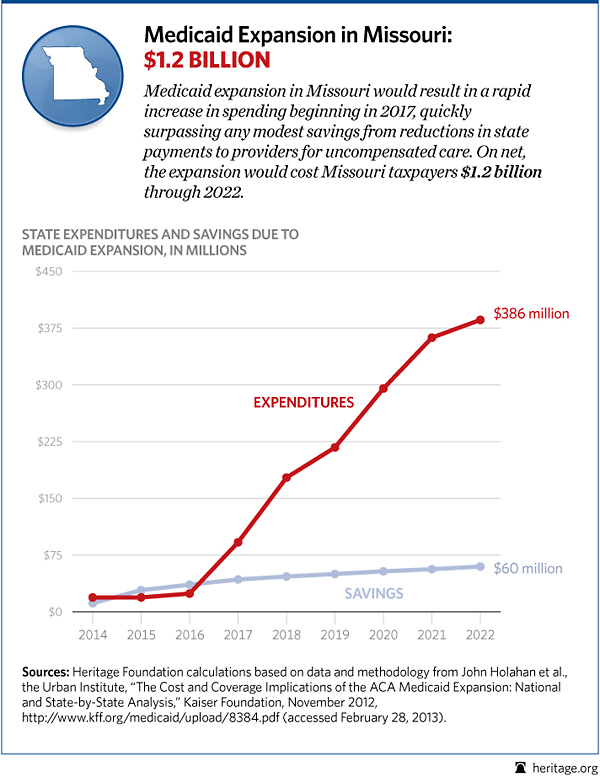
Chart: This Is Not ‘Medicaid Reform’

Earlier this month, the Heritage Foundation built and published a chart that ran out the direct costs of a Medicaid expansion with the “savings” the state could expect from now until 2022. This chart does not include the $1.6 billion in costs associated with the expansion’s so-called “woodwork effect,” whereby those currently eligible for the existing Medicaid program but not yet enrolled would become enrolled as a result of the Medicaid expansion. That fact makes this chart essentially a best-case cost-benefit scenario for a program whose costs, again, have not really been engaged by Medicaid expansion proponents. “No plan” for those costs is not good enough, as this chart bears out.

North Kansas City Should Privatize Its Hospital

The number of government-owned and operated public hospitals in the United States has declined dramatically over the past three decades. There were almost 2,000 public hospitals in the U.S. in the 1970s. There were only 1,045 public hospitals by 2011, and the trend is continuing for many of the same reasons North Kansas City is considering selling its hospital. Like the post office, the model of a government-owned and operated public hospital facility is simply not nearly as effective as it used to be. All the public concern and political opposition that opponents can generate will not change the long-term economic outlook of public hospitals.

Local governments should provide services that government is best suited to provide and that the private sector cannot serve as effectively. This includes streets, police, fire protection, and neighborhood parks. The list does not include hospitals. The private sector, including both non-profit and for-profit hospitals, has long provided fantastic health services to our country. Indeed, to many Americans, the idea of a government hospital probably feels like a relic.

As with many privatization efforts, the fears of turning a beloved public asset over to the profit-mongering private sector are vastly overstated. The Kaiser Foundation found in a 1999 study of public hospital ownership changes that, “In most instances, access to care for low-income patients has been preserved after conversion and teaching programs have not been cut.”

A 2001 study for the National Bureau of Economic Research concluded: “In many respects, the empirical evidence from hospital conversions is reassuring. … On the whole, hospitals’ missions appear to be preserved post-conversion.” The studies note that the government should carefully negotiate the contracts and monitor the operations after the sale to ensure compliance with public goals and protect the public interest. Missouri law already requires the state attorney general to review any hospital sales, as it did when Sweet Springs, Mo., sold its hospital to a for-profit company in 2009. No more state regulation is needed, especially changes that outright prevent sales to for-profit companies.

Private hospitals, both non-profit and for-profit, are a cornerstone of our health care system. They treat the uninsured and poor as part of their mission, and they do it well. The idea that only a government hospital can take care of society’s needy is as ill-founded as the idea that government should make clothes and grow food for the poor because the private sector is not capable of doing those things, either.

There is nothing wrong with North Kansas City making money off the sale of the hospital if that is what it chooses to do. That money would not disappear in a sinkhole — it would be invested back in the city or returned to city taxpayers via lower tax rates. In particular, if a for-profit hospital took over operation, the tax base of the city would be greatly enhanced. The money from the sale or new taxes could allow the city to do many things, including investing in a lower-cost health care clinic if it chose. Clinics are a far more responsible long-term strategy for local governments than large hospitals. Such a change would not be new to Missouri. Saint Louis County now operates three clinics after closing its public hospital more than two decades ago.

North Kansas City officials deserve credit for launching a careful effort to investigate the best options for the city. They are not doing this as part of a fire sale. If city leaders determine that a sale of the hospital to a private company is best for the city and its residents, they should be allowed to do so without new state regulations blocking the way. Limiting the city’s options, which recent bills filed in the state legislature would do, has no real benefit. If residents and voters do not like North Kansas City officials’ ultimate decisions, they have numerous ways to send that message.

Privatizing the hospital will benefit North Kansas City. Health care services under private operation would continue just as they have for decades under public ownership. North Kansas City should not be expected to hold back against a nationwide trend toward converting public hospitals because of erroneous fears of private operation.

David Stokes is a policy analyst at the Show-Me Institute, which promotes market solutions for Missouri public policy.

Valuing Public Employee Pension Liabilities: Nothing ‘Fair’ About It

The Show-Me Institute recently released a study that I authored about Missouri public employee pensions. The study argued that pensions should value their future benefit liabilities using a low “discount rate” to account for the fact that retirees’ benefits are legally guaranteed, regardless of how the plans’ investments turn out. The study cites numerous sources, such as the Federal Reserve, the Congressional Budget Office, and others arguing for so-called “fair market valuation.” If you value guaranteed public pension liabilities using a safe 4 percent interest rate, rather than the 8 percent rate that is common for public plans, Missouri’s unfunded pension liabilities rise from about $11 billion to $54 billion.

The St. Louis Post-Dispatch’s David Nicklaus brought these results to Gary Findlay, executive director of the Missouri State Employees Retirement System (MOSERS) and an outspoken opponent of fair market valuation. “Using a risk-free discount rate, Findlay says, is about as sensible as arguing that the state should take a zero-risk approach to traffic accidents — by banning cars.”

In fact, fair market valuation does not say that pensions cannot take investment risk. Nor does it argue that investment risk cannot pay off. Rather, it merely says that we cannot assume that investments always pay off and ignore the risks those investments pose to the budget and the taxpayer. Under current pension accounting rules, a plan that takes more investment risk — say, by shifting into stocks, private equity, or hedge funds — automatically becomes “better funded” because the plan then assumes a higher investment return. But high-risk investments do not make pensions better funded. Yes, they reduce contributions for current taxpayers — but shift an equal and opposite contingent liability onto future generations to pay full benefits should the assumed rates of return fail to materialize.

And, as recent experience has shown, riskier investments do not always pay off, even over the long run. In fact, MOSERS’s own investment consultants told them that the plan has a less than 50 percent chance of achieving its stated returns. But full benefits must be paid 100 percent of the time. Fair market valuation catches the cost of guaranteeing full benefits. Current accounting standards ignore it.

Findlay’s traffic accident analogy is not the most apt, but think about it this way: Automobiles come with obvious benefits but also costs, including the risk of traffic accidents. But we cannot weigh the costs and benefits if we refuse to count the number of accidents each year. Similarly, we cannot refuse to consider the possibility that our bets on high-risk pension investments will not pay off, particularly when billions of taxpayer dollars are on the line.

Support Us

The work of the Show-Me Institute would not be possible without the generous support of people who are inspired by the vision of liberty and free enterprise. We hope you will join our efforts and become a Show-Me Institute sponsor.

Donate
Man on Horse Charging