Remember That Residents Are Customers

One of the reasons I shop on Amazon almost weekly is because of the company’s impeccable customer service. (I also like that I can read reviews from strangers on everything before I buy, allowing them to justify my purchases when they say, “This is the best EVER, you need this!”)

Successful business owners will tell you that paying attention to their customers’ needs is ultimately what drives the business. Yet, sometimes customer desires can be pushed aside, even when they are observable and understandable.

There is strong opposition to the proposed new Kansas City Airport terminal, from both Kansas City residents and politicians. A recent poll showed that two-thirds of respondents were opposed to a single terminal, and groups such as Save KCI are getting involved in the discussion. Despite the vocal opposition, however, the city supports moving forward with a study to lay out plans for the new terminal.

If the study were coming from a completely unbiased source, I would say, study away. But many times these studies report what the strong political interests want, instead of truly depicting the best options for a project.

This case is different from some other public projects because ultimately, the success of the airport depends on how many people use it. If the new terminal is not user-friendly and travelers do not like it — they are less likely to fly as often. Right now, people love the convenience of the airport. If it becomes a hassle to fly, the city must remember that people do have other options. It is counteractive to waste billions, as we did in Saint Louis, on a new terminal that attracts less business than the supposedly outdated one.

Better Bottom-Line Fuels Budget Battle

Because of increased revenue, the state of Missouri looks like it is on track for a surplus by the end of the current fiscal year. Great! Now the question is, what to do with it? The House and Senate are going back and forth on what to do with any projected surplus. Hopefully it is not plugged into the operating budget, but anything is possible. Of course, I have a modest suggestion.

How about using some of that surplus to pay off the state’s pension liabilities? The Missouri State Employees Retirement System (MOSERS), for example, has an unfunded liability of more than $3 billion (it is really much larger than that, but for the sake of argument, let’s go with the official numbers). Even if the state moved to a defined contribution (DC) plan immediately, the current liabilities in the pension remain.

Unless there is some kind of economic miracle between now and June 30, the surplus will not be $3 billion. However, a little money invested now can yield large savings in the future. Even using a 4 percent discount rate, a $100 million investment today will be worth more than three times as much in 30 years. It is the same principle as putting a larger down payment on a house. The larger up-front payment will mean lower total spending on the mortgage as a whole. That is a savings for future taxpayers.

A state surplus would be a good thing, but the state has an obligation to use any surplus responsibly. Helping to make sure our pensions are funded is a worthy goal and one worth pursuing.

Kansas City Thinkin’ About A Charter Change

Tony’s Kansas City has had the story about some in Kansas City who are considering changes to the city charter in order to strengthen the role of the mayor. This is as good an opportunity as any to remind people of all the work we have released on the issue of local government in Kansas City.

My main charter recommendation for Kansas City government is to remove the peculiar designation that makes each at-large councilmember also represent one of the council districts. There are benefits to at-large elections (lower overall spending), but they are reduced if you make at-large officials also represent a district. Just let the at-large reps serve at-large and the district reps serve the districts.

It will be interesting to see what concrete proposals come out of this. Will the role of the mayor be increased at the expense of the council or the city manager? It is basically impossible to implement a true “strong mayor” system like Chicago (or, for a Missouri example, like Florissant — neither is really a good comparison) and maintain an influential city manager. But there certainly can be smaller steps taken to strike more of a balance. I cannot wait to hear what those steps may be.

Ethanol Subsidies Should Be Eliminated

Give Ryland Utlaut points for audacity in his commentary in favor of the Renewable Fuel Standard (RFS). Seeing an ethanol producer rail against “special interests” is like watching members of the Kardashian clan object to reality television. The ethanol industry is the ultimate “special interest.” The industry exists only because of government mandates and subsidies; there is no real market demand for its product.

Unfortunately for the ethanol industry, everything it claims it can do is already being accomplished by improved natural gas production, commonly called “shale gas,” in the United States. Increasing American energy output? Check. Reducing dependence on foreign oil? Check. Lowering energy costs for consumers? Check. Reducing CO2 emissions to improve our environment? Check. American energy output currently is the highest it has been for decades and our dependence on foreign oil is the lowest it has been for decades. We have shale gas extraction to thank for this, not biofuels such as ethanol that have long had political muscle but no market appeal.

Fortunately for consumers and taxpayers, these amazing changes to our energy industry are being accomplished with limited government involvement. The federal government is not even the primary regulator of natural gas, states are. Natural gas is subsidized to a lesser degree than many other types of energy, especially ethanol. According to the U.S. Energy Information Agency (EIA), in 2010, natural gas produced 80 percent of the non-electricity energy in the country, and received 21 percent of the subsidies. Biofuels, including ethanol, produced just 11 percent of the non-electricity energy in the country, but received a whopping 73 percent of the subsidies.

How has America benefitted from those huge subsidies ($6.64 billion in fiscal year 2010, the most of any type of energy)? Our largest “benefit” has been a major diversion of corn from food — where it was useful — to gas — where it is not. This has helped lead to increased food prices. Nice benefit – higher prices across the entire food chain, from eggs and bread to chicken and steak, and almost all dairy products, costing American consumers billions of dollars.

Most ethanol consumed in Missouri is a result of our state’s deplorable E10 mandate that all gasoline sold includes 10 percent ethanol. However, in some places, E85 gasoline is sold at gas stations as a consumer option. In those places, E85 competes with traditional gasoline on price and quality, like any product in a market economy should. E85 competition should be the model for the industry, not continued reliance upon federal and state mandates and subsidies. Regrettably, organizations such as the Coalition for E85 remain committed to government involvement as a staple of the industry.

Utlaut quotes a number of impressive-sounding totals for ethanol investment in Missouri. Whatever the totals are, they do not hide the fact that without government support, the industry would shrink dramatically – and almost certainly collapse. That may sound unfortunate, but is it really preferable to continue taking tax dollars from everyone else to prop it up? The simple fact is there is no sizable market demand for ethanol.

The growth of the ethanol industry in Missouri and the entire country is tied to government. We have a state mandate that ethanol be in our gasoline. We use state tax dollars to support its production. We have federal mandates that a certain amount of ethanol and other renewable fuels be sold (the RFS), whether people want it or not. We have all of these subsidies despite the fact that shale gas is already moving our energy industry forward and succeeding in ways ethanol can only dream (or lobby) about.

The Renewable Fuel Standard was unnecessary even before shale gas and other improvements rendered it meaningless. Once again, the free market is solving problems on its own. The ethanol industry is like your least favorite uncle at Christmas who borrows money from your parents to buy you a crummy gift you do not want or need and then expects you to fawn all over him. No thanks, we would just like our money back. The RFS needs to go.

David Stokes is a policy analyst at the Show-Me Institute, which promotes market solutions for Missouri public policy.


Part Five: The Smallness Of The Potentially ‘Hip’ Core

In Part Four, I wrote about how the number of jobs in Saint Louis’ “central core” fell dramatically in the last decade. The Brookings Institution found that in the 3 miles surrounding Saint Louis’ business district, the city had lost almost 28,000 jobs from 2000 to 2010. Of the job growth the region did experience, those jobs predominantly materialized far outside the city center.

Kansas City feels Saint Louis’ pain. Like Saint Louis, Kansas City has undertaken a series of urban redevelopment plans of its own that, again, have focused on attracting the “hip” class to the city center, oftentimes with significant tax incentives. And as has become commonplace, the hip have come, but the jobs have not.

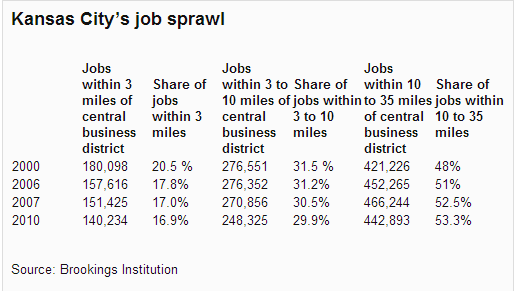
A report released […] by the Brookings Institution said that in 2010 just 16.9 percent of the area’s jobs were in the core, defined as within three miles of Kansas City’s downtown. That’s down from 20.5 percent in 2000.

Dragged down by the Great Recession, the raw number of jobs in the central core also shrank from 180,000 in 2000 to 140,000 in 2010, according to the study.

For areas between 3 and 10 miles from the city center, the number of jobs also dropped. But between 10 and 35 miles from the central business district? As in Saint Louis, the total number of jobs rose — and in Kansas City’s case, they rose significantly.

The chart below, created by the Kansas City Star, tells the decade-long tale.

Indeed, all of the regions in Kansas City were buffeted by the Great Recession. Notably, the 10- to 35-mile band was still shy of its intra-decade high as of 2010. But the downtown Kansas City job figures tell a pretty unambiguous tale: jobs have been falling in Kansas City’s central core. Like Saint Louis, population in downtown Kansas City rose over the decade, but . . . (emphasis mine)

. . . new residents hadn’t translated directly to job creation in the core by the time the Brookings information was compiled.

Since then, “we’re seeing some small businesses locate in the Crossroads and the like, but they don’t employ that many,” said Jeff Pinkerton, economist at the Mid-America Regional Council. “And we haven’t had any major employer move downtown recently.

“The fact is that jobs follow rooftops, and housing is growing in the suburbs.”

As has been explained before, “the hip crowd” does not typically have much in the way of jobs coattails. Unfortunately, it seems, Saint Louis and Kansas City know this all too well.

A Strong, Pro-Growth Tax Bill

In the high-stakes arena of legislating, the Missouri Senate and House are going heads up. In March, the Senate drew a pair of fives with Senate Bill 26, its version of substantive tax reform. It is a decent hand, but the House just one-upped the upper chamber.

House Bill 253, “The Broad-Based Tax Relief Act of 2013,” would eventually create a 50 percent deduction for pass-through entity income and cut the corporate income tax rate in half. Moreover, HB 253 ends up costing less in revenue. According to the Committee on Legislative Research-Oversight Division, the estimated revenue shortfall that would occur once HB 253 is fully implemented comes to $364 million. That is less than the $438 million in lost revenue that the state expects to occur if SB 26 were to be fully implemented.

I think HB 253 is a superior tax proposal to SB 26. Importantly, HB 253 cuts more in the areas that will produce the biggest immediate and long-term growth benefits. For its part, SB 26 creates a 50 percent deduction for pass-through income and reduces both the corporate income tax by .75 percentage points and the individual income tax rate by two-thirds of a percentage point over five  years.

Business income, i.e., profits, are the returns to capital owners after labor is paid. There is a strong academic basis for believing that taxes on capital, which business income is, are among the most economically damaging a taxing entity can impose. It is good that both SB 26 and HB 253 seek to enact cuts in these taxes. However, from a growth perspective, bigger business income tax cuts would better enhance the returns to capital owners and should be preferred to considerably smaller across-the-board cuts. HB 253 does this.

If legislators want to pursue a more ambitious proposal, they could also leverage the state’s tax credit liabilities against the tax that is left over after HB 253’s cuts. Combining HB 253 with the provisions of SB 120, which passed the Senate in March, the state could set out a course to enact further reductions in business income tax rates. Something to consider.

Part Four: The Smallness Of The Potentially ‘Hip’ Core

As I have reiterated many times during this series, Missouri’s taxpayers have ample reason to be skeptical of whether “hip” developments, often fueled by tax incentives, are producing valuable dividends to the state and region. But let’s focus on just Saint Louis’ downtown area for a moment longer. As I observed in Part Three, Saint Louis’ downtown population rose from about 4,000 people in 2000 to about 7,000 people in 2010. But what happened to the net number of jobs downtown during that time?

In a study published last week, the Brookings Institution found that Saint Louis’ “central core” — which Brookings defines as the 3-mile radius around a city’s central business district — lost almost 28,000 jobs between 2000 and 2010. That is the equivalent of almost one-in-six jobs disappearing from the downtown area in one decade. Areas just a bit further outside the central core fared similarly. Between 3 and 10 miles from the city center, the Saint Louis region lost almost 39,000 jobs.

The only area that saw growth in Saint Louis was the 10- to 35-mile ring, which gained a paltry 572 jobs. The math is not in hip developments’ favor, despite what some consultants might say.

But the math also makes another conclusion inevitable: that Saint Louis’ central core — the area where the “hip” development disproportionately predominates — lost employment market share to its outer-ring rival between 2000 and 2010. Today, only 13 percent of Saint Louis’ regional jobs are in the central core, about half the national average; meanwhile, more than 60 percent of the region’s jobs are between 10 and 35 miles away, compared to the national average of 43 percent. Saint Louis is now the fifth-most decentralized city in the country in terms of regional job distribution — behind only Detroit, Chicago, Atlanta, and Philadelphia.

While the resident population in downtown Saint Louis has grown, the number of jobs in the 3-mile ring around Saint Louis’ central business district has actually fallen. And again, all the while, the overall population of Saint Louis city has declined. This does not sound like an urban development plan that is working. City centers were built to facilitate commerce. In Saint Louis, that commerce appears to be bleeding out into some of the furthermost stretches of its region.

But Saint Louis is not the only major Missouri city experiencing a job drain. Stay tuned.

Support Us

The work of the Show-Me Institute would not be possible without the generous support of people who are inspired by the vision of liberty and free enterprise. We hope you will join our efforts and become a Show-Me Institute sponsor.

Donate
Man on Horse Charging