The Show-Me Spend-O-Meter For A New Year

New Year? It’s the end of July! Yes, it is, but for the state, it actually is a new year. Missouri’s fiscal year (FY) 2014 began on July 1, and as a part of our mission to keep you informed about the state spending money, we have updated the Show-Me Spend-O-Meter.

Compared to last year, the state is set to spend almost a billion dollars more. For those who like these things broken down (as the Spend-o-meter does), that amounts to nearly $30 more every second ($766.53 per second in FY 13 vs. $796.40 per second in FY 2014). A huge chunk (nearly 40 percent) of that comes from increased spending on Medicaid. Medicaid has continued to take up a larger share of the state budget. Just 10 years ago, Medicaid took up a little more than 29 percent of the budget; now, it is more than 36 percent. And this is a program that the governor wants to expand.

Other Show-Me oldies are in the new budget. The Wine & Grape Board gets a cool $1.8 million. Biodiesel incentives are still seeing a nice $5.5 million, and the Missouri Agricultural and Small Business Development Authority gets $130,000. Eliminating these won’t lead to a massive windfall, but every little bit helps.

The goal of the Spend-o-Meter is to help break down state spending in order to make it more comprehensible. When people realize that the state is spending close to $800 a second, it could put things into perspective and hopefully make taxpayers care about how the state is spending their money.

Obamacare-Enforcing IRS Employees Don’t Want Obamacare Enforced Against Them

If it’s “good enough” for us, why isn’t it good enough for them?

National Treasury Employees Union officials are urging members to write their congressional representatives in opposition to receiving coverage through President Obama’s health care law.

The union leaders are providing members with a form letter to send to the congressmen that says “I am very concerned about legislation that has been introduced by Congressman Dave Camp to push federal employees out of the Federal Employees Health Benefits Program and into the insurance exchanges established under the Affordable Care Act.” …

Like most other federal workers, IRS employees currently get their health insurance through the Federal Employees Health Benefits Program, which also covers members of Congress. House Ways and Means Committee Chairman Dave Camp offered the bill in response to reports of congressional negotiations that would exempt lawmakers and their staff from Obamacare.

The NTEU joins the roofers and food unions, the Teamsters, the AFL-CIO and other unions that don’t want to be subject to important provisions (for a variety of reasons) in a law they helped pass. If millions of supporters of the law’s passage don’t support even-handed enforcement and implementation of the law, why is it the law of the land at all? And why should it continue to be?

Entrepreneur vs. Government: Fashion Trucks

Emily Ponath wants to bring high fashion to office workers on their lunch breaks in downtown St. Louis. However, Emily’s been unable to get a permit from the city to park her mobile boutique, Rack + Clutch, on public streets. She needs the permit because the regulations that govern other vendors, like food trucks, don’t apply to her fashion truck. St. Louis’s leaders should cut through the red tape and allow Emily and similar small businesses to expand the economic activity downtown through entrepreneurial innovation.


What Should Crestwood Do?

The Crestwood Tax Increment Financing (TIF) proposal is dead, at least temporarily. Joining it in death is Crestwood Mall, also perhaps temporarily. City officials in Crestwood did the unthinkable and actually questioned the basis for giving large sums of public money to private developers. In return, the developer has reacted to not getting millions of dollars of other people’s money by closing Crestwood Mall (a.k.a. Crestwood Court), and pulling out of talks with the city. That is fine — it is what I would expect.

Perhaps more surprisingly, the city’s urban planning partner, PGAV, has stopped working with Crestwood because, for once, a city didn’t do exactly what PGAV told them to do. Here’s hoping that this example of a city listening to its residents and voters instead of its planning consultants gains a lot of traction.

From a municipal finance perspective, Crestwood’s solution to the closure of the mall is straightforward: join the sales tax pool. As of 2010, Crestwood was receiving $189 per capita for its general sales tax, while the pool cities received about $116 per capita. However, the $189 number has probably gone down a lot since then, and is certainly going to go down fast now that the mall has closed. Joining the sales tax pool is the answer for city finances, both short-term and long-term. Would some services have to be reduced and some taxes raised? Perhaps. But responding to this situation by trying to resuscitate a failed mall with a huge TIF would be insane. Just look at Northwest Plaza to see how that simply will not work.

From the perspective of what to do with the space, that is going to require a commitment to patience and a faith in free markets. Just look at our recent (and now very timely) video about the rejected TIF in Olivette as an example of how good things can and will come without huge incentives if you give it time.

I went to Crestwood Mall plenty when I was younger. I remember its glory days. Those days are not coming back. Reacting to the closure with some huge tax subsidy and more corporate welfare won’t work either. No matter how grandiose the planner’s dreams may be, it does not justify taking other people’s money to give out more corporate welfare. Crestwood officials deserve great credit for their judiciousness so far. Here’s hoping it holds.

For A Few Dollars More (Terminal Financing – Part 2)

According to the Kansas City Star, adding $14 to every ticket will have little repercussion on Kansas City International Airport’s (MCI) financial position. Unfortunately, it does not accurately reflect how airports operate or the important negative impacts of higher fees at MCI.

The Show-Me Institute post that the Kansas City Star responded to showed that the claims from the Kansas City Aviation Department about the moneymaking potential of a new airport are incorrect. My post ended with the statement that MCI would have to find federal funding, use local taxpayer money, or increase landing fees. The Star rightfully points out that I used rounded-down debt payment estimations — to give the city the benefit of the doubt on finding construction savings.

However, the treatment of the $14 per passenger misrepresents the actual impact to the airport. First, an airport cannot legally place a per-head charge on passengers. Only the United States Congress can do that, and the current cap is $4.50 a person. If MCI requires $14 more per passenger to break even, it will have to pass that cost onto the airlines or find the revenue on its own. Given MCI’s current contracting model, the airport is responsible for terminal debt and needs to either raise fees on airlines or sell $40 million more in hot dogs. While MCI may be able to pass all $14 onto the airlines, it would affect MCI’s ability to find new tenants to increase or maintain passenger volume. In addition, the reliance on airlines for funds means MCI is highly exposed to airline bankruptcy, which in the past has allowed major airlines to push debt onto the airport.

Additionally, the idea that this is just “a day at the movies” is incorrect. Airports compete with each other and various transportation services for customers, and they do so based on market size and cost per enplanement (CPE, or cost per passenger). Having a high cost per passenger can mean fewer passengers, as the marginal leisure traveler chooses not to fly for vacation and businesses decide to economize on airline tickets. This, in turn, reduces airline profits and constricts service, which further pushes up CPE. This is precisely why that measure is a major point in airport bond ratings, and why MCI currently advertises the fact that its CPE is only $5. The Star seems to assume that $19 per passenger, far above the median CPE for peer airports, will have no effect on MCI’s bond ratings or competitiveness.

There is no way to predict the future, but moving from a low-cost, low-debt airport to an extremely high-cost, high-debt airport that has lost passengers over the last decade is risky for MCI and Kansas City taxpayers.

New Essay: Redefining Public Education

What does it mean to support public education? To some, it means supporting the traditional system of education, whereby students are assigned to a local school based on where they live. In my new essay, “Redefining Public Education,” I discuss why this notion is completely and utterly wrong. Public education is not a system, it is the idea that all students should have access to a quality education at public expense.

For too long we have clung to a system, believing it defined public education. As I write in the essay:

It is time we redefine public education. It should no longer mean assigning students to a specific type of school, regardless of quality, but rather that we provide access to a quality education, regardless of the type of school delivering that education.

Essay: Redefining Public Education by James Shuls, PhD by Show-Me Institute

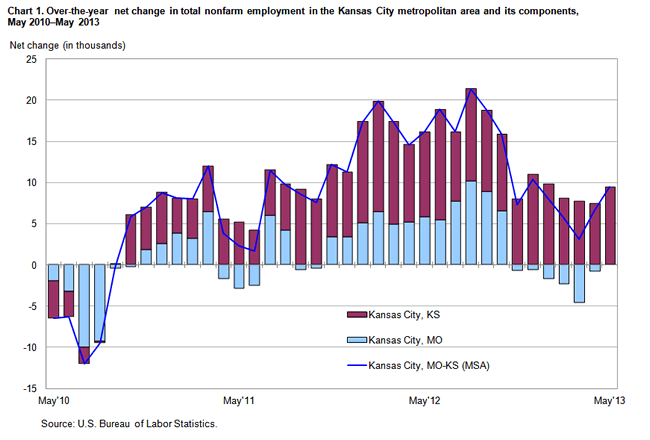
The Kansas/Missouri Economic Border War, In A Graph

Via the U.S. Bureau of Labor Statistics, who does it look like has been winning the battle lately?

Stay above the line and you gained jobs; drop below the line and you’ve lost them. And to be clear, the Kansas City, Kan./Kansas City, Mo., designations here are references to the Metropolitan Statistical Areas that compose the Kansas City metropolitan area; indeed, the data used here is appropriately broad and provides a fuller picture of Kansas City’s regional economic picture by including other large Kansas and Missouri cities along and around the border — from Overland Park to Platte City and beyond.

In the past, we’ve talked about how jobs have moved, or simply disappeared, from Kansas City’s city center in the past decade. These BLS figures provide further meat to those bones, showing that when it comes to job creation and growth, the advantage right now appears to be very much in Kansas’ favor. The question is, how long will Missouri let that undesirable status quo remain?

MCI’s New Terminal Won’t Be A Money Maker (Terminal Financing – Part 1)

An optimistic projection of future income still shows that Kansas City International Airport (MCI) will lose tens of millions of dollars a year trying to pay down the debt for a proposed new $1.2 billion terminal. The Kansas City Aviation Department may believe that a billion dollar project will satisfy the pride of the city government, but it cannot expect that any potential increased income will match the investment costs.

The yearly debt service required to pay off the $1.5 billion in bonds requested for the new terminal is more than twice MCI’s current net income, which was $30 million from operations in 2012. In order to pay off $1.5 billion in new bonds, MCI would have to pay an additional $68 million per year in interest and amortization. To support their plan, officials with the Aviation Department claim that the project will increase concession revenue and decrease security and maintenance costs.

According to the Aviation Department’s plan, the new terminal will increase revenue with more space for restaurants and services. However, in 2012, MCI only made $14 million from rentals and concessions. Comparing MCI with peer airports (pages 73-75) it could, at best, double concessions and rental fees. That would generate an additional $14 million in revenue.

The current cost of law enforcement and terminal maintenance is about $14.5 million. Reducing security lines and using a new, centralized facility is projected to decrease costs, but there is a limit to efficiency savings. In addition, MCI receives sizable federal grants for security and maintenance, so the federal government will share any savings. So, as a best-case-scenario, let’s be generous and assume that the annual cost savings is $7 million.

The figures suggest that Kansas City will not recoup its new investment costs even in the best conditions. Even if MCI doubled its concession/rental income and slashed its security and maintenance by 50 percent, the airport could cover less than a third ($21 million) of the project’s $68 million yearly financing costs.

Ultimately, the airport will have to bridge that $47 million gap with higher landing fees, federal grants, Kansas City taxes, or an unappealing combination of the three.


An optimistic projection of future income still shows that Kansas City International Airport (MCI) will lose tens of millions of dollars a year trying to pay down the debt for a proposed new $1.2 billion terminal. The Kansas City Aviation Department may believe that a billion dollar project will satisfy the pride of the city government, but it cannot expect that any potential increased income will match the investment costs.

The yearly debt service required to pay off the $1.5 billion in bonds requested for the new terminal is more than twice MCI’s current net income, which was $30 million from operations in 2012. In order to pay off $1.5 billion in new bonds, MCI would have to pay an additional $68 million per year in interest and amortization. To support their plan, officials with the Aviation Department claim that the project will increase concession revenue and decrease security and maintenance costs.

According to the Aviation Department’s plan, the new terminal will increase revenue with more space for restaurants and services. However, in 2012, MCI only made $14 million from rentals and concessions. Comparing MCI with peer airports (pages 73-75) it could, at best, double concessions and rental fees. That would generate an additional $14 million in revenue.

The current cost of law enforcement and terminal maintenance is about $14.5 million. Reducing security lines and using a new, centralized facility is projected to decrease costs, but there is a limit to efficiency savings. In addition, MCI receives sizable federal grants for security and maintenance, so the federal government will share any savings. So, as a best-case-scenario, let’s be generous and assume that the annual cost savings is $7 million.

The figures suggest that Kansas City will not recoup its new investment costs even in the best conditions. Even if MCI doubled its concession/rental income and slashed its security and maintenance by 50 percent, the airport could cover less than a third ($21 million) of the project’s $68 million yearly financing costs.

Ultimately, the airport will have to bridge that $47 million gap with higher landing fees, federal grants, Kansas City taxes, or an unappealing combination of the three.

Show-Me Minute: Tax Credits

The Show-Me Minute is a short radio advertisement to inform listeners about the work of the Show-Me Institute in a particular policy area. In this Show-Me Minute which first aired on KWTO 560AM in Springfield, MO, we discuss tax credits.

Transcript:

Know any big time gamblers?

Sure you do. They’re your elected
officials. They gamble all the time with tax credits. Tax credits sound like
a great idea–a way to attract business without spending any money. It’s
like using your credit card to buy that expensive watch or HD TV you’ve
always wanted. You don’t have to pay any money up front and you figure
you’ll somehow have the money when you need it. So Governments hand
out tax credits like candy, rolling the dice with your dollars and betting that
they can pick winning businesses.

But tax credits aren’t free money. Often the gamble doesn’t pay
off and then the bill comes to you in the form of reduced services or
higher taxes. Why should lawmakers gamble with your money? They
shouldn’t. Let the free market work. If a business idea is such a good one,
let private entrepreneurs develop it and assume the risk.

This has been the Show-Me Minute.~ learn more about the Show-Me
Institute, where liberty comes first, click on our website at ShowMeInstitute.org

Support Us

The work of the Show-Me Institute would not be possible without the generous support of people who are inspired by the vision of liberty and free enterprise. We hope you will join our efforts and become a Show-Me Institute sponsor.

Donate
Man on Horse Charging