

State Audit Recommends Sunset Of Historic Preservation Tax Credit

You saw the original, and now here’s the sequel. Just weeks after producing an excellent report on Missouri’s Low Income Housing Tax Credit, Missouri’s state auditors have returned with a review of the Historic Preservation Tax Credit (HPTC) program. We have talked about the HPTC at length here on the blog and elsewhere, and I am delighted that the state’s auditors took a look at a program that has hemorrhaged taxpayer money for years.

What did the auditors find? A lot. For starters, HPTC tax credits have cost the state nearly $600 million over the last five years alone and more than a billion dollars over the last 10. Missouri leads the country in “qualified rehabilitation expenses” (QRE) for historic preservation, which relates to the expenses against which the HPTC could be applied. Broadly speaking, the higher the QRE that rehabbers claim under the HPTC, the more money the state will be spending on it.

So, how big is Missouri’s QRE lead? Check out this chart from page 8 of the audit.
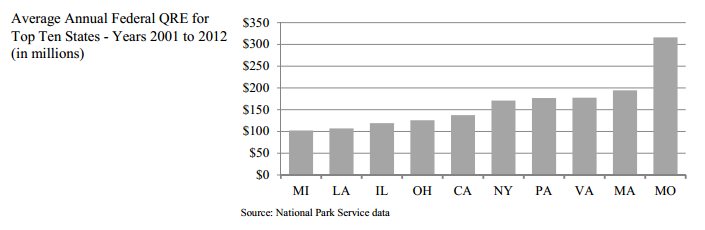
For perspective, Massachusetts, Virginia, Pennsylvania, and New York are all original U.S. colonies. Are we to believe that Missouri should have been subsidizing preservation spending at almost twice the rate as the next closest state… and not only that, subsidizing it at that level for more than a decade?

I can appreciate that we love our old buildings in Missouri, but if anything and everything can get the stamp of being “historic,” then we degrade the things that are, in fact, historic and waste limited taxpayer resources in the process. Could some projects be worthy of taxpayer support? Possibly, but those cases would be an exception, not a billion dollar rule.

To name a fraction of the examples that underscore this reality, Norwood Hills Country Club should not have received taxpayer money. A whole host of private mansions that the HPTC subsidized should not have received taxpayer money. Check out this story, from the audit:

In 2011, the DED issued about $296,000 in credits to an applicant who renovated a 3-story, 5,400 square foot home in an affluent neighborhood in a metropolitan area. The applicant purchased the home in 1993 for nearly $300,000 and reported about $1.2 million in qualified rehabilitation expenditures. The home has a fair market value of approximately $434,000.

So the owner buys a $300,000 house, drops $1.2 million into it, gets nearly $300,000 (almost what he paid for the house originally!) in credits from the state, and the value of the house rises… about $130,000? On what planet does subsidizing a private residence in a wealthy neighborhood make any sense for taxpayers? Why did Missourians have to effectively reimburse this person the purchase price of their home? Who’s looking out for the taxpayers here? And who in their right mind and looking at the numbers thinks this is a good “investment” for the state?

The HPTC is a mess of a program. The least the legislature could do is set a date for this madness to end.

Spending ‘Brewster’s Millions’ On Missouri Public Schools

Brewsters Millions

Imagine your great uncle passes away and leaves you a huge sum of money, but there is a catch. To get the money, you have to spend $30 million on Missouri’s public education system and make a demonstrable impact on student achievement. Contrary to the plot of the 1985 comedy “Brewster’s Millions,” your great uncle demands results. Would you follow Missouri Budget Project’s advice and put the $30 million into the state’s foundation formula for public schools to make up for the funding gap?

If so, you could probably kiss your riches goodbye. You might be better off following Monty Brewster’s lead and organizing a baseball game against the St. Louis Cardinals. You could invite disadvantaged students to watch the game on a field trip. After all, one study has shown that “poor” readers with more knowledge about baseball outperformed “good” readers with relatively little knowledge about baseball.

All levity aside, there is little reason to believe that pumping more money into the funding formula will lead to improved results.

Let’s imagine that you do put the money in the formula to fill the “underfunding” gap. In the table below, I display how much Missouri schools would get from your great uncle’s generosity. In this graph, schools were sorted into deciles based on the percentage of students scoring proficient or advanced on the state’s math exam (districts were weighted for size). As you can see, you would be giving almost as much money to the highest-performing schools as you would to the lowest-performing schools.

If you would not invest your own money in this manner, why would you invest taxpayer money this way?

I have never denied that Missouri is underfunding the foundation formula; the state is. This does not mean that the formula is infallible. The formula is flawed and is in need of change. It is time to stop asking how much money we can spend on schools and start asking how we can spend our money more effectively, so that we can truly improve the lives of students.

Performance Decile (1=Low, 10=High)

Percent of Funds Received

Brewster’s Wasted Millions

1

11%

$ 3,268,083.78

2

11%

$ 3,408,597.58

3

9%

$ 2,633,148.34

4

12%

$ 3,562,383.35

5

9%

$ 2,742,869.50

6

10%

$ 3,107,064.16

7

10%

$ 3,026,888.02

8

12%

$ 3,545,048.73

9

8%

$ 2,407,816.09

10

8%

$ 2,298,100.43

Kansas City Streetcar Expansion Could Buy More Than 100 Buses

For the same cost as the proposed streetcar expansion, Kansas City could buy and operate 105 additional buses, even with a planned Transportation Development District (TDD).

The TDD is intended to raise $471.9 million to complete the nascent streetcar system throughout the inner city. Our position is that these systems are less efficient at moving people than buses and that the promises of economic development from streetcars are without empirical basis. To their credit, most streetcar supporters spend their time arguing that the streetcars bring economic development and do not try to claim that streetcars are more efficient people movers.

Nevertheless, many proponents have the idea that it is cheaper in the long run to build a streetcar system than to expand bus service. This post addresses these arguments and asks how many buses the Kansas City Area Transportation Authority (KCATA) could buy and operate if it were given the resources of the $500 million streetcar plan.

Using data from the National Transit Database, KCATA, and actual performance of streetcars in Portland, I estimated yearly operating costs and revenue streams for the streetcar and an expanded bus system. While any such calculations on an unfinished system require some estimation, my calculations are streetcar-friendly by assuming high ridership, elevated farebox recovery, and controlled capital and operating costs.

The findings were that KCATA could buy and operate 105 additional buses for the same cost of building and operating 7.6 miles of streetcar lines.  To satisfy objectors who might claim huge life cycles for streetcars, I also made a calculation assuming the streetcars were not replaced and that only buses were replaced. This reduction in streetcar costs meant KCATA would only be able to buy and operate 100 buses.

To put that in perspective, KCATA currently only operates 257 buses for 61 bus routes that serve the entire Kansas City region. Adding 105 buses would significantly improve regional services and would utterly transform bus service if they were bound to the TDD meant to serve the streetcars. The chart below shows what type of bus service 7.6 miles of streetcar lines buys:

Matt Transit Graph

The case is clear. Whatever one believes about the economic development promises of streetcars, in terms of providing mobility, buses are far more cost-efficient than streetcars.

Does An Underfunded Formula Really Hurt Schools?

Does “underfunding” have a detrimental impact on Missouri school districts? The people at the Missouri Budget Project think so. According to their recent study examining Missouri school district funding, “The vast majority of school districts throughout Missouri have been significantly hurt by Missouri’s inability to fully fund the state’s education funding formula, which is the key to our kids receiving the world-class education they need to compete in today’s global economy.” However, Show-Me Institute Director of Education Policy James Shuls and I find that there is no correlation between how much a school district is “underfunded” and its actual performance.

I agree with Shuls when he says that, on principle, the foundation formula (which is the state’s method of determining how much of its annual appropriation to district aid goes to each school district) should be fully funded. The people at the Missouri Budget Project would have you believe that the more underfunded the school, the worse its performance will be. Shuls and I were skeptical that this was actually the case so we tested the Missouri Budget Project’s claim.

In our analysis, we used the Missouri Budget Project’s numbers for the amount each district was underfunded per student. In the past, I have raised issues with the Missouri’s Budget Project’s methodology (or lack thereof) in their work. However, for the sake of argument, Shuls and I decided to accept their results at face value. To measure a district’s performance, we used each district’s English and math MAP (Missouri Assessment Program) test scores and the percentage of students who scored proficient or advanced. We then ran the numbers through STATA to determine if any correlation existed between a school’s academic performance and their level of “underfundedness.” We found none (for more on our results, please see the comments section).

The underfunding of Missouri’s school districts “hurts” school districts if you define hurt as not getting money. If, however, you define hurt as having a negative impact on performance, these results indicate that is not the case. Even if these schools were fully funded, it would not guarantee that their performance would improve. A growing body of evidence suggests that increasing funding for schools will not necessarily lead to an improvement in educational outcomes. We believe in adequately funding our schools, but the state should first make sure that taxpayer money is spent wisely before asking taxpayers for even more.

All Hail The Taxi App

The Saint Louis Taxicab Commission recently approved its first multi-company taxi-hailing app, allowing customers to book cabs from the airport. While this is a step in the right direction, Saint Louis should move aggressively toward allowing more ride-hailing apps and deregulating the taxicab industry.

Taxi service in Saint Louis City and County, like most metropolitan areas in the United States, is regulated in terms of both price and entry. This despite the fact that most economists find that this regulation reduces the total number of cabs, raises prices for customers, and increases rents for taxicab companies. They find that cab companies end up using regulatory bodies to reduce competition and increase prices. A prime example: Not long ago, the chairman of the Saint Louis Taxicab Commission said he suspects there are too many cabs in Saint Louis. Residents have to question whose welfare is protected when a cab commission official believes that.

One of the traditional defenses of the regulated taxi industry was that a free market would allow too many different pricing schemes. This would lead to price gauging of less-informed customers and, in the long term, deter ridership.

Enter ride-hailing apps, which allow anyone with a smart phone to set up a ride whenever needed. Carmel, the app that the taxicab commission approved, only partners with existing companies. However, services such as Uber and Lyft in other cities can work with individual cabs.

The approval of Carmel did not come without opposition. Some cab owners fear that eventually Carmel will start to work with individual cab owners, cutting out traditional dispatches and devolving control. As St. Louis Public Radio reported, one owner stated:

“Right now, there’s other operators that operate illegally within St. Louis, sedan operators, and they’re not able to control that, so how are they going to be able to control and monitor this?”

Why is this a bad thing? If new apps allow customers to find a cab they want at a price they are willing to pay, what “problem” is the taxicab commission solving by controlling prices and market entry?

If the only answer to this question is “control,” it is clear that the taxicab commission should not regulate entry or market prices. They should focus instead on simple cab registration and safety inspections.

Bad Data, Bad Tech and No Expansion Lead to Fall in Missouri Medicaid Enrollment

After President Barack Obama signed the Patient Protection and Affordable Care Act into law, the Centers for Medicare and Medicaid Services estimated that nearly 12 million people would be added to the country’s Medicaid rolls by 2014. At the time the expansion was mandatory, and the expectation was that most states would fall into line and enroll people. Hundreds of thousands were expected to enroll in Missouri alone.

Read the rest of this commentary by Patrick Ishmael in the March 7 edition of Forbes.

Patrick Ishmael is a policy analyst at the Show-Me Institute, which promotes market solutions for Missouri public policy.

No Environmental Or Energy Need For A New Terminal

According to the so-called Fact Sheet that the Kansas City Aviation Department produced in April 2013 regarding the Kansas City International Airport (MCI):

The current terminal infrastructure does not allow the airport to meet the EPA’s new standards for capturing deicing fluids, which require capturing about 30% of run-off. The new single terminal will capture nearly 100% of the run-off and resolve Environmental Protection Agency (EPA) issues the airport is currently facing. The single terminal will also require less [sic] bus trips to and from the consolidated rental car facilities than the current three terminals significantly reducing carbon emissions.

This is misleading, as it suggests that MCI is under some sort of EPA requirement to improve its ability to capture deicing fluids. The EPA is fine with how MCI performs this task now. While MCI could do a better job of collecting these fluids, the EPA allows for several much cheaper ways to do it than the one method called for in the proposed $1.2 billion new terminal plan.

For example, MCI could attempt either greater efficiency in use of deicing or greater collection of runoff. Ways of reducing runoff include using highly concentrated type IV fluids, anti-icing fluids before inclement weather, hot-air deicing, and infrared deicing. As for capturing more runoff, the EPA considers using collection trucks, improvements in drainage systems, and mobile deicing pads as viable options. These options are certainly cheaper than building a new terminal, aprons, roadways, and parking structures.

The airport’s fact-checking goes on to include:

The new single terminal, built as a replacement facility on the reclaimed Terminal A site, will be built to LEED standards. The  New Terminal’s enhanced daylighting concepts , thermally designed building envelope, and new high-efficiency systems will maximize energy performance to achieve sustainability goals.

Yet we learned from a recent study of LEED-certified buildings in Washington, D.C., that the rating is apparently meaningless (emphasis added):

The free-market group analyzed the first round of energy usage data released by city officials Friday and found that large, privately-owned buildings that received the green energy certification Leadership in Energy Design (LEED) actually use more energy than buildings that didn’t receive this green stamp of approval.

The Show-Me Institute has argued that it is unlikely that a new terminal will increase revenue or provide sufficient savings to make it a viable alternative. Now we know there is no environmental or energy necessity for it either.

Support Us

The work of the Show-Me Institute would not be possible without the generous support of people who are inspired by the vision of liberty and free enterprise. We hope you will join our efforts and become a Show-Me Institute sponsor.

Donate
Man on Horse Charging



