Bad for Borrowing: Saint Louis Bond Ratings Slip

Recently, Moody’s, a prominent credit rating group, downgraded Saint Louis’s debt rating.  While the changes are nothing drastic (and the city’s outlook is stable) a lower credit rating may raise the cost of major projects in Saint Louis.

                The recent downgrade saw Saint Louis’s general obligation debt rating fall one notch, from Aa3 to A1. That still leaves the city with a rating denoting an upper-medium investment grade, even if the rating is well below prime. And as some news sources have pointed out, that means Saint Louis’s rating is higher than Chicago’s or Detroit’s. Unfortunately, if we don’t compare Saint Louis to cities exiting or very likely entering bankruptcy, its rating is relatively low, as the chart below demonstrates:

City

2015 General Obligation Debt Rating

Oklahoma City

Aaa

Indianapolis

Aaa

San Francisco

Aa1

Minneapolis

Aa1

Phoenix

Aa1

Seattle

Aa1

Dallas

Aa1

Portland

Aa1

Atlanta

Aa2

Memphis

Aa2

Washington, DC

Aa2

Kansas City

Aa2

Houston

Aa2

Baltimore

Aa2

New York City

Aa2

Nashville

Aa2

Denver

Aa2

Cleveland

A1

Saint Louis

A1

San Diego

A1

Philadelphia

A2

Detriot

A3

Chicago

Baa2


                A lower bond rating can lead to higher borrowing costs. In the same way that an individual with a low credit score might have to pay higher interest rates on a car loan or a mortgage than someone with a great credit score, a lower rating for a city can mean it has to pay more to borrow. As cities regularly borrow money to make civic improvements, the higher cost of borrowing means residents pay more for large projects like, say, a football stadium. Speaking of stadiums, the rating for nonessential debt (read: convention center and stadium) issued by the Saint Louis Municipal Finance Corporation was also downgraded, to A3. That corporation would responsible for issuing bonds for a new stadium.

                The primary reason for Saint Louis’s weak credit rating is the city’s “weak socioeconomic profile,” which is admittedly difficult for city leaders to fix. However, there are ways city hall could work to increase the city’s bond rating. According to Moody’s, the city is too reliant on the earnings tax. In addition, the city could boost its rating by making an effort to reduce total debt. Unfortunately, with the city prepared to go even further into the red to build a billionaire a new football stadium, it may be a while before Saint Louis can brag about its credit rating to people who don’t live Chicago. 

SMI Responds to PSRS on Teacher Pension Fund Risk

One of the core purposes of the Show-Me Institute is to promote transparency at all levels of government. We think this is critically important for Missouri’s public employee pension systems, and in recent years we have committed substantial time and effort to exploring the issues confronting these systems. 

Most recently, Michael Rathbone and I pointed out that Missouri’s teacher pension systems have shifted to riskier assets. From this study, we concluded that lawmakers “should be aware that these pension plan returns are based on increasingly risky assets and acknowledge that fact when planning for the future.” In particular, we suggested that the plans should forecast assets based on various expected rates of return.

On August 7, PSRS Executive Director M. Steve Yoakum issued a three-page response to the paper. Mr. Yoakum claims that our study “provides a limited and somewhat biased view of PSRS/PEERS and the Systems investment strategy,” but in the rest of his response he acknowledges several of the points we made.

Mr. Yoakum acknowledges the shift away from fixed-income investments and toward higher-risk investments, and goes on to justify this shift by citing lower returns on the former and greater opportunities “in other areas of the investment universe.” This is essentially the point we were making: equities and alternative investments have historically delivered higher returns than fixed-income investments, but they also carry greater risk.

Our paper states that current teacher and school district contributions do not cover the existing obligations, meaning that pension plans must rely on investment returns in order to meet their obligations to members. Mr. Yoakum’s response: “Only if we exclude income from investments is this true.” It is difficult to describe this as anything but a restatement of our point.

We stated, and Mr. Yoakum’s response acknowledges, that public employee pension systems have moved toward riskier assets than they held in the past. Much of Mr. Yoakum’s response is devoted to explaining this change—which is important— but the point of our paper was not to question the reasons behind the shift. Our goals were instead to document this trend and to endorse the recommendations of the Pew report that we cited repeatedly in our own study, namely that “Government sponsors can demand better reporting of future expected costs and the associated downside risks, and then use this information to make decisions about ways to deal with poor outcomes, should they occur.”

We remain committed to these recommendations, and we stand behind every word in our study. 

Course Access in Rural Texas

Earlier this month, I wrote about an emerging trend in school choice policy: course access  programs, which allow students to direct a portion of their per-pupil funding toward courses outside of their school offered by approved providers. For example, students in Michigan may choose two online courses per term, and tuition is drawn from the student’s per-pupil expenditure. Michigan Virtual School offers courses in art history, advanced math and science, and foreign languages. Courses like these are typically difficult to staff in rural and remote school districts, where teacher recruitment is a challenge.

In Missouri, 88 percent of school districts are classified as rural, and in 2014 almost 15 percent of Missouri school districts enrolled a student population of 150 or less. A course access program has the potential to provide diverse curriculum options for students in these districts, as well as an opportunity for local school districts to earn revenue through student enrollment outside district boundaries.

Guthrie Common School District in Texas provides an example of the possibilities offered by course access programs. In 2013, the district enrolled 91 students. Like many small, rural school districts, Guthrie faced staffing challenges. According to a recent report, the district could not afford to hire a foreign language instructor, posing a problem for students wanting to attend the University of Texas, which has a foreign language admission requirement.

To solve this program, Guthrie leveraged the state’s course access program and partnered with Rosetta Stone to create state curriculum–aligned Spanish courses. Now, students from Guthrie who want to get into the University of Texas have a chance. 

But that’s not the end of the story. Because of the flexibility built into the program, Guthrie was allowed to enroll students from other districts. Guthrie Virtual School now enrolls 850 students, and offers programs in multiple subject areas. Students from around the state can access these courses from their own brick-and-mortar schools.

A small, rural school district in Missouri in Guthrie’s situation would have few choices: either merge with another district, or continue to beat the drum for more education spending.

Guthrie did neither.

Districts like Guthrie show that with a little creativity, students in rural and remote school districts can have access to the course opportunities their urban and suburban counterparts already enjoy, but policy must set the stage for innovation to take place.

Employee Freedom Week

It’s employee freedom week. That means groups around the nation are educating employees about freedoms they have to opt out of union membership. Unfortunately for Missouri public-sector union employees, these freedoms are limited.

For most Missouri public employees, unionization is a one-way trip. Once employees elect to have a union represent thier interests in negotiations with management, no further elections are scheduled, no term limits are imposed, and the union stays in power indefinitely. Workers are usually stuck with the results of that original election, even if their representative fails to provide the services it promised. New employees will be forced to accept a representative for whom they never voted.

Recently, some have questioned whether employees should be subject to this one man, one vote, one time system. Why not hold elections at regular intervals?

Regular union elections would give public employees the right to vote for a union for a fixed term. When that term ended, the union could choose to run for re-election. Other unions might also offer their services and run against the incumbent union.

Proponents of regular elections argue that competition among unions will breed innovation and accountability. At the very least, regular elections help keep the actions of unions in line with the interests of voters. With union elections, workers could choose to keep their union, elect a new union, or forego a unionized workplace altogether. Workers would no longer be bound to a union that was put into power years before they were hired. In addition, worries of unaccountable unions squandering dues on things that don’t benefit workers would be greatly reduced. If members didn’t like the way their union was run, the next election would offer the opportunity to make a change.

The power to choose who speaks for you is a fundamental freedom. Regular union elections preserve this freedom for employees, and I can’t think of a better time to promote union elections than during national employee freedom week. 

More Analysis on Minimum Wage Claims

On Thursday the City Council of Kansas City will consider placing on the ballot an initiative petition calling for an increase in the minimum wage to $15 per hour. Kansas City has been wrestling with this issue for months, perhaps because city leaders appear to have used the matter for political gain rather than for serious policy consideration. For example, regardless of the merits, there is debate as to whether the City Council even has the legal authority to increase the minimum wage.

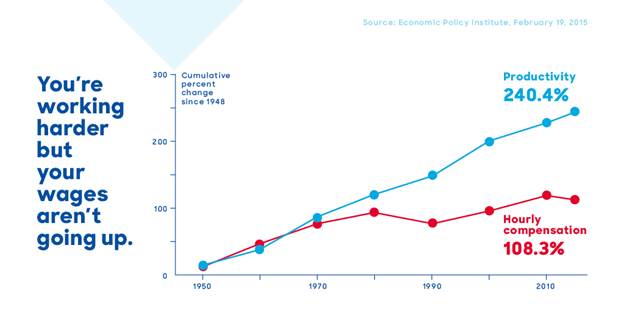
I testified on the minimum wage in May; a video of the testimony is available here. Afterward, then-councilwoman Cindy Circo asked about a chart presented previously in testimony that appeared to show that worker productivity has been rising since the 1970s while wages had not. For anyone following the minimum wage issue, that claim was a familiar one. Here is a version of the chart that has been circulating most recently:

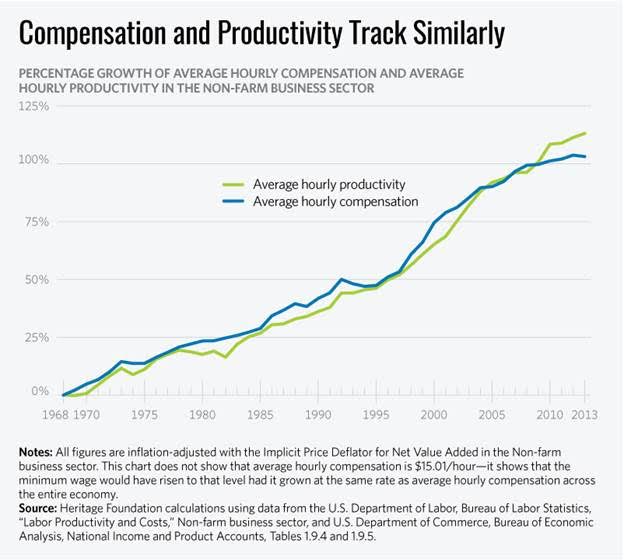
There has been criticism from the right and the left concerning this chart and what it claims to show. The Heritage Foundation weighed in with data that actually compare the productivity of hourly workers with the compensation of hourly workers. The increases over time line up nicely.

If the voters of Kansas City have an opportunity to vote on an increase to the minimum wage, they deserve an honest policy discussion about the costs and impacts of a wage hike, who will really benefit, and how it will affect the services on which they rely. 

The Video Kansas City Doesn’t Want You to See

On July 22, Professor Heywood Sanders spoke at the Kansas City library about the research in his book, Convention Center Follies. This is the same Sanders that VisitKC head Ronnie Burt and developer Mike Burke did not want to debate. One Star opinion writer even criticized the library for having a one-sided presentation on the matter (never mind that the library has speakers on policy matters all the time).

The library put Sanders's talk on YouTube. Sanders's talk starts at about 19:10 and runs for about 30 minutes, not including questions and answers. Please consider taking the time to watch the talk. Sanders presents valuable and substantive information and does so entertainingly.


New Superintendent Gives Kansas City Opportunity to Rethink School Organization

For the 5th time in 16 years, the Kansas City Public Schools are in the market for a new superintendent.  With the announcement that R. Stephen Green will be moving to Georgia, his name can be added to the list of Covington, Amato, Taylor, and Demps (and even more if we wish to look further back).

During Green’s tenure, Kansas City’s school district improved on some indicators.  Unfortunately, even with this growth, in absolute terms, the district is far from where it needs to be.  The graduation rate is only 67 percent.  As I wrote recently, that’s better than the 50 percent it was two years ago, but it’s still well behind our regional peers.  (Little Rock has a 75 percent graduation rate, and Chicago’s is 70 percent.)

Dr. Green’s departure gives the Kansas City community a chance to take a step back and think about the fundamental organization of the city’s schools.  Does a centralized bureaucracy, even led by someone with great talent, have the capacity to meet the needs of every child in the city? 

Look at New Orleans. Once considered home to some of the worst schools in the country, the Crescent City decentralized the operation of its schools and changed the role of city and state government to that of a funder and regulator. Since that time, the city has seen a marked improvement.

According to an article in the summer issue of the journal Education Next, in 2005, 64 percent of students in New Orleans attended a school designated as failing by the state of Louisiana. By 2015, it was only 9 percent.  High school graduation rates have grown from below 50 percent to over 70 percent.  What’s more, the gap between the performance of New Orleans’s schools and those in the rest of the state is closing—a more than 20 point gap among students scoring “basic” or above on state tests has shrunk to only four points. The expulsion rate is even below the state average.

The lesson from New Orleans and other cities around the country is that we should not build school systems that require a superstar at the helm in order to work.  In such a system, one great superintendent can move mountains, but one bad superintendent can jeopardize everything.

If the city were to move the operation of schools to independent and autonomous organizations and limit its role on funding and regulation, it would maximize the likelihood that the system could create the number and type of schools the children of Kansas City need. 

The city has already started down this path with a broad swath of charter school options, which clearly haven’t harmed the district.  It’s a great time to think about expanding those options to more Kansas City families.

Do the Math?

How many times has someone said “just do the math?” Unfortunately, too many children in Missouri are likely to respond with “I can’t.”

            On August 10, the Missouri Department of Elementary and Secondary Education released the MAP scores for 2015. Direct comparisons between this year’s results and those from previous years are problematic, because in the interim the state changed its standards. This makes it difficult to assess how much any particular school or district has improved student learning over time. If that’s not enough, the 2015 test results are based on Common Core, adding another layer of difficulty. Despite the challenges in making comparisons over time, we can take a snapshot of student performance, and that snapshot isn’t pretty.

            It turns out that elementary and middle school students did comparatively well in language arts and social studies. In both cases, over 60 percent of the test-takers had passing scores. However, the outcome was not as rosy when in math and science. Fewer than half of students achieved proficiency in math. For science, the one area where the standards remained unchanged from 2014, just under half of students (49 percent) achieved proficiency in 2015, a result little changed from last year.

            The overall results point out a continuing problem: poor scores in math and science. While some schools undoubtedly are producing students who are doing quite well, the fact is that even with changing standards, Missouri’s math and science scores have been low for some time. This is not a good omen for the future of Missouri’s economy. Mountains of economic research (see my essay, “Are Education and Economic Growth Related?”) show that a population’s math ability is directly related to its economic success. That is to say, countries and states in which the residents have more advanced math skills also tend to have higher levels of income and output per person.

Missouri’s future prosperity depends on the ability of our students to compete for high-quality, well-paying jobs. Those jobs will require math and science skills that our schools currently aren’t providing.

Support Us

The work of the Show-Me Institute would not be possible without the generous support of people who are inspired by the vision of liberty and free enterprise. We hope you will join our efforts and become a Show-Me Institute sponsor.

Donate
Man on Horse Charging