Student Loan Default in Missouri

Like many twenty-somethings, I am kept up at night—not by noisy neighbors, but by my student loan debt. I’ll be honest—I wasn’t a smart borrower.

If there is any consolation, it’s in knowing I’m not alone. In fact, more than one-fifth of borrowers have proved to be less-than-savvy higher education investors—22% have loans in default or forbearance. The consequences of default are serious, including wage garnishment and a severe hit to credit scores.

Last month, the Department of Education released data on the default rates for colleges and universities in all fifty states and abroad. Before getting into what solutions policy leaders have proposed to lessen the burden of student debt, let’s look at student loan default rates in Missouri.

The table below shows the percentage of students by type of institution who entered repayment in fiscal 2012 and had defaulted by December 2014. The default rate for public two-year institutions or community colleges was more than double that of public four-year and private four-year universities. Private four-year universities had a lower default rate than public four-year universities by 1 percentage point. Special-focus colleges like St. Louis College of Pharmacy had the lowest default rates (with the exception of the Kansas City Art Institute, which had a default rate of 10.2 percent*). To view default rates for most colleges and universities in Missouri, click here

Default Rate by Type of Institution in Missouri
Public four-year 8.5
Public two-year 19.4
Private four-year 7.5
Private two-year 9.6
Special focus 2.6

The pie chart below breaks down the students in default in 2014 according to the types of institutions they attended. This figure shows that public two-year colleges produce the most student loan defaults in Missouri (this trend is also apparent nationwide).
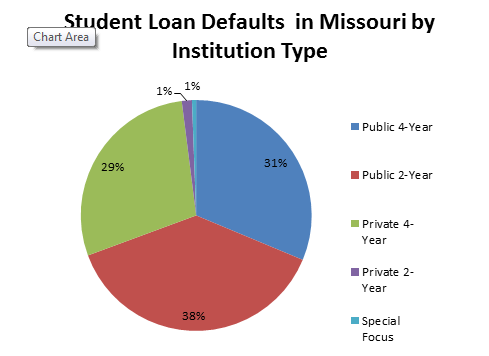
Why? The most common defaulters are students who attend college but do not graduate. These students  incur the debt, but don’t see any of the benefit, making it harder for them to pay back their loans. According to one study, the completion rate for students who start at two-year universities in Missouri is less than 40 percent. That’s a lot of students with debt and no degree. It’s a recipe for default. 

To combat default, some policy leaders, including President Barack Obama, have proposed further subsidizing higher education, but that skirts the real issue. What we should really talk about is how to make college less expensive in the first place and how to help more students graduate. The state could take several steps to do that.

First, it could work with schools to promote low-cost options. States like Texas and Florida have explored ways of reducing total costs to as low as $10,000. Inexpensive degrees that students successfully complete are an antidote to default; loans (if they are even necessary) have very low payments and degrees have high benefits.

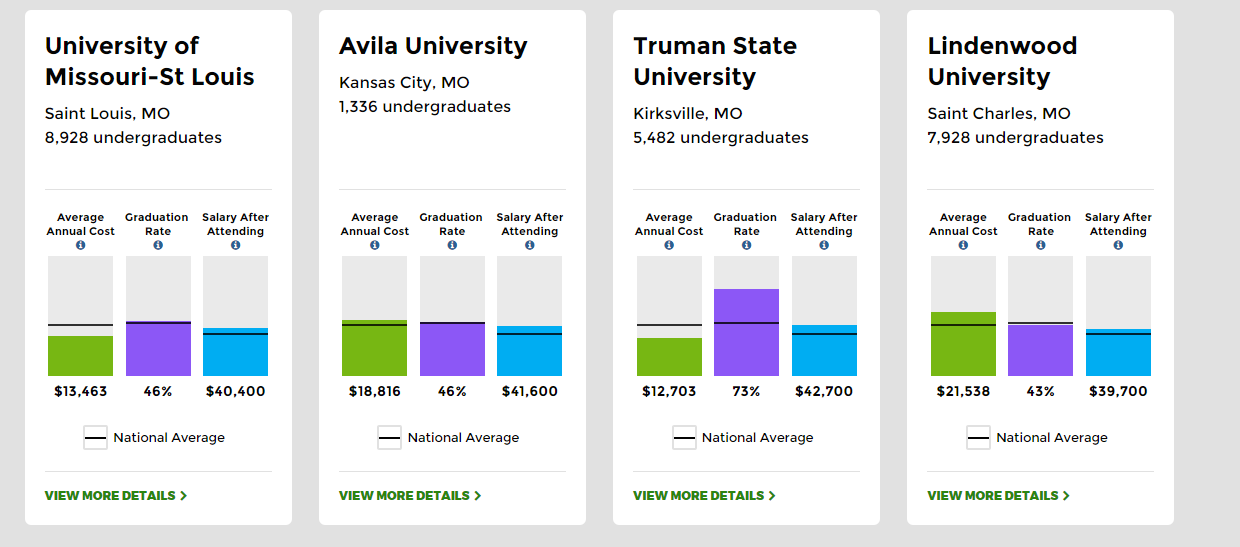
Second, the state could make both costs and benefits more transparent to potential students so they can make informed decisions and exert pressure to keep prices down. The Department of Education created the college scorecard to help students make better choices about “where to study and how to maximize their investment.” The graphs below highlight four universities in Missouri, displaying the average annual cost of attending, graduation rate, and salary after attending. The Student Right to Know Before You Go Act of 2015, an update to the Higher Education Act of 1965, was referred to a congressional committee in May and requires universities to provide more accurate and complete data.
Finally, states could force colleges to have some “skin in the game.” Under such a plan, schools would be required to pay a portion of any defaulted government loans. This would push universities to accept only students who they thought would be successful, to work with students to make it through their studies, and to help place students in jobs that will earn enough to pay back their loans.

Lower-cost options, better information, and institutions with an interest in preventing loan defaults could go a long way to helping curb debt, defaults, and the $1.3 trillion problem they create.


*The default rate for the Kansas City Art institute was originally posted as 17.1%, which was the rate reported for 2010. The 10.2% rate is correct for 2012.




Could Direct Primary Care Be An Answer to Post-Obamacare Access Problems?

Even after Congress passed the Affordable Care Act in 2010, the Show-Me Institute continued to point out the problems that the ACA not only created, but also the fundamental health policy problems it left unaddressed. Among the problems the law substantively failed to address, one of the biggest was the supply of primary care doctors. That's why it's my pleasure to share with you our latest research paper, "Where Obamacare Leaves Questions, Direct Primary Care May Offer Answers."

Along with explaining what direct primary care is and the advantages it may offer patients and doctors alike, the paper also walks through many of the problems of the ACA and outlines why those problems need to be addressed sooner, not later, if health care in this country is going to improve over the long haul. We'll have more on the contents of the paper in the days ahead.

Saint Louis and Kansas City Enjoy Low Congestion, Commute Times

Recently, the Texas A&M Transportation Institute released a report on mobility in the nation’s urban areas, specifically focusing on congestion. According to the Institute, traffic congestion is a serious problem. For example, the mobility report states that:

“In 2014, congestion caused urban Americans to travel an extra 6.9 billion hours and purchase an extra 3.1 billion gallons of fuel for a congestion cost of $160 billion.”

Direct costs aside, traffic congestion make cities more difficult places in which to live and do business. The good news for Missouri is that both Kansas City and Saint Louis actually have relatively little traffic.

                Of the 46 metropolitan areas in the United States with more than one million residents, Kansas City and Saint Louis ranked as the third and fourth least congested (by traffic indexes), respectively. In both cities, a trip that takes 30 minutes in off-peak periods only takes between 34 and 35 minutes during peak periods. In other words, rush hour isn’t really that bad in either city. Compare that to San Francisco or Los Angeles, where a 30 minute trip outside of rush hour will take about 43 minutes during rush hour.

And not all rush hours are created equal. In fact, Saint Louis might want to ditch the term altogether, because the city’s highways only experience 1.3 hours of congestion per day, meaning it’s more like “rush 40 minutes” in the morning and evening. That’s the shortest period of congestion for any large city in the United States. Compare that to Los Angeles, where the city experiences nearly 8 hours of congestion per day. It’s not your imagination, Angelenos—rush hour really does last all day.

Metro Area

Traffic Index

Rush Hours

Kansas City

1.15

2.5

Saint Louis

1.16

1.3

Large City Average

1.24

4.1

Los Angeles

1.43

7.8


Traffic congestion is correlated with a metropolitan area’s size, so Kansas City and Saint Louis benefit from not being among the nation’s largest metropolises. However, some very large cities (Atlanta, Philadelphia) have reasonably low congestion, while some cities with smaller populations (Portland, Austin) are among the top 10 most congested cities. A continuing commitment to expanding highways and eliminating bottlenecks (when necessary/possible) likely makes the biggest difference. As for Missouri’s major cities, very low levels of congestion are evidence of an adequate supply (or possible oversupply) of highway capacity. If accelerated population growth takes hold in either city, needs could quickly change, and it will be up to cities and the Missouri Department of Transportation to maintain the congestion advantages. But for now, Saint Louis residents should enjoy their “rush 40 minutes” with the knowledge that others have it much, much worse. 

For Most Teachers in Missouri, Pensions Are a Raw Deal

“Educators and education employees can focus on what they do best, educating and supporting the education of Missouri’s school children. After a full career of serving the children of this state, educators and education employees can retire with the peace of mind that they have financial security via a monthly benefit from the Systems.” [emphasis mine]

Steve Yoakum, executive director of the Public School Retirement System of Missouri (PSRS)

Steve Yoakum is absolutely right. As I have often said, teacher pensions are great for those who stay for 30 years, but they are not for those who don’t. Indeed, this was the key finding of a recent report by researchers at Bellwether Education Partners and The Urban Institute.

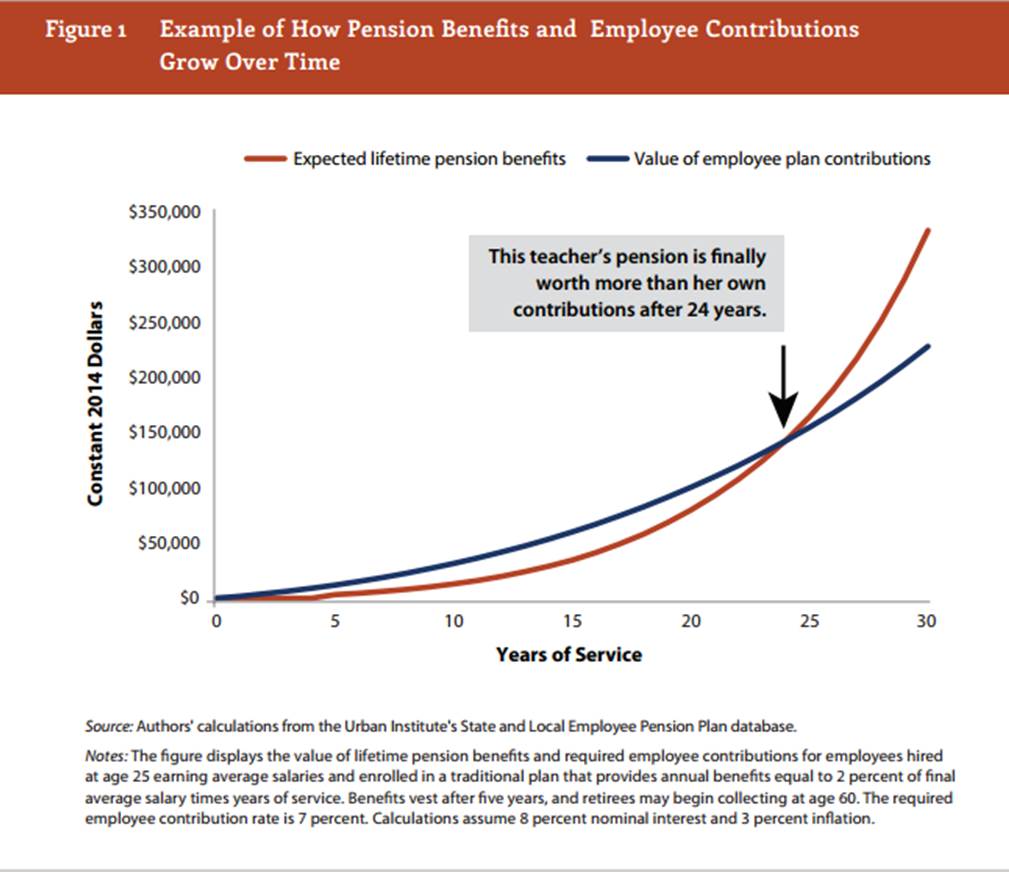
The report examines how the value of teacher contributions and teacher pension benefits accrue. In Missouri’s system, 29% of a teacher’s salary is contributed to the pension, 14.5% from the district and the teacher. As you might imagine, these contributions accumulate over time. Unfortunately for teachers, the value of their pension does not accumulate at the same rate because the pension is not tied directly to contributions. The illustration above shows how the value of the contributions can exceed the value of the benefits.

The report finds the break-even point for Missouri teachers is 28 years. That means a Missouri teacher must work for 28 years before the value of their pension exceeds the value of their contributions.

But how many teachers actually make it to 28 years? According to the report, just 38%. In other words, 62% of Missouri teachers are going to pay more into the pension system than they are going to get out. 

“After a full career,” Missouri’s teacher pensions are great. For those not working a full career, Missouri’s teacher pension system is a raw deal. We could fix this, and solve a host of other pension problems, by moving from a defined-benefit plan to a defined-contribution plan. Until we begin to tie retirement benefits directly to contributions, many teachers will continue to get shortchanged. 

Saint Louis teachers want a raise, and they have a point

On Friday, the Post-Dispatch covered a recent Saint Louis school board meeting where over 100 teachers vociferously argued for a raise.  Many have been stuck at the same place in the salary schedule for years, and the article mentions several popular, award-winning teachers who have left the district for other states or better paying schools in Saint Louis County.

The debate over how much teachers should be paid will never be settled.  We can, however, talk about teacher pay in the broader context of school funding and perhaps come to agreement on how teachers should be paid, if not how much.

Let’s walk through the numbers.  First, according to the Missouri Department of Elementary and Secondary Education (DESE), Saint Louis spends $14,093.21 per student per year. That reflects current expenses; it does not count capital costs, debt service, or several other significant line items. DESE also reports that the Saint Louis Public School District (SLPS) has a 1:18 classroom teacher: student ratio and a 1:12 total teacher: student ratio. 

That means that the average 18-student classroom brings in $253,677.78 in revenue per year.  Even looking at a 12-student classroom means $169,118.52 per year.  According to the Post-Dispatch, the average teacher salary is $46,163.*

Bottom line: A lot of money is failing to make it to the classroom.

How can this be? I’d have to dig deeper into the numbers for a full explanation, but even a quick glance points us in a couple of directions.  In no particular order:

1.       Administrative Bloat—According to DESE, SLPS has a ratio of 206 students for every administrator.  That compares to 272 students per administrator in Kirkwood, 274 in Lindbergh, 277 in Rockwood, 306 in Wentzville, and 321 in Mehlville.  Less money to administrators means more to teachers.

2.       A poorly designed salary schedule—Take a look at SLPS’s teacher salary schedule.   The big raises for teachers only come after they have earned degrees with dubious connections to actually improving student learning.  A great teacher who only has a bachelor’s degree tops out at just over $56,000 per year. Removing step-and-lane pay scales and empowering school leaders to compensate teachers based on quality could ensure that top teachers stay in the classroom.

3.       Pension contributions teachers won’t see—Saint Louis teachers are covered by the Public School Retirement System of the City of Saint Louis.  They are required to contribute 5% of their salary every year.  The district puts in an additional 16.5%. Now, if those teachers stay employed by the district until retirement, they can get a tidy pension, usually about 60% of their final salary (and they’re eligible for Social Security!).  The problem?  Teachers who don’t stay in SLPS for all 25 or 30 years of their career get only a fraction of that pension.  Indeed, it takes 5 years to “vest.” More than 60% leave before this time, and while they can take their contributions, they sacrifice what the district has contributed.  Contributing directly to a portable retirement account from day one of employment would ensure that every teacher gets his or her due.

Teachers are incredibly important, and they should be paid appropriately.  Unfortunately, the structure of teacher pay in Saint Louis and across the state prevents that from happening.

*Note: When originally posted, the average teacher salary was mistakenly listed as $41,163. The error has been corrected above.

Aviation Department Withholds Information from the Star

On September 11, The Kansas City Star Editorial Board called on the Aviation Department to end the practice of issuing free parking passes to local officials and a few others. The piece is worth reading in its entirety, and it includes this recommendation: 

City officials should pull the plug on a little-known perk that allows [Kansas City Council member Quinton] Lucas and 28 other people to park for free in the public garages at Terminals B and C. The passes are awarded by the Aviation Department’s parking division.

In advance of their editorial, The Star requested the parking pass records from the Aviation Department on September 4. On September 8 the Department responded with the list on which the editorial board based their September 11 column.

The Show-Me Institute was also looking into this data, but we also requested a copy of all passes issued since January 2011. The second list we received included additional names the Aviation Department did not share with The Star. They included passes issued to:

·         John McGurk, former chief of staff to Mayor James,

·         Buffy Smith, current staffer to Congressman Sam Graves

·         John Diehl, former Missouri House speaker,

·         Paul LaVota, former Missouri senator, and 

·         Tom Dempsey, former Missouri senator.·          


All of these passes were voided at 9:05 a.m. on September 8, right before the Aviation Department provided The Star with a list of active passes.

(Links to both lists provided by the Aviation Department can be found at the bottom of this post.)

It's unknown why the Aviation Department did not fully comply with The Star's straightforward request. What they withheld hardly amounts to much: a few recently-resigned state officials and some staffers. But it appears that their first instinct was to obfuscate; they didn't share the whole picture when asked. If the Department wants to be a credible source of information about the need for a new terminal, or much of anything else, they must be more transparent about their operations.

Charter Schools Do Serve Students with Special Needs

It’s been nearly two decades since Missouri passed a law allowing public charter schools to operate in St. Louis and Kansas City. You’d think that by now, charter schools would be old news. Unfortunately, a lack of understanding persists.

Most recently, in a Post-Dispatch letter-to-the-editor, a Ferguson resident responded to my commentary about expanding access to public charter schools. “Charter schools can pick and choose whom they allow in, unlike the public schools who, by law, must take in everyone including troubled and handicapped students,” he wrote.

It is true that typically charter schools enroll a smaller percentage of students with disabilities than traditional public schools. Some, like the above letter writer, believe that means charter schools only accept the “crème of the crop,” taking away the “best and brightest” from traditional public schools. But that isn’t the case.

One report found that students with disabilities are simply less likely to apply to attend charter schools. This may be because parents prefer the resources their children receive at their local traditional public school. It may be because parents are counseled away from the option either by a charter school or the traditional public school their child attends. More likely than not, parents may be unaware that their child can even attend a charter school.  That’s selection on the parent’s, not the school’s, part.

If a critic wanted to find out about charters serving students with special needs, they would need to look no further than St. Louis’ own EAGLE College Preparatory School. In its application, the charter school outlines the types of services it provides to students with special needs. Today, the percentage of students with disabilities at EAGLE is 13 percent. The statewide average incidence rate of students with special needs is 12.69 percent.

When I visited EAGLE, I had the opportunity to speak with Regional Special Education Director Elisha Ferguson, who told me, “Charter schools have gotten a bad rap, because people assume they don’t offer these (disability) resources. It’s a lack of information”

According to Ferguson, all students at EAGLE receive small-group support. Even students without disabilities who have been identified as needing additional help receive special attention. This is in contrast to the complicated and time-consuming process parents, teachers, and students must go through just for a child to receive an individualized education plan (IEP). Federal law and implementing regulations do not set a timeline for the IEP process—in some cases it can take months before a child receives special accommodations.

At EAGLE, you can’t tell which child has a disability and which doesn’t—every child is treated as having unique needs. This is the exact approach that we should be supporting, not stifling.

It’s unfortunate that misperceptions about charter schools still linger in Missouri policy discussion. Falsehoods that are spread through a lack of information, or exposure to misinformation, add nothing to the conversation. In fact, they may be preventing some children from receiving a quality education.

Saint Louis City Property Tax, Part 5: Problems Ahead

Saint Louis City Property Tax Blog Part V: Problems Ahead

In the first four blog posts in this series, we have seen how Saint Louis City’s property tax base is significantly curtailed because much of the city’s land is owned by governments and nonprofits, which pay little or no real property tax. Many other properties also receive special real property tax breaks, like TIF and Chapter 353 abatements, further reducing the number of parcels paying the city’s full property tax rate of $7.5850 per $100 assessed value (plus a $1.64 commercial surcharge). In total, an incredible 40% of the city’s property by value either is tax exempt or receives special tax breaks. The situation is worse downtown, where virtually any recent development has received tax breaks.

This situation has put Saint Louis City in a bind. Most cities rely almost entirely on property taxes and sales taxes to run government. But in Saint Louis, the city is forced to rely on an earnings tax to make up for the weak property tax base. Many economists and even Mayor Slay agree that earnings taxes are damaging to city growth and put Saint Louis at a competitive disadvantage. The mayor promised to look for ways to reduce the city’s reliance on the earnings tax in 2011. However, since that time Saint Louis’s reliance on the earnings tax has grown.

Another effect has been the creation of an unlevel economic playing field, especially for small businesses and depressed neighborhoods. Effective property tax rates vary from neighborhood to neighborhood, from block to block, and from building to building. If a business or development is big (or is setting up where civic leaders would like it to), it is almost certainly going to get a real property tax break. If a resident or a business doesn’t meet either of these criteria, it pays the full property tax rate. The homeowner in Southwest Garden pays full property tax rates, but the condo dweller downtown doesn’t. The laundromat in the Central West End pays full property taxes, but the Chase Park Plaza doesn’t. Fairness aside, the civic leaders are using the tax code to entice certain businesses or favor certain neighborhoods, in the hopes that these municipal champions will create trickle-down development. This prevents the city from charging broadly lower tax rates, which could generate more broad growth from the bottom up.

In the end, a good portion of the city’s property tax base problems are beyond its control. Parks, courthouses, schools, and cemeteries are tax exempt by state law or practicality. But much of the problem is the result of city policy. The city’s land bank, the LRA, has long dragged its feet over selling properties to willing buyers. Other city organs inappropriately own land on which private developments stand, like Busch Stadium. And when the city hands out tax breaks to any large developer that makes the request, even when their development plan is speculative at best, the hole gets deeper. With another vote on the earnings tax coming soon, now would be good time for the city government to stop hollowing out the tax base and reverse the damage already done.

Aviation Administrator Still Denying Reality

Kansas City Aviation Administrator Mark VanLoh is struggling to cope with reality, it appears. In a recent video interview given to Airport Revenue News and posted on their website on May 15 2015, VanLoh says the following [starts at 1:40]:

The challenges again would be educating the public on why we think we need a new single terminal. So many people—and around the country—think that aviation revenues should be spent fixing potholes or schools, where as you know airport revenues have to stay on the airport. And because we’re a department of the city that’s a tough sell.

First of all, I can think of no one who claims that aviation revenue should be used elsewhere in the city. It appears to be a red herring argument and it gives short shrift to the arguments that people have made against building a new terminal: Namely, that it will increase fees and therefore risk costing us flights, and that MCI is a great and convenient airport just as it is,

But even more importantly, VanLoh's claims that airport funds stay at the airport is wrong, and he knows it. After all, he signed the documents moving $10 million dollars from the Aviation Department to the City Finance Department, And he agreed to the amendment that extended the loan, too.

If the Aviation Department wants to convince Kansas Citians of anything, they first need to start speaking honestly about how they operate.

Support Us

The work of the Show-Me Institute would not be possible without the generous support of people who are inspired by the vision of liberty and free enterprise. We hope you will join our efforts and become a Show-Me Institute sponsor.

Donate
Man on Horse Charging