Latest economic data paints same picture: Missouri in bottom half of states

The Bureau of the Census recently released its 2014 American Community Survey (www.census.gov/programs-surveys/acs/).   Based on two key measures—income and education—Missouri ranked in lower half of all states.

                The Survey provides a current, comprehensive look at various characteristics of American society, from economic to social to demographic.  The data are available at the national and state level.  Though there are hundreds of possible data sets to look at, I chose two that are key indicators of Missouri’s current and future economic health:  household income and educational attainment.        

Missouri ranked 36th in median household income when compared with all other states.  (The median means there are just as many households above this number as below.) The national median household income at $53,657, and the number for Missouri is $48,363.  At least we’re better off than Mississippi, where the median household income was only $39,680.  In terms of education, the percentage of adults with a bachelor’s degree or more shows how well Missouri is doing at producing (and keeping) or attracting from other places those individuals ready for the modern workplace.  Here again Missouri’s record is mediocre at best:  27.5 percent of Missouri adults have a BA or better, below the national average of 30.1 percent.  Missouri ranks 32nd on this measure of education.

                Are the two related?  The weight of evidence says yes: better educated people tend to earn higher incomes.  The 2014 Survey data show that of the top 25 states in terms of median household income, on average 32 percent of the adults had least a BA.  For the bottom 25 states (in terms of income) on average just a little more than one-quarter of the adults had at least a BA.  Moreover, if you statistically compare the median household income and BA attainment data, the correlation (how closely they are related statistically) between these two series is 0.83.  With a correlation of 1.0 representing one-to-one correspondence between the two, this suggests that median household income and education are related.

                Is this correlation reflecting the fact that more education is associated with higher income, or is it that higher income areas attract those with more education?  Either way, Missouri is coming up short.  We are not generating and keeping those with college degrees nor are we attracting them from other places.  Continued failure to do so will ensure a lackluster economic future.

The Ever-Growing Bureaucracy

St. Louis County intends to make landlords liable for the actions of their tenants. At least, that’s what will happen if St. Louis County passes a new ordinance requiring landlords in unincorporated parts of the county to be licensed.

Under the provisions of this ordinance, property owners seeking to rent to tenants will have to fill out an annual application so that they may receive this license. Proponents argue that only those who don’t keep their property up will have to worry about the contents of this ordinance. Yet, this ordinance creates many negative incentives for landlords as well as another hoop for them to jump through in order to do business.

A major issue is the provision that the license can be revoked if an occupant of the property is convicted of one of the following: selling drugs, selling alcohol, gambling, or prostitution. This encourages landlords to discriminate under the auspices of some possible future illegal activity. Even if the landlords didn’t discriminate, forcing them to evict people on the basis of committing a misdemeanor in order to keep renting property is excessive.

Even if the final ordinance lacked this provision, creating more paperwork for landlords is no way to encourage more people to enter to market. For example, this ordinance could push out people who don’t plan to be full-time landlords, but might want to rent out their house for a few months. Would renters be better off with fewer landlords out there renting out property?

Licensing requirements should be reserved for a few select professions (e.g. doctors). By requiring licensing for more and more professions—like landlords—the government closes out that profession to many new entrants and reduces consumer choice. Licensing landlords will do exactly that. 

What the Ferguson Commission Gets Right and Wrong About Public Transportation in Saint Louis

The Ferguson Commission recently released a report that outlined a series of problems and proposed solutions to racial disparities in the Saint Louis region. One of the areas that the commission looked at was transportation, specifically public transportation.

The commission rightfully pointed out that for those who do not have access to a personal vehicle, the Saint Louis region can be difficult to navigate. Few jobs are easy to get to via a short transit trips, and car ownership can be costly. The commission’s recommendations, channeling Samuel Gompers, can mostly be described as “more.” The group specifically recommended a North-South MetroLink expansion.

Unfortunately, the commission’s report does not get at the reasons why public transportation is of so little use in Saint Louis, reasons that will make a billion-dollar plus MetroLink expansion more window dressing than beneficial reform.

To start, it is important to understand that fast and effective transit relies on high workplace and population density. But in Saint Louis, employment and population are spread out across a wide geographic area, much of which the existing transit system (Metro) does not serve. The majority of residents do not live or work in the city’s urban core and most commutes are suburb-to-suburb. While this situation describes many American cities, in Saint Louis the problem is particularly acute. Saint Louis’s may rank 17th nationally in terms of total metro population, but it is only 31st largest when we look at population within 10 miles of city hall.  Despite the population dispersal, Saint Louis’s public transportation system is geared towards moving people into and around the city core, not between suburbs. It should come as no surprise that most people, even the economically disadvantaged, do not find the system useful.

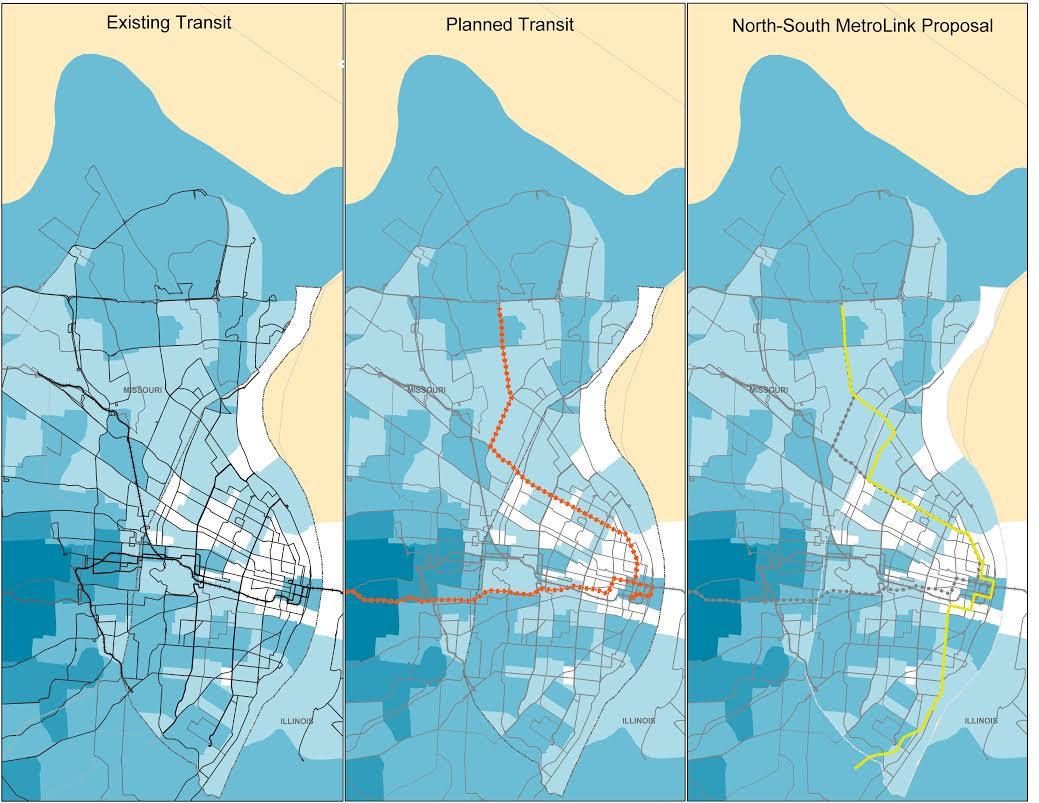
What effect will a MetroLink expansion have on this situation? Saint Louis already has an extensive (and expensive) public transportation system. That system is most readily available in the areas the proposed MetroLink expansion would serve, as the map below shows:

If the goal is providing new access to employment centers outside of the city center, the plan has little value. The line would of course speed up travel for some (and convince some who don’t use transit to ride more often), but that will mean only marginally lower commute times for transit users who do not live and work near the MetroLink.

While its impact on employment access will be low, the cost of a MetroLink expansion will be high, likely more than a billion dollars. Worse yet, if history is any guide, the expansion will be funded with general sales taxes, which are known to be regressive. If regional mobility and opening up more of the region to the poor is what the commission cares about, more bus routes with better service and more destinations are orders of magnitude less expensive to create. Rail enthusiasts often accept this cost disparity because rail lines are part of a grand urban rebirth vision, with immediate mobility gains taking lower priority (or ignored altogether). That the commission did not attempt to search for new transit solutions more germane to the problems at hand is disappointing.

“That’s Crazy!”: Consumer Reports Video Highlights Health Care Billing Problems

If you ever wondered what it would be like to pay for pizza the way most Americans pay for health care, you're in luck. Today Consumer Reports released a tongue-in-cheek video (click here to watch) that imagines a world where out-of-network dough throwers and topping formulary lists determine the cost, quality and availability of your favorite pizza dishes. It’s worth checking out. In the next week, Show-Me will release a new paper that explores one possible way to fix some of these very health care problems that have bedeviled America's health care system for years—both before and (especially) after the passage of the Affordable Care Act. Stay tuned.

Michael Cannon on the Future of Medicine: “So Bright, I Gotta Wear Shades”

Earlier this year the Show-Me Institute had the pleasure of hosting Michael Cannon, the director of health policy studies at the Cato Institute and one of the intellectual architects of the King v. Burwell lawsuit, to speak on a variety of Obamacare-related health care issues here in Missouri. Since then, Cannon has written extensively on the future of health care, including an article for the Willamette Law Review called "Health Care’s Future Is So Bright, I Gotta Wear Shades." You can find the entire piece here, and the whole thing is worth a read. 

I want to pull out one paragraph, though, that touches a bit on a topic that I will be talking about at greater length in the days ahead: the re-personalization of medicine in America. In the future, according to Cannon,

Just about every health plan and provider network offers each patient a personal concierge who is equal parts counselor, clinician, and financial advisor. Your concierge helps you communicate with your medical team, helps you understand your treatment options, and even acts as a costsharing consultant. As a patient, you understand how much you’re going to pay before you choose a treatment plan.

In Cannon's telling, his futuristic "concierge" acts as a sort of hub connecting the spokes of a coordinated health care model, guiding patients through the process of finding and receiving quality health care. It's an interesting role that in contemporary times has been filled by primary care physicians (PCPs). Unfortunately, the supply of PCPs has stagnated over the last few decades—contributing to health care access problems and, likely, to the vision of a sort of "health care sherpa" that Cannon contemplates. 

Does the future of health care have a non-doctor concierge at its center? Maybe . . . but maybe not. More on that soon.

Property Taxes Will Not Save the Saint Louis Stadium Plan

Recently, the Post-Dispatch reported on a study done by Harvard Business School graduates (one of whom is from Chesterfield) on the returns from a new stadium plan. Contra virtually every study performed by academic economists, the students claim that the stadium would be a good investment for at least some part of Saint Louis City.

There are numerous criticisms one could make of their study. The authors assume that Saint Louis will get an MLS team and numerous other non-NFL events (that aren’t simply being drawn away from other Saint Louis venues). They only count the cost and benefits to a narrow section of Saint Louis City, and leave out the costs borne by state residents, which is around $300 million. There is also a lack of accounting for substitution effects, which will greatly reduce the NFL’s impact of city sales tax revenue and employment.

However, this post focuses on the key section of their analysis, namely their assumption that growing property tax receipts will exceed the costs of the new stadium for the city of Saint Louis. The authors claim that there is evidence that property values increase around stadiums, with effects diminishing the further away one is. They assumed that the central city’s property value would increase by 6% (excluding the stadium area and the street grid), which the city would tax at the full rate. This assumption accounts for the vast majority of the positive return the authors claim the stadium will create.

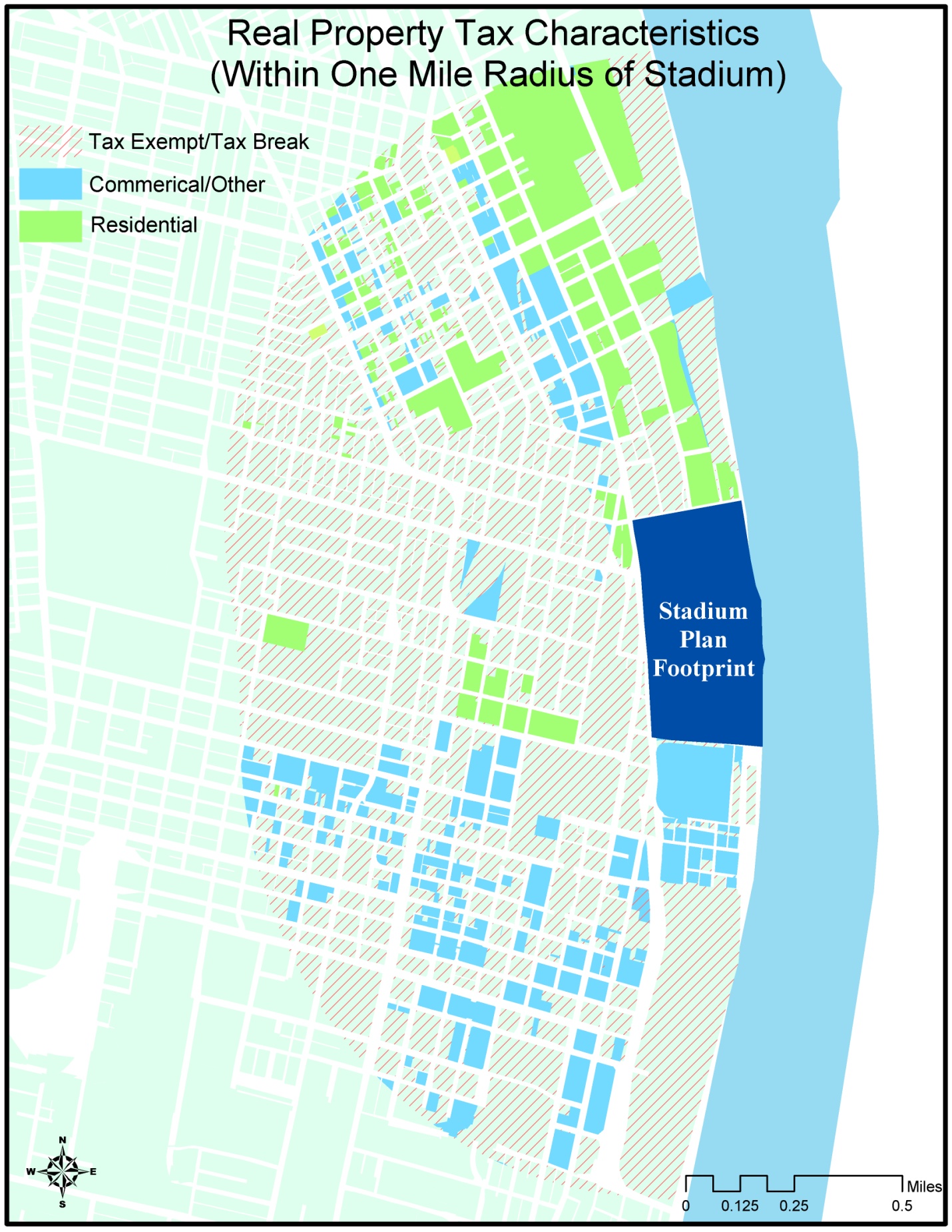
Unfortunately, as readers of this blog know, the city’s real property tax base has been hollowed out, especially downtown. Government bodies and tax exempt organizations own a sizable chunk of the city’s core, and much of what’s left receives tax abatements or lies in TIF districts. For these properties, an increase in real property value will have little or no effect on the city’s tax receipts. And we’re not talking about some negligible number of parcels. If we look at the area within a mile of the proposed stadium site, about 60% of real property (by assessed value) either is not subject to real property taxes, receive tax breaks, or is in a TIF district:

Even worse, the article the authors’ cite as a primary basis for their claim that stadiums increase property tax values only looks at residential property. While that article’s claim is in fact disputed, it expressly does not analyze commercial property value. As the map above shows, among what little is left of the unadulterated real property tax base near the proposed stadium, very little is residential.

In light of these facts, the students’ assumption of how much new property taxes the stadium will generate requires a massive downward correction, probably at least 60%. This is not a small problem for their study’s conclusions; property taxes make up about three-quarters of their tangible stadium-created benefits.

To be fair, this was simply a side project done by former business school students, not trained economists. This is only news because the Post-Dispatch ran an entire article on it. Can we now expect similar write-ups on each of the dozens and dozens of economic studies showing no positive impact from stadiums? Will they write an article on how prominent Washington University faculty members acknowledge that a riverfront stadium is not a good investment for taxpayers?

We’re waiting.

Sales Taxes will Not Save the Saint Louis Stadium Plan

This past week, the Post-Dispatch spilled some electronic ink touting a new study authored by a group of Harvard MBA students regarding the proposed new stadium development on the North Riverfront. The study claims that the new development will be financial plus and that the city will see millions in additional tax revenue. Their claim, for lack of a better word, is bogus.

My colleague Joe Miller and I found so many things wrong with this study that our critique required more than one blog post. In the first post, Joe addressed the study’s faulty reasoning in regards to property taxes. This post covers the authors’ overestimation of additional sales taxes the city would be set to collect due to a new stadium.

In their study, the authors’ anticipate the new stadium will generate an additional $1.4 million in sales tax revenue annually. Actually, a new stadium will most likely generate very little if any additional sales tax revenue.

The authors overestimate new sales tax revenue because they fail to take into account substitution effects. Substitution in the context of entertainment spending is when consumers spend their money on one entertainment option instead of another. For example, instead of spending $20 dollars at a bar in Washington Avenue, someone instead spends that $20 dollars at the new football stadium. Overall spending does not go up; the money is just shifted from one place to another. When the authors calculate that the stadium and the developments around it will generate $1.4 million in revenue, they do not subtract out the tax revenue lost from other businesses decreased revenues due to the stadium.

There is a lot to say about this Harvard study, and this post only scratches the surface. The key takeaway, though, is that nothing in this study challenges the conclusion held almost universally among economists: that there is no economic justification for public financing of sports stadiums.

Support Us

The work of the Show-Me Institute would not be possible without the generous support of people who are inspired by the vision of liberty and free enterprise. We hope you will join our efforts and become a Show-Me Institute sponsor.

Donate
Man on Horse Charging