

On October 15, members of the Kansas City City Council heard from developers and supporters of a proposal to use taxpayer funds to subsidize a $300+ million convention hotel. The Show-Me Institute’s Patrick Tuohey suggested that Council members need to read the reports prepared by consultant to the developers and others to assess the wisdom of investing taxpayer dollars. From what we’ve seen so far, we question whether the projections made are realistic—especially when similar projects in Kansas City have failed in the past.
Melville School District Wants to Raise Property Tax Rates

Today voters in the Mehlville School District will decide if their current property tax rate will increase by 49 cents per $100 dollars of assessed valuation. If Prop R passes, the owner of a $150,000 dollar home will pay about $140 more per year in property taxes.
Funds raised from the tax increase will be directed toward priorities such as hiring 16 new certified teachers to help struggling students and restoring technology and student club funding. Proponents of Proposition R say that without additional funds, home values will decrease due to declining academic performance. Opponents believe the additional funds won’t be used wisely, in which case the increased tax rate will lower the value of their homes.
Analysts at the Show-Me Institute have looked at how school quality and tax rates affect home prices. In Real Estate Assessment and Property Taxation, analysts demonstrated that the quality of schools and their related tax rates are capitalized into the value of property. As the video below explains, homeowners in the Clayton and Ladue school districts in Richmond Heights pay substantially more for comparable homes with better performing schools and lower tax rates.
In short, homeowners and voters want to get the most bang for their tax bucks. The following data on school performance and school funding may shed some light on what’s going on in the district.
First, the graph below shows how Mehlville and the districts around it performed on the MAP test in 2015 in both math and science.
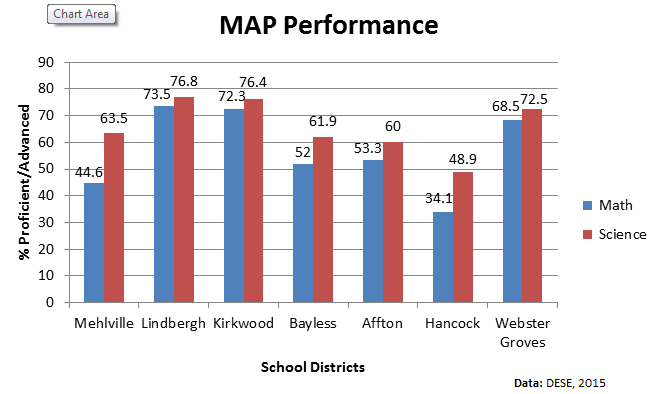
Mehlville doesn’t look great. In fact, the district has the second lowest math scores in the area.
But, if we look at a second data set—college readiness indicators like average ACT scores, college remediation rates (the percentage of students who enroll in courses they should have completed in high school), and the number of AP courses the district is offering—Melville is performing better than other districts in the area (see table below).
|
College Readiness Indicators |
|||
|
School District |
Avg. ACT Score |
College Remediation Rate |
# of AP Courses Offered |
|
Mehlville |
23 |
32.9 |
16 |
|
Kirkwood |
24 |
30.3 |
19 |
|
Lindbergh |
23 |
23.6 |
19 |
|
Bayless |
21.7 |
59.6 |
2 |
|
Hancock |
22 |
33.3 |
9 |
|
Affton |
19.7 |
50 |
5 |
|
Webster Groves |
23.1 |
24.6 |
3 |
Even with reports of losing teachers to neighboring districts, Mehlville is able to offer a large number of AP courses and prepare students for college at about the same rate as neighboring districts with more teachers and administrators (as our next graph displays).
The graph below presents teacher/student and administrator/student ratios. Mehlville has more students per teacher than Kirkwood, but fewer students per teacher than Lindbergh, even though both are better-performing districts. Mehlville also has the highest student-to-administrator ratio in the area.
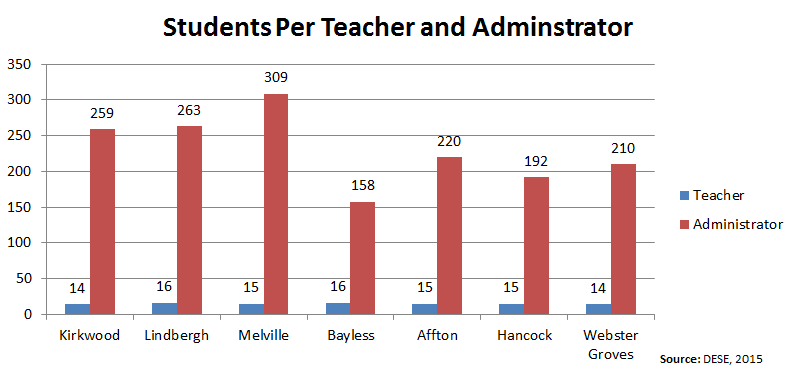
Finally, relative to other school district property tax rates in the area, Melville has the lowest rate:
|
School District |
Tax Rate Per $100 |
|
Mehlville |
$3.7621 |
|
Kirkwood |
$4.2524 |
|
Lindbergh |
$4.2906 |
|
Bayless |
$4.7682 |
|
Hancock |
$4.8164 |
|
Affton |
$5.368 |
|
Webster Groves |
$5.8584 |
So what should we make of all of this? Frankly, it’s tough to say. In some ways, it appears that Mehlville is operating efficiently. With fewer teachers and administrators and a lower tax burden, the district is achieving about as well on several key indicators as other districts. In other ways, it appears that the district is lagging behind.
The real question is whether new dollars will do anything to move the needle on student performance. Simply hiring more teachers and investing in technology and student clubs doesn’t seem particularly compelling. What’s more, will raising taxes hurt Mehlville’s competitive edge in recruiting new homeowners? Without strong answers to these questions, it is hard to determine if taxpayers should get behind any effort to increase tax rates in the district.
Property Tax Increase on Ballot in Kirkwood School District
Tomorrow, Kirkwood School District voters will decide if the district will increase its operating tax levy by 78 cents per $100 dollars of assessed valuation. This is a substantial increase—the neighboring Melville School District is proposing only a 49-cent increase. The tax levy pays for the operating costs of the district, including salaries and benefits for teachers and administrators. If Prop A passes, the owner of a $250,000 dollar house will pay $370 dollars more per year.
Earlier, I wrote about Mehlville School District’s proposed property tax increase. Voters in both Melville and Kirkwood must decide whether they think additional funds will improve the quality of the districts. To make this decision, they should consider how the school districts are currently spending tax dollars.
A group called Tax Fairly opposes the tax hike. Information about their reasons for opposing the tax increase may be found here.
Tax Fairly points out that Kirkwood has the highest-paid superintendent in the state and the second highest-paid teachers in the state (only the Clayton School District pays more). Kirkwood School Board President E. J. Miller told the Post-Dispatch, “We want the best of the best. We think that to hire them and retain them, we want to pay them well.”
Proponents of Prop A believe the property tax increase is necessary due to increasing enrollment. A district-hired demographer estimated an enrollment increase of between 10 and 11 percent by 2019. To keep up with the rate of enrollment, the district would have to hire new teachers to keep class sizes down.
Tax Fairly disagrees with the district’s enrollment estimates. The group questions the methods used to determine 2019 enrollment. They point out that at least some of the rising enrollment the district has experienced has been due to transfer students from the Normandy and Riverview Gardens districts. They also call attention to the fact that Kirkwood allows children of teachers in the district to attend the school tuition-free.
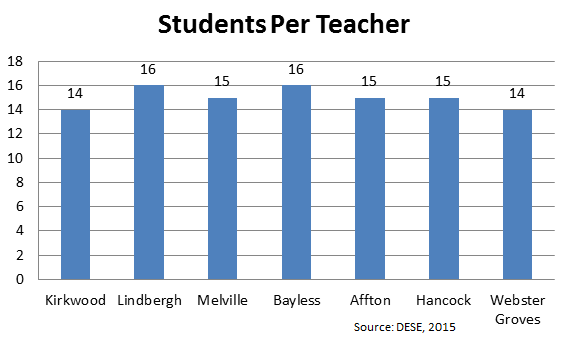
I want to add one wrinkle to this debate. The chart above provides teacher–student ratios for Kirkwood and the surrounding school districts (using Department of Elementary and Secondary Education Data). Kirkwood classrooms average 14 students per teacher, which is lower than most other school districts in the area. Perhaps it’s not Kirkwood’s teacher salaries that are driving costs, but the number of teachers they need.
Research shows that teacher quality is more important than class size, that is, class sizes could increase slightly and still maintain the same level of quality. In fact, according to the Department of Elementary and Secondary Education, the desirable standard for student enrollment in classrooms is between 17 and 25 students, depending on the grade level, well above Kirkwood’s average. Is the district operating as efficiently as it could? Arguably not.
Although many agree the district is performing well, a major concern for taxpayers is how the district will spend $10.4 million in additional revenue annually. The 2015–2016 operating revenue budget is $62 million. Is all of that new money necessary?
Missouri’s Latest Report Card: C-
The National Center for Education Statistics recently released the latest assessment scores for all 50 states. Missouri ranks in the lower half.
The National Assessment of Educational Progress (NAEP) is a biennial assessment of fourth-grade and eighth-grade students across the country in English and math proficiency. The good news from the 2015 scores is that Missouri did about as well (or poorly) as in 2013. But that is where the good news ends.
I will focus on the math scores, because there is ample evidence that how students do on the math component of the test is a good indicator of future economic success. That is, states with low math scores also tend to be states that have poor records when it comes to economic growth. And Missouri is not an economic powerhouse by any stretch of the statistical imagination.
So how did Missouri students do in math this time around? Thirty-eight percent of fourth-graders scored at the proficient level. If my own math is correct here, that means 62 percent scored at levels less than proficient. That put Missouri at 29th compared to other states. Eighth-graders did slightly worse: only 31 percent scored at or above the proficient level. That score put Missouri at 32nd. (For perspective, more than 50 percent of fourth- and eighth-grade students in Massachusetts scored above at or above the proficient level in math.) And as the recent post by James Shuls) points out, adjusting for state demographics does not improve the outcome.
Missouri’s Department of Elementary and Secondary Education (DESE) notes that these current rankings are no worse (eighth-grade math) and an improvement (fourth-grade math) compared with the 2013 results. They fail, however, to report that both scores are lower than their peaks, which occurred in 2009. Though the scores appear to have stopped falling, they also have not regained the ground lost over the past six years.
With NAEP scores falling or, at best stable, how long will state education administrators and politicians continue with the ineffective Top 10 by 20 campaign? The only way Missouri will become a top-10–ranked state in terms of educational achievement is if most of the states currently ahead of it somehow begin to fail miserably.
I just do not see that happening. Do you?
Keeping the Rams – Lessons from a Nursery Song

Baa, baa, black sheep, have you any wool?
Yes, sir, yes sir, three bags full.
In reading reports of Tuesday’s NFL “hearing” at the Peabody Opera House, I was reminded of that old nursery song, which is really a parable about scarce resources.
In the nursery song, there are four woolly sheep of different colors (black, white, grey, and brown), plus a fifth sheep that has already been fleeced. Beginning with the black sheep, the four sheep all give “three bags full” of wool for others to use:
One for the master,
one for the dame,
and one for the little boy
who lives down the lane.
But then, of course, you come to the last sheep, and there’s the problem:
Baa, baa, bare sheep,
have you any wool?
No sir, no sir, no bags full.
None for the master,
none for the dame,
and none for the little boy
who lives down the lane.
Alternately rowdy and tearful, some 1,000 Saint Louis Rams fans showed up to plead with NFL officials to keep the team in Saint Louis. The passionate fans who wore NFL jerseys featuring the names of their favorite players see themselves in the role of the sheep that has been fleeced – or are about to be – assuming the owner Stan Kroenke succeeds in moving the team to the Los Angeles area. That is an understandable reaction to the disappointment of losing a favorite team.
However, from an economic viewpoint, it is really the taxpayers in the state of Missouri who were fleeced once – and are about to be fleeced again – if the plan to build a new $1 billion public/private downtown stadium along with the riverfront goes ahead – with the expenditure of some $400 million in public money through issuance of bonds, state tax credits, and infrastructure grants.
The Edward Jones Dome (or TWA Dome, as it was formerly called) was a 100 percent publicly financed project. The Rams pay an annual rent of just $240,000, which is just 1 percent of the $24 million annual cost that taxpayers have paid (and will continue to pay until 2022) to service the debt on its construction.
There is no legitimate reason to subsidize professional football, which is a hugely profitable business in its own right. Saint Louis and the state of Missouri shouldn’t have to sweeten the pot at public expense to keep the Rams in the St. Louis. It would be better to let them go.
Transportation Funding: I-44, Tolling and the Road to Tomorrow

MoDOT interim director Roberta Broeker and Show-Me Institute Policy Analyst Joseph Miller discuss transportation funding in Missouri and the need for infrastructure investment in the Springfield area. Excerpts from the question-and-answer session follow the talk.
So Long, Farewell, Auf Wiedersehen, Goodbye

This is my final post for the Show-Me Institute, and it has been a great four years. I am proud to have had the opportunity to work with my colleagues and to have played a part in helping to protect liberty in Missouri. But while much has been done, there is a lot left to do.
Missouri needs to remain economically competitive with Kansas and other neighboring states. Eliminating income taxes on job producers would be a great step toward this goal.
Missouri needs to ensure that public pensions don't wreck state and local finances.
Missouri should not enact job-devastating regulations like the minimum wage. Well-intentioned as it might be, an increase to the minimum wage would destroy jobs for the people who need them most.
These are a few of the many topics that Missourians will need to address going forward, and my colleagues will carry on that fight in the months and years ahead. For my part, it was an honor to work with them, and for you.
I Was a Good Teacher. I Could Have Been Better
For four years I was an elementary school teacher in southwest Missouri. Not to toot my own horn, but I was a pretty good teacher. Students and parents liked me. Several of my colleagues even requested me as their child’s teacher.
But you want to know the truth?
I could have been better.
The sad thing is, I didn’t have to be.
The structure of public education is such that anyone with a decent head on their shoulders can become a teacher and, with minimal effort, remain a teacher for rest of their career.
Compared to many other professions, becoming a teacher is relatively easy. In fact, many consider an education degree one of the easiest degrees to obtain. On average, students going into education as a college major have lower scores on college placement tests. In 2014, prospective educators scored an average of 20.4 nationally on the ACT, below the national average of 21.0. The people entrusted with educating our children scored more than three points lower, on average, than individuals going into engineering or English and foreign languages.
Despite having lower aptitude as measured by college admission tests, teachers receive incredibly high marks in their college courses. According to Corey Koedel, an economist at the University of Missouri, the average grade point average for undergraduate education courses is 3.8. What’s more, Koedel found that 20 percent of undergraduate classes in the college of education gave every student an “A.”
Students who graduate and get teaching jobs are rarely challenged to grow, because they rarely receive the types of evaluations that will truly motivate them and help them improve. In many districts, new teachers are only evaluated a handful of times. In most cases, these formal observations are announced in advance. Thus, teacher evaluations are based on snapshots of what should be a teacher’s best lessons. Little wonder, as a report by The New Teacher Project noted, that almost all teachers are given superb marks.
While the fear of losing his or her job may motivate a teacher to work hard, social norms and school staffing policies effectively counter this motivation. Teachers, unlike most workers, are typically paid according to a predetermined salary schedule. No matter how hard they work, a teacher cannot earn a raise. Truly motivated teachers who go above and beyond face considerable pressure to conform. Nobody likes a rate buster.
Over time, the fear of losing one’s job fades. A teacher who reaches tenure—after three years in most states— has what state statutes call an “indefinite contract” or a “permanent job.” Of course, those terms, “indefinite” and “permanent,” come with a small proviso that a teacher doesn’t do anything egregious to a student. Barring that, the job is basically secured.
These were the realities when I was a teacher, and they are the realities today. Had the structures of education been different; had I been motivated and challenged by administrators; had my performance been really evaluated; or had I had the opportunity for advancement, recognition, and raises, things may have gone differently. Maybe I would have improved from a good teacher to a great teacher. In fact, I might still be in the classroom.
Ohio’s Medicaid Explosion Under Obamacare Is a Warning for Missouri

Instead of getting a handle on the cost of care and working to maximize access to medical professionals, the Affordable Care Act instead prioritized "coverage"—a strategy that not only threw millions of Americans out of their private health insurance plans, but also put millions more into broken welfare programs. Over the past few years in particular, analysts at the Show-Me Institute have written a great deal about the importance of reforming Missouri's Medicaid system to ensure that our neediest can find the care they need. Simply expanding "coverage" and dumping enrollees into already-failing government programs would not only burden taxpayers, but also would imperil care for thousands of Missouri's most vulnerable citizens.
Indeed, those risks are now playing out in Ohio.
Most of the Ohioans who entered Medicaid under the expansion are working-age adults without children or disabilities. Before Obamacare, Medicaid was restricted to children, the elderly, the disabled, pregnant women, and impoverished families.
Pitching Obamacare expansion to the Ohio General Assembly in 2013, the Kasich administration estimated 447,000 would enroll by fiscal year 2020. Actual enrollment exceeded 620,000 by the time fiscal year 2015 ended in June.
Kasich implemented Obamacare expansion after vetoing a legislative ban on the policy, despite publication of a National Bureau of Economic Research study finding Tennessee’s employment increased when the state removed working-age adults from Medicaid.
Money spent on these able-bodied beneficiaries is money that cannot be spent on unequivocally vulnerable populations. And perversely, as Ohio has expanded its Medicaid program to those not in poverty, it appears the state is also planning cuts to services for some of Ohio's neediest, including the disabled.
Missouri's neediest beneficiaries deserve better than that, and Missouri taxpayers should be able to rest assured not only that their tax dollars are going toward help for those who need it the most, but that failed government policies—particularly those we are seeing fail in real time across the country—aren't brought home to the Show-Me State. We should reform Medicaid for Missouri's neediest. We should not expand it under Obamacare.
