The Unspeakable in Full Pursuit of – a Football Stadium

Oscar Wilde described fox-hunting as “the unspeakable in full pursuit of the uneatable.” We can make the same point about Missouri Gov. Jay Nixon, Saint Louis Rams Football Owner Stan Kroenke, and the Great Riverfront Stadium Hunt.

Nixon and Kroenke are two squires cut from the same cloth – a trophy-hunting governor who thinks he can pick winners and losers and a super-rich developer with a long history of currying favor from government entities.

In this situation, we may debate the question of whether it is worse (i.e., more “unspeakable”) to give or to receive. Here we are talking about the award of hundreds of millions of dollars of taxpayers’ assistance to a hugely profitable sports business that does nothing to advance the public good.

It is at least appropriate that the object of the hunt is made largely of concrete.  Along with the unwarranted subsidies, that makes it doubly indigestible – both from a gastronomic and an economic viewpoint.

County Residents on the Hook for Trolley Folly-Since When?

Those who read this blog will know that the Loop Trolley is $8 million over budget, and Saint Louis County residents are getting stuck with the bill. We’ve also discussed that, despite the news breaking only a couple of weeks ago, regional officials have planned for overruns since mid-July, and may have known about problems much earlier. As Saint Louis County officials prepare to allocate mass transit funds to bail out the project, it is instructive to look at what the public was told about possible cost overruns during the planning phase—because they weren’t told that county taxpayers would be on the hook.

Flashback to July 16, 2012: On that day, University City held a special meeting on the Loop Trolley, at which Doug Campion (project manager for the trolley), presented an overview of the project. One of the council members asked Mr. Campion how much planners were setting aside for contingency (going over budget) and what would happen if the Trolley’s budget were exceeded. According to the meeting’s minutes:

“Mr. Campion said it would be normal to have between a 10 and 20 percent set up for contingency for the project. At the moment they have a 17.2 percent contingency. Mr. Campion said in the event that something would happen the TDD [transportation development district] could issue revenue bonds against it.”

Later, Mr. Campion reiterated that:

“…if there was an overrun the TDD would float a revenue bond to fund it.”

It is now clear that “something” has indeed happened, and the 17.2 percent contingency was not at all adequate. However, the TDD is not floating a revenue bond to cover the overruns, despite what Mr. Campion said when asked about this exact scenario. Nor did Trolley planners propose a special sales tax for the district or an increase in proposed fares, both of which could have been used to match an additional federal grant for the project. Instead, Saint Louis County is expected to pay for that match (and then some) with Proposition A funds. For those who have forgotten, Proposition A is a half-cent sales tax for mass transit. County residents were told that the tax was necessary to save bus service and improve existing transit so that people could get to work. Would voters have approved such a tax if they had known millions would be peeled off for pet trolley projects?

Saint Louis County residents were told that the Loop Trolley project would cost $43 million, and that construction contingencies were well in place. They were told that federal government and TDD revenues, not county taxes, would pay for the project and any cost overruns. They were told that Proposition A funds were about getting people to work and improving essential transportation. And now they’re being told to forget all that. 

How to Prevent Teacher Pay Inequity from Worsening

Veteran teachers make considerably more than novice teachers. A recent report by Marguerite Roza of the Edunomics Lab at Georgetown University noted that Missouri teachers at the end of their careers make 137% of what a teacher with a master’s degree and 10 years of experience makes. This ranks Missouri 14th in terms of having the “steepest” salary schedule. In other words, we are back-loading teacher pay.

Roza points out that rewarding teachers in this manner has serious implications for teacher recruitment and retention, fiscal sustainability, and pension obligations. High-quality college graduates with high-paying alternatives may steer clear of education. Similarly, young teachers may be more inclined to leave the profession because of low salaries.

Teachers are primarily paid via a salary schedule, which gives standardized raises to teachers for each additional year of service and each additional postgraduate degree earned. The problem is that a salary schedule often gives teachers a raise that is set as a percentage of what they make, not a predetermined dollar amount. This leads to larger end-of-career increases, because the raises compound over time. For a teacher who starts at $40,000 per year, a 3% raise at the end of the first year will mean a $1200 increase. But their second-year raise will come to 3% of $41,200, which works out to $1,236. Keep projecting the numbers out and each year’s raise just gets bigger and bigger.

In addition, school districts often give cost-of-living (COLA) raises. These too are often awarded on a percentage basis, further widening the pay gap between veteran and novice teachers.

I highlighted this in a post a couple years ago. In which I wrote:

Take, for example, the salary schedule for a teacher with a master’s degree in the Parkway School District. In his or her first 10 years, a teacher in Parkway only receives a 17 percent pay raise. Between their 11th and 20th years, they receive a 51 percent pay raise. The difference is $20,000. It is no wonder we have difficulty retaining new teachers. The system is designed by veteran teachers for veteran teachers. After all, veteran teachers are usually the ones who serve on salary bargaining committees.
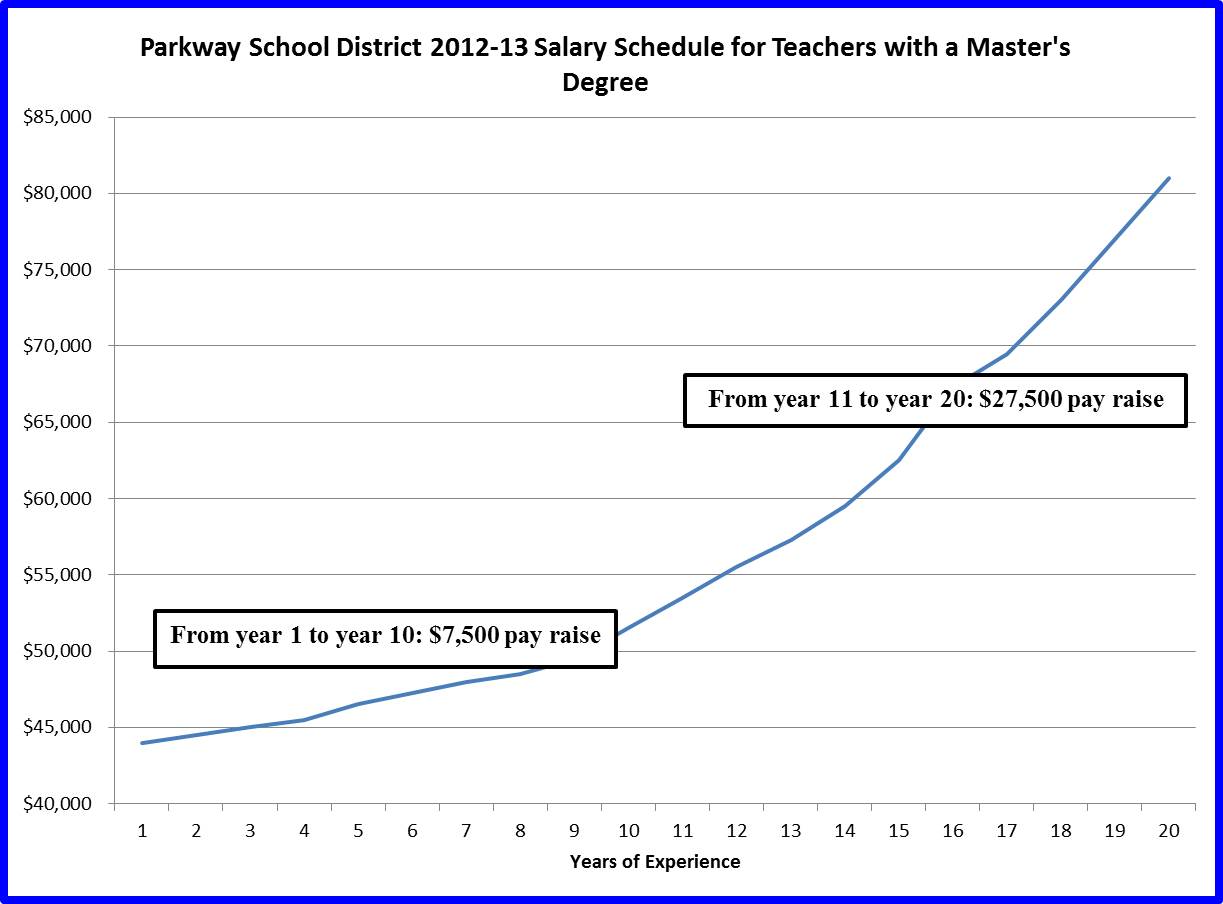
Parkway School District Salary Schedule

Teachers are unique among professionals in this regard. Using U.S. Census Bureau data, Roza calculated the earnings trends for teachers, lawyers, doctors, accountants, and computer programmers. Compared to these other professions, teacher pay is significantly back-loaded.
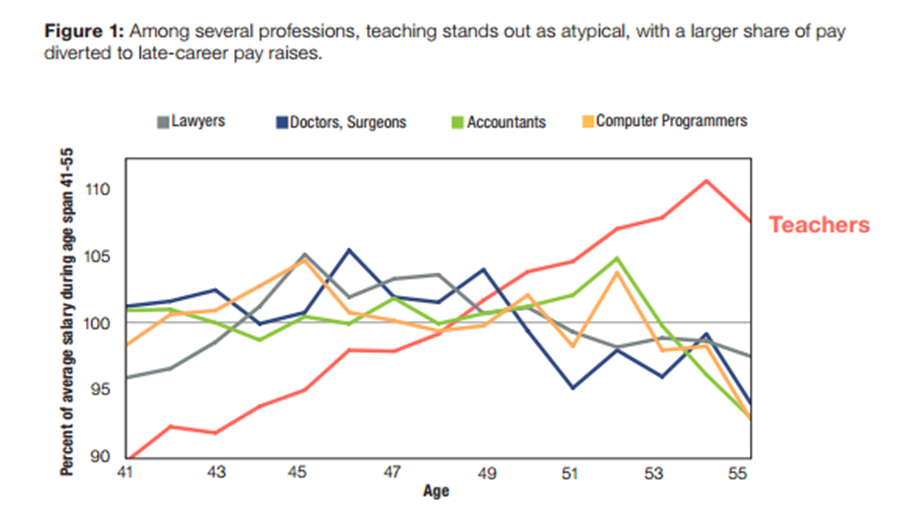
Comparison of pay schedules

I have written a number of times about the need to revamp how we pay teachers (see here and here). In this report, Roza doesn’t go that far. Rather, she offers a simple solution to slow down the growth in inequity between junior and senior teachers—a fixed-dollar pay raise. Instead of awarding COLA’s on a percentage term, districts should award the same dollar amount to teachers at every step of the pay schedule.

Regardless of your preferred method of reform, Missouri will struggle to attract and retain great young teachers until we stop back-loading teacher salaries.


Kansas City’s War on Voters

The Show-Me Institute has written extensively about efforts by government officials in St. Louis to keep the public from voting on a proposed new stadium. But the war on voters is spreading, and here is Kansas City, the battle is becoming pitched.

In a special and "disastrously run" Tuesday meeting, the TIF Commission voted 6 to 2 to move ahead with a deal that would have taxpayers subsidize a project by a wealthy developer so she could charge high rents to a successful architectural firm in a tony part of town. It would have been a 6 to 5 vote, but three commissioners representing Jackson County and the Kansas City Library walked out in protest. (Actually, it could have been 6 to 5 against, but Mayor James replaced one of the commissioners who didn't toe the line.)

Speaking of the decision to revisit a previous vote, the representative for the school district said

It is very apparent that this rush to bypass the prior decision of this commission, with no regard for the reasons for the delay, is an effort to stop parents of KCPS students, community groups and the voting public from putting this use of taxpayer dollars on the ballot in April. There seems to be a level of politics at play here that is disheartening.

TIF policy, as frequent readers of this blog know, was designed as a way for municipalities to encourage development in economically declining or blighted areas. In Kansas City, however, "the TIF process is dominated by developers and their attorneys, who dominate campaign contributions to elected officials."  In that respect it is another form of reverse Robin Hood, taking from the working class and poor to give to the wealthy.

How long will it last? One can hardly know. The newspaper of record has its own tax break, so one wonders if it can be counted on to report fully on the matter. Petition efforts have been undertaken to require public votes not only on this TIF deal, but also on the convention hotel TIF. City Hall is fighting those efforts, too. (Cindy Circo, the head of the TIF commission, didn't even bother to hear public testimony before the vote.)

If City Hall is working so deliberately to thwart public input and reward their cronies, who will speak up for the people?


KMOX Interview on Mizzou’s Problems

Earlier today I had the chance to speak with Mark Reardon on KMOX about my Mizzou commentary, published over at Forbes. You can find the interview here, and rather than force you to Google around for the op/ed, I thought it may just be easier to share the link with you here on Show-Me's blog. I've also written on the subject here.

And as always, your commentaries are welcome in the comments below.

Missouri’s Certificate of Need Law Needs to Go

One of the keys to promoting patient health is ensuring that patients can actually access the care they need. Unfortunately, government regulations often get in the way. One such regulation in Missouri (and other states) is the Certificate of Need (CON) law, which essentially regulates the number of hospital beds a community can have and the sorts of equipment that hospitals can purchase.

CON laws were intended to prevent duplication of services, increase care access, and control costs. However, research and experience over the last forty years suggest that while CON laws do stop new players from entering markets, they don't really reduce cost or increase access to care. That result is intuitive; restricting competition in goods and services, whether in health care or in hamburgers, tends to restrict access and raise prices for consumers because incumbent businesses have less incentive to compete for business based on cost and quality. It's why many states have repealed their CON laws, and why Missouri should follow suit.

It's bad enough that CON laws don't accomplish what they were originally intended to do, but CON laws can also be used by incumbent health care players to keep out competition in areas where people are not getting the care they need. One example of this was made clear in a recent St. Louis Business Journal story about long-term care providers demanding that the state tighten up its CON approval process—ultimately to the detriment of patients:

Representatives from the Missouri Health Care Association and the Missouri Assisted Living Association made a presentation during a recent Missouri Health Facilities Review Committee Certificate of Need (CON) meeting calling for a change in how strictly CON procedures are enforced. According to Nikki Strong, executive vice president of the MHCA, too many long-term care and assisted living projects are being approved for areas of the state in which there is no demonstrated need….

Health Facilities Review Committee member William Krodinger said many projects that are in areas where there does not appear to be a need are approved because they are serving patients with a specific need—such as mental health or memory care facilities. Also, he said some areas look like they have an oversupply of available beds on paper because the numbers include projects that have been approved but not yet built, some of which never come to fruition.

Indeed, some health care providers want the state to act as if phantom projects are meeting the needs of Missourians, which would also protect their business models. That's good for incumbent health care providers, but it's bad for Missourians' health and pocketbooks. Rather than secure Missourians' health care, CON laws can actually imperil it. They need to go.

Missouri Dodges A Bullet: Bombardier Seeks Billion Dollar Rescue in Canada

Back in 2008, the Show-Me Institute was staunchly opposed to a plan that could have given aircraft manufacturer Bombardier nearly $1 billion in Missouri tax credits to attract the Canadian company to the state. As Joe Haslag, the Institute’s chief economist, said after the company instead took advantage of tax incentives abroad, Bombardier’s decision to go elsewhere wasn’t necessarily a bad thing at all. For one, tax money given to Bombardier couldn’t have been spent on other state priorities. For another, giving just one company a huge tax advantage was a highly risky gamble for the state, given the thousands of other businesses that otherwise could have had their taxes cut and could have made their own, potentially higher-yielding investments.

Which brings us to 2015: Bombardier, back in Canada, now needs a bailout.

Hours after Justin Trudeau was sworn in as Canada’s prime minister last week, the government of Quebec came calling with a pitch for the biggest state-backed corporate bailout in North America since the financial crisis of 2008-09.
 
Quebec is asking the federal government to make a “significant” contribution to the $1 billion lifeline the province gave the storied Montreal-based company as it struggles to find buyers for its new commercial jets….
 
Ottawa has invested heavily and consistently in Bombardier, issuing more than 1.3 billion Canadian dollars (about US$1 billion) in loans to the company over the last half-century. The Montreal company has paid back C$543 million of the loans, according to recently released figures from Industry Canada, and has also received $650 million in export aid.
 
The province of Quebec is not flush with money, either, and “had a deficit of C$2.35 billion for the last year ended March 31.” Quebec is, however, highly dependent on the Bombardier company for jobs, which only makes throwing good tax money after bad all the more alluring to province lawmakers—though no less misguided.
 
The good news is that Missouri won’t bear the brunt of Bombardier’s troubles, thanks in no small part to the work of good government advocates across Missouri. The bad news is that Missouri still has a serious tax incentive problem at both the state and local levels. Bombardier may be Canada’s problem today, but Missouri has plenty of tax incentive problems of its own. And as we’ve said before, better to get a handle on them sooner rather than later.

St. Louis Mills Auctioned Off for 6 Percent of Its Original Cost

The St. Louis Outlet Mall, formerly St. Louis Mills Mall, sold on November 18 on Auction.com for $9 million. The mall’s value—$40 million—has depreciated considerably since 2008 when it was appraised at $117 million.

I remember my first visit to “the Mills” shortly after it opened in 2003. The 1.2 million square foot building was bustling with people. The line for Panda Express was more like that of an amusement park ride than a mall food counter.

Today, only 77 percent of the mall is occupied (the average occupancy rate for malls is 92%). “Ghost town” is the best way to describe what I saw during my visit last November. The stores I once frequented as a teen were gone—replaced by metal bars and “for rent” signs.

You could look at the decline of the Mills Mall as a sign of the times—malls are out, online shopping is in. In fact, survey data supports this conclusion. In 2014, 34% of Americans said they did more than half of their shopping online—a 99% increase from the 2006 shopping season.

It’s certainly true that digital retailers like Amazon have disrupted the shopping industry, but the decline of the Mills Mall signals more than just the need for mall rats to find a new place to hang out. The failure of the Mills exemplifies why governments shouldn’t use tax increment financing (TIF) as a mechanism for economic development.

TIF is a method of attracting businesses to blighted communities through government subsidies. In 2003, an $18.5 million TIF in conjunction with a $34 million transportation district helped fund the mall’s development. In a 2006 Primer on TIF, UMSL professor Kenneth Thomas pointed out a few problems with this instance of TIF use.

  • The building of the Mills Mall displaced sales tax revenue from Northwest Plaza in St. Ann, a shopping complex nearby.
  • The project was environmentally harmful—the mall and surrounding road system was constructed on top of a wetland.
  • The median income in the community was $52,656—hardly blighted.

Hazelwood’s Economic Developer David Cox told the St. Louis Business Journal, “If the developers could have looked into a crystal ball, they probably would have built it smaller.”

But that underscores another problem with funding large development projects like the Mills—crystal balls don’t exist.

The construction of the Mills Mall had promised 3,000 new jobs. Only half that number was realized.

The Mills Mall points to a serious need for TIF reform in Missouri. Malls may, indeed, be on their way out. Inappropriate uses of TIF should follow suit.

Support Us

The work of the Show-Me Institute would not be possible without the generous support of people who are inspired by the vision of liberty and free enterprise. We hope you will join our efforts and become a Show-Me Institute sponsor.

Donate
Man on Horse Charging