As Uber Surges, Riders Reap the Benefits

As another New Years’ Eve has come and gone, more writers in Saint Louis and across the nation have spilled ink over expensive Uber rides for partiers. Fares were as much as ten times what Uber normally charges, leading some to pay well over $100 for short rides. For all the complaining, it is important to remember why Uber uses “surge pricing” and why new ridesharing services are so popular in Saint Louis and nationwide.

It was not so long ago that Uber was not available in any city, much less Saint Louis. Heavy regulation restricted the supply of cabs in most large cities. With competition ruled out, it was often a sellers’ market for cab rides, especially at times like New Years’ Eve. It was the type of environment where someone could write an article like “How to Get a Cab in San Francisco and 4 Other Tips From Taxi Drivers,” which put the inability to hail cabs at the feet of “bossy” and otherwise clueless residents. In Saint Louis, on New Years’ Eves past, much of the taxi fleet decided additional fares weren’t worth their time and stayed home. Partiers waited hours for cabs that did not come.

With the introduction of ridesharing companies, findng a ride home is getting better across the country. People complain about surge pricing, but being able to make 2 or 10 times the normal fares keeps drivers on the road when it’s late or when it’s cold or when it’s New Years’ Eve. An expensive ride home is better than no ride home. Despite fears that ridesharing would lead to underservice of far-flung or economically disadvantaged areas, Uber provides transportation options where taxis are hard to find. At the time of writing, an Uber is within five minutes of my location in the Central West End. But it’s also available within six minutes of locations in Ferguson.

What of traditional cabs? Some may fear that Uber and its ilk spell the end of traditional cabs, but traditional taxis do have advantages. They have full-time drivers who could have more driving experience and knowledge of their cities. Taxi service is integrated into the civic environment, with cab lines at airports, hotels, and cab stands. Centralized operations could allow taxi companies to enforce standards of cleanliness and customer service that Uber cannot.

Some of these changes may already be happening. New data shows that increased competition from ridesharing is raising customer service levels for traditional cabs. Complaints against cabs have fallen greatly in New York City, and in Chicago there are suddenly fewer broken credit card machines. Whether traditional cab companies will survive is still an open question. We can only hope that in Saint Louis, and in other cities, the question is answered by potential customers, not regulatory bodies. 

Deflate-gate in Saint Louis: Air goes out of a plan for a new subsidized football stadium

In stimulating tourism, trade, and economic growth, the Roman Coliseum may be the world’s only sports stadium that has repaid the cost of its construction more than a thousand-fold, or even a million-fold.

The Edward Jones Dome in downtown Saint Louis is another story. Praised as state-of-the-art when it opened in 1995, the 100 percent publicly financed dome is on the verge of abandonment several months shy of its 21st birthday.

The future of the St. Louis Rams – the dome’s current occupants – will be decided in the next couple of days as the NFL owners club considers two competing plans for new stadiums in the Los Angeles area – one of them put forward by Stan Kroenke, the owner of the Rams, who wants out of Saint Louis.

Whatever happens, the Saint Louis dome’s playing days as a football stadium are probably over. It stands as a monument to wishful thinking – a telling example of the fallacy that public officials can accelerate a city’s growth or reverse its decline by “investing” large sums of money in a giant sports complex.

When the dome was first proposed and developed, its backers – including two Saint Louis mayors, business and civic leaders from the city and county, Missouri legislators, and the editorial board of the St. Louis Post-Dispatch – described the project as a much-needed shot in the arm for downtown Saint Louis. They claimed it would create thousands of jobs, generate hundreds of millions of dollars in new business activity, and more than pay for itself through the additional tax revenues it would create for St. Louis City and County and the state of Missouri.

In a 1993 editorial, the Post predicted a “downtown resurgence” and only worried that the riverfront might become “a gridlock of automobiles overlooked by a garish strip replete with pulsating electric signs and the amplified voices of barkers luring people aboard (casino) boats.”

Today the St. Louis riverfront is emptier than ever.  Over the last two decades, the city has continued to lose both population and jobs, while St. Louis County and the state as a whole have also experienced subpar economic growth. There is no sign of any dome-centered economic growth.

The Edward Jones Dome was desperation’s child.  In 1988, after the St. Louis Football Cardinals took flight for Phoenix, Arizona, leading figures in the city became serious about building the new stadium that the departing owner Bill Bidwill (not wanting to share space with the baseball Cardinals) had craved.  Enlisting the help of Saint Louis County and the state of Missouri as partners, they gambled on building a stadium entirely on spec – not knowing when, or even if, they would be able to attract another NFL franchise to replace the Cardinals.

Surely, the thinking went, a metro area of our size (two and half million people) and with our willingness to open the public purse strings, should have no trouble attracting one of two NFL expansion franchises then coming up for grabs.

That was a big mistake. In late 1993, the NFL awarded the new franchises to Charlotte, North Carolina (with the now #1 seeded Panthers in this year’s NFL playoff), and to Jacksonville, Florida.

Thus, there was great joy in Mudville when Georgia Frontiere, the widow of longtime L.A. Rams owner Carroll Rosenbloom, elected to move the Rams franchise from an aging stadium in Anaheim to a new one in her old hometown of St. Louis.  As the dome was nearing completion, she saved political and civic leaders from the embarrassment of having a football stadium but no team.

Corralling the Rams was hailed as a great victory for the city and state – but was it a good deal for taxpayers?

Plainly it was not.  The Rams shared no part of the cost of building the dome, yet they have paid an annual rent of $250,000, or just 1 percent of the $24 million that the city, county, and state have paid to service the debt on its construction . . . and will continue to pay ($12 million from the state and $6 million each from the city and county) for another five years. That means taxpayers are still on the hook for another $120 million – money that would otherwise be available for public services ranging from fire and police protection to education, roads, and infrastructure.

In addition, the lease agreement allowed the freeloading tenant to demand major improvements at public expense, and gave the team the right to opt out of the lease ten years early – in 2015 – if the city and state failed in their contractual duty to keep the dome in the top tier of NFL stadiums.

That is the option that Mr. Kroenke deployed at the beginning of last year when he announced his intention of moving to Los Angeles.  For a while, the response from city and state officials was déjà vu all over again.  St. Louis Mayor Francis Slay and Missouri Gov. Jay Nixon joined forces in trying to raise some $400 million in public assistance to go toward the building of a new $1 billion-plus riverfront stadium to keep the Rams in St. Louis.

But now it seems the air has gone out of that spheroid. There seems to be a growing realization (even in St. Louis) that if a team thinks it can make a whole lot more money in one city – with no subsidies – than it can in another – even with copious subsidies – it probably makes sense for all concerned to let the team go where it wants.

Increasing Teacher Pay from On High Is Simply Bad Policy

Are teachers overpaid or underpaid? It’s as old a debate in education as whether Han Solo shot first is for Star-Wars fans. It’s incredibly hard to answer the question, because it requires taking into account a large number of factors that get glossed over every time the argument arises.  The first and most important consideration, of course, is the quality of the teacher.  Better teachers should get paid more, but trying to figure out what makes a “better” teacher is incredibly difficult.

But what we also should take into account (but almost never do) are the conditions of the labor market in which teachers work.  If you pay the same amount to a teacher in St. Louis that you do a teacher in Nodaway County, it’s very likely that you’ve underpaid the St. Louis teacher and overpaid the Nodaway County teacher, even though they got the same amount.  Let me explain why.

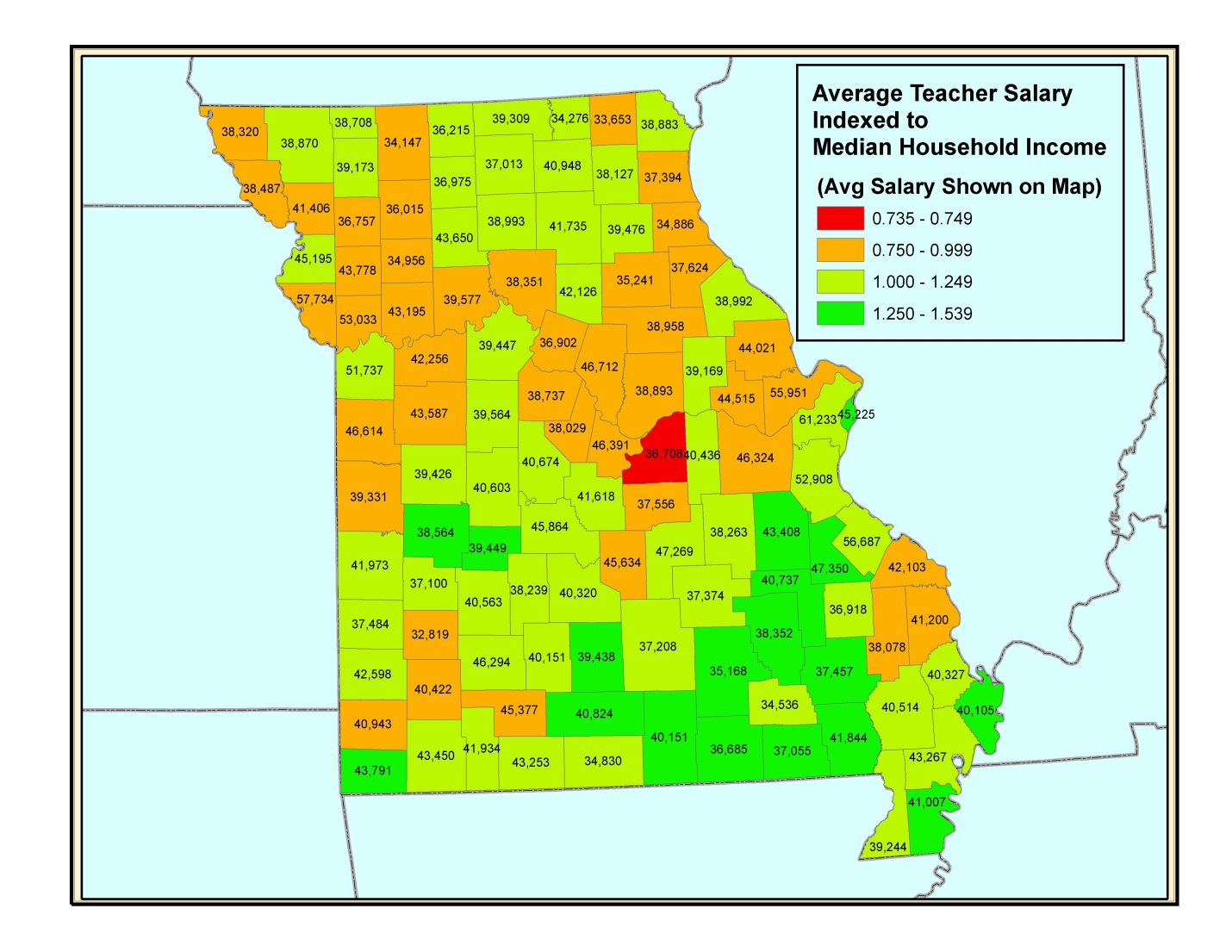
There are vast differences in the cost of living and average salaries of workers across the state. Take Shannon County for example. Located just south of the Mark Twain national forest, Shannon County is one of the poorest counties in the state (It also happens to be where my wife’s grandparents call home). The median household income in 2011 was roughly $20,000 less than the state average, at $25,684.  The average teacher in the county makes over $35,000, more than 135% of the median household income. On top of that, teachers receive a 14.5% match on retirement contributions and employer-paid health care. All of this for 180 days of work—that is, unless they use their 10 to 12 built-in sick/personal days. 

What would happen if we gave these teachers a raise? Would paying teachers an extra $2,000 or $3,000 and moving them to 140 or 150 percent of median household income attract new teachers or retain current teachers? That’s unlikely. They’re already far above their neighbors. What’s worse, it would strain the already limited stream of money that the district has to fund its schools. Small benefit, high cost, bad policy.

As I pointed out yesterday on the blog, teacher pay should reflect local economic markets.  The map at the top of this post shows the average salary of teachers in each Missouri county. The color indicates how the salary compares to the median household income of the county. An index can be thought of as a percentage, so in the counties shown in orange, teacher salaries range between 75% and 99% of median household income.  In many areas of the state with “low” teacher salaries, the wages are actually high compared to the median household income. 

Because of all of this, a statewide increase in teacher salaries (like the ones the MSTA calls for) would mean paying teachers in some areas of the state above what their local market demands.  It would push districts that are already financially strapped to take unpopular measures such as holding wages down for more senior teachers or increasing class sizes by hiring fewer teachers.

Today Missouri requires all school districts to start teachers at a salary of at least $25,000, and teachers with a master’s degree and 10 years of experience must earn at least $33,000. Increasing the minimum teacher salary to, say, $30,000 would have little effect on overall teacher pay.  According to a study by the Missouri State Teachers Association, the average starting teacher salary in Missouri is $33,012.

Still, many school districts—poor, rural districts—would be affected by an increase in the state-required minimum wage for teachers. Thus, this type of mandate would disproportionately affect those districts most strapped for cash. It would mean they could hire fewer teachers because they have less money to spend.

Increasing teacher salaries may be a noble goal, but the decision of whether to do so should be made by local school boards taking into account local conditions, not by politicians in Jefferson City.

Lambert-Saint Louis International Airport, Still Taxiing

2015 was, at first blush, a good year for Lambert Saint Louis International Airport (STL). Passenger levels are up, the airport added a couple of new destinations, and a long-awaited renovation project was completed. There’s talk of a new Mexico hub. The airport manager, Rhonda Hamm-Niebruegge, was named airport director of the year by Airport Revenue News.

But looks can be deceiving. For one thing, passenger growth at the airport (1%) lagged behind the national average (4%). This mirrors Saint Louis’s overall economic performance in the last year, which, while improving, is growing at a slower rate than much of the rest of the country. Look back further than last year and the situation is worse. STL’s traffic is still 12% lower than it was just before the recession. In fact, there were fewer passengers and flights from STL in 2015 than there were in 2010, after the recession had ended.

Year

2010

2015

Non-stop destinations

55

60

Total flights

195,409

185,474

Total passengers

6,276,530

6,247,994


The only category where the airport is has had success is in adding non-stop destinations, which increased from 55 to 60 in the last five years. But even here, improvement isn't necessarily as impressive as it first appears. Most of the added destinations are seasonal options, bound for resort destinations in the Caribbean. STL flies to fewer national, year-round destinations than it did five years ago.

Why is STL having such a difficult attracting more flights and more passengers? The culprit may be a slow Saint Louis economy, which airport managers have little control over. However, the airport is still dealing with a hangover from the new (and ultimately unneeded) runway it built in the early 2000s. That has made the airport more expensive, and therefore less attractive for additional airline service. For example, low-cost airline Allegiant recently chose to use Mid-America Regional Airport for new flights to Florida.

While it’s easy to blame things outside the airport’s control, STL’s leadership can make the best of a difficult situation. That means resisting the impulse, so prevalent in civic affairs, to try spending their way to health with lavish improvement projects. Providing efficient and plentiful air service is better than less service and more luggage shops. Bringing in more freight traffic may allow the airport to use extra room it thought it would need for the TWA hub. If STL leadership can implement a cost-effective, customer-oriented strategy, it will help not just the airport, but the entire Saint Louis region.

More Evidence on the Negative Effects of the Minimum Wage

University of California–San Diego economist Jeffrey Clemens’s recently published analysis once again indicates that raising the minimum wage has detrimental effects on low-skilled workers. Clemens’s analysis investigated the effect of the increases in the Federal minimum wage from $5.15 to $7.25 between 2007 and 2009 on the most vulnerable group of workers: those aged 16 to 30 without a high school education. 

Because the minimum wage increase was not equally binding in all states, Clemens was able to analyze the differential effect of the hike across groups of workers and states. After controlling for the overall negative economic effects stemming from the Great Recession, Clemens reports as follows:

My baseline estimate is that this period's full set of minimum wage increases reduced employment among individuals ages 16 to 30 with less than a high school education by 5.6 percentage points. This estimate accounts for 43 percent of the sustained, 13 percentage point decline in this skill group's employment rate. . . .

As argued before in numerous analyses published by the Show-Me Institute and others, raising the minimum wage simply does not improve the economic welfare of all low-wage workers. Clemens’ work reaffirms the notion that those whom minimum wage increases are touted as benefiting the most are in fact those who are the most likely to be harmed. 

There are better ways to improve the welfare of the most vulnerable workers in society. Improving and expanding programs like the earned income tax credit (EITC) should be considered before more minimum wage increases do further harm to the neediest in society.

Streetcars and the Error of Confusing Correlation vs Causation

On January 20, I will participate in a panel discussion of the Kansas City streetcar sponsored by the American Public Square. I am eager to participate and hope you can attend. 

To their credit, Kansas City's streetcar aficionados rarely make the claim that streetcars are good transit. They aren't. They are woefully expensive for the service they offer, are inflexible, and are slow. Bus rapid transit such as the MAX on Troost is a much more effective method of moving people.

In Kansas City and elsewhere, the matter comes down to one of correlation versus causation. Streetcar proponents want desperately to claim that the streetcar causes economic development downtown. It doesn't. In fact, all sorts of literature in the United States and around the world fails to show that streetcars cause economic development. There might be a correlation, however, as economic development often occurs along streetcar routes. Why? Because cities such as Kansas City lard their streetcar routes with all sorts of taxpayer subsidies such as tax increment financing and property tax abatements that are much more likely to drive development. Economic development may occur along streetcar routes, but it is not caused by them.

In fact, a 2010 study sponsored by the Federal Transit Administration found that,

The literature regarding empirical measurement of actual changes in economic activity, such as changes in retail sales, visitors, or job growth, is almost nonexistent for streetcars.  

This finding undercuts the primary claim made by advocates of streetcars—that they spur economic development. The same report adds,

Given that federal funding for streetcars emphasizes economic development, along with many local policymakers’ objectives to stimulate economic development, the literature is particularly weak on impacts of streetcars on economic development, such as the attraction of jobs, retail sales, and tax revenue.

In Kansas City, officials have strung together a laughable list of projects supposedly caused by the streetcar. We've debunked them here and here and here. While there may be a correlation between development and the streetcar, it isn't plausible to claim that the streetcar caused the development.

Consider that in the 2013 and 2014 seasons up to May 22, 2014, when ground was broken on the Kansas City streetcar line, the Royals record was 109-99, for a winning percentage of .524. Since the streetcar tracks were laid, however, the Royals went 183-126, including two World Series appearances and one world championship. That's a winning percentage of .592. If I suggested that the relationship between the streetcar construction and Royals’ success was one of causation—the streetcar caused the Royals to win two pennants and the World Series—I'd be laughed out of the room.

Yet this is exactly the sort of specious argument streetcar proponents make when they point to downtown development. The progress of the streetcar and the Royals’ success may run in parallel, but there is no relationship between them or among their causes. Like the streetcar and many developments attributed to it, the relationship is illusory.

New Study Shows Negative Effect for Vouchers. We’ve Got Some Explaining To Do.

After an unbroken streak of gold-standard, random assignment studies finding either positive or neutral results for school voucher programs, a new paper published by NBER finds large, negative results for the Louisiana Scholarship Program.

My friends Adam Peshek, Matt Ladner,  Jason Bedrick, Lindsey Burke, and Jonathan Butcher have written what I think are fair explanations of the findings.  Based on survey research and buttressed by the enrollment patterns of schools participating in the program, it appears that the requirements that the program placed on schools kept good schools from participating.  This drove students into lower-quality schools and, not surprisingly, worse outcomes.  Yet another reason to remember that program design matters.

Let me add two points:

First, we should be Bayesians.  To borrow from the branch of statistics, when trying to understand a phenomenon we should make assumptions about how it works, test them, update our assumptions based on the results of our tests, test them, update again, and so on, in a slow march toward the truth.  Study after study has supported the belief that private school choice programs benefit the students who participate (across a number of indicators). This study should decrease our confidence, but—especially given the issues that Peshek and others raise with the fundamental design of the program—it should not decrease it a great deal. That said, there is clearly a lot going on here, and we need to keep digging and updating what we know.

Second, and more importantly, if you live by the sword, you die by the sword. For years now, advocates (present company included) have used state math and reading test scores as the primary means to argue that school choice “works.”  In addition to probably not capturing everything that we want out of schools, we should also take into account that it appears that more and more families are opting into private schooling  to get away from schools that they think are obsessed with standardized testing . We should not be surprised when we look at standardized test scores from private schools and see that these students are scoring lower.  In fact, we should probably expect it.  But, if we’re going to support our arguments for choice with test scores (using them to show either shortcomings in public schools or the benefits of choice), we have hitched our wagon to them and can’t be surprised if people attack vouchers when poor test score results come out. Similarly, advocates (present company included) have treated voucher programs as interchangeable when talking about their effects, even though they differ in meaningful ways. If we’ve talked about their benefits without taking program design into account, we can’t be surprised if people attack their shortcomings without doing it either.

I hope this study causes a course correction in the school choice community on several fronts (understanding the costs of regulation, how we think about test scores, the fact that all voucher programs are not created equal). It should be a wakeup call, not a death knell.  

The Loop Trolley Bailout: A Retrospective

On December 8, the Saint Louis County Council voted to bail out the Loop Trolley, a 2.2-mile vintage streetcar line currently under construction. Back when the trolley was in the planning phase, Show-Me Institute researchers pointed out that the project was redundant as a transportation option. The trolley’s route, from the History Museum to the Delmar Loop, is served by seven MetroBus routes and the MetroLink.

Despite these objections, Saint Louis regional officials allowed the project to move forward. The trolley, they promised, would lead to development. Trolley planners also assured residents that the money needed would come from a transportation development district (TDD) around the line, along with federal grants. As we pointed out in a previous post, trolley planners originally stated that cost overruns would not be the responsibility of city or county taxpayers.

However, as of late 2014, the Loop Trolley faced cost overruns. Initial construction bids came back $11 million over the project’s $43 million budget. The project was put out to bid once more, and Loop Trolley planners announced the project was within the budget and everything was fine. But actually, the second round of bids still came back $8 million over budget.

Instead of looking to the Trolley’s TDD to cover cost overruns, trolley planners sought regional tax dollars. This included money from Great Rivers Greenway (a sales tax–funded body designed to build recreational trails) and an additional $5.4 million federal grant (which required a local match).

None of these efforts was known to the public until November, 2015, well after the construction of the trolley was underway. The overruns only became public because the Saint Louis County Council had to approve the $3 million needed to match the aforementioned federal grant. That money will come from County’s mass transit fund, which means that more than $8 million is being diverted from transit projects in the County. That $3 million easily could have matched other, similarly sized federal grants for transit projects of the county’s choosing. Now it will be spent on the trolley.

Summing it up, trolley planners sold their project to Saint Louis residents with a budget that would not work and promises they could not keep. When that became apparent, those planners said nothing, quietly committed local residents to pay for overruns, and then started putting rails in the streets. Presented with this fait accompli, the County Council approved what amounts to an $8 million bailout. In essence, the Council rewarded the tactics of trolley planners.

Rebecca Friedrichs’ Supreme Court Case Could Expand Workers Rights in Missouri

Next week the nation’s highest court will hear oral arguments in a case that will decide the constitutional rights of thousands of government workers. The court will decide whether the constitution protects a government employee’s right not to be associated with, or pay for, speech with which she disagrees.

Rebecca Friedrichs is a public school teacher in California who has long struggled with the California Teachers Association, a union that advocates for policies that run counter to Rebecca’s beliefs. Because a majority of the teachers in Rebecca’s school district at one time voted to elect the California Teachers Association to represent them, every current teacher in the district—including Rebecca—is now forced to pay to support the Association.

Rebecca believes this violates her rights. And she has a pretty strong case.

Rebecca’s case is fundamentally about the right of an individual or a minority in a group to think differently than the majority. The majority of the teachers in Mrs. Friedrichs’ school district support a union with an agenda that she disagrees with. Rebecca stands apart as someone who wants to speak with her own voice.

The court’s decision could affect public employees here in Missouri. If the court sides with Mrs. Friedrichs, it would expand the first amendment rights of thousands of teachers, fire fighters, and other Missouri government workers. As a result, each Missouri government employee could choose whether or not to support the union that operates in his or her workplace.


Support Us

The work of the Show-Me Institute would not be possible without the generous support of people who are inspired by the vision of liberty and free enterprise. We hope you will join our efforts and become a Show-Me Institute sponsor.

Donate
Man on Horse Charging