

St. Louis is considering a billion-dollar plus expansion of its light-rail system, the MetroLink, but is the burden to taxpayers just too high?
Collateral Damage of our Pension Systems
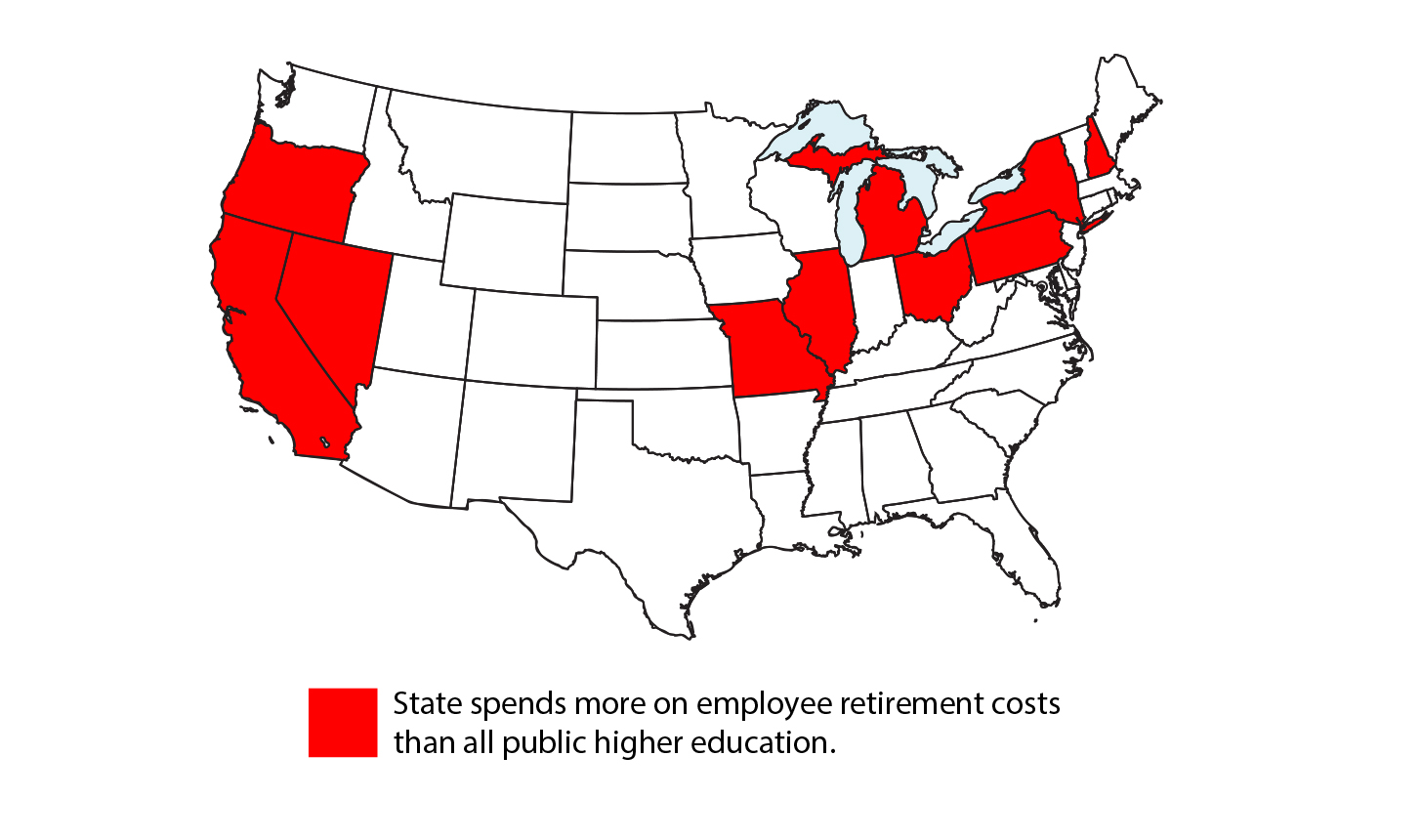
Here at the Show-Me Institute, we have harped, for years, on the unsustainability of Missouri’s pension system. We do this for one simple reason: poorly administered funds hurt the people of our state. They hurt the teachers who have to log 28 years of service in order to get more out of the system than they put into it. They hurt young, mobile teachers who leave before vesting. They have the potential to hurt future retirees when they invest in risky assets that could affect their solvency when more of our baby boomer teachers retire and the bills come due.
We can add another group to that list as well: our institutions of higher education. Chad Aldeman of Bellwether Education Partners (which publishes the website teacherpensions.org) has a new blog out wherein he shows the 10 states that are now paying more into their retirement systems than into their institutions of higher education. It’s not a good list to be on, but Missouri is on it.
Aldeman sums it up well:
“What to make of this finding? That depends on your perspective, but over time, I suspect higher education budgets will continue to be squeezed in favor of pensions. On the retirement side, costs will likely continue to rise. Even amidst one of the longest and strongest bull markets in history, pension plans still haven't recovered, and if pension plans fail to hit their 8 percent investment targets every year, they will need taxpayers to continue bailing them out. Higher education will be one of the primary losers from this arrangement.”
The great economist Herbert Stein is known for the quotation “trends that can’t continue, won’t.” The worrisome trend in our pension system can’t continue. Absent reform, it’s only a matter of time until it won’t.
(Data used for map are for FY 2014. Retirement data include state and local employer pension contributions. Data taken from http://crr.bc.edu/data/public-plans-database/pension. Higher education expenses include state general fund and “other state fund” contributions; see Table 12: http://www.nasbo.org/publications-data/state-expenditure-report.
Back to the Future (Taxpayers)

This Thursday, representatives of the Missouri State Employees Retirement System (MOSERS) and the Public School Retirement System (PSRS) will meet to decide whether or not to lower expected pension investment return rates. In the past they have assumed a long-term return rate of 8% on pension investments, but due to current underperforming investments, the systems are being forced to reassess that assumption.
For those unfamiliar with how public pensions work, these meetings may not seem particularly noteworthy, but the decisions made by MOSERS and PSRS will ultimately have a significant impact on taxpayers across the state. Overestimating the rate of return will result in lower initial payments into funds, higher total unfunded liabilities, and higher tax burdens down the road. A lower assumed return requires higher initial payments, but it helps ensure pensioners and taxpayers alike that the pensions can be funded solely out of those payments in the future.
Missouri Treasurer Clint Zweifel hopes to lower the current 8% assumption MOSERS uses to 7.4% this year and drop it to 7% over the next four years. He predicts that the lower rate would cost Missouri taxpayers tens of millions of dollars, but states “This is the fiscally responsible thing to do, not only for the fund and for its beneficiaries but also for taxpayers in the state.” In the past the Show-Me Institute has written about how pension discount rates should be evaluated in a more realistic manner in order to reduce unwanted future risks.
And we are by no means on the ideological fringe on this question. In 2014, the University of Chicago’s Business School surveyed professional economists and found that 96% agreed that assuming higher rates of return understates pension liabilities and the costs of providing pensions to public sector workers. That finding underscores the importance of these pension meetings.
Of course, one way to avoid burdening taxpayers with future pension liabilities, which we've also talked about, is to explore defined-contribution plans that consist of employer/employee contributions and investment gains as the final payout. In a defined-contribution plan, taxpayers won’t be held accountable when a retirement plan is underfunded because, by definition, the plan cannot incur liabilities.
But to be clear, pension liabilities are legally binding, so if the state is going to have defined-benefit pensions, it only makes sense that those pensions should be managed in a way that guarantees that employee pensions can be paid.
A truly fully funded pension plan would ensure that unfunded liabilities do not rise and that pensions are sufficiently funded today rather than shifting the burden to future generations. Let's hope MOSERS and PSRS seize the opportunity to protect pensioners and taxpayers.
Free Speech Under Fire at Colleges and Universities

Churchill called courage the “first” of the virtues. In the garden of good and evil, it is the one virtue that allows all of the others to flourish—from humility to wisdom and from charity to a genuine respect for the rights of others.
Courage does not tremble in the face of coercion. It does not beg for forgiveness for non-existent crimes. It stands tall in the defense of freedom . . . and in opposition to the dangers of mob rule or jackbooted tyranny.
All of which brings us to the wave of student protests that hit colleges and universities across the country in the fall of 2015. In one college after another, college presidents and administrators capitulated to unreasonable demands and went out of their way to curry favor with unruly protestors. In doing so, the titular leaders of these citadels of higher education acted both unwisely and with a shameful lack of courage.
The wave of protests began at the University of Missouri in Columbia, and it was here that assault on free speech became crystallized in the now-infamous picture of an MU communications professor calling for “some muscle” to bar campus journalists from a public area occupied by protestors.
Showing real courage in the face of taunts and physical intimidation, Tim Tai, a student photographer on assignment from ESPN, refused to leave the scene and asserted his First Amendment right to videotape in a public place—telling the protestors that his desire was to protect free speech for them no less than for himself.
In a quick succession of events in early November, protesters toppled University of Missouri system President Tim Wolfe, who was unpopular for reasons that had little or nothing to do with race. It began when a black graduate student (the son of a wealthy business executive) went on a hunger strike demanding Wolfe’s resignation. A few days later, black football players (coming to the end of a losing season) joined in a sympathy strike—refusing to play and exposing the university to a $1 million fine if it were forced to forfeit an upcoming game against Brigham Young University. Then head football coach Gary Pinkel (only days before announcing his retirement for health reasons) chose to play Fletcher Christian to Wolfe’s Captain Bligh – supporting his players in the mutiny against a sitting university president. On the very next day, Wolfe resigned—and black football players agreed to end their strike.
Lessons learned?
We are all limited to our own experience, so no one can tell how prevalent bias and racism may be at an institution the size of the University of Missouri (with 35,000 students). However, putting aside undocumented claims of deep and widespread bias by a few protestors (including a much-trumpeted but spurious report of a large Ku Klux Klan presence on the MU campus), we will cite three lessons.
First, there is a clear free-speech problem at the University of Missouri and other campuses. People are not allowed to express certain opinions, and even media coverage of protesting students is prohibited by those whose self-righteousness is overwhelming.
Second, you can tell that the values of the university have been misplaced—and indeed corrupted—when the football team and its coach play a decisive role in the resolution of a major conflict.
Third, it seems to us that the obsessive insistence by protest leaders (not just at MU but within the larger Black Lives Matter movement) that almost everything that is wrong in our society reduces to a single problem—white racism and supremacy in an ongoing saga that casts blacks in the role of victims—is not only unfair but truly unhelpful. More than anything else, it is a major distraction in the way of any serious attempt to come to grips with problems that disproportionately affect black people living in poorer neighborhoods—everything from low rates of K-12 educational achievement to high rates of unemployment and crime among black youth, and from government programs that discourage work to the sharp decline in recent decades of intact two-parent families.
At the end of the day, it may be that what happened at Mizzou last November will serve a useful purpose—alerting many people to the danger of falling into an intellectual trap: supporting calls for greater “diversity” that are more realistically described as an attempt to enforce an unquestioning and frightened conformity.
We hope that the new leaders of the university will have the wisdom and courage to reject an anti-free speech conformity that masquerades as a paradigm-busting “diversity.”
The Infectious Optimism of Education Entrepreneurs

By disposition, I am an optimist. For a person of my particular predilections it is, to echo Dickens, the best of times and the worst of times.
It is the best of times because, based on almost any indicator imaginable, it is the best time in human history to be alive. Just look at the decline in poverty over the last 200 years. Harvard professor Steven Pinker says that we’re living in the most peaceful time in the history of our species. The data back him up. When you consider that from the dawn of history through the year 1800 there was almost no improvement on most quality-of-life indicators, or the fact that there is no country on earth today with a shorter life expectancy than the country with the highest life expectancy in 1800, it is difficult not to feel grateful. Smallpox has been eradicated, and polio and guinea worm appear to be next, potentially saving tens of millions of lives every year. The pessimists were wrong. There are more of us, and yet we are richer and healthier than we could have possibly imagined 50 years ago.
It is the worst of times as it seems much of the fabric that has held together the interests and individuals that have made such prosperity possible is rending at the seams. Anti-Semitism appears to be on the rise, progress seems to have stalled on issues where our nation has made great strides, and a new group of our fellow citizens finds itself in crisis. Our nation is over-represented by folks at the bottom of the trunk of the “elephant graph.” Our politics are dreadful. Our universities are being overrun by people who appear to be afraid of ideas that are different than their own. Attachment to societal institutions that have long helped unite people during trying times is growing weaker each year.
It was against this backdrop that I walked into the Sprint Accelerator, a loft-like rehabbed warehouse in Kansas City’s Crossroads District. On this unseasonably hot June morning The Lean Lab, a nonprofit organization that works to develop and incubate educational entrepreneurs, welcomed its 2016 class of fellows to our fair city for four weeks of work on their nascent projects. They invited community members, educators, entrepreneurs, and researchers to listen to their pitches and give whatever advice they could to improve their projects.
Group after group took the stage, and it was hard not to be taken by their optimism. Each outlined the problem they were trying to solve: kids aren’t eating healthy food, and cafeterias waste inordinate amounts of it; foreign language instruction is based too much on memorization and not enough on conversation; crowdfunding platforms are not well designed to help teachers raise money for their classrooms; high school students can’t get unbiased information from colleges about what it is really like to go there; parents aren’t able to have meaningful conversations about what goes on in school every day with their children. They all identified serious problems, and they offered intriguing solutions. Over the course of the next month, each group will prototype and refine their products with a big final pitch at the end of the fellowship in the hopes of winning one of two $25,000 prizes.
People hoping to improve the nation’s education system could learn a lot from these budding entrepreneurs, who by and large were former teachers or had teachers on their teams. Rather than offering platitudes or infeasible plans to completely reshape the education system, they looked to solve clearly articulated, discrete problems that are right in front of them. Rather than be overwhelmed by all of the problems that face our schools and students, they focused on what small thing they could do to make the lives of kids, teachers, and parents better.
I have no idea if these products will ultimately work or not. But, if I’m being honest, I’m no more or less confident than I am about most new education reform ideas I come across. What I am confident about is that creating space for people like these optimistic entrepreneurs to solve problems is the way to maximize the likelihood that new and better schools will emerge and grow. (If you want a longer-form treatment of why I think this is the case, you can check out the introduction to Rick Hess’s and my new volume Educational Entrepreneurship Today.)
I left the building that day invigorated and feeling like my optimism is well founded. I wish all the teams, and entrepreneurial educators all around the country and world, good luck and Godspeed. I can’t wait to see what you develop.
The Infectious Optimism of Education Entrepreneurs
By disposition, I am an optimist. For a person of my particular predilections it is, to echo Dickens, the best of times and the worst of times.
It is the best of times because, based on almost any indicator imaginable, it is the best time in human history to be alive. Just look at the decline in poverty over the last 200 years. Harvard professor Steven Pinker says that we’re living in the most peaceful time in the history of our species. The data back him up. When you consider that from the dawn of history through the year 1800 there was almost no improvement on most quality-of-life indicators, or the fact that there is no country on earth today with a shorter life expectancy than the country with the highest life expectancy in 1800, it is difficult not to feel grateful. Smallpox has been eradicated, and polio and guinea worm appear to be next, potentially saving tens of millions of lives every year. The pessimists were wrong. There are more of us, and yet we are richer and healthier than we could have possibly imagined 50 years ago.
It is the worst of times as it seems much of the fabric that has held together the interests and individuals that have made such prosperity possible is rending at the seams. Anti-Semitism appears to be on the rise, progress seems to have stalled on issues where our nation has made great strides, and a new group of our fellow citizens finds itself in crisis. Our nation is over-represented by folks at the bottom of the trunk of the “elephant graph.” Our politics are dreadful. Our universities are being overrun by people who appear to be afraid of ideas that are different than their own. Attachment to societal institutions that have long helped unite people during trying times is growing weaker each year.
It was against this backdrop that I walked into the Sprint Accelerator, a loft-like rehabbed warehouse in Kansas City’s Crossroads District. On this unseasonably hot June morning The Lean Lab, a nonprofit organization that works to develop and incubate educational entrepreneurs, welcomed its 2016 class of fellows to our fair city for four weeks of work on their nascent projects. They invited community members, educators, entrepreneurs, and researchers to listen to their pitches and give whatever advice they could to improve their projects.
Group after group took the stage, and it was hard not to be taken by their optimism. Each outlined the problem they were trying to solve: kids aren’t eating healthy food, and cafeterias waste inordinate amounts of it; foreign language instruction is based too much on memorization and not enough on conversation; crowdfunding platforms are not well designed to help teachers raise money for their classrooms; high school students can’t get unbiased information from colleges about what it is really like to go there; parents aren’t able to have meaningful conversations about what goes on in school every day with their children. They all identified serious problems, and they offered intriguing solutions. Over the course of the next month, each group will prototype and refine their products with a big final pitch at the end of the fellowship in the hopes of winning one of two $25,000 prizes.
People hoping to improve the nation’s education system could learn a lot from these budding entrepreneurs, who by and large were former teachers or had teachers on their teams. Rather than offering platitudes or infeasible plans to completely reshape the education system, they looked to solve clearly articulated, discrete problems that are right in front of them. Rather than be overwhelmed by all of the problems that face our schools and students, they focused on what small thing they could do to make the lives of kids, teachers, and parents better.
I have no idea if these products will ultimately work or not. But, if I’m being honest, I’m no more or less confident than I am about most new education reform ideas I come across. What I am confident about is that creating space for people like these optimistic entrepreneurs to solve problems is the way to maximize the likelihood that new and better schools will emerge and grow. (If you want a longer-form treatment of why I think this is the case, you can check out the introduction to Rick Hess’s and my new volume Educational Entrepreneurship Today.)
I left the building that day invigorated and feeling like my optimism is well founded. I wish all the teams, and entrepreneurial educators all around the country and world, good luck and Godspeed. I can’t wait to see what you develop.
Time for the TSA to Pack Its Bags?

Airports across the country are experiencing longer security lines, but is there a solution? Yes. Several U.S. airports, including Kansas City International Airport, have privatized their security, resulting in shorter lines and lower costs.
Unions’ Orwellian “Takings Clause” Argument

Unions in Idaho and Wisconsin have filed federal lawsuits claiming that employees who don't want to be in their unions are violating the Fifth Amendment's Takings Clause by not paying for union representation. For those unfamiliar with the section, the Takings Clause says that "private property (shall not) be taken for public use, without just compensation." The unions' claim is that the act of collective bargaining is a union's "private property," and that employees who are subject to the union's agreements but reject the union are not compensating these unions for that property interest.
The irony is that a straightforward reading of the Takings Clause should actually protect individual employees from having their paychecks bitten into without consent. These lawsuits use the reverse argument—requiring the Court to believe that the paychecks of employees are fundamentally union property to begin with, and that nonunion employees are “taking” money away from them by withholding their support.
In the past the Supreme Court has found that "unions have no constitutional entitlement to the fees of non-member employees," so the odds of success in these lawsuits do not appear high. But even if the law wasn't in favor of the rights of individual workers, the idea that unions have a constitutional right to the paychecks of laborers who reject them seems not only undemocratic but also, frankly, immoral.
Workers – whether union members and not – deserve better than that.
Deathblow to St. Louis Charter Schools?

Saint Louis Public Schools are suing the state for 42 million dollars, claiming this money was improperly sent to charter schools. If charter schools have to turn over this money, they will be financially crippled. Click on the link to see the video.
