

Earlier this week the Department of Health and Human Services released next year's Obamacare insurance exchange prices. You can find the full data set here; I have set aside Missouri's rates in the spreadsheet embedded below. To find the range of rates and plans that will be available to you, press CTRL-F (or Open Apple-F on a Mac) to open the search function, and then input your county. As you scroll right, you'll find the range of prices in your county, sorted by demographic.
Kansas City’s Development Guru Admits He Was Wrong

Most Kansas Citians won’t recognize the name, but we owe much of the inspiration for our downtown development scheme to urbanist Richard Florida. According to The Houston Chronicle, through his book, “The Rise of the Creative Class,” Florida
popularized the early-aughts idea that faded cities could revitalize themselves by attracting the talented, intellectual types who made up what he called the "creative class." Lure some hip coffeeshops, create an "arts district," play up your gay friendliness, and watch the laptopping masses pour in.
Unfortunately for Kansas City, our leaders bit hard on the bait and haven’t yet let go. Witness the millions of dollars poured into failed downtown economic development schemes such as the Power & Light District and the H&R Block building. Note the rhetoric around the streetcar or the Smart Cities proposals. Note the Mayor’s focus on Kansas City’s startup mirage. We’re chasing a creative class dream spun by Florida. Show-Me Institute writers pointed out flaws in his ideas for years, and now, at last, Florida himself admits he was wrong:
I got wrong that the creative class could magically restore our cities, become a new middle class like my father's, and we were going to live happily forever after," he said. "I could not have anticipated among all this urban growth and revival that there was a dark side to the urban creative revolution, a very deep dark side.
For Kansas Citians, the dark side we are being saddled with now is an ever-more hollowed out tax base, a city that struggles to deliver basic services, and an east side made even more unattractive to developers due to the flow of subsidies to other neighborhoods that were already economically sound. Regular readers of this blog know we’ve argued against Florida for years.
Florida has admitted his error. Will those in Kansas City who followed his advice do the same?
A Skunk at the Pre-K Garden Party for Cigarette Taxes

The English language offers several beautiful idioms to describe someone unwelcome at a social gathering. The most common, “a skunk at a garden party,” paints the image quite nicely.
Look at all these glamorous people eating canapés and drinking champagne in their seersucker suits and sundresses! Oh, no—is that what I think it is? RUN!
If you think it’s not a great idea to fund educational programs via cigarette taxes, you can start to feel like a skunk at a garden party.
Here in the great state of Missouri, on November 8 we will vote on a constitutional amendment that would establish a 60-cent tax per pack of cigarettes to create a fund for pre-K education. Backers believe that it would generate as much at $300 million per year, which would pay for tens of thousands of Missouri children to attend pre-K. They have an impressive advertising campaign and a strong social media presence highlighting the bipartisan support they have assembled for their plan.
On one level, I am sympathetic to their cause. I understand that there are perfectly defensible reasons to support raising cigarette taxes. Smoking is terrible, and we want fewer people to do it. Raising taxes will deter them. If we can provide pre-K with the funds such a tax generates, we’re killing two birds with one stone.
But there is more to this plan than meets the eye.
The largest financial backers of the amendment campaign have been big tobacco companies. Why, you might ask, is an industry looking to increase taxes on itself? Well, paired with the 60-cent tax on all packs of cigarettes is a 67-cent surcharge on so-called “wholesale” cigarettes—cigarettes produced by “small tobacco” companies not party to the landmark tobacco settlement that required the big tobacco companies to pay states in exchange for protection against future lawsuits. Big tobacco pays right around 67 cents per pack into these funds, giving small tobacco an edge in the marketplace. This amendment would eliminate that advantage.
What’s more, many anti-smoking and cancer-fighting groups have decided to oppose the amendment. They argue that a 60-cent tax is not substantial enough to deter folks from smoking.
For those of you keeping score at home: We have a cigarette tax campaign that is funded by big tobacco companies and opposed by the American Cancer Society. If I’m a skunk at the garden party, at least I’m in good company.
Setting the parlor intrigue aside, it’s hard for me to not think that for many Missourians, the real draw here is getting something for nothing. I don’t smoke, so I would never pay this tax. Most Missourians, particularly educated and wealthy ones, don’t either, so they won’t have to pay. If the state generates enough funds, there is good reason to believe that many middle-class children of nonsmokers will get pre-K without their parents having to pay a dime.
If we think one step further though, we see the problem. Cigarette taxes are about the most regressive tax we could possibly institute. Poor people pay the brunt of them. If this tax was going to be passed in 1950, when nearly half the population smoked, it would be spread more evenly across the populace. But it is 2016, and only a specific subset of Missourians smoke. What’s worse, a lot of those people are addicted to cigarettes, and we are preying on that addiction to fund something that we want.
Look at what happened in Arkansas, which instituted a lottery in 2008 to provide scholarships for students to attend college in the state. Like cigarettes, lottery tickets are disproportionately purchased by poor people. In Arkansas, scholarship recipients are disproportionately middle- and upper-income, making the scholarship lottery a pretty clear upward transfer of wealth. Sure, it sounded great at the outset, as non—lottery ticket buying parents eyed scholarships for their kids, but on the backs of the poor? It just feels unseemly.
There are reasons to support providing scholarships to pre-K to students in the state, but the how matters. How we fund those services, how we determine who is eligible, and how we pay for them is critically important. These considerations can get lost in big promises to people with little skin in the game.
Subsidies in Saint Louis: Part 1

What would you think if your city officials had gambled with nearly $1 billion in taxpayer dollars? What would you say if I told you that City of Saint Louis has put that amount of money at risk over the last 15 years?
Tax-increment financing (TIF) and property tax abatement (TA) are incentives used across Missouri to encourage development and economic activity. In short, these tax breaks subsidize private developers with tax revenue. When city leaders hand out these incentives, they’re betting that the resulting development will stimulate the local economy and increase long-term tax revenue. Unfortunately, the gamble rarely pays off.
In 2015, the 504 TIF projects in the state diverted $2.49 billion in tax revenue away from schools, libraries, and other taxing jurisdictions. Instead of funding core government services, these revenues went to private developers. Heavy use of TIF and other incentives in cities like Kansas City and Saint Louis has prompted officials, citizen groups, and researchers to investigate the effectiveness of these development subsidies.
This May, a comprehensive report on incentives in Saint Louis was released by the Saint Louis Development Corporation (SLDC), the agency that administers TIF and TA in Saint Louis. In a series of blogs, op-eds, and other outlets, we will explain and analyze the findings of the report.
Here are a few of the findings we’ll touch on:
- Development incentives have little or no positive economic development benefits. The $709 million the city has spent on TIF and TA have not created jobs, revitalized neighborhoods, or increased long-term tax revenues.
- Rather than being used in economically depressed areas, TIF and TA are used mostly in neighborhoods with strong housing markets. In fact, nearly two-thirds have been used in just three neighborhoods in the central corridor.
- The level and quality of reporting on incentives is so poor that officials and the public “cannot readily determine what may or may not be deemed a project worthy of consideration for a City tax incentive” (p. 7).
In short, it looks as if the use of incentives in Saint Louis has been a disaster. Look for more commentary on incentives in Saint Louis and across the state in the coming weeks.
What an Honest Economic Development Study in Kansas City Might Conclude
A July piece by Steve Vockrodt for The Kansas City Star talked about the city’s efforts to study the real impact of economic development programs in Kansas City. According to Mayor Sly James,
Such an analysis, if done correctly, will take some time to complete, however, we will be working to complete it as soon as possible. The report will provide the sort of data and facts that can lead to reasonable and responsible improvements to our economic development policy.
It’s been three months since that piece, and no study is forthcoming. A subsequent Star story, however, suggests that the City’s effort may be more interested in highlighting incentives than in assessing them.
Mayor Sly James said at a recent meeting of KCStat — a data-crunching initiative of the city’s meant to improve its effectiveness — that City Hall doesn’t do a good enough job of promoting how economic development benefits the city.
Will the proposed $350,000 study aim to assess policy or “promote” successes? Existing research into the city's economic development policies does not paint a pretty picture. The Show-Me Institute conducted its own examination of TIF abuse in Kansas City broadly as well as individual analyses of questionable tax abatement (TA) projects such as for H&R Block and Burns & McDonnell. We’ve also highlighted independent university research that shows that subsidies like TIF have no impact. Still, some pundits in Kansas City simply “don’t care.”
While we wait for the Kansas City report, let’s consider a similar report recently completed in St. Louis. My colleagues Graham Renz and Michael Highsmith are releasing a series of pieces (the first of which is available here) examining that report. In short, the study found that:
- Development incentives have little to no positive economic development benefits. The $709 million the city has spent on TIF and TA has not created jobs, revitalized neighborhoods, or increased long-term tax revenues.
- Rather than TIF and TA being used in economically depressed areas, they are used mostly in neighborhoods with strong housing markets. In fact, nearly two thirds are used in just three neighborhoods in the central corridor.
- The level and quality of reporting on incentives is so poor that officials and the public “cannot readily determine what may or may not be deemed a project worthy of consideration for a City tax incentive.”
The sheer amount of money being diverted away from important city services makes this an important area for the city to examine. While Kansas City works to analyze the data, the honest examination from St. Louis should serve as a model—and a warning.
The North Side’s Unlearned Lesson
Many Saint Louis residents are familiar with the empty promise of the NorthSide redevelopment project and how it hasn’t achieved any actual redevelopment. The City of Saint Louis has authorized roughly $400 million dollars in tax increment financing (TIF) for Paul McKee’s envisioned development, yet despite the project’s collapse it seems the city hasn’t learned its lesson.
Earlier this month the Saint Louis Board of Aldermen’s Housing, Urban Development and Zoning Committee voted 4-3 to approve the release of a $2.8M TIF note and to establish a community improvement district (CID). This decision would impose an additional 1% sales tax in the area to assist with the development of a $20M grocery store and gas station that Paul McKee announced back in March.
Both residents and city officials pushed back on this decision in part due to their frustrations with NorthSide’s history, and in part because the CID would increase the burden on residents in the area who may not be able to afford it. The proposed CID would bring the area’s sales tax up to 9.679% (Missouri’s average is 7.86%).
When we consider how heavily subsidized the development already is, the argument for a CID becomes less convincing. The development’s costs are estimated at $20M. Considering that $10M of funding is coming from a U.S. Department of Agriculture grant, $5M from New Market Tax Credits and $2.8M from TIF, the project is almost entirely being taken on with funds from taxpayer pockets. Is such heavy incentive use appropriate for a venture that includes a dime-a-dozen gas station?
The Northside Regeneration fiasco has received a staggering amount of incentives and has little to show for it. The bills in question now move on to the Saint Louis Board of Aldermen to determine whether this development needs yet another subsidy.
Like an Exploding Cell Phone, Obamacare Should Be Replaced
The last few months have been pretty devastating for the "Patient Protection and Affordable Care Act." Shortly after United and Aetna announced they would be exiting practically all of Obamacare's insurance exchanges, including Missouri's, we found out that Americans' insurance premiums will be rising signficantly in the plans that remain. Here in the Show-Me State, the premium hikes alone in the exchange could be as high as 20 to 30 percent—harming, not protecting, patients with unaffordable and steadily deteriorating coverage options.
On Thursday the President more or less confirmed this, albeit unintentionally. Many of our readers are aware that tech giant Samsung has recalled its Galaxy Note 7 cellular phone because it's, well, exploding. In response, the company has told Note 7 owners to stop using the device immediately. Even the FAA has banned taking such phones aboard airplanes because of the risk associated with the phone catching fire. Rather than try to upgrade the product to avert their catastrophic failures, Samsung is now… replacing all of the devices.
I had not previously thought to compare Obamacare to a device with an unadvertised tendency to explode, but luckily President Obama just painted that picture for us.
Obama compared problems in the law to a bug in new technology. He said, for example, that a company will fix a problem with a smartphone.
"They upgrade it, unless it catches fire and then they just pull it off the market," Obama joked, in a reference to the recalled Samsung Galaxy Note 7 smartphone. "But you don't go back to using a rotary phone. You don't say, we're repealing smartphones."
Along with the joke being a tad tone deaf given the pain the law has put families through, President Obama's analogy is imperfect because by repealing the PPACA we wouldn't be repealing "health care"—just an indisputably broken part of it. As Samsung is swapping one failed product for another that won't set your hair on fire, so should policymakers fundamentally reassess and replace what was and is an ill-conceived health care law that doubled-down on the status quo rather than reforming it.
As the President suggests, sometimes trying to "upgrade" an inferior product can be downright dangerous. After 6 years of poor Obamacare results, it's time for policymakers to move on to something better.
Immortal COMBAT?

In November, Jackson County voters will be asked to renew a 0.25 percent sales tax used to fund the Community Backed Anti-Crime Tax (COMBAT). The tax has been renewed by voters five times since it was first instituted in 1989. What are taxpayers getting for their money? That’s a difficult question to answer.
Unsurprisingly, everyone on the receiving end of the tax wants to see it renewed. According to a piece in The Kansas City Star,
Renewing the tax is essential for preventing and reducing violence, County Executive Frank White said.
“Anything that we can do to help our citizens in terms of prevention, and being proactive in what we do, is really what this (tax) is about,” he said.
County prosecutor Jean Peters Baker echoed the same sentiment. Yet homicide is up in Kansas City, (home to more than 68 percent of Jackson County’s population) and markedly so since COMBAT launched its anti-violence campaign in 2013. Kansas City’s homicide rate in 2015 was so high as to have made the FBI’s list of cities driving the national numbers. The 2016 homicide rate will be even higher. Exactly how is the tax helping to prevent violence?
As for drug prevention, one of the programs funded by the tax is the DARE program. Yet research has shown for years that the DARE program either does not work or makes matters worse. Exactly how is the Jackson County program making a positive difference on drug use?
Recall too that taxes in Jackson County are not low. The left-leaning Brookings Institution found in 2013 that Jackson County was well above average when it came to property taxes paid and property taxes paid relative to home value. So why the additional tax? As former Star columnist Yael Abouhalkah pointed out in 2009, "Almost no other county in the nation has a special drug tax—and yet communities across the country close drug houses, hire police officers to chase drug dealers and fund drug courts." In fact, these communities appear to be doing a better job of it than Jackson County does.
Good public policy requires more than good intentions; it requires good outcomes. Crime and drug prevention efforts in Jackson County seem to be failing badly—and not because of a lack of funding.
Taxpayers deserve an honest accounting of how the County is spending their money and making a difference for the better.
Show-Me Now! Startup Jobs Fall. Is Government In The Way?
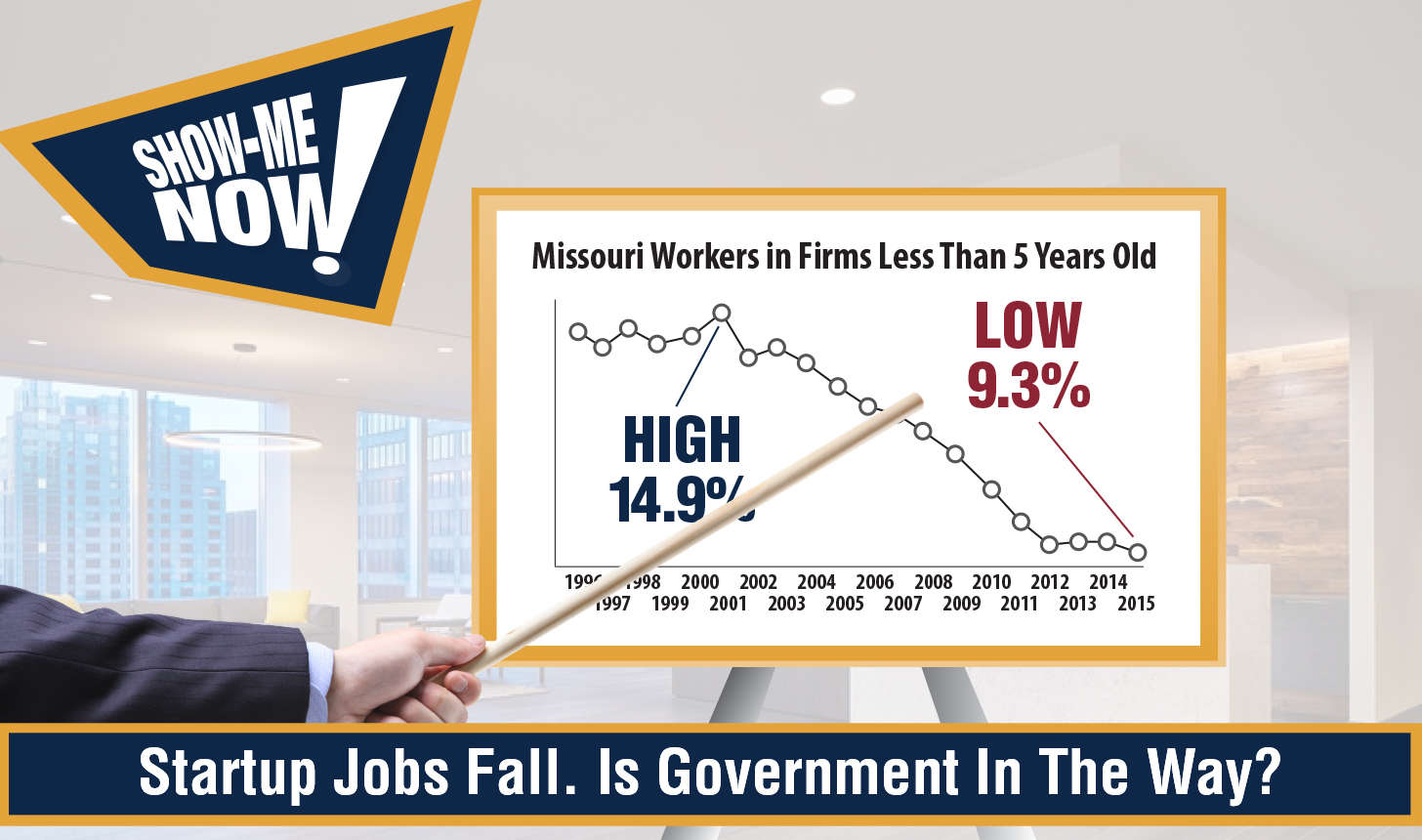
Show-Me Institute Policy Analyst Michael Austin notes that the percentage of Missouri workers employed by startups has fallen dramatically. If the state got out of the way, perhaps more companies would open in the Show-Me State.
To learn more, check out Entrepreneurship in Missouri Part I and Part II.
