Subsidies in Saint Louis: Part 1

What would you think if your city officials had gambled with nearly $1 billion in taxpayer dollars? What would you say if I told you that City of Saint Louis has put that amount of money at risk over the last 15 years?

Tax-increment financing (TIF) and property tax abatement (TA) are incentives used across Missouri to encourage development and economic activity. In short, these tax breaks subsidize private developers with tax revenue.  When city leaders hand out these incentives, they’re betting that the resulting development will stimulate the local economy and increase long-term tax revenue. Unfortunately, the gamble rarely pays off.

In 2015, the 504 TIF projects in the state diverted $2.49 billion in tax revenue away from schools, libraries, and other taxing jurisdictions. Instead of funding core government services, these revenues went to private developers. Heavy use of TIF and other incentives in cities like Kansas City and Saint Louis has prompted officials, citizen groups, and researchers to investigate the effectiveness of these development subsidies.

This May, a comprehensive report on incentives in Saint Louis was released by the Saint Louis Development Corporation (SLDC), the agency that administers TIF and TA in Saint Louis. In a series of blogs, op-eds, and other outlets, we will explain and analyze the findings of the report.

Here are a few of the findings we’ll touch on:

  • Development incentives have little or no positive economic development benefits. The $709 million the city has spent on TIF and TA have not created jobs, revitalized neighborhoods, or increased long-term tax revenues.
  • Rather than being used in economically depressed areas, TIF and TA are used mostly in neighborhoods with strong housing markets. In fact, nearly two-thirds have been used in just three neighborhoods in the central corridor.
  • The level and quality of reporting on incentives is so poor that officials and the public “cannot readily determine what may or may not be deemed a project worthy of consideration for a City tax incentive” (p. 7).

In short, it looks as if the use of incentives in Saint Louis has been a disaster. Look for more commentary on incentives in Saint Louis and across the state in the coming weeks.


What an Honest Economic Development Study in Kansas City Might Conclude

A July piece by Steve Vockrodt for The Kansas City Star talked about the city’s efforts to study the real impact of economic development programs in Kansas City. According to Mayor Sly James,

Such an analysis, if done correctly, will take some time to complete, however, we will be working to complete it as soon as possible. The report will provide the sort of data and facts that can lead to reasonable and responsible improvements to our economic development policy.

It’s been three months since that piece, and no study is forthcoming. A subsequent Star story, however, suggests that the City’s effort may be more interested in highlighting incentives than in assessing them.

Mayor Sly James said at a recent meeting of KCStat — a data-crunching initiative of the city’s meant to improve its effectiveness — that City Hall doesn’t do a good enough job of promoting how economic development benefits the city.

Will the proposed $350,000 study aim to assess policy or “promote” successes? Existing research into the city's economic development policies does not paint a pretty picture. The Show-Me Institute conducted its own examination of TIF abuse in Kansas City broadly as well as individual analyses of questionable tax abatement (TA) projects such as for H&R Block and Burns & McDonnell. We’ve also highlighted independent university research that shows that subsidies like TIF have no impact. Still, some pundits in Kansas City simply “don’t care.”

While we wait for the Kansas City report, let’s consider a similar report recently completed in St. Louis. My colleagues Graham Renz and Michael Highsmith are releasing a series of pieces (the first of which is available here) examining that report. In short, the study found that:

  • Development incentives have little to no positive economic development benefits. The $709 million the city has spent on TIF and TA has not created jobs, revitalized neighborhoods, or increased long-term tax revenues. 
  • Rather than TIF and TA being used in economically depressed areas, they are used mostly in neighborhoods with strong housing markets. In fact, nearly two thirds are used in just three neighborhoods in the central corridor.
  • The level and quality of reporting on incentives is so poor that officials and the public “cannot readily determine what may or may not be deemed a project worthy of consideration for a City tax incentive.”

The sheer amount of money being diverted away from important city services makes this an important area for the city to examine. While Kansas City works to analyze the data, the honest examination from St. Louis should serve as a model—and a warning.

The North Side’s Unlearned Lesson

Many Saint Louis residents are familiar with the empty promise of the NorthSide redevelopment project and how it hasn’t achieved any actual redevelopment.  The City of Saint Louis has authorized roughly $400 million dollars in tax increment financing (TIF) for Paul McKee’s envisioned development, yet despite the project’s collapse it seems the city hasn’t learned its lesson.

Earlier this month the Saint Louis Board of Aldermen’s Housing, Urban Development and Zoning Committee voted 4-3 to approve the release of a $2.8M TIF note and to establish a community improvement district (CID).  This decision would impose an additional 1% sales tax in the area to assist with the development of a $20M grocery store and gas station that Paul McKee announced back in March.

Both residents and city officials pushed back on this decision in part due to their frustrations with NorthSide’s history, and in part because the CID would increase the burden on residents in the area who may not be able to afford it.  The proposed CID would bring the area’s sales tax up to 9.679% (Missouri’s average is 7.86%).

When we consider how heavily subsidized the development already is, the argument for a CID becomes less convincing.   The development’s costs are estimated at $20M.  Considering that $10M of funding is coming from a U.S. Department of Agriculture grant, $5M from New Market Tax Credits and $2.8M from TIF, the project is almost entirely being taken on with funds from taxpayer pockets. Is such heavy incentive use appropriate for a venture that includes a dime-a-dozen gas station? 

The Northside Regeneration fiasco has received a staggering amount of incentives and has little to show for it.  The bills in question now move on to the Saint Louis Board of Aldermen to determine whether this development needs yet another subsidy. 

Like an Exploding Cell Phone, Obamacare Should Be Replaced

The last few months have been pretty devastating for the "Patient Protection and Affordable Care Act." Shortly after United and Aetna announced they would be exiting practically all of Obamacare's insurance exchanges, including Missouri's, we found out that Americans' insurance premiums will be rising signficantly in the plans that remain. Here in the Show-Me State, the premium hikes alone in the exchange could be as high as 20 to 30 percent—harming, not protecting, patients with unaffordable and steadily deteriorating coverage options.

On Thursday the President more or less confirmed this, albeit unintentionally. Many of our readers are aware that tech giant Samsung has recalled its Galaxy Note 7 cellular phone because it's, well, exploding. In response, the company has told Note 7 owners to stop using the device immediately. Even the FAA has banned taking such phones aboard airplanes because of the risk associated with the phone catching fire. Rather than try to upgrade the product to avert their catastrophic failures, Samsung is now… replacing all of the devices.

I had not previously thought to compare Obamacare to a device with an unadvertised tendency to explode, but luckily President Obama just painted that picture for us.

Obama compared problems in the law to a bug in new technology. He said, for example, that a company will fix a problem with a smartphone.

"They upgrade it, unless it catches fire and then they just pull it off the market," Obama joked, in a reference to the recalled Samsung Galaxy Note 7 smartphone. "But you don't go back to using a rotary phone. You don't say, we're repealing smartphones."

Along with the joke being a tad tone deaf given the pain the law has put families through, President Obama's analogy is imperfect because by repealing the PPACA we wouldn't be repealing "health care"—just an indisputably broken part of it. As Samsung is swapping one failed product for another that won't set your hair on fire, so should policymakers fundamentally reassess and replace what was and is an ill-conceived health care law that doubled-down on the status quo rather than reforming it.

As the President suggests, sometimes trying to "upgrade" an inferior product can be downright dangerous. After 6 years of poor Obamacare results, it's time for policymakers to move on to something better.

Immortal COMBAT?

In November, Jackson County voters will be asked to renew a 0.25 percent sales tax used to fund the Community Backed Anti-Crime Tax (COMBAT). The tax has been renewed by voters five times since it was first instituted in 1989. What are taxpayers getting for their money? That’s a difficult question to answer.

Unsurprisingly, everyone on the receiving end of the tax wants to see it renewed. According to a piece in The Kansas City Star,

Renewing the tax is essential for preventing and reducing violence, County Executive Frank White said.

“Anything that we can do to help our citizens in terms of prevention, and being proactive in what we do, is really what this (tax) is about,” he said.

County prosecutor Jean Peters Baker echoed the same sentiment. Yet homicide is up in Kansas City, (home to more than 68 percent of Jackson County’s population) and markedly so since COMBAT launched its anti-violence campaign in 2013. Kansas City’s homicide rate in 2015 was so high as to have made the FBI’s list of cities driving the national numbers. The 2016 homicide rate will be even higher. Exactly how is the tax helping to prevent violence?

As for drug prevention, one of the programs funded by the tax is the DARE program. Yet research has shown for years that the DARE program either does not work or makes matters worse. Exactly how is the Jackson County program making a positive difference on drug use?

Recall too that taxes in Jackson County are not low. The left-leaning Brookings Institution found in 2013 that Jackson County was well above average when it came to property taxes paid and property taxes paid relative to home value. So why the additional tax? As former Star columnist Yael Abouhalkah pointed out in 2009, "Almost no other county in the nation has a special drug tax—and yet communities across the country close drug houses, hire police officers to chase drug dealers and fund drug courts." In fact, these communities appear to be doing a better job of it than Jackson County does.

Good public policy requires more than good intentions; it requires good outcomes. Crime and drug prevention efforts in Jackson County seem to be failing badly—and not because of a lack of funding.

Taxpayers deserve an honest accounting of how the County is spending their money and making a difference for the better.

Two Thumbs Down for MetroLink Expansion

I had a friend – a newspaper editor and publisher – who mangled many words, sometimes inventing new ones in the process.

Let everyone else sing the praises of a new book or movie. If he couldn’t make heads or tails of it, he told you so in his own inimitable way. He said it was weirt. Not weird, but weirt.

As a one-word critique, his mispronunciation spoke volumes. Weirt was more than passing strange and more than a little peculiar. If something was weirt, only someone with his head in the clouds, or buried in the sand, would think it worthy of serious consideration.

What else is weirt?

How about plans to spend $2.2 billion in taxpayer money to build a 17-mile extension of the Saint Louis MetroLink light-rail system? That works out to more than $100 million per mile, or about $2,000 per foot.

Despite the colossal expense, it’s a must-do, says Mayor Francis Slay. He calls it “a moral and economic imperative.”

If you believe that, you must also believe that more light rail will help to solve a multitude of urban problems – everything from inner city decay and high unemployment to traffic congestion and air pollution.

In fact, in a sprawling metropolis like Saint Louis, there is little light rail can do to ease, let alone solve, any of those problems.

Since the 1990s, MetroLink has soaked up $3 billion in taxpayer money through capital outlays and operating subsidies. What do we have to show for it?

Very little. MetroLink carries less than one-half of one percent of the area’s commuters. Adding 17 miles to the existing 46 miles of track won’t make much of a difference there.

So here’s a better idea, which people who actually ride on MetroLink – as opposed to the downtown political class – would surely appreciate.

Instead of adding a line, give new cars to all MetroLink riders – to include today’s 44,000 daily riders, plus an estimated 15,000 future riders from the planned expansion.

The local/regional share of the construction cost is $1.1 billion, plenty of money ($18,600 per rider) to buy everyone a new compact. Add the matching federal dollars, and you could give new SUVs to all MetroLink riders.

What else could the St. Louis region do with $1.1 billion. It could:

  • pay tuition for more than 27,000 Missouri residents at the University of Missouri at Saint Louis (for their entire degrees)
  • triple Bi-State Transit’s fleet of buses and make other major improvements
  • send out $500 checks to every man, woman, and child in the metropolitan area.

That is not to say that we should do any of those things; it is just to put the magnitude of the proposed expenditure on MetroLink into a broader perspective.

For Slay and others to advocate spending that much money on an underutilized and largely irrelevant light-rail system is beyond weird; it is truly weirt.

How Low Can We Go?

No, this isn’t about the Presidential election. It’s about the Missouri economy’s lack of economic vitality. And what I will show is that the lack of vitality is not a recent development.

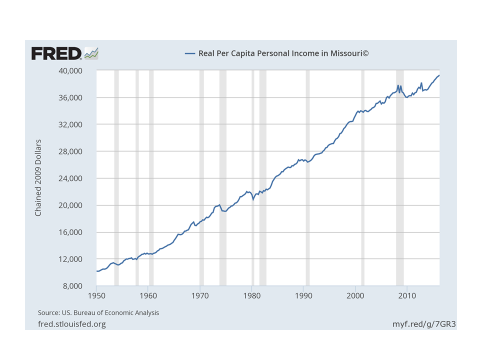
The two charts below tell the story. The first chart shows real personal income per capita (hereafter income), measured in 2009 dollars, for Missouri since 1950. In that year income stood at $10,168. By 2015 it had risen to $38,612. That almost-fourfold increase means that individuals today are, on average, much better off than they were in 1950. That’s the good news.

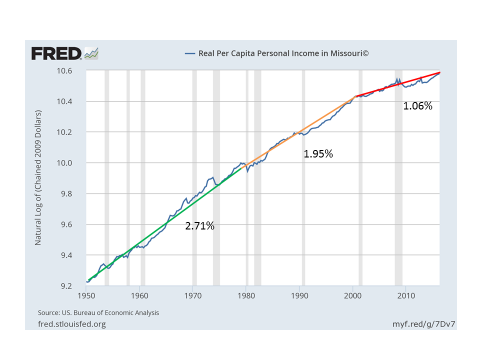
The second chart uses the same data, this time shown using a log scale for income. That means we can look at the slope of the line to better see how fast income has been growing over time. I have picked out what look to me like three fairly distinct stages of decline. The first runs from 1950 through 1979, and is highlighted with a green line. During these three decades Missouri income increased at an annual average rate of about 2.7 percent. The next period runs from 1980 through 1999 and is delineated by the amber line. During this period income in Missouri grew at an average annual rate of less than 2 percent, a notable drop from the previous period. The final stage, shown by the red line, is the period since 1999. So far in this century, income in Missouri has increased at an average rate of just slightly more than 1 percent per year. Income in Missouri today is increasing at about a third of the pace that it did 40 years ago.

If you are not used to thinking about growth rates of income, you might think that such changes are not really important. But they are, and some context shows why.

The slower the growth rate, the longer it takes for income to double. For the first period, that growth rate implies that income would double approximately every 26 years; for the second period the time to double increases to every 37 years; and the current growth rate means that it would take 68 years for income to double. The slower income growth means that it will take much longer for Missourians’ standard of living to increase.

Another way to think about what these growth numbers imply is to ask “What would income be today if the growth slowdown had not occurred?” Recall that income in 2015 was $38,612. Starting with the level of income in 1979, if Missouri's economy had continued to grow as fast as it had from 1950 to 1979, income today would be over $57,000. Or, suppose we use the 1999 level of income, which was $32,524, and ask what it would be in 2015 if income had increased at its slower 1980–1999 rate. The answer is about $44,300. In either case, income today would be appreciably higher that what it has turned out to be. Slower economic growth translates into lower standards of living.

The upshot is that ever-increasing layers of regulations that have impeded business formation, an increasingly complex tax structure that reduced incentives to work or expand businesses and, perhaps most important, a dysfunctional educational system all help explain Missouri’s slowing rate of income growth. If we continue down a current policy path that perpetuates this dismal performance, we will sentence future generations—at least those that choose to stay—to ever-diminishing standards of living.

Come Together, Right Now, on Charter Schools

When the editorial boards of the  Washington Post and the Gray Lady, as well as opinion pieces in National Review, Reason Magazine, and the St. Louis Post-Dispatch all agree on supporting an issue, you know they’re probably on to something.

What is that issue, you ask? Is it that puppies are cute? That apple pie is delicious? That Ken Bone is the hero we desperately need?

Nope, its Charter schools. Specifically that charter schools help low income and minority children.

The research literature is unambiguous. While suburban and rural charter schools are often statistically indistinguishable from their neighboring traditional public schools, urban charter schools consistently demonstrate significant positive results for their students. Yes, there is a distribution, with some performing far better than others. No, they cannot single-handedly solve every social ill of inner-city communities. But on average and in aggregate, they provide a better education for students than those children would have without charter schools in the mix.

This is why lawsuits trying to stop charter schools are bad for poor kids. This is why limiting charter schools to within the boundaries of the Kansas City and St. Louis school districts is short sighted. This is why major advocacy organizations for African-Americans taking stances against them is potentially harmful.

In a time of deep division, charter schools are an issue where we can come together. Let’s get to it.

Support Us

The work of the Show-Me Institute would not be possible without the generous support of people who are inspired by the vision of liberty and free enterprise. We hope you will join our efforts and become a Show-Me Institute sponsor.

Donate
Man on Horse Charging