The University of Missouri has received more than its share of media attention over the past few years, but most of that coverage has focused on the 2015 protests in Columbia and their aftermath. In his new essay, Show-Me Institute Director of Education Policy Michael McShane takes a more measured look at Missouri’s university system and asks how well it is fulfilling its dual missions: education and research. Click here to read the entire essay.
Repealing a Mountain of Regulation with This One Simple Trick

Last week, the U.S. Senate voted 50-49 to strike hundreds of pages of regulations drafted by the Department of Education in the waning days of the Obama presidency.
How did they do this? By invoking a heretofore little-used law called the Congressional Review Act, originally passed as part of the Contract with America in 1996. It allows Congress, through a joint resolution, to strike down recently issued regulations wholesale if they believe that those regulations differ substantially from the intent of the original legislation. The Department of Education’s rules surrounding the Every Student Succeeds Act were ripe for the picking, and for good reason.
The Every Student Succeeds Act (ESSA) was passed in late 2015 and signed into law by President Obama. After nearly a half century during which the federal government accumulating increasing amounts of power over K-12 education, ESSA was a bipartisan attempt to return a substantial amount of authority back to the states. The Department of Education, however, in writing the rules that states would have to follow to be in compliance with the law, seems to have tried to hang onto everything it could.
The National Governors Association published a list of some of the regulations it had problems with, and just a quick perusal reveals that Department had mandated things like a single summative grade for schools, had narrowed the kinds of indicators that can be used to measure school success, and had tried to set timelines for things like school improvement plans when the underlying legislation was purposely vague in order to give states more flexibility. These examples and many others show the degree to which bureaucrats acted like mini-legislators in their own right.
It is the job of the executive branch of our government to faithfully execute the laws written by Congress. Members of administrative agencies might not like a law, but it is their duty to see it through regardless.
Practically speaking, Congress just put the ball firmly in Missouri’s court. We can no longer point to the federal government as some bogey-man preventing us from doing what is best for kids. We are in charge of our education system, and we need to work diligently so it delivers for all of our children.
According to this PowerPoint presentation by the Missouri Department of Elementary and Secondary Education, it looks like the state plans to submit its plan to comply with the new law on April 3. When the plan is released, we will make sure to have analysis available for you, detailing what it means for districts, schools, teachers, and children.
Exposing the GO Bond Campaign Claims

On Saturday, The Kansas City Star published a piece titled, “Campaign flier on KC’s infrastructure proposal understates tax increase” in which they pulled some quotes from a Show-Me Institute press release issued on March 7. In the piece, the Star calls the numbers used by proponents of the general obligation bond (GO bond) an “oversimplication” and sets out to explain the real costs to taxpayers.
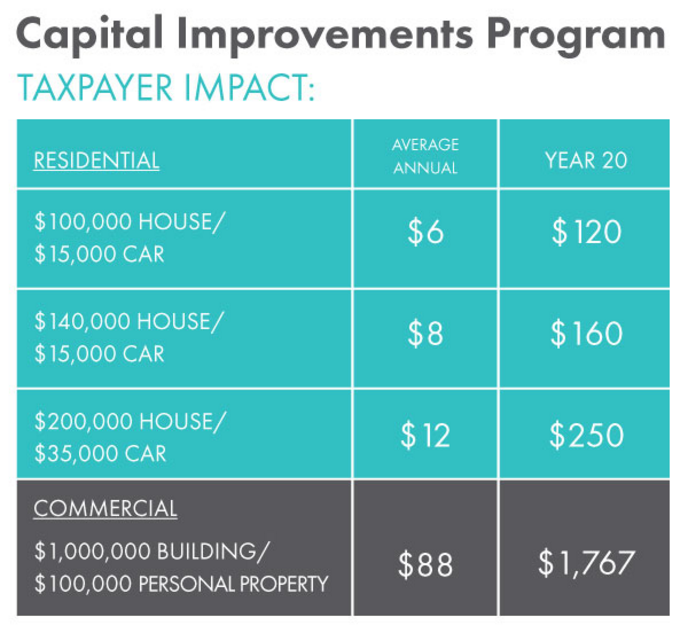
The Star piece includes a graphic called, “A comprehensive look at taxpayer impact,” which totals the actual tax that property owners would pay over 20 years if the GO Bond is approved. The Star should be commended for cutting through the financial gobbledygook presented to voters by the city and by bond proponents. The Star writes,
The annual tax increases for the first 20 years for the owner of a $100,000 house total about $1,540. For the owner of a $140,000 house, it’s more than $2,000. It totals about $3,185 for the owner of a $200,000 house.
That is a far cry from the $120/$160/$250 cost claims made on the city’s website. My complaint with the Star piece is that it is incomplete. The tax burden for this GO Bond lasts for 40 years, so the Star’s numbers are half of what they should be. As we wrote last week, the total additional tax paid for a $140,000 home and $15,000 car is $4,152.98 over the life of the bonds. If the Star had calculated the cost for the full 40 years of debt, they would have arrived at our numbers.
The Star’s position is that anything beyond 20 years is speculative—so that is where they stopped. The city could refinance, offer additional non-tax bonds, or the economy could boom. All these things are true, and cast further doubt on the city’s account of an $8 average annual increase that assumed no new increases in the property tax levy for 40 years! In the Star’s defense, they did not claim that the costs were only for 20 years. And in previous stories they made clear that the bond sets up 40 years of debt.
Ultimately, voters will decide whether the costs are worth the benefit, and whether they trust the city to do with the new revenue what they have neglected to do for decades: maintain infrastructure. That the Show-Me Institute and the Star are agreeing on the costs—at least in the first twenty years—is a good thing for transparency and good government.
A Minimum Wage Increase and the Unintended Consequences for Kansas City

Members of the City Council are at odds over how to increase the minimum wage—through city ordinance or statewide petition. Kansas City Mayor James calls the ordinance path a waste of time and says that it should be done through statewide petition effort. Lost in the argument over process is the huge and destructive impact such a dramatic increase in the minimum wage will have in Kansas City, especially for low-skill workers at the bottom of the socio-economic ladder.
Moving from a $7.65 minimum wage to a $15 wage by 2020 is a huge increase, and something that is not even supported by all the usual liberal pundits. Matt Yglesias wrote in Vox of the effort in St. Louis,
In St. Louis, people are much more likely to adjust to a higher cost of employing people by employing fewer people. The most relevant precedent for a big hike in a relatively poor jurisdiction may be Puerto Rico, where an effort to match the US federal minimum wage led to a rise in unemployment and increased migration to the mainland United States. St. Louis is richer than Puerto Rico, but moving a person or a job across the St. Louis city line into the suburbs is a lot easier than migrating from Puerto Rico to the US mainland.
Here is what will happen in Kansas City if the wage is increased: Employers who rely on minimum wage employees will seek to avoid the higher labor costs by hiring fewer people and investing in technology. We’re already seeing the latter in fast food restaurants that rely on kiosks for ordering. With fewer jobs available, the competition for them will grow, and those with the fewest job skills—who are also those with the greatest need for that first job—will be harmed the most. There just won’t be enough work for them. This is true is most places that require an increase in wages.
The second item is particular to Kansas City and will further diminish job opportunities for poor and low-skill workers. Middle class kids from Overland Park, where the minimum wage is $7.25, will suddenly have an incentive to cross State Line Road to earn $12, $13, and perhaps even $15 an hour. (Remember, 44.6% of those earning minimum wage or less come from households that earn three times the poverty level.) Many of these kids will have work experience and skills that make them more appealing to employers. If you’re going to pay a higher wage, you will want a better employee.
There will be pressure on Overland Park employers to raise wages to keep workers on their side of state line. And Kansas City workers may then have to commute to Kansas to get the lower wage jobs that are suddenly available, but they may not have the access to transportation that their wealthier suburban job-seekers have. Kansas City’s urban poor will find themselves with fewer job opportunities locally and no good way to get to the jobs that are available to them outside of Kansas City.
There is no shortcut to creating an environment for more jobs and higher salaries—government cannot create wealth and success by fiat. Instead, local governments need to focus on delivering basic services efficiently and cost-effectively and on limiting taxes and business regulation.
Missouri Students Need Access to Advanced Coursework
High-school students confronted with the looming expense of college tuition have a lot to gain from advanced-placement (AP) courses. These courses enable students to earn college credit while still in high school—potentially an enormous savings in time and money—provided that students complete the rigorous coursework and pass an exam at the end of the term. So it’s disappointing to learn that in 2016, only 11.4 percent of graduating high school students in Missouri passed an AP exam. This rate is the sixth-worst among the 50 states.
The statistic comes from a new report released by The College Board last week. According to the report, 21.9 percent of high school graduates nationwide pass an AP test. Massachusetts had the highest percentage (31.0 percent), while Mississippi had the lowest (5.9 percent).
So how can Missouri policymakers help more students take advantage of AP courses?
A good first step would be to increase enrollment in AP classes through course access programs. Show-Me Institute analysts have written about the need for course access in Missouri for some time now, and currently bills are making their way through the legislature that would allow students to take AP courses (either online or at an approved off-site location) when those courses are not offered at their high schools.
Recently, we updated our numbers and found that 284 out of 448 school districts with high schools did not have a single student enrolled in an AP course during the 2015–2016 school year.
It is time to expand opportunities for our high schoolers to take advanced courses and prepare them to better compete in college with students from other states.
Conversations on an Ice Facility in Chesterfield

Recently, I delivered public comments at a Chesterfield City Council meeting concerning a proposal to extend and redirect a special transportation tax to fund 31% of the costs of a new ice complex that would be privately owned. Members of the council weren’t entirely receptive to my comments, and one is left to wonder why. Still, the 100 or so hockey players and their parents and coaches, in discussion after the meeting, let me know they appreciated my input and the dialogue. The points below paraphrase the two main arguments made in favor of the subsidy and how I did/would respond to them.
1.Chesterfield is a hockey town, so investing in an ice facility makes sense. If the community wants a facility, what’s so wrong with the community helping to finance it?
Response: The community has no say in this. The overwhelming majority of Chesterfield residents would not be allowed to vote on whether to subsidize the new arena. Only voters in some 130 households within a special taxing district—less than 1 percent of households in Chesterfield—will get to vote on the proposal. But if Chesterfield is so enamored of hockey, why not let all residents vote? On the other hand, if hockey fever is confined to those 130 households, why should the rest of Chesterfield’s residents (and anyone else who shops in the Chesterfield Valley retail area, where the tax is levied) be asked to subsidize the proposed facility?
2.The Hardee’s Ice Arena in Chesterfield brings in a lot of business for the community. If we don’t replace it with a new facility, the economy could take a hit. Wouldn’t the positive economic impact of a new facility make a $7 million subsidy worthwhile?
Response: While the Hardee’s Ice Arena is closing, its place is being taken by a high-end golfing entertainment facility, which should also generate economic activity for the community. So the Chesterfield economy may not take a hit at all with the closure of the Hardee’s Ice Arena. More importantly, if an ice facility is such a boon for Chesterfield businesses, why don’t they become investors in the project? Why should families buying groceries at Walmart have to pay extra to create demand for businesses they may never patronize? Moreover, is this really the kind of argument proponents of the subsidy want to make? Wouldn’t the same “logic” apply to other projects as well? Would the hockey community in Chesterfield be OK with subsidizing, say, a “knitting hall of fame” if it would generate economic activity?
Financing a privately-owned ice facility through a tax increase that affects anyone who shops in the valley retail area—regardless of their interest in skating or hockey—amounts to asking an entire community to help pay for the recreational activity of a small group of people. Chesterfield City Council members should keep that simple truth in mind, “hockey town” or not.
No, Charter Schools Won’t Take Over Your School District
Recently, the Superintendent of the Hickman Mills School District and officials from the Columbia Public School District spoke out against HB 634, which would allow the expansion of charter schools throughout the state. In their statements, they repeated familiar claims that charter schools cherry-pick students, they drain money from public schools, and they are not held accountable. These assertions, while common, have been refuted by research (see the links at the end of this post). But a resolution approved by the Central R-III School District’s Board of education voiced a different concern, warning that:
if the legislative body allows charter schools to expand into the Central School District, taxpayers within the community would have no say in whether a charter school is needed and, furthermore, money would be consequently removed from classrooms due to increased overhead and operating costs.
So how likely is it that charter schools will start appearing in communities whose residents see no need for them? Not very. Charter operators seek to open schools in areas where there is a clear demand, to ensure that the schools have enough students to enroll.
In my recent paper on charter school expansion, I referenced a survey of high-performing, national charter management organizations which examined their approaches to expanding into a new area. The report containing the survey explains:
These CMOs [charter management organizations] learned that networks must deeply and meaningfully engage a new community to understand its needs and concerns, build partnerships from the ground up, and be prepared to repeatedly explain the work of the organization. This often requires a long window of time to build relationships and establish credibility. Otherwise, many communities view national operators as outsiders and a threat to the local education ecosystems.
Even if HB 634 passes, charter schools are unlikely to appear in districts like Central, Columbia, and Hickman Mills before charter operators gauge the interest in those communities.
Those who are satisfied with their public school and district should not worry about a charter school “invading” their community. But neither should they assume that because they are satisfied with their public school, charter schools are unwanted or not needed elsewhere in the state. Far too many kids in Missouri are stuck in failing schools and deserve the opportunities new charter schools can offer.
For more information:
“Student Selection, Attrition, and Replacement in KIPP Middle Schools.” Available here.
“Is there Empirical Evidence Consistent with the Claim that Charter Schools ‘Push Out’ Low-Performing Students?” Available here.
“Charter School Funding: Missouri.” Available here.
“A Closer Look at the Charter School Movement: Charter Schools, Students, and Management Organizations, 2015-2016.” Available here.
Kansas City’s Questionable GO Bond Assumptions
In my recent post, The GO Bonds Will Cost You Much More Than You’re Being Told, I concluded that—contrary to claims on the city’s website—the total amount of taxes paid for the GO bond would be $2,400 over the life of the bond for someone with a $100,000 house and a $15,000 car. But this was wrong. It turns out that I underestimated the total impact of the GO bond tax. It is actually over $4,100. My initial estimate was wrong because I did not have the city’s assumptions in front of me. Now that I do have the assumptions, they bring no comfort.
In my previous post, I relied on the information made available on the city’s website, but I could not duplicate the city’s claim that the “average annual” cost was only $8 for someone who owned a $140,000 house and a $15,000 car. I incorrectly concluded that the city must be talking about only one of the 20-year bonds. The city’s Deputy Finance Department Director pointed out my errors and provided me their assumptions in the spreadsheet attached here.
In short, the $8 shown in the “Average Annual” column is the average annual increase in city property taxes, not merely the “average annual” impact of the bonds that the website presents The city’s website makes no mention of this, but those increases are cumulative. The city’s own data shows a GO bond tax increase on the $140,000 home/$15,000 car of $13.67 in fiscal year 2018. The following year it will be $26.95, then 39.62 and $52.32 in fiscal years 2020 and 2021. These figures represent the genuine cost of the GO bonds.
To get to the $8 figure, the city factors in the retirement of other bonds that will be paid off during the life of the GO bond. Those issues are independent of the matter in front of voters on April 4 and ought not be considered. The $8 figure also assumes that the city will not issue any new special or general obligation bonds until the year 2056. How seriously can we take projections based on the assumption that Kansas City won’t issue any more bonds over the next 40 years?
To keep things simple, I calculated the GO bond impact to taxpayers independent of other bonds that would expire or that might be issued. Using the city’s own assumptions on interest and growth in assessed value, the total additional tax paid for a $140,000 home and $15,000 car is $4,152.98 over the life of the bonds. The property tax increase called for in this GO bond will start at $13.68 in FY2018, gradually climb to a peak of $206.13 in FY2037, and then decrease to $7.77 in FY2056.
I wish these assumptions were made available by the city on its website. But now we know: the GO bonds will cost much more than we’re being told. And the way in which the city arrives at its own estimate of the cost to taxpayers is less than transparent.
Summer 2017 Internships

The Show-Me Institute is pleased to offer internship opportunities for Summer 2017.
- Internships are open to current undergraduate and graduate students, as well as recent graduates.
- Internships last approximately four to five months. The exact starting and ending dates are flexible, but we anticipate that each internship will run from June 5 until August 11.
- Summer interns will work a part- or full-time schedule (9 a.m. to 5 p.m.).
- Interns will be involved in many aspects of the Institute’s operations and will work closely with senior staff on a wide variety of projects. They can expect greater responsibility and personal attention than they would receive at larger organizations.
- Interns will assist staff members with a range of tasks that may include researching public policy topics, organizing events, and writing and editing op-eds, newsletters, studies, and other documents. Some administrative and clerical work also will be required.
- Policy internships as well as communications and development internships are available.
- A Show-Me Institute internship is an excellent opportunity to improve your research and writing skills. Each intern will produce regular blog posts and an op-ed on a public policy topic of interest to him or her. Each intern will receive feedback and assistance from SMI staff members throughout the process.
- Internships are available at the office in St. Louis or Kansas City.
- Interns will be paid on an hourly basis.
Those wishing to be considered for an internship should submit an application and the requested supporting materials. The deadline for applications is Friday, April 21, 2017. However, we will begin conducting interviews as applications are received. Applicants can expect a decision in late May.