
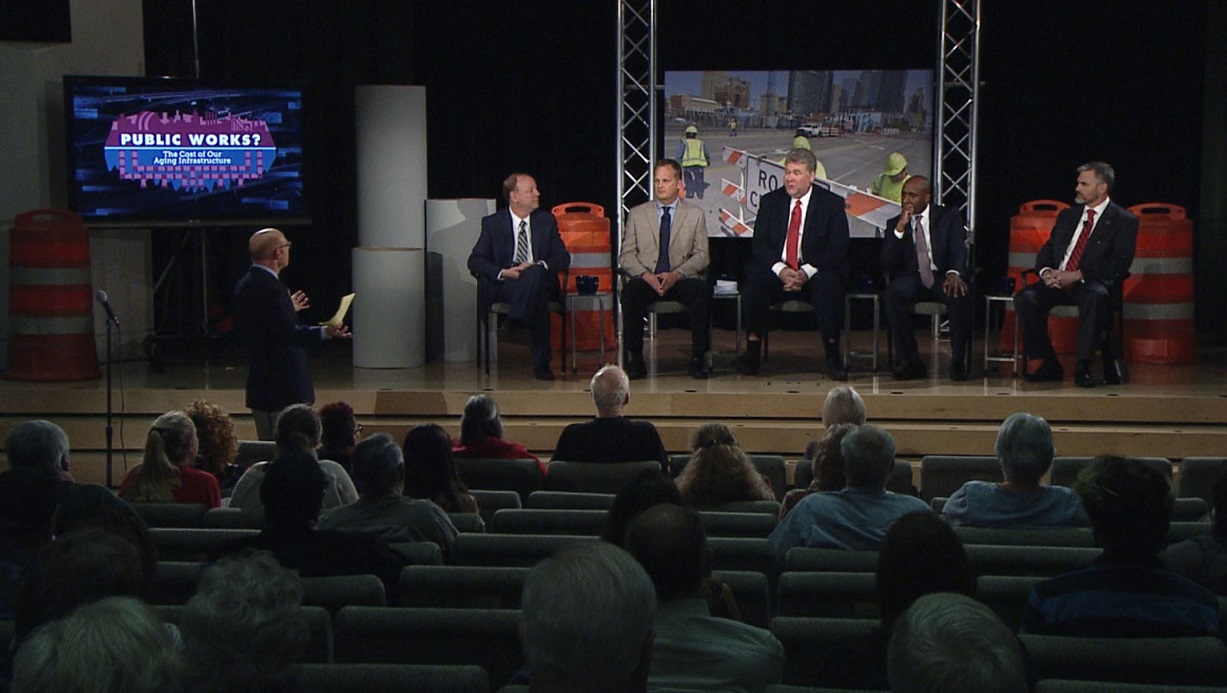
On Friday, April 28, Patrick Tuohey appeared on KCPT’s Public Works? The Cost of Our Aging Infrastructure . Tuohey appeared as panelist to discuss the current state of Kansas City’s infrastructure and the recently passed general obligation bond.
Session Notes: ESAs Clear the Senate!

Yesterday afternoon, the Missouri Senate passed Senate Bill 313, which would create a $25 million tax-credit-funded education savings account (ESA) program for students with special needs, children who are wards of the state, and children from military families. The bill passed 20-12, and not on strict party lines, as is common with so many votes in the Missouri Legislature. Both Senator Maria Chapelle-Nadal and Senator Jamilah Nasheed joined 18 of their Republican compatriots in supporting the bill.
In the process of the bill working its way through the Senate, several additional provisions were added to it. If passed, the bill would also authorize the Department of Elementary and Secondary Education to accredit individual school buildings in Jackson and Saint Louis Counties. If those schools did not pass muster, students would have similar transfer rights as currently exist in districts that lose accreditation. The bill also takes steps to rectify some of the problems that have developed with the school transfer program and specifies several interventions to be taken in schools in Saint Louis and Kansas City around literacy instruction in early grades.
Generally, I favor “clean” bills that tackle one topic at a time. I also realize that policymaking requires compromise, and that some of the additions to this bill deal with issues that people in the state have been trying to address for years. While I immediately recoil at the legislature trying to dictate pedagogical decisions for individual school districts, I recognize that making sure a wider set of views are represented during its enactment can make the ESA program more durable and ensure more buy-in at the state and local level. That seems like a compromise worth making.
The main obstacle ESAs now face is Missouri is the calendar. With only two weeks left in session and budget that still must be agreed upon, time will be short. We will be following this closely and will report back with news.
Join the Pension Discussion!

Pension discussions are all the rage these days. Don’t believe me? Just check out the Post-Dispatch.
A few days ago, an op-ed by a retired teacher made some inaccurate claims about Missouri’s teacher pension system. Today, the Post-Dispatch graciously ran a letter by yours truly in which I rebut them. Primarily, I discuss the pension system’s underfunding, the potential for retirees to lose some of their income, and who would benefit from changing the retirement plan.
Additionally, David Nicklaus, business columnist for the Post-Dispatch, has an article in which he highlights my forthcoming paper in the Journal of Education Finance. Nicklaus writes:
Teachers love their pensions. A generous monthly check at the end of one’s career helps make the important, and sometimes underappreciated, profession worthwhile.
I wonder if teachers in Missouri’s lower-paying rural districts realize, though, that their pension contributions help subsidize the retirements of their better-paid counterparts in districts like Rockwood and Clayton.
It is great to see all of this attention going to an important topic that affects so many hard working Missourians.
Resolution for Article V Convention Deserves Serious Consideration

It’s been said that you can’t teach an old dog new tricks, but can you remind an old dog of long-forgotten tricks? That theme (and variation) are relevant to a bill currently being debated in the Missouri legislature that would amend the U.S. Constitution and rein in federal power through a little-used section of Article V.
How would legislators do it? As our readers may know, the most commonly attempted way to amend the Constitution has been via a two-thirds vote of Congress and ratification by three-quarters of the states. But perhaps less known is that two-thirds of the states themselves can call their own constitutional conventions for the purpose of independently proposing amendments to the Constitution. As the National Archives notes, “None of the 27 amendments to the Constitution have been proposed by constitutional convention.” That no amendments have been proposed in this way, however, doesn’t mean amendments can’t or won’t be, and if supporters of a Missouri Senate resolution have their way, the 28th Amendment will be the first of its kind to have been initiated by the states themselves.
There’s a lot in the resolution itself about what it intends to do and how, but here’s the heart of the resolution:
Now, Therefore, Be It Resolved by the members of the Missouri Senate, Ninety-ninth General Assembly, First Regular Session, the House of Representatives concurring therein, hereby apply to Congress, under the provisions of Article V of the United States Constitution, for the calling of a convention of the states limited to proposing amendments to the United States Constitution that impose fiscal restraints on the federal government, limit the power and jurisdiction of the federal government, and limit the terms of office for its officials and members of Congress;
Later provisions lay out the precise nature of the convention and what it may consider—it’s worth your time to read—but the key reform elements of the bill are clear enough: federal fiscal limitations, federal power limitations, and federal term limitations. Beyond that, the exact reforms are open to debate, albeit circumscribed by the reform language of the bill itself to prevent a runaway convention. Resolutions like this one have passed in ten other states and may also pass later this year in North Carolina, as well, so it’s certainly an active idea nationally.
Twelve states aren’t enough to initiate a convention, of course; to initiate it, thirty-four states will have to pass similar resolutions. But the objectives of the resolution here are worthwhile enough, and its prospects plausible enough, to highlight here. If the bill passes the House, Missouri would become either the 11th or 12th state to sign on to this initiative. We’ll keep you posted if that happens.
Session Notes: House Sends PLA Reform to the Governor

Yesterday the Missouri House of Representatives passed SB 182, the Senate version of project labor agreement (PLA) reform. PLA reform was a top issue this year for the Show-Me Institute that we featured in our Blueprint and testified on earlier this year. We have written about the issue on the blog, and spoken about it on the airwaves and elsewhere, so I won’t rehash the importance of PLA reform. Suffice to say, I am happy to see progress on this labor legislation and hope that it will be just one of many market-oriented successes we’ll see this year.
Show-Me Now! TDDs: Public Money, Private Gain
The truth is out: special taxing districts have been receiving billions of public dollars under the taxpayers’ radar for decades. A new report by Missouri’s State Auditor sheds much-needed light on the abuse of transportation development districts (TDDs) and offers some ideas for protecting taxpayers. Click above to watch.
WRONG WAY: Anti-Tolling Group Gets It Wrong
Some of Missouri’s roadways are in critical condition. Interstate 70 is half a century old in many places and needs to be rebuilt from the ground up. Other roadways aren’t far behind. But even with an improving economy, the Missouri Department of Transportation (MoDOT) doesn’t have the funding to take on the multi-billion-dollar task of reconstructing I-70.
Show-Me Institute researchers have analyzed numerous roadway funding policies, ranging from general revenue diversions to fuel taxes to tolls. We’ve concluded that the best policies are those that let the free market work and impose the costs of roadways on those who use them. That means tolling and fuel taxes should be the way forward for funding Missouri’s road system.
Not everyone agrees. An anti-tolling group is calling for a constitutional ban on tolling in Missouri, claiming that tolls are unfair and economically pernicious. The group claims to be committed to “solving Missouri’s transportation crisis,” but I can find nothing on their website about how the rebuilding of Missouri’s interstates should be funded. The group offers an abundance of negatives about tolling, but many of their claims are incorrect or misguided. Let’s break some of them down here and set the record straight.
- Tolling is double taxation. We already pay for roads with fuel taxes, so we shouldn’t have to pay tolls, too.
MoDOT cannot cut its way to a new I-70. Over the past six years, it has reduced costs by $605 million, but that’s not money for new projects—that’s money to keep shop open. So, for I-70 to get the attention it needs, new revenues will need to be generated. Whether those revenues come from tolls, fuel taxes, general taxes, or some other source, they will be new; they will be on top of existing taxes. One might worry that tolls constitute double taxation, but do tolls differ that much from a higher fuel tax or higher (or diverted) sales taxes? Is paying two taxes, $1 and $1 each, really any different or worse than paying a single $2 tax?
Important to note too is that discussions about tolling I-70 have mostly focused on tolling only new, additional lanes, not the existing lanes. That means only the drivers who use the new lanes would be tolled, so if you didn’t want to pay a toll, you wouldn’t have to.
- Tolling will hurt businesses near tollbooths and hamper the freight industry’s growth.
This argument is another way of complaining that businesses near interstates will not be subsidized. When driving is made artificially cheap through general taxation (e.g., through sales taxes as opposed to fuel taxes or tolls), land near interstates becomes more valuable because of the higher consumer traffic. On the other hand, if drivers must pay to use the roads, the consumer traffic on interstates could be lower, reducing the value of nearby land. In short, a toll-free road means all Missourians are paying to create demand for a select few businesses along the interstate.
Some worry that tolling, which would show drivers the true cost of driving, would deter consumers from businesses along the interstate. While it’s true that tolling may hurt some businesses near interstates, it does so only by unburdening taxpayers in general. If roads are paid for with tolls, that means other taxes previously dedicated to roads can either stay in taxpayers’ pockets or be spent on other public services.
And just as taxpayers shouldn’t have to subsidize businesses near interstates, they shouldn’t have to subsidize trucking companies (many of which do not employ Missourians). Heavy trucks do well over 90% of the damage to our roads, so why shouldn’t they should pay for rebuilding them (via tolls)?
- Toll roads are poor investments, and when they fail, taxpayers are on the hook.
Some proposals to toll I-70 call for private firms to invest in the roadway in exchange for tolling concessions. Such an arrangement would let firms try to make a profit from tolls, but only by assuming the risk of major capital investment. Like other enterprises, toll roads run the risk of going under. But contrary to what anti-toll crusaders claim, taxpayers do not bear the risk of toll roads. Firms are required to invest in the roadway before collecting tolls, so the public gets a new road regardless of whether the company makes a profit. If a firm goes under, its assets are repossessed, but that just means a different firm owns the road—the new road the public gets to enjoy.
Tolling is by no means the only way forward, but it is a way forward. Dozens of states across the country have successful toll roads and bridges, and Missouri can, too. Banning toll roads won’t solve Missouri’s transportation woes; in fact, given policymakers’ reluctance to increase fuel taxes, it would cut off yet another free-market policy solution.
Penny Wise and Pound Foolish?
The Missouri House voted earlier this month to reject, by an overwhelming majority (51-103), the latest proposal to raise the state’s gas tax. The plan, which originated in the Senate last year, would have sought voter approval for about a six-cent increase to the current tax (which is about 17 cents per gallon—one of the lowest gas taxes in the nation). This decision is fiscal responsibility at its worst.
Why the defeat? As stated in the Post-Dispatch, “opponents to the bill said it was up to the state to better manage the money in its coffers and not expect Missourians to cough up more out of their paychecks.”
Just how much would the average Missourian have coughed up if the tax actually passed? Using national figures, a rough estimate is that the average family—two adults and two driving children—put about 45,000 miles a year on their automobile(s). With a reasonable assumption that the cars used would get 25 miles per gallon, the average family uses about 1,800 gallons of gas a year. The six-cent, one-time increase would increase the family’s annual cost of driving by a paltry $2 a week. So the House’s vote protected the public from a decision about whether to increase our tax burden by less than the cost of a cheap coffee a week.
The case for increasing the fuel tax has been made many times before by Show-me Institute writers. Such a tax increase is a sound method for funding the repair and upkeep of Missouri’s deteriorating highways and bridges. Unlike the ill-conceived sales-tax approach suggested in the past, at least raising the tax on fuel levies the tax on those who actually use state roads.
The inability to raise funds needed by the Missouri Department of Transportation for maintenance and improvements of the state’s roadways will not enhance economic growth in the state. This most recent decision by political leaders is instead likely to solidify Missouri’s position as one of the slowest-growing states in the nation.
HB 130 a Win for Transportation and Economic Freedoms
Yesterday, Governor Eric Greitens signed HB 130 into law. HB 130, colloquially known as the ‘Uber Bill’, creates statewide regulations for transportation network companies (TNC) such as Uber and Lyft. By streamlining TNC regulations across all of Missouri, the law reduces regulatory uncertainty and eliminates anti-competitive red tape at the local level. Show-Me Institute analysts, myself included, have testified in favor of HB 130 and similar legislation in the past, and we’re delighted to see it become law.
HB 130’s passage means that Missouri will be an easier place to earn an extra income and get around. Rather than navigate a patchwork of rules and regulations—or none at all—TNC drivers and riders across the state will now all follow the same, reasonable rules. In some cities, like Kansas City, St. Louis, and Columbia, bureaucrats and special interests have attempted to regulate TNCs out of existence, killing jobs, slowing economic progress, and reducing consumer choice. HB 130 eliminates unnecessary barriers to market entry, thereby expanding economic opportunity (especially for the disadvantaged) and efficient transportation choices.
I commend the Legislature and Governor for advancing liberty and economic freedom by making HB 130 law. (The law’s swift progression has even prompted ossified and cartelized taxi firms to call for deregulation.) We’re hopeful this is just one of many free-market transportation reforms to become law over the next few years.
