
On Thursday, December 22, the Show-Me Institute's Patrick Tuohey appeared on KCPT's Ruckus to discuss right to work and Kansas City's upcoming $800 million bond issue. Click on the link to watch the entire episode.
City of Saint Louis Joins Charter School Fight

Saint Louis charter schools received good news earlier this month: the City of Saint Louis is taking their side in a lawsuit with the Saint Louis Public Schools regarding more than $50 million in local tax revenue.
In the lawsuit, which was filed in April, SLPS contends that charter schools should not have access to funds from a special sales tax levied for school desegregation programs because they were not mentioned in the original agreement when the tax was passed. You can read Mike McShane’s full explanation of the lawsuit here. As Mike wrote in April, “Depending on the outcome, this case could financially cripple the city’s charter schools and jeopardize the education of the more than 10,000 students who attend them.”
According to the Post-Dispatch, the city’s brief argues that the 1998 law authorizing charter schools and the law authorizing the sales tax were both a part of the state’s efforts to desegregate public schools. Thus, the revenue from the tax was intended to fund traditional public schools and charter schools alike. While there has not been a final ruling on the lawsuit, the support of the City of Saint Louis is a big win for charter schools.
Missouri Should Not Stop at a State EITC; Larger Entitlement Reforms Are Needed

This month the Show-Me Institute was proud to publish our 2017 Blueprint for Missouri government, a document that catalogues fifteen state-based reforms to make Missouri more competitive and her citizens more prosperous. Included among the suggested reforms is transitioning some of the state’s welfare spending toward an earned income tax credit, or EITC. Apart from the well-documented economic benefits of the program, the EITC offers other benefits as well, including the promotion of work. As my colleague Michael Austin and I wrote in the Blueprint,
[t]ransitioning current public welfare dollars to an EITC will help foster a culture of self-reliance among the state’s poor while also restricting growth in public welfare spending. Not only does the EITC help working families make ends meet, but it also encourages recipients and families to find jobs and increase hours worked.
The EITC bills that appear to be next year’s legislative frontrunners are encouraging. Longtime readers know that Show-Me Institute writers have long supported unloading destructive income taxes; that the proposed EITCs can help achieve this for the poor is an added bonus to the work incentives embedded in the program.
But for the EITC to do the most good, policymakers should work toward a “transition” to it, not simply an implementation of it. Rather than viewing the program in isolation, EITC supporters should have an eye toward parallel reforms and work requirements in existing entitlement programs as well. That could mean a dollar-for-dollar downsizing of other entitlement programs to make room for the EITC, or the passage of other work-related reforms for able-bodied enrollees in Missouri’s entitlement programs.
A straight up expansion of entitlements, however, should be a non-starter for supporters of small, efficient, and effective government. The EITC should be part of a larger government push toward offering an effective hand up out of poverty, not just a new state program in addition to countless others already in existence. Without that conversation and action toward reducing the costs of other programs, the state risks undermining the good that can come from an EITC—for beneficiaries and taxpayers alike.
New Paper Offers Guidance for Improving Mizzou
It has been hard to watch the flagship public university of our state struggle this past year and a half. Just recently, it was announced that after 15 years of steady growth, Mizzou’s enrollment shrunk last year.
The tumult in Columbia has caused people around the state to ask “What can we do?” The Missouri legislature even went so far as to create its own independent review commission to examine the workings of Mizzou and the rest of the University of Missouri system.
We’re here to help.
In a new case study released today, Michael Highsmith and I present three case studies of different universities and university systems from around the country tackling the very problems that are facing Mizzou today: namely, how do we make college more affordable, relevant, and rigorous?
We travel from Purdue University in West Lafayette, Indiana, where President Mitch Daniels has embarked on an ambitious program to keep costs down and design new majors and programs that allow students to progress at their own pace, to Texas, where then-Governor Rick Perry’s call to create a $10,000 degree spurred innovation statewide. Finally, we conclude at one of the finest universities in our nation, the University of Chicago, to show what it means to have a commitment to free speech and the open exchange of ideas.
We don’t present these stories as a paint-by-numbers guide to exactly what Mizzou should do to improve its standing in the state and region. Rather, we hope to spark a conversation about how to make Mizzou, and higher education in Missouri, stronger. We hope you’ll join us in that conversation in the coming months.
Click here to read more.
Listen Up, Missouri Lawmakers: Here Are Seven Resolutions for 2017
Oh, Missouri lawmakers, it is me, the Ghost of a Christmas Yet-to-Come, who whispers in your ear this wintry night. I come not to frighten you (like the baleful ghost in Dickens’s tale), nor to load you down with unearned and therefore inconsequential and soon-to-be-forgotten gifts.
Opportunity beckons. This is your chance to do something big. In breaking into your midnight slumbers, I hope only to point the way forward – with a few thoughts on how to accelerate growth and quicken prosperity in Missouri come the New Year.
One is to tell you plainly: Stop trying to pick winners and losers with taxpayer money. Let’s say (to use a real example) a group of businessmen tell you that they need $120 million in public support ($40 million from the state and another $80 million from the city) to build a new soccer stadium and bring a Major League Soccer franchise to downtown Saint Louis. While predicting that the project will create jobs and ancillary development, backers are asking for taxpayer money to pay for about two-thirds of the cost of building the stadium.
You must say “No” to all such proposals. If professional investors demand major subsidies for a profit-seeking venture, then you know (or should know) it’s a bad deal for taxpayers. Governor-elect Eric Greitens has already signaled his opposition to the $40 million in state tax credits for the proposed stadium. You can go further – much further – by reducing annual spending on state tax credits for targeted economic development from more than $350 million per year down to zero. That would free up money for better purposes (see next point).
Two is to leave more after-tax money in the pockets of wage earners and business owners alike. People and businesses vote with their feet. They move out of states where the “tax price” of living, working, or running a business is too high and into states where it is lower. If you include the 1 percent earnings tax in our two biggest cities, Missouri has a top income tax rate of 7 percent, which is more than all but 11 states. You should slash state income taxes 50 percent over the next three years.
Three is to end compulsory unionism as a condition of employment. Six out of eight neighboring states have already passed right-to-work legislation. Missouri should join them in embracing greater freedom and competition in the workplace.
Four is to promote public sector union democracy and transparency. Public sector employees should have the right to say “yea” or “nay” to continued union representation at intervals of every two or three years. At the same time, Missouri should close the loophole that allows public officials and government unions to conduct collective bargaining in closed sessions.
Five is to allow charter schools – now limited to the Kansas City and Saint Louis areas – to expand statewide without limitation. Missouri should adopt innovative programs, such as education savings accounts and tax credit-funded scholarships, enabling public school students trapped in underperforming school districts to attend private schools.
Six is encourage greater competition and choice in another area ripe for reform – health care. You can begin by converting much of Missouri’s Medicaid program into health savings accounts (HSAs). After purchasing catastrophic health care plans, beneficiaries would be free to tailor their spending to their needs and roll over unspent money from one year to the next.
Seven is to eliminate a major disincentive that keeps many poor people from looking for jobs – the loss of public welfare benefits that too often results from finding gainful employment. Earned income tax credits (EITCs) are one practical solution to this problem.
Arise and shine, Missouri legislators. This is a once-in-a-lifetime opportunity to make exceptional progress across a broad range of important public policy issues.
Kansas City’s $800 Million Animal Shelter?
For months Kansas City has been talking about issuing an $800 million general obligation bond, backed by increased taxes, to make up for years of deferred maintenance on the city’s basic infrastructure. Now that the ballot language is being shaped, city leaders have provided few specifics about how that $800 million will be used, with the exception of building an animal shelter
Lynn Horsley at The Kansas City Star writes,
The city’s finance staff is arguing for more general, flexible language, because anticipating future needs is difficult. Finance Director Randy Landes pointed to a successful $250 million general obligation bond vote in 2004 for just “deferred maintenance and basic capital infrastructure.”
But some council members said voters need more specificity. Mayor Sly James has argued for flexible language but suggested there could be an annual “report card” to assure voters the money is being spent responsibly.
The idea of the city issuing its own report card on the matter should raise eyebrows. But in a recent interview on KCUR, the mayor said the city could publish a list of projects to be addressed by the bond, but he didn’t want to be held to it! Imagine a student asking to issue his own report card on his ability to accomplish vaguely defined tasks!
It shouldn’t be surprising that city leaders aren’t eager to be held to specifics. Remember, these are the same city leaders who:
- Issued an emergency ordinance allocating $10 million toward streetcar expansion. But when the streetcar expansion was defeated, just spent the money elsewhere;
- Dismissed the need for an audit of the water department despite a huge increase in water rates to pay for water and sewer infrastructure improvements;
- Responded internally to a call for information on economic development subsidies with, “Be very careful. Do not divulge anything more than necessary;”
- Repeatedly (and incorrectly) characterized the movement of money from the Aviation Department to the City;
- Issued questionable numbers on downtown and east side development efforts; and then
- Hired a trade association of development financiers to report on the success of the City’s development schemes.
Voter skepticism in Kansas City and around the country is high, and for good reason. There is little trust of political leaders, and the weak promise of a “report card” for the spending is a perfect example of why. Kansas Citians are right to demand a specific list of projects rather than an $800 million blank check for an animal shelter.
The Wrong Kind of Bet with the Wrong Kind of Money

A group of local businesspeople (SC STL) is trying to lure a Major League Soccer (MLS) team to the Gateway City. The only catch is that SC STL is asking Saint Louis taxpayers to cough up an extra $80 million in new taxes to support the venture. In addition, as the Business Journal reports, SC STL is also asking for $40 million from the state of Missouri. Altogether, SC STL hopes taxpayers will pick up $129 million of their projected $405 million in costs. Below is a breakdown of those projected costs and revenues.
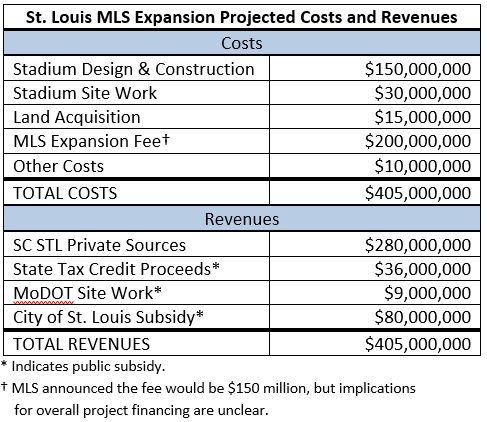
The state just cut $50 million (including $40 million from Medicaid) from its budget due to shortfalls. So how can it afford to chip in $40 million for a sports stadium? And what could justify placing a new burden on taxpayers for a project that Governor-elect Eric Greitens recently described as “nothing more than welfare for billionaires?” Perhaps Greitens will find out from SC-STL investors directly; earlier today they asked to meet with the Governor-elect to discuss the proposal before moving it along any further.
One recent claim is that taxpayers, the state, and the city itself will see big returns on their investment. That is: (1) the economy will grow, (2) jobs will be created, and (3) the city and state will see increased tax revenues. But do any of these promises stand up to scrutiny?
- Economists are divided on many issues, but on the economic impact of sports stadiums there is broad consensus. The research is clear: major league sports stadiums have a negligible effect on the economy. Rather than create new economic activity, stadiums simply rearrange existing activity. Sure, people will spend money at a new stadium, but it’s likely that most of those dollars would have gone to movie theaters and restaurants, etc., had the stadium never opened.
- But what about all the jobs created by the stadium? To the extent that those jobs are funded with taxes, they are funded with money being taken out of the economy. But more importantly, the 1,883 projected construction and permanent jobs that backers project the stadium would generate would cost taxpayers more than $68,500 each!
- What about the claim that the stadium will boost local tax revenue and thereby improve basic government services? For one, just as the economic activity at the stadium would have happened somewhere, so too the taxes collected at the stadium would be have been collected somewhere in the region. It’s doubtful the city or state will see any significant new revenues from the stadium. But, more importantly, the city shouldn’t embark on a risky venture with taxpayer money just for the chance to increase its own revenue.
Researchers find that stadium benefits are often overstated and oversold (see here, here, here, here, here, and here). Missourians should demand that the city produce what dozens of economists could not—credible evidence that a stadium investment will produce returns for Missourians—before agreeing to subsidize this project.
Show-Me Now! Income Growth: Still Hibernating
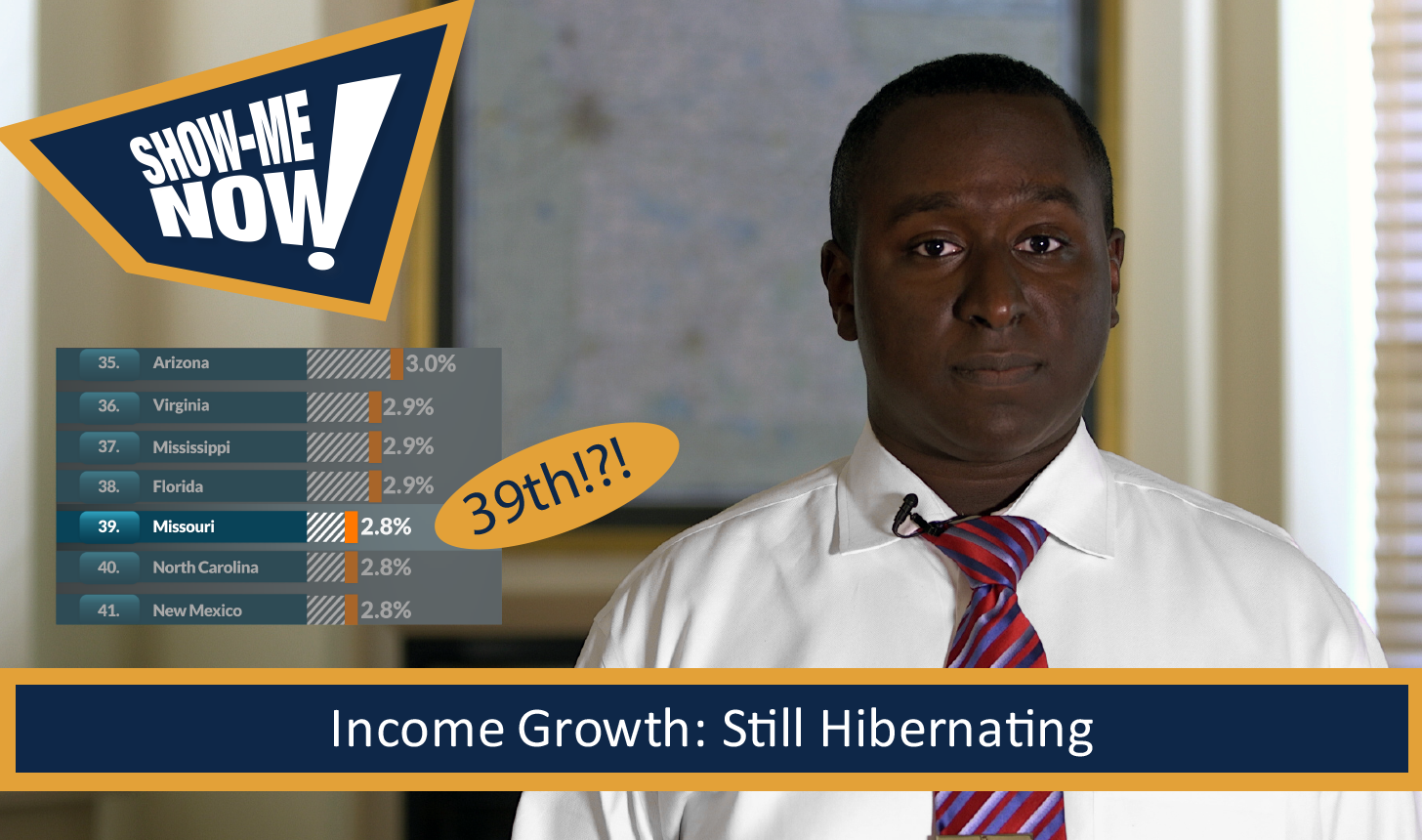
In the 2nd quarter of 2016, Missouri ranked 28th among the states for income growth. Looking at the state’s performance since 2010, Missouri ranks 39th. This disappointing performance is a cause for concern.
Company Births and Deaths: “Churn” and State Economic Growth

The continual birth and death of companies is a natural byproduct of competition in the marketplace. But is the rate at which this "churn" takes place related positively or negatively to the growth of our state's economy? Show-Me Institute Chief Economist Joseph Haslag explores the importance of churn for state growth in his new essay. Click on the link below to read more.
