Ready-Fire-Aim Approach Yields Predictable Results at KCI

The rush to build something—anything—at Kansas City International Airport is calling into question the ability and even the seriousness of Kansas City leadership.

Consider a recent story in The Kansas City Star, which states that Burns & McDonnell would be given “the opportunity to equal other proposals if it chooses, since it brought the idea to a municipality to begin with.” The Star called this “nuance,” though apparently some thought it was a serious problem. Seven days later, the Star reported that:

City Manager Troy Schulte said Monday that the city’s lawyers had advised that the right of first refusal could potentially be subjected to a legal challenge, so it was eliminated.

How did a proposal outside the city’s municipal procurement code provisions, and possibly even fodder for a lawsuit, get past the corporate attorneys at Burns & Mac and all the attorneys on the City Council, including Mayor Sly James himself? Why did the City Manager announce the decision to allow Burns & Mac the right of first refusal without consulting with the city’s attorneys beforehand? If he did consult with them, how did they initially miss it? And how did The Kansas City Star, the city’s paper of record, unquestioningly describe a potentially unlawful bidding practice as mere “nuance?”

Could it be that this policy proposal—if it can be called that—is being rushed through? That may be an odd question to raise about a matter that has been under discussion in Kansas City for years, but it appears to be what is happening.

The public wasn’t convinced of the need for a new single terminal before this latest political fiasco kicked off. The deadline of a public vote in November has created a false sense of urgency—resulting in the kind of mistakes you’d expect from people more concerned with getting something done fast than with getting it done right.

The airport is an important and valuable asset. The consequences of a mistake in the planning or implementation of its development will reverberate throughout the region for decades. There is no reason to rush this decision—good policy is not served by hurried half-measures. The Starand the airlines themselvesought to suspend their calls for a November election, and the Council ought to ignore false deadlines. 

Subsidies, Not Streetcars, Lure Developers

Kevin Collison, freelance reporter and supporter of taxpayer-subsidized economic development, inadvertently undercut the argument that streetcars spur economic investment in a recent story on a downtown Kansas City blog.

The piece details yet another downtown building getting historic tax credits and being let off the hook for property taxes. Taxpayers can be forgiven if they wonder whether the glass cube building completed in 1973 and pictured above is historic and worthy of subsidized preservation. But that is a matter for another time; this is about the streetcar.

Collison writes,

The $50 million redevelopment plan for the reflective glass-clad building known as the Flashcube received critical tax incentives to move forward today, the latest project on the downtown Kansas City streetcar line.

Streetcar supporters may decide to include this renovation in their shifting and often incorrect list of projects that can be credited to the streetcar. At best, they can claim that the streetcar got developers interested in seeking taxpayer subsidies. But the streetcar was neither necessary nor sufficient for the project. The available research does not support the claim that streetcars—in Kansas City or elsewhere—drive development. And Collison’s own story makes that point clear. The building sat vacant for a decade, and it wasn’t until taxpayer subsidies were offered that any renovation deal moved forward—in short, the public is investing in yet another downtown development deal that businesses wouldn’t touch on their own.

Regardless of the merits of the downtown development subsidies—and again, we discuss that elsewhere—this project is moving forward because of the subsidies, not the streetcar.

Great News! Mizzou Embraces Free Speech

Last week, Mizzou took several important steps in ensuring that all students on campus, regardless of viewpoint, will have the freedom to express their beliefs openly.  As the Foundation for Individual Rights in Education (FIRE) explains, the university released a policy statement recognizing the free speech rights of students and also adopted new policies around protests and demonstrations that clearly explain the rights of students to congregate and speak their minds in public spaces.

One paragraph in particular stands out:

“Thus, the University’s fundamental commitment is to the principle that debate or deliberation may not be suppressed because the ideas put forth are thought by some or even by most members of the University community to be offensive, unwise, immoral, or wrong-headed. Individual members of the University community, not the University as an institution, should make their own moral judgments about the content of constitutionally protected speech, and should express these judgments not by seeking to suppress speech, but by openly and vigorously contesting the ideas they oppose. Indeed, fostering the ability of members of the University community to engage in such debate and deliberation in an effective and responsible manner is an essential part of the University’s educational mission.”

This is exactly right. The mission of the University should be to empower students with the skills and knowledge that they need to debate and disprove things that they believe are false, not to tell them it’s OK to run and hide from them.

As FIRE points out, Mizzou’s new free speech policy is based upon the Report of the Committee on Freedom of Expression, a document published several years ago at the University of Chicago that has become the gold standard for ensuring that students and faculty have the maximum freedom to discuss and debate topics of importance.

Here at the Show-Me Institute, we have been urging the university to adopt such speech protections for some time now.  In a report I co-authored with Michael Highsmith, “Moving Mizzou Forward: Reform Ideas from Around the Nation” we wrote:

Freedom of speech and debate is at risk and can be protected. It seems that not a week of the school year goes by without some story emerging about efforts by a student council, residence hall, professor, or school administrator to stifle the speech of students. If we do not impress upon our students the importance of free speech and defend it vigorously, we risk creating a citizenry that does not value one of the foundational values upon which our nation was built. Luckily, institutions like the University of Chicago offer a great blueprint for fostering debate and protecting speech. Mizzou would be wise to study that blueprint carefully.”

Mizzou has clearly done this. Good for them. 

Regional Interdependence in Missouri

The Saint Louis and Kansas City metropolitan areas account for over half of Missouri’s economic output. Accordingly, the state’s economic performance is largely determined by the successes or struggles of the two metro areas. But can growth in Missouri’s outstate areas be predicted by metro area growth as well? This essay explores the question of whether economic events in the metro areas might be of greater interest to the rest of the state than is usually thought. To read the entire essay, click on the link below.

Kansas City Teacher Pension Faces Possibility of Insolvency

In 20 years, the probability that the Kansas City Public School Retirement System (KCPSRS) will not be insolvent is only somewhat better than a coin flip. Don’t take my word for it—just take a look at the report from Segal Marco Advisors which was commissioned by the board of KCPSRS. The report, which was presented to the board but not widely distributed, paints a bleak picture for the defined-benefit pension system. It illustrates what Show-Me Institute analysts have been saying for years: these systems face many obstacles and should be more transparent.

When Michael Rathbone and I released our report, “Betting on the Big Returns: How Missouri Teacher Pension Plans Have Shifted to Riskier Assets,” in 2015, we stated that pension plans should be more transparent about funding possibilities. We wrote:

To improve transparency, lawmakers could require pension plans to forecast assets using multiple assumptions on investment returns. What would the funding ratio for each of these plans be if returns are 4 percent or 6 percent instead of 8 percent? This is something policymakers should know as it would allow them to choose the best way to structure contributions so that downside is minimized and that these plans can be adjusted to adapt to any unexpected downturns that may occur.

The report is exactly what we called for. It illustrates how the forecasts of the health of the system will be affected by varying contribution rates and investment return assumptions. Here and in a follow-up post I will present some of the findings from the KCPSRS report.

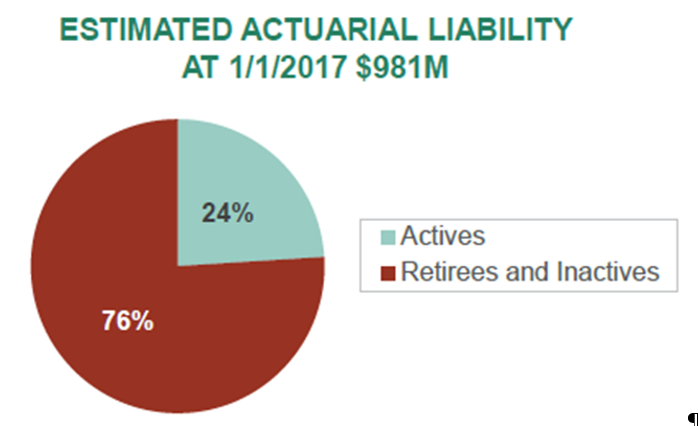
The main takeaway is that the system could be in serious trouble within the next two decades. Currently, the system is 64% funded with $349 million in unfunded liabilities. Next year, the plan expects to pay out $85 million in benefit payments. In contrast, the system will only collect $33 million in pension contributions. This is because the participants in the plan are trending older and older. Today, more than three-fourths of the members of KCPSRS are retirees:

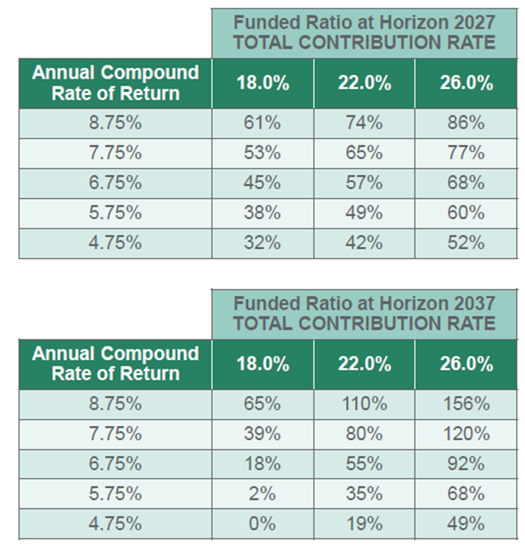
The tables below present projections for the funded ratio over 10 and 20 years under different scenarios that take into account various rates of return and contribution rates. Currently, active members of KSPSRS and their employers each pay 9 percent of salary into the system for a contribution rate of 18 percent.

The best-case scenario within 10 years is that the system will improve to an 86% funded ratio. If the plan doesn’t make any changes to contribution rates and receives the expected rate of return of 7.75 percent (the actuarially assumed rate), the funded ratio will drop to 53%. In 20 years, the funded ratio could continue to drop to less than 40 percent.

But here’s the real kicker, the authors write that “The probability of insolvency is 2% at the 10 year horizon and increases substantially to 42% at the twenty year horizon.” You read that right. Within 20 years there is a real possibility that the KCPSRS could be insolvent. We hear all the time that these defined-benefit plans are great for retirees. Well, not if they are bankrupt.

In my next post, I’ll discuss how the system may address the issue of unfunded liabilities.

No Surprise: Fresh Competition from Rideshare Companies Leads to Taxi Reforms in St. Louis

Straight from the Department of Totally Expected Outcomes, Saint Louis’ Metropolitan Taxicab Commission has slashed a wide array of fees and requirements on taxi operators in anticipation of a market-share battle between the traditional taxicabs regulated by the group and ride-share companies like Uber and Lyft.

To help cab companies compete with Uber and other ride-hailing firms, the Metropolitan Taxicab Commission voted Wednesday to slash license fees and reduce inspection requirements.

The new rules, which take effect Thursday, also cut minimum liability insurance requirements for the cab firms.

Fingerprint background checks still will be required for new cab drivers but they’ll be able to get them from lower-cost private vendors instead of at the commission office.

The St. Louis Post-Dispatch article linked above goes into greater depth on what is changing in Saint Louis, so hit the link to get the full rundown. Show-Me has discussed the issue at length for a number of years now, and more recently my colleague Graham Renz in particular has repeatedly raised flags about the behavior of Missouri’s taxi cartels and their impact on consumers. After the Legislature defanged taxi commissions statewide, this week’s regulatory changes were more or less a foregone conclusion.

On behalf of Graham, I have the privilege of saying that today’s events are no surprise. When you let the market work, innovators will innovate, or else be left behind, and it seems clear that the Commission has recognized and responded to that reality this week.

Whether in transportation or energy or some other sector of the economy, monopolies and oligopolies often work to the detriment of the average person and to the advantage of entrenched interests. Let the market—let competition, let innovation—work, and the result tends to be far superior to letting the status quo ossify, with the backing of government bureaucracy.

These reforms were long overdue, but they are here. Congratulations, St. Louis.

Double Taxation: Saint Louis Zoo Edition

Policymakers in Jefferson City passed Senate Bill 49 (SB 49), which allows for a sales tax of one eighth of one percent to be levied in Saint Louis City and County for construction, maintenance, and operations at the Saint Louis Zoo. The bill itself doesn’t impose the sales tax, but simply allows a ballot to be submitted to voters. Voters in the city and county would have the final say on whether or not to impose the extra tax.

The version of the bill in front of the Governor has changed since it was first introduced. Previous drafts would have allowed for similar sales tax hikes in Saint Charles, Franklin, and Jefferson counties. The narrower focus of the bill means distant shoppers won’t have to subsidize the zoo (which is fair), but it also means a smaller portion of the public will shoulder the burden of supporting a “free” zoo. It also means city and county taxpayers could be taxed twice for the zoo. 

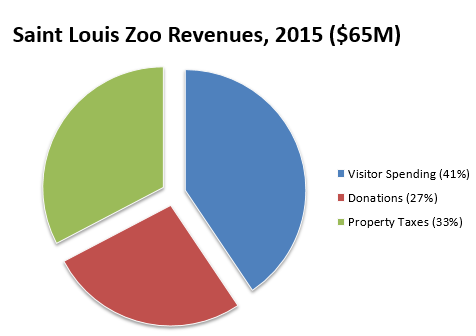
Currently, the zoo is supported by visitor spending, donations, and a property tax levied in Saint Louis City and County. So if a sales tax is passed, city and county voters will pay two taxes for the zoo. And while taxpayers would get an improved zoo for that extra money, the new funding wouldn’t fix the underlying problem with the zoo’s funding structure: free riders.

Since no admission is charged at the zoo, city and county taxpayers support the zoo for everyone, from Saint Charles residents to visitors from Hawaii. Predictably, the issue of fairness arises: why should just city and county residents pay for the zoo? While some propose a regional taxing structure to remedy the free-riding problem, in reality it would convert only a portion of the free riders into supporters. A fairer solution would be to charge admission for those not paying zoo property taxes. (For perspective, a $2 admission fee for residents outside the city and county, assuming a 10% reduction in visitors, could raise more than $3.5 million a year.)

A zoo sales tax would worsen the ever-growing sales tax burden for city residents. With the passage of the MetroLink sales tax hike in April, the city’s sales tax rate jumped to 9.179%, the 13th highest of major US cities (and higher than in New York City, Los Angeles, and San Francisco). If a zoo tax were to be approved, the city’s base rate would top 9.3%, and in some areas littered with special taxing districts, be as high as 11.3%. For many city families, these tax increases mean hundreds of dollars a year they cannot spend on food, school supplies, and other goods and services.

We all love the zoo, and there’s no denying it could use some cash for infrastructure and other projects. But taxpayers should think hard about whether sales taxes are a fair way to fund this famous Saint Louis institution.

Support Us

The work of the Show-Me Institute would not be possible without the generous support of people who are inspired by the vision of liberty and free enterprise. We hope you will join our efforts and become a Show-Me Institute sponsor.

Donate
Man on Horse Charging