

The Saint Louis and Kansas City metropolitan areas account for over half of Missouri’s economic output. Accordingly, the state’s economic performance is largely determined by the successes or struggles of the two metro areas. But can growth in Missouri’s outstate areas be predicted by metro area growth as well? This essay explores the question of whether economic events in the metro areas might be of greater interest to the rest of the state than is usually thought. To read the entire essay, click on the link below.
Kansas City Teacher Pension Faces Possibility of Insolvency

In 20 years, the probability that the Kansas City Public School Retirement System (KCPSRS) will not be insolvent is only somewhat better than a coin flip. Don’t take my word for it—just take a look at the report from Segal Marco Advisors which was commissioned by the board of KCPSRS. The report, which was presented to the board but not widely distributed, paints a bleak picture for the defined-benefit pension system. It illustrates what Show-Me Institute analysts have been saying for years: these systems face many obstacles and should be more transparent.
When Michael Rathbone and I released our report, “Betting on the Big Returns: How Missouri Teacher Pension Plans Have Shifted to Riskier Assets,” in 2015, we stated that pension plans should be more transparent about funding possibilities. We wrote:
To improve transparency, lawmakers could require pension plans to forecast assets using multiple assumptions on investment returns. What would the funding ratio for each of these plans be if returns are 4 percent or 6 percent instead of 8 percent? This is something policymakers should know as it would allow them to choose the best way to structure contributions so that downside is minimized and that these plans can be adjusted to adapt to any unexpected downturns that may occur.
The report is exactly what we called for. It illustrates how the forecasts of the health of the system will be affected by varying contribution rates and investment return assumptions. Here and in a follow-up post I will present some of the findings from the KCPSRS report.
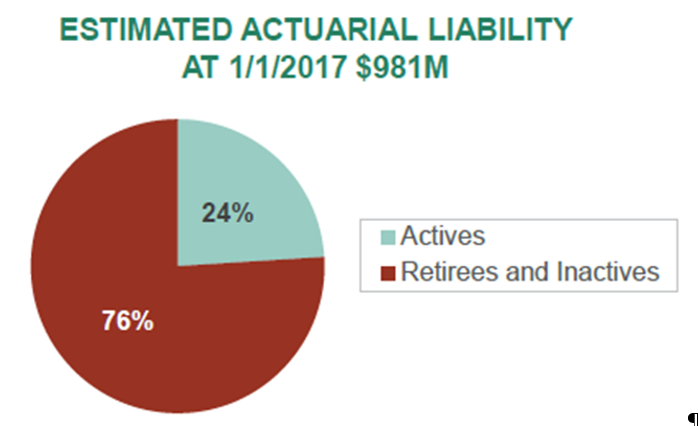
The main takeaway is that the system could be in serious trouble within the next two decades. Currently, the system is 64% funded with $349 million in unfunded liabilities. Next year, the plan expects to pay out $85 million in benefit payments. In contrast, the system will only collect $33 million in pension contributions. This is because the participants in the plan are trending older and older. Today, more than three-fourths of the members of KCPSRS are retirees:
The tables below present projections for the funded ratio over 10 and 20 years under different scenarios that take into account various rates of return and contribution rates. Currently, active members of KSPSRS and their employers each pay 9 percent of salary into the system for a contribution rate of 18 percent.
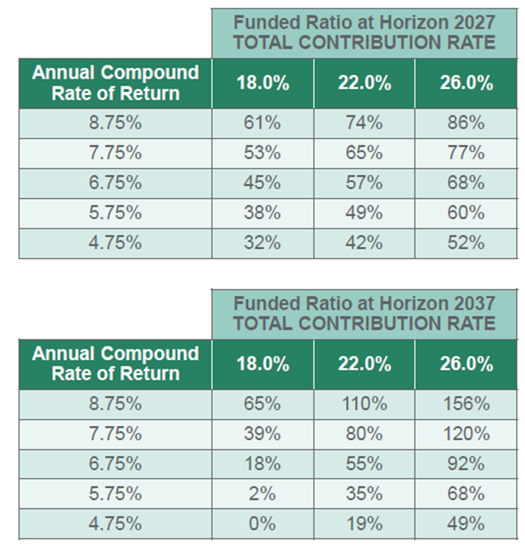
The best-case scenario within 10 years is that the system will improve to an 86% funded ratio. If the plan doesn’t make any changes to contribution rates and receives the expected rate of return of 7.75 percent (the actuarially assumed rate), the funded ratio will drop to 53%. In 20 years, the funded ratio could continue to drop to less than 40 percent.
But here’s the real kicker, the authors write that “The probability of insolvency is 2% at the 10 year horizon and increases substantially to 42% at the twenty year horizon.” You read that right. Within 20 years there is a real possibility that the KCPSRS could be insolvent. We hear all the time that these defined-benefit plans are great for retirees. Well, not if they are bankrupt.
In my next post, I’ll discuss how the system may address the issue of unfunded liabilities.
No Surprise: Fresh Competition from Rideshare Companies Leads to Taxi Reforms in St. Louis

Straight from the Department of Totally Expected Outcomes, Saint Louis’ Metropolitan Taxicab Commission has slashed a wide array of fees and requirements on taxi operators in anticipation of a market-share battle between the traditional taxicabs regulated by the group and ride-share companies like Uber and Lyft.
To help cab companies compete with Uber and other ride-hailing firms, the Metropolitan Taxicab Commission voted Wednesday to slash license fees and reduce inspection requirements.
The new rules, which take effect Thursday, also cut minimum liability insurance requirements for the cab firms.
Fingerprint background checks still will be required for new cab drivers but they’ll be able to get them from lower-cost private vendors instead of at the commission office.
The St. Louis Post-Dispatch article linked above goes into greater depth on what is changing in Saint Louis, so hit the link to get the full rundown. Show-Me has discussed the issue at length for a number of years now, and more recently my colleague Graham Renz in particular has repeatedly raised flags about the behavior of Missouri’s taxi cartels and their impact on consumers. After the Legislature defanged taxi commissions statewide, this week’s regulatory changes were more or less a foregone conclusion.
On behalf of Graham, I have the privilege of saying that today’s events are no surprise. When you let the market work, innovators will innovate, or else be left behind, and it seems clear that the Commission has recognized and responded to that reality this week.
Whether in transportation or energy or some other sector of the economy, monopolies and oligopolies often work to the detriment of the average person and to the advantage of entrenched interests. Let the market—let competition, let innovation—work, and the result tends to be far superior to letting the status quo ossify, with the backing of government bureaucracy.
These reforms were long overdue, but they are here. Congratulations, St. Louis.
Double Taxation: Saint Louis Zoo Edition
Policymakers in Jefferson City passed Senate Bill 49 (SB 49), which allows for a sales tax of one eighth of one percent to be levied in Saint Louis City and County for construction, maintenance, and operations at the Saint Louis Zoo. The bill itself doesn’t impose the sales tax, but simply allows a ballot to be submitted to voters. Voters in the city and county would have the final say on whether or not to impose the extra tax.
The version of the bill in front of the Governor has changed since it was first introduced. Previous drafts would have allowed for similar sales tax hikes in Saint Charles, Franklin, and Jefferson counties. The narrower focus of the bill means distant shoppers won’t have to subsidize the zoo (which is fair), but it also means a smaller portion of the public will shoulder the burden of supporting a “free” zoo. It also means city and county taxpayers could be taxed twice for the zoo.
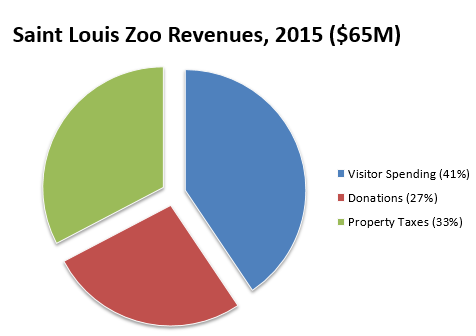
Currently, the zoo is supported by visitor spending, donations, and a property tax levied in Saint Louis City and County. So if a sales tax is passed, city and county voters will pay two taxes for the zoo. And while taxpayers would get an improved zoo for that extra money, the new funding wouldn’t fix the underlying problem with the zoo’s funding structure: free riders.
Since no admission is charged at the zoo, city and county taxpayers support the zoo for everyone, from Saint Charles residents to visitors from Hawaii. Predictably, the issue of fairness arises: why should just city and county residents pay for the zoo? While some propose a regional taxing structure to remedy the free-riding problem, in reality it would convert only a portion of the free riders into supporters. A fairer solution would be to charge admission for those not paying zoo property taxes. (For perspective, a $2 admission fee for residents outside the city and county, assuming a 10% reduction in visitors, could raise more than $3.5 million a year.)
A zoo sales tax would worsen the ever-growing sales tax burden for city residents. With the passage of the MetroLink sales tax hike in April, the city’s sales tax rate jumped to 9.179%, the 13th highest of major US cities (and higher than in New York City, Los Angeles, and San Francisco). If a zoo tax were to be approved, the city’s base rate would top 9.3%, and in some areas littered with special taxing districts, be as high as 11.3%. For many city families, these tax increases mean hundreds of dollars a year they cannot spend on food, school supplies, and other goods and services.
We all love the zoo, and there’s no denying it could use some cash for infrastructure and other projects. But taxpayers should think hard about whether sales taxes are a fair way to fund this famous Saint Louis institution.
Memorial Day

Money Doesn’t Grow on Trees, But We Can Grow the Economy
When we were kids, our parents used to say things that seemed strange, but made sense after a little thought. For instance, “Money doesn’t grow on trees.” Of course it doesn’t. You don’t have to tell a kid that; it’s obvious. Nevertheless, some people still fail to completely grasp this lesson. As we grow older, we realize the importance in our own lives of spending less than we make. We know that we must make decisions to balance our budgets, and that if we spend more on one thing we have to spend less on another. Yet somehow, when we move from talking about personal finance to state finances this lesson goes out the window. We know money doesn’t grow on trees, but we sometimes treat it as if it should.
For years, educators and some lawmakers in the state have railed against the legislature for failing to fully fund the foundation formula for K-12 public schools. Last year, one lawmaker said her colleagues “refuse” to fund the formula. While lawmakers could choose to fully fund the formula, they aren’t simply deciding to withhold money without reason. Those dollars have to come from somewhere, which means less funding for other programs.
Indeed, this year lawmakers have passed a budget that increases aid for the foundation formula by $45 million, to a total of $3.4 billion. For the first time since the new formula was enacted in 2006, lawmakers will fully fund the formula.
Did they find that elusive money tree? No, of course not. They simply took the money from somewhere else (and they wisely reinstated a cap to growth of the foundation formula target amount)
One place hit hard by this reallocation of funds was higher education. As a result, higher education administrators are making cuts and laying off staff. (Full disclosure: I am a professor at UMSL which has been negatively impacted by the budget cuts).
State lawmakers have done exactly what you and I do when the budget is tight: shift funds from one thing to another. This will always happen as different administrations prioritize one thing over another. The only way to reduce the need to shift money around is to increase the amount of money available by growing the economy. To do this, policymakers should refer to the Show-Me Institute’s 20 for 2020 policy proposals. We’re far more likely to find new revenue for schools through sensible policy reform than by looking for it on trees.
Essay: Education, Income, and Social Behavior Across Missouri

You wouldn’t expect a lot of pushback if you claimed that there is a positive relationship between income and level of education. But simple truisms only get us so far, especially in formulating policy. Education budgets aren’t unlimited, and the best use of our resources isn’t always obvious. Should we concentrate on maximizing the number of people who earn a college degree, or is it more important to focus on getting as many students as possible through high school?
A new essay by Gail Heyne Hafer and Rik Hafer explores questions like these by examining data across Missouri counties to track not only economic outcomes but also social behavior in order to see whether different levels of education produce different outcomes at the county level and to inform debate about how educational funding should be allocated across the state.
Click on the link below to read the entire essay.
Kansas City’s Airport: A Monument to Political Ego
Kansas City has an effective and efficient airport. There is no reason why Kansas City cannot continue to meet the needs of modern travelers while honoring our past architectural innovation, maintaining the convenience we have come to cherish, and keeping costs down. Many of the complaints that people have are largely cosmetic: (lighting, USB chargers, bathrooms) and could be addressed by repairs and upgrades rather than a complete rebuild. Yet a focus on these less-expensive options is absent from the current debate. Why?
Could the airport just be a legacy project? Two years ago, then–Aviation Department Director Mark VanLoh made it seem that way when he told the Northland Regional Chamber of Commerce, “You don’t have [all the information] yet. We don’t even have it yet. I know what I want because I want a new airport.” He just wanted it.
VanLoh is gone, but the strange enthusiasm for a single terminal continues. The new plan is just as over-the-top as the old one. The justifications for the spending come and go—claims of EPA mandates, TSA concerns, and airlines’ refusal to expand services—but the project itself remains the same: a $1.2-billion single terminal that is actually a downsizing of what we have now.
What is new in this round of the discussion is the financing and no-bid contracting. But regardless of who finances and builds the airport, the risk to Kansas City comes from the possibility of increased fees to airlines and passengers. Right now, Kansas City’s airport is very cheap for airlines, and travelers benefit with lots of flights from here. Increase the costs to airlines, and we risk losing that competitive advantage. Other airports have suffered after building new terminals for just that reason (Consider Cincinnati, Sacramento, or San Jose.).
The good news is that the city is no longer claiming that the airlines agreed to finance the project. This was never the case, despite incorrect claims from the Kansas City Star and the Kansas City Business Journal. In truth, the airlines merely agreed to pay higher rent for a new terminal while reserving their right to renegotiate once the terminal is built. They did not issue or back any debt; they accepted no risk.
Proponents of a new terminal are fond of telling us that the new terminal idea is not a Taj Mahal. In fact, they’ve been using that curious term over and over again for years (see the Google search here). The Taj Mahal, of course, is a 400-year-old elaborate mausoleum in India built to house an emperor’s wife. Such determination to settle for nothing less than a new terminal, however, combined with the candor of Mark VanLoh and the out-of-hand dismissal of cheaper alternatives, suggests that this is exactly what the new terminal is: a modern monument to political ego—not what is best for Kansas City.
Breaking: Blue Cross KC to Leave Obamacare Exchanges

Major news from Andy Marso at the Kansas City Star. Reportedly the move comes after the company experienced a $57 million loss on the exchange in 2016:
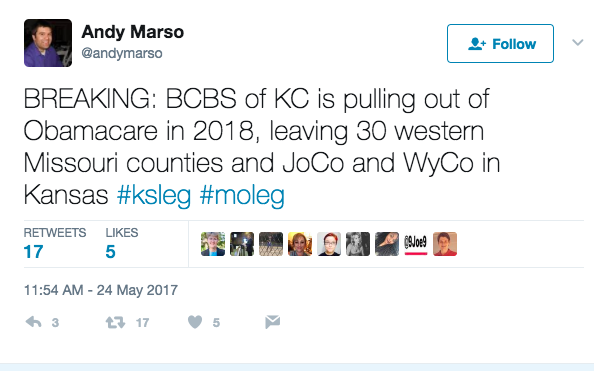
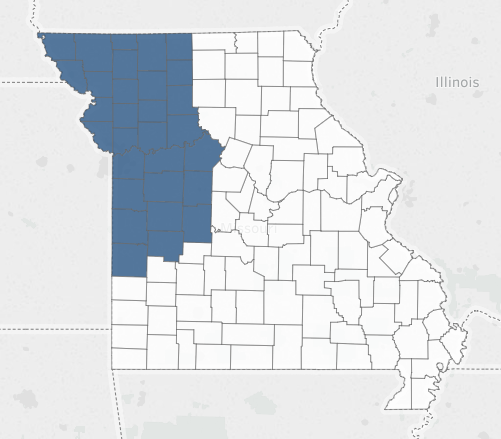
As we have noted before, rural areas of Missouri were already severely underserved by the Obamacare exchanges, and the departure of Blue Cross Kansas City will leave dozens of counties with no Obamacare providers next year if nothing else changes. To give our readers a sense for what part of the state the insurer covered, BCBSKC’s 2017 service map in the exchanges is below:
This may only be the first major insurer departure from Missouri that could happen this year. More on this story as it evolves.
