To Keep the Zoo Great, Keep It Out of Taxpayers’ Pockets

A version of this op-ed appeared in the Clayton Times on July 11, 2017.

We’re told early in life that nothing is truly free. If you’ve had to learn this lesson first-hand, you know that some “free” things are actually quite costly.

The Saint Louis Zoo, one of our region’s most beloved institutions, is one of those expensive free things. And soon it could get a whole lot more expensive.

Senate Bill 49 (SB 49), if signed into law, could mean voters in Saint Louis County and City will be asked to hike their sales taxes by one-eighth of one percent (0.125%) to help fund infrastructure, conservation projects, and other zoological activities at the Saint Louis Zoo. By all accounts, the needs at the zoo are genuine—many of its pipes, sewers, etc., are original. But the zoo already receives $21 million—about one-third of its budget—from county and city taxpayers through a property tax. Is ratcheting up the region’s already-high sales taxes the best way to raise additional funds?

Here are some reasons to think not.

Sales taxes in both the county and city just went up. The city’s sales tax rate will soon be 9.179%, higher than New York City’s or San Francisco’s—and another half-percent hike is on the horizon. Things don’t look much better in the county. With the passage of Prop P, Clayton will soon have a rate of 9.113%, as will places like Olivette, Webster Groves, and Ballwin. In Ferguson, sales taxes will sit even higher, at 9.613%. Add in the extra 2% levied by numerous, overlapping special taxing districts, and in some places you’ll be paying more than 11%! A new zoo tax will only make your shopping more expensive, and it will hurt the region’s poor the most.

Considering that policymakers have a seemingly never-ending list of “transformative” or “essential” projects that require tax hikes, is a zoo tax the best use of limited public resources? There is no formula to determine the optimal sales tax rate, nor is there a documented sales tax ceiling, but taxpayers will only stomach so much. If the sky isn’t the limit for tax rates, could a zoo tax help exhaust the region’s sales tax capacity?

And then there’s a basic math issue. The proposed tax could raise roughly $20 million per year if passed in both the county and city, and zoo officials have claimed there is a backlog of needed infrastructure projects that will require approximately $100 million. Accordingly, by conservative estimates, a mere six years of the tax could take care of all the zoo’s infrastructure needs, and an extra year or two could raise tens of millions for conservation efforts. But there is no language in the bill that states the tax would be temporary. So while zoo officials talk of specific needs that justify the tax, they fail to mention that, in addition to taking care of these needs, the tax would increase their annual budget by a third—and, apparently, permanently so.

Finally, a sales tax hike wouldn’t fix the underlying funding problems. Since the zoo does not charge admission, it has what economists call a free-rider problem. Not all of the visitors who enjoy the zoo pay for its operation. The result is a zoo with piling bills and no way to pay for them. But rather than address this problem, a zoo tax would simply exacerbate it. City and county taxpayers who currently subsidize the zoo for everyone would be forced to doubly subsidize the zoo for everyone. And while it’s convenient to say Saint Charles, Franklin, and Jefferson counties should impose a zoo tax too, residents from these counties comprise only 13% of the zoo’s visitors, and taxing them would likewise fail to address the free-rider problem.

There are alternatives to hiking sales taxes, and one in particular deserves greater consideration: charging a reasonable admissions fee. If other top zoos charge more than $50 for admission, visitors can pay a fraction of that to keep ours one of the best in the county. A small admissions fee—for those not currently paying property taxes for the zoo—could raise millions annually, and help avoid hiking an unnecessary, regressive tax.

It’d be great if some things in life were truly free, but they’re not. And nothing is wrong with that. The user-fee system works—it’s both fair and financially sustainable. Let’s hope policymakers and zoo officials keep that in mind in the coming months.

Saint Louis, the Sales Tax Monster

As Cookie Monster is to cookies, Saint Louis is to sales taxes.

Back in April, voters in the City of Saint Louis approved a half-cent “economic development” sales tax hike. The increase, which brings the city’s base sales tax rate to 9.179%, is slated to fund a north–south MetroLink expansion, public safety, workforce development, and other programs. It also makes Saint Louis home to one of the highest sales taxes in the nation. In fact, Saint Louis now has a higher sales tax than New York City and San Francisco.

But policymakers aren’t finished yet.

There are two new sales tax proposals coming down the pipeline. One would raise sales taxes by one-eighth of one percent (0.125%) to help fund infrastructure improvements and conservation efforts at the Saint Louis Zoo, which is already funded with tax dollars. The other would raise the rate by one-half of one percent (0.5%) to bolster public safety spending. If both hikes were approved, the base sales tax rate in the city would be 9.804%, the 6th-highest in the nation. In areas with overlapping special taxing districts (of which there are dozens in the city), the rate would be nearly 12%.

There is neither a formula to determine the proper sales tax rate, nor a proven sales tax “ceiling,” but policymakers should carefully consider the implications of these proposals and whether there are alternatives to raising taxes.

For instance, if these sales taxes are approved, will voters have an appetite for other, more pressing proposals? That is, will these proposals exhaust Saint Louis’s sales-tax capacity? Also, will the proposed hikes disproportionately affect the poor? Is it fair for the city’s poor to subsidize the zoo for visitors from surrounding counties? Moreover, are sales taxes an appropriate source of funding for public safety? Police and firefighters are essentially security guards for taxpayers’ persons and property, so shouldn’t they be paid from property taxes?

Sales taxes can generate significant revenue and are easy to collect, but that doesn’t mean rates should be hiked every time a public need comes around. Perhaps if officials weren’t so eager to hand out taxpayer dollars for corporate welfare, Saint Louis wouldn’t need such high taxes for basic services. So, before asking taxpayers for more, perhaps city officials can reflect and ask themselves, “Can we do more with what we’ve already got?”

Stadium Subsidies: Not Just for the Big Leagues Anymore

Show-Me Institute analysts have opposed spending taxpayer money on sports stadiums in Kansas City, Saint Louis, or anywhere. These subsidies are usually targeted for major league teams that are privately owned and wildly profitable. But in a cautionary tale for Missouri, across the border in cash-strapped Kansas, the Unified Government of Wyandotte County and Kansas City, Kansas (UG) is spending taxpayer dollars to prop up a failing semi-professional baseball team, the T-Bones, in a struggling independent league.

According to the Wyandotte Daily, the T-Bones aren’t faring well lately.

Jon Stephens, UG interim director of economic development, said the direct and indirect economic impact of the T-Bones is $4.2 million a year. However, attendance at the T-Bones games has declined in recent years.

“We view it as an integral part of the Village West development, as part of the No. 1 tourist attraction in the state of Kansas,” Stephens said.

Stephens’ remarks are odd. The team is seen as integral and successful by government officials, but apparently not by sports fans, whose attendance is declining—down 25% since 2010. Also, the team has failed to pay its utility bills and owes $314,000 for electricity and water. Jeff Bryant, vice president of the Board of Public Utilities, which denied the T-Bones’ request to simply waive $172,000 of their utility bill debt, testified against the UG action:

“We enjoy the baseball game,” he said. “Like any other business, it needs to stand on its own.”

He doubted if the UG would help out many other businesses that may be having trouble.

The new agreement shows the UG is paying 55 percent of the utility bill. “The UG is not paying 55 percent, the residents of Wyandotte County are paying 55 percent,” he said.

Taxes already are high, and this helps support a for-profit business, he said.

“I don’t believe that is fair to all the citizens of our county,” Bryant said. Many license plates in their parking lot are not from Wyandotte County; therefore, Wyandotte County is subsidizing the entertainment for other counties, he added.

Unfortunately, this is not the first time government has stepped in to help. Back in 2013, the UG gave the team $174,000 so they could pay their mortgage. The same year the UG purchased the ballpark itself of $8 million. (Note that in 2013 the team was said to generate $5.5 million per year for the local economy; now the number is $4.2 million.) But the franchise is still failing.

Subsidies for sports teams are a bad idea even in good times—but using taxpayer funds to subsidize and then purchase a failing sports team is even worse. 

Policy, Not Politics, Should Drive Airport Decision

A few weeks ago, when engineering firm Burns & McDonnell announced its proposal to finance and build a new billion dollar single terminal at the Kansas City International Airport, it was doing so alone. But on Friday the firm announced the addition of, “Some of the most recognized Kansas City firms in architectural design for airport terminals and aviation facilities” to their team. Why?

When the original story broke on May 11, we learned that Burns & Mac has offered their own airport solution:

One key to the proposal for Burns & McDonnell is that it would get an exclusive arrangement with the city to provide the design and come up with a guaranteed maximum price.

Other firms would not have access to make their own offer, nor would the city request bids. James said the city would waive bidding requirements in accepting this plan and that it is legal for the city to do that.

That last part was called into question and the city rescinded the plan shortly thereafter. But Burns & Mac remained the sole provider and they were strident in going it alone.  The CEO of architectural firm BNIM was caught off-guard and wondered why they—and other Kansas City firms—were not included. This could not have been mere oversight; we’re told that Burns & Mac developed the plan over several months with 25 employees working on the project full time. Perhaps they thought at the time that their long-standing relationship with the Mayor was all they needed.

That changed quickly. The no-bid contract fell apart, as did the poorly considered right-of-first refusal option, along with the short window for considering proposals. Now that the deadline has been extended and other international companies are considering making proposals, Burns & Mac is teaming up with those KC firms they once thought unnecessary. Previously, Burns & Mac added general contractors JE Dunn and McCownGordon to their team. At the same time, the firm is publicizing data from a poll they themselves commissioned, raising concerns that I described in a previous post.

The question for Council members and voters ought to be: Does any of this yield a better, more cost-effective product for the people of Kansas City? The companies involved should not drive the decision-making. After all, if Burns & Mac didn’t think they needed BNIM et al. before, why do they think they need them now?

New Study Documents (Again) the Harmful Effects of Raising Minimum Wages

The results are in, and they are hardly surprising: A new study has found that the increase in Seattle’s minimum wage has had detrimental effects on exactly those groups such market interventions are supposed to help. This result should give pause to other cities that are considering such a pestilential policy path.

Some background: In January 2014 the Mayor of Seattle formed an advisory committee charged with raising the city’s minimum wage. After deliberation, the committee’s plan was forwarded by the Mayor to the Seattle City Council, which approved the proposed changes. The minimum wage thus far has been increased in two phases: from $9.47/hour to as much as $11/hour on April 1, 2015, and from that level to as much as $13/hour on January 1, 2016. Future increases are on tap to eventually increase it to $15/hour.

To evaluate the impact of the minimum wage hike, the city contracted with researchers at the University of Washington’s Evans School of Public Policy & Governance, who used this policy change to test for three effects:

  • Do such wage increases affect the number of low-wage jobs?
  • Do workers in low-wage jobs face cut backs in hours worked?
  • Do workers in low-wage jobs suffer reductions in total earnings?

Using data from across the state, the researchers formed a control or comparison group to which changes in employment conditions in Seattle could be compared. Their control group covered all low-wage jobs—not just jobs in one or two industries (such as the restaurant sector), as is sometimes the case in such studies. So what did they find?

The UW study, which is available here, finds that the first increase, from $9.47 to $11, had relatively minor effects on low-wage job employees. There were small reductions in jobs available, and little change in the total payroll for low-wage jobs.

After the minimum wage was increased to $13/hour, however, things changed for the worse for existing low-wage workers in Seattle. While hourly wages rose slightly, many low-wage employees suffered a sizable reduction (9 percent, on average) in hours worked under the higher minimum wage. The study also found this wage hike reduced overall payroll for low-wage jobs. Following the 2016 increase in the minimum wage, the annual total payroll for low-wage jobs in Seattle declined by over $100 million. This amounts to about a $125 reduction per month for the average low-wage worker.

The loss of earnings among Seattle’s low-wage workers reflects one of the more nefarious (though usually ignored by politicians) aspects of raising minimum wages: Even though hourly wages rise, the decline in hours worked and/or jobs available can lead to a reduction in the total income of those on the lowest rung of the employment ladder. That outcome, which will only get worse as additional increases occur, is just another flaw in what really amounts to a misdirected welfare program.

Kansas City’s Economic Diversion

City leaders are still pointing to Kansas City’s downtown as an economic development success story. Taxpayers lose millions each year in subsidies for corporate headquarters, luxury apartment buildings, entertainment districts, and other projects. But is all of this spending working?

The research, if you care about research, says the spending is wasteful. Previous studies in Saint Louis and Kansas City say the same thing. And studies of other cities like Chicago and Indiana, and of the country as a whole, likewise cast doubt on the value of these development subsidies.

As we have written previously, the H&R Block headquarters building downtown, one of the first in the downtown spending spree of the Mayor Barnes administration, has failed to create jobs. At best, the company merely moved jobs that existed from elsewhere in Kansas City to this new location; no new jobs were created.

Consider one of the poster children for streetcar-created economic development, Centric. The company moved two blocks, but it is somehow considered by the city to have created jobs and economic development. It did not create anything; it merely moved locations.

And here is perhaps the most damning evidence: despite all the spending, the economic growth of Kansas City due to downtown subsidies is a myth. We all know that the Power & Light District is the result of taxpayer subsidies—that is undeniable. Where before downtown was decrepit and abandoned, now it appears new and vibrant. But has any new economic development taken place? Has society or the average Kansas City family grown more prosperous because of these subsidies?

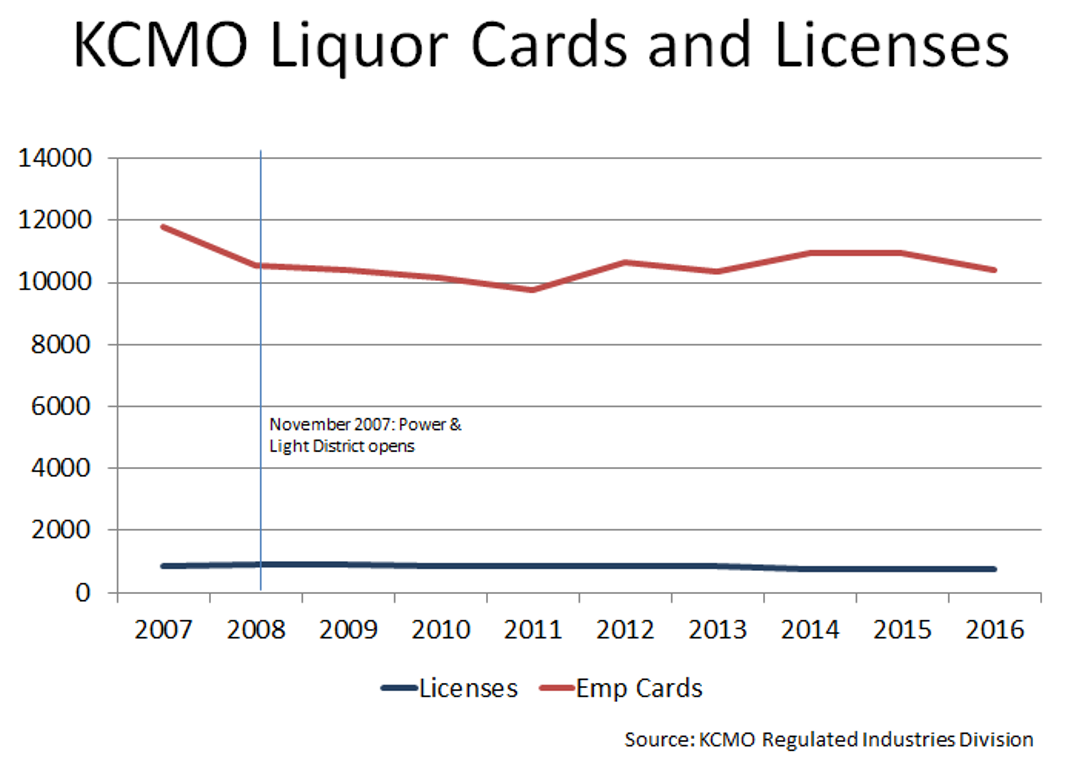
According to the Regulated Industries Division of Kansas City, Missouri, the number of liquor licenses (a gauge of how many restaurants and bars are operating) and employee health cards (a proxy for the number of people employed at bars and in food service) has remained flat since before subsidies were awarded. So while there may be more economic activity in the downtown area, citywide there has been no growth. Our subsidies haven’t created anything—they’ve just diverted activity from elsewhere in the city to downtown.

This shouldn’t come as a surprise. Imagine a new shopping center is built right near your home. There are a few stores and restaurants you’ve never been to, as well as a few outlets familiar to you. If you shop at this new location, you won’t continue to spend the same amount at the previous locations. The new stores haven’t caused you to spend more, they just cause you to spend differently. Yet the politicians in your neighborhood point to the new buildings as evidence of economic growth.

In the smaller incorporated cities in Johnson County, Kansas, this tactic might actually work at a very local level. A store that was generating sales tax income for Prairie Village could be lured to Shawnee with subsidies. That might be a win for Shawnee, but regionally it’s a wash, if not a total waste of public capital. (Writ large, this is the story with the Kansas-Missouri border war—lots of subsidies spent by both side with no real regional growth.) But in a large metropolitan area like Kansas City, there is no benefit. Citywide, there has been no growth in the number of bars, liquor stores or waiters and bartenders as a result of the Power & Light District. We’ve just diverted the economic activity downtown.

Policymakers are free to argue that diverting economic activity from elsewhere in Kansas City to the downtown area is good policy. That would be a welcome policy debate worthy of consideration. But supporting policies that merely move activity around and then pretending something new has been created is not only disingenuous, it is unsustainable.

Support Us

The work of the Show-Me Institute would not be possible without the generous support of people who are inspired by the vision of liberty and free enterprise. We hope you will join our efforts and become a Show-Me Institute sponsor.

Donate
Man on Horse Charging