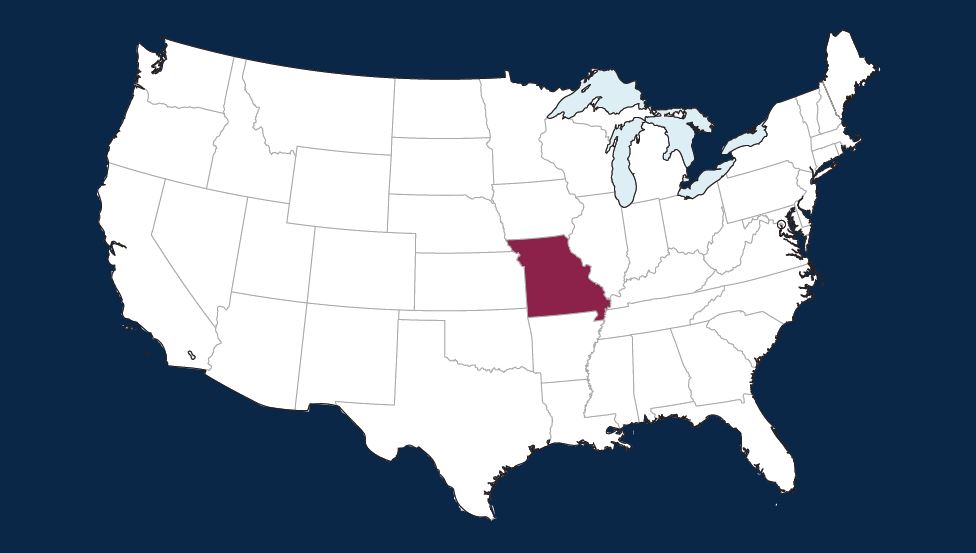
How Missouri’s Special Taxing Districts Promote “Legal Plunder”

In the land of the blind, the man with one eye is king. When it comes to Missouri’s rapidly proliferating special taxing districts, one-eyed kings pick millions of dollars out of the pockets of unseeing and unsuspecting consumers / taxpayers.

Who preys upon the sightless with such cruel impunity? More often than not, it is leading citizens and business organizations, taking advantage of poorly conceived laws with the stated purpose of promoting economic development.

Under Missouri laws established in the 1990s, transportation development districts (TDDs) and community improvement districts (CIDs) operate as micro-governments that direct tax revenues to private interests to use for the supposed benefit of their local communities. A primary benefit of a TDD – from the viewpoint of a single property owner or a group of owners banding together to form a district – is the ability to impose a tax on people with no vote in the matter.

Over the past two decades, more than 200 TDDs and nearly 300 CIDs have sprouted up in big cities, small towns, and suburban enclaves across the state. In 2014 and 2015, TDDs collected more than $175 million in tax revenue, according to the Missouri State Auditor’s Office. “Given that TDDs have been operating this way for nearly 20 years,” Show-Me Institute Policy Analyst Graham Renz has observed, “their collective impact is in the billions.”

Before becoming a city councilman and later mayor of Neosho (pop. 12,000), south of Joplin, Richard Davidson served on the town’s school board from 2004 to 2008. He was shocked when supporters of a TDD sought an $800,000 contribution from the school district to support the building of new roads. “We educate kids,” he told the TDD proponents. “We don’t build roads.” Later he wrote a column for the Neosho Daily News titled, “TDD Spells Trouble for Our Schools.”

The Neosho TDD was set up in 2009 to fund $6.9 million in transportation projects, with a projected $4.5 million coming from a half-cent sales tax from businesses within the district and another $2.4 million from the Missouri Department of Transportation. Like many TDDs, this is a special taxing district with no residents. Within its boundaries, the 550-acre district includes the city’s golf course, wooded areas, and mostly uncropped farmland, along with a small commercial strip with a Wal-Mart, a Lowe’s, and some other shops and restaurants. Through the half-cent sales tax, customers of those businesses have paid in excess of $500,000 a year to support the TDD’s activities.

So far, those efforts have not stimulated any new business development. But who is to say that the millions of dollars spent by the TDD on roads and transportation won’t at some point turn woods and idle farmland into valuable commercial property?

Davidson, who served as mayor of Neosho from 2010 to 2016, regards the TDD as a clear case in which the end (not so much economic development as the enrichment of a small number of private property owners) does not justify the means (taxing unseeing and unsuspecting consumers).

Community improvement districts work in a similar way. Examples include the luxurious Intercontinental Hotel on Country Club Plaza in Kansas City and the Cardinals’ Ballpark Village in downtown Saint Louis. CIDs allow both of these commercial ventures to collect a one-percent sales “tax” from patrons, which is really just an artfully disguised part of the selling price.

It is time to jettison two-decade-old Missouri laws that promote taxation without representation and provide a textbook example of what the 19th-century economist Frederic Bastiat called “legal plunder.”


A Tax-Cut Change of Heart from the Post-Dispatch?

I read with interest the St. Louis Post-Dispatch‘s staff editorial, “Illinois’ economy stacks up to Missouri’s, despite Schmitt’s criticism.” Much can be said about the piece, but I found it particularly notable that the first item tallied in Illinois’ win column was, of all things, that Illinois has a lower personal income tax rate. From the Post-Dispatch:
 
Illinois’ personal income tax hike from 3.75 percent to 4.95 percent still leaves it lower than Missouri’s 5.9 percent. That nears 7 percent in St. Louis and Kansas City when the 1 percent earnings tax is added. Schmitt, as a state senator in 2014, sponsored a bill that is reducing Missouri’s income tax rate by 0.5 percent over five years.
 
That the Post-Dispatch, of all publications, would cast Missouri’s high income taxes as a mark against the state is priceless. In 2014, the same editorial board criticized Missouri’s extremely modest income tax cut, subject to revenue triggers, as “a knockout blow for Missouri’s future.” So it is good, albeit wholly unexpected, to see the Post-Dispatch finally come around to our position: that income taxes do indeed matter to economic growth, and that in Missouri, those taxes are too high.
 
To be clear, rates aren’t the only things that matter when it comes to economic development policy; tax brackets and exemptions matter, too, as do non-tax factors like infrastructure and workforce preparedness. To make Missouri great, all of these issues must be seriously studied and ultimately followed through on by our representatives. But the Post-Dispatch’s apparent 180-degree turnaround on the issue of income tax rates is an event worth applauding.
 
I hope legislators in 2018 will swiftly enact new income tax cuts that at least match Illinois’ rates and hopefully go beyond them, and examine anew the economic impact of Saint Louis’s and Kansas City’s local earnings taxes. We may not agree with the Post-Dispatch on much, but it’s good to see that on the destructive economic impact of income taxes, we may have found some common ground.

The Cost of Government Transparency in Missouri

Collecting data for a research project on Missouri city budgets—known for now as the “government checkbook project”—I have found inconsistencies across the state regarding how easy it is to get information about how different Missouri cities spend local tax dollars.

Kansas City and Saint Louis, for example, upload full spreadsheets of city expenditures on their websites for anyone to download at no charge. For many other cities, getting data was as easy as sending an email request and, occasionally, paying a small service fee.

On the other hand, some local governments ignored my request entirely or said their software does not have this reporting capability, as was the case with Independence. At the far end of the spectrum, a Jefferson City employee said the process would take about 40 hours and would cost $936.

The goal of the government checkbook project is to allow all Missouri residents the same level of access to information that those living in places like Kansas City and Saint Louis currently enjoy.

As it now stands, public records on city expenditures are not always kept in a way that can be shared easily. Though Missouri’s sunshine law requires state and local governments to disclose their documents upon request, it does not prevent these governments from charging fees, nor does it obligate them to generate new documents. As a result, what might seem like a simple request can result in fees of thousands of dollars when the data are not user-friendly, as analysts working on previous Show-Me Institute projects have discovered.

Is there any reason why a digital-age society that values government transparency and accountability should not make public information easily available?

Shocker! KC Developer Builds Building, Pays Taxes!

In a sign of the times, Rob Roberts at The Kansas City Business Journal found it newsworthy that a developer seeking  to build a mixed use high rise in Westport is not asking for taxpayer subsidies.

In response to a question from Councilman Quinton Lucas, Cole added that the developers would not seek any incentives for West Port Terrace at Manor Square. They expect to begin work on the project by early next year and complete construction within about 18 months.

I can’t speak to the merits of the project, but I am pleased that Pulse Development LLC, the developer of record, is willing to pay taxes. Happily, this appears to be a trend. A proposed 13-story, 257-unit apartment building just west of Country Club Plaza and an entertainment development at Ward Parkway Mall that are likewise eschewing taxpayer subsidies. Maybe someday businesses paying taxes in Kansas City will be so common that it won’t show up in news reports.

Want to Value Teachers? Eliminate Salary Schedules

It looks like teachers in Marshfield are finally getting a raise.

Teachers are paid on what is known as a salary schedule, which maps out exactly how much a teacher will make for their entire career based on how many years of experience they have, with additional adjustments made for teachers with advanced degrees. When finances are tight, however, district officials will often do one of two things: sometimes they decline to adjust the schedule for inflation, and in leaner years they may “freeze” teachers at their current salaries. According to the Springfield News-Leader, salaries for Marshfield teachers were frozen for four years, and teachers received just a one percent raise in two other years.

Some teachers feel a sense of entitlement regarding pay raises. As a former public school teacher, I know this from experience. You would feel entitled to a raise too if your employer presented you with a predetermined salary structure. You consider yourself bound by the salary schedule, but you consider the district bound by it as well. What good is an agreement that only one side must abide by?

Over the years, I have analyzed hundreds of salary schedules. While conducting my research, I found one school district that did not have a salary schedule. When I spoke with an administrator there, I asked him why not. He said the schedule was like a promise to teachers. They expected to receive those raises. When they did not, they felt that something had been taken away from them. It felt like a slap in the face.

When workers in any field believe they are not valued, morale drops, productivity may decrease, and employees might look for jobs elsewhere. We certainly don’t want low morale among our teachers.

In Marshfield, with the foundation formula fully funded for the first time since its inception, the district will largely make up the “missed” pay increases. This will help ameliorate any negative sentiments from the years when their salaries were frozen. It will, however, do little to change expectations among teachers.

Currently, salary schedules dominate school district budgets. They tell the financial office how much money is available to hire new teachers or to purchase new resources. The National Center for Education Statistics reports that approximately 80 percent of a district’s operating expenses go toward salaries and benefits. With salary schedules, school boards and administrators cannot control these expenses without “taking away” raises from teachers. That is a problem.

The school district without a salary schedule has a different model, one in line with sound financial management. It gives raises based on how much money is left in the budget, which helps school officials effectively manage their budget.

Valuing teachers and wanting to give pay raises is a good thing. So are pay systems that reduce strife between teachers and administrators, while also promoting more responsible governance. As Marshfield and other school districts look for ways to reward teachers for their service, they should examine how they pay teachers.


Electrician Licensure Proposal Signed into Law

With little fanfare, Missouri Governor Eric Greitens signed SB 240 into law on June 28. You’re forgiven if that bill number doesn’t ring a bell immediately, because even though we’ve talked about it in the past, it generally did not rate in the media as a particularly newsworthy reform. To us, however, it is.

SB 240 reforms the state’s licensure rules for electricians, generally decoupling them from the patchwork of local licensing rules in favor of a statewide system that removes artificial local barriers to entry for the profession. We have talked about the problems of various interstate licensing laws that often serve to block qualified professionals, including doctors, from practicing across state lines; SB 240 attacks a similar problem, intrastate licensure barriers.

We applauded the legislature for passing the bill back in May, and we extend that praise to the governor now that the bill is signed. But I do think there was a missed opportunity here, or at least that an opportunity has been missed for the time being. SB 240’s signing was, perhaps inadvertently, buried by the pre-July 4th holiday weekend alongside three other bills. And since the Governor has been very aggressive on social media in explaining important bills to the public, I do think that SB 240 rises to a level that merits publicity. Keep in mind, the legislature and the governor have actively pushed the idea of lowering regulations and imposing fewer licensing barriers on hard-working Missourians; it seems to me that this reform provides an excellent opportunity to bring the public up to speed on that initiative and explain why it’s so important.

But while the opportunity has been missed so far, it’s always possible that the Governor’s media shop plans to talk at greater length about the bill in the near future. Regardless, free marketeers should be delighted with the signing of SB 240, and I hope it’s the first of many reforms in the pipeline.

Wait . . . I Thought the Zoo Was Free

The Saint Louis Zoo is prized by locals as the best free attraction in the area, but the truth is it isn’t free at all. Residents in Saint Louis City and County pay for it through their property taxes, and a new ballot measure may force these same residents to pay more through a sales tax increase. Shouldn’t everyone who visits the zoo help pay for it?

The School Choice Barrier from the State of Maine

We often complain about the rancor in politics these days, but politics has always been filled with acrimony and bitterness. Heck, in 1804 the sitting vice president of the United States, Aaron Burr, shot and killed one of the founding fathers, Alexander Hamilton, in a duel. One of my favorite stories of political partisanship, however, is much less known. During the 1884 presidential election, Democrats derided the Republican nominee with the chant, “Blaine, Blaine, James G. Blaine, the continental liar from the state of Maine!”

You may never have heard of James G. Blaine. He didn’t win. Yet, for more than a century we have been living with one of Blaine’s legacies—Blaine amendments. While he was a senator, Blaine offered an amendment to the U.S. Constitution that would prevent the federal government from funding sectarian institutions. It was widely known that the amendment stemmed from anti-Catholic sentiment. In 2000, Justices Thomas, Rehnquist, Scalia, and Kennedy stated in Mitchell v. Helms that “it was an open secret that ‘sectarian was code for ‘Catholic.’” The federal amendment failed, but similar versions would be installed later in 37 state constitutions.

Many state officials have cited their Blaine amendments as a reason that private school choice programs would be unconstitutional. These amendments have also prevented religious institutions from receiving funds for non-religious activities. For instance, the amendment was used to bar Trinty Lutheran Church in Columbia, Missouri, from participating in the state’s scrap tire program, which helps nonprofits resurface playground surfaces. Trinity Lutheran appealed this decision all the way to the United States Supreme Court and won.

There is still some debate, as my colleague Mike McShane has noted, as to what impact the Trinity ruling will have on school choice legislation. Our first indication, however, is that the court’s repudiaiton of anti-religious sentiment may bode well for private school choice programs. On June 27, the day after the Trinity Lutheran ruling, the nation’s high court vacated the Supreme Court of Colorodo’s ruling in the Douglas County, Colorado, voucher program, which had been found unconstitutional. The case has been remanded to the state supreme court in light of the Trinity Lutheran ruling.

The Institute for Justice, a group that supports school choice, has long stated that Missouri’s Blaine Amendment was relatively strong and has suggested vouchers may not be feasible in the state. It will be interesting to see if the decisions of the U.S. Supreme Court in the Trinity case will further impact Blaine amendments in Missouri and other states. We may never get rid of rancor in politics, but this may be the case that helps us say goodbye to Blaine, Blaine, Amendment Blaine, the school choice barrier from the state of Maine.

Was Missouri Always Like This?

The year 1997 marks a grim turning point for Missouri. In the 10 years before 1997, Missouri’s economic growth had kept pace with that of the nation as a whole. Since 1997, Missouri has been one of the slowest-growing states in the nation. What happened–and why? This essay explores those questions, analyzing the decline in Missouri’s fortunes by looking specifically at taxation and state spending for clues. To read the essay, click on the link below.

Support Us

The work of the Show-Me Institute would not be possible without the generous support of people who are inspired by the vision of liberty and free enterprise. We hope you will join our efforts and become a Show-Me Institute sponsor.

Donate
Man on Horse Charging