Economic development tax credits that, whatever their intended purpose, enrich a few at the cost of the many are simply bad policy. Such tax credits fail to deliver on their promises in a manner that is worth the public investment.
For this reason, when Governor Greitens blocked the issuance of low-income housing tax credits—a practice that Show-Me analysts have written for years should be exposed, sunsetted, and discontinued—it appeared that the state might have begun a journey toward putting tax credits in their proper place. Likewise, analysts have written about the wastefulness of stadium subsidies, and so we read with pleasure that Lt. Governor Parson voted against tax credits to build an ice rink and practice facility for the St. Louis Blues.
Unfortunately, further investigation reveals that there is less here than meets the eye.
Regarding the St. Louis Blues tax credit, the St. Louis Post Dispatch wrote that all three of the Governor’s appointments to the Missouri Development Finance Board voted in favor of issuing $2 million in tax credits for the ice rink. Parson was the sole vote against. His lone voice of opposition might be comforting to Missouri taxpayers until one reads further. According to the Post-Dispatch:
Parson said that while he appreciated the boost the project could give St. Louis’s economy, he could not vote to issue tax credits for a new sporting complex at a time when the state is refusing to issue any low-income housing tax credits.
The logic here is all wrong. We don’t need counterproductive tax credits to be evenly distributed (and for the record, the low-income housing credit is indeed counterproductive). What we need is for these credits to be eliminated.
If Missouri is to thrive, it needs a system of taxation that treats everyone equally, is efficient, and is dedicated to supporting the important functions of government. The tax credit system is none of those things. Even if the credits weren’t subject to abuse—and they are—and even if the state were good at delivering on economic development promises—and it isn’t—it’s long past time for Missouri’s leaders to focus on policies that hold promise for helping everyone by creating real jobs and real growth.
Without a doubt, the question that I get most often about charter schools is, “But don’t they hurt the public schools?” The short answer is that charter public schools don’t hurt traditional public schools any more than other factors that can affect enrollment, but they may challenge them.
Charter schools, wherever they operate, are often accused of having a harmful effect on the traditional public schools in the area. The thinking seems to be that if parents choose a charter school, then they’re rejecting—and thereby hurting—their assigned neighborhood school. So, did the Honda Accord “hurt” the Ford Taurus, or did Sprint “hurt” AT&T because some people stopped choosing them? Or did they challenge them?
Charter schools do create change in the public school districts in which they open, and that change can take many forms. Charter school opponents tend to focus on one pain point: Charter schools take funding from the public school district. Before addressing this charge, I’d like to remind readers that charter schools are public schools and charter school students are public school students. When parents are given a choice over one of the most important aspects of their child’s life—their school—not all parents choose the public school assigned to them on the basis of their address. Many choose a public charter school instead. So, while their child’s public education funding stays within the borders of their public school district, it is no longer available to be spent by the local school board.
When a parent chooses to send a child to a charter school, the state funding that would have been sent to the public school district where that student lives is sent, instead, to the charter school the parent has chosen. Federal funding, such as that for low-income students or students with disabilities, also, theoretically, follows the student. Some, but not all, of the local funding may go with the student. The same is true whether the student chooses a charter school, moves to another school district, or moves to another state. The local public school district is no longer tasked with educating the student, so they no longer get the money to do so.
The rub seems to be that charter schools create a new school where one already exists, and when students leave, the existing school really can’t downsize—at least not quickly. Of course, the likelihood of a substantial number of students choosing a charter school is related to the perceived quality of the schools in the district. Prior to charter schools, parents in poorly performing school districts moved out if they could. Rising and declining enrollment can be challenging for public school districts. But the solution isn’t to prevent kids from leaving because the district can’t afford it, any more than it would be reasonable to prevent parents from moving out of the district.
Public school districts have some options when faced with the loss of students to charter schools. They can consider it a challenge and do what’s needed to bring parents back. They can collaborate with the charter school to better serve the needs of all students. They can move away from long-term fixed expenses to a more nimble way of doing business, similar to how many charter schools finance their buildings. If they don’t like any of those options, they can always complain that the world isn’t fair. But at the very lease they should stop trying to protect a failed status quo
On Thursday, March 22, the Show-Me Institute’s Patrick Tuohey appeared on KCPT’s Ruckus to discuss school funding in Kansas and other important issues of the week.
At around 25,000 students, the Springfield Public Schools is currently the largest district in Missouri. Just 20 years ago, the St. Louis and Kansas City school districts were much larger than Springfield, but after years of poor performance, their enrollment numbers have dropped by more than half.
Last month, former Missouri legislator Dr. Roy Holand wrote a letter to the editor of the Springfield News-Leader warning about trends—including both an increase in student poverty and declining test scores—that have the Springfield School District headed in the wrong direction. Could Springfield end up like Kansas City or St. Louis and, as Dr. Holand warns, suffer from “local urban flight” to surrounding districts? Moreover, will students from low-income families be stuck in poor-performing schools because they cannot afford to move to another district or attend a private school?
Based on data from the Department of Elementary and Secondary Education (DESE), Springfield’s enrollment is remaining steady around 25,000, but it is not faring as well as neighboring districts. Take a look at nearby districts’ performance as measured by the 8th grade MAP tests and student population characteristics compared to Springfield:
District
2017 Enrollment
2017 FRPL
% of 8th-Graders Proficient or Advanced in English (2017)
% of 8th-Graders Proficient or Advanced in English (2017)
Springfield
24,995
54.2%
57.7%
13.4%
Districts contiguous with Springfield
Fair Grove R-X
1,085
41.8%
69.1%
44.5%
Logan-Rogersville R-VIII
2,226
36.7%
55.6%
9.1%
Ozark R-VI
5,579
35.4%
64.9%
46.6%
Pleasant Hope R-VI
796
62.0%
51.2%
14.9%
Republic R-III
4,720
42.3%
59.4%
38.7%
Strafford R-VI
1,173
42.7%
64.3%
34.7%
Willard R-II
4,465
43.2%
57.6%
45.4%
Compared to surrounding districts, Springfield has a similar achievement level in eighth grade English, but scores much lower in math. Moreover, Springfield is close to the statewide average of 60.2 percent of eighth graders scoring proficient or better in English, but it is far behind the statewide score of 30.5 percent of eighth graders scoring proficient or advanced in math.
Given these scores, it is not surprising that six out of nine middle schools in the district scored less than 70 percent on the 2017 Annual Performance Review (APR), which is the state’s threshold for full accreditation.
Additionally, legislation has been introduced that would allow for charter schools to open in any district that has at least one school that earned 60 percent or fewer of the possible points on the APR in two of the last three years. Four elementary schools and three middle schools in Springfield currently meet those criteria. If this legislation passes, Springfield will join St. Louis and Kansas City as “charter schools as intervention” districts.
While Springfield is technically still accredited under the Missouri School Improvement Program (MSIP) system, the number of struggling schools in the district is cause for concern. Because some of the 2017 MAP tests were thrown out, 2016 is the most recent year that all school received an APR score; as you can see, the schools’ performance varies significantly:
Considering this range in performance, can a parent in Springfield be confident that their child will be able to attend a quality school? While Springfield does have some choice programs, such as the option to enroll in schools emphasizing STEM subjects and an intra-district transfer option, the seats for these programs—and in the good middle schools—are limited. With so few quality options for middle school, and with the elementary schools being a mixed bag, it would not be surprising if families started leaving for the surrounding districts or sending their kids to private schools.
Holand is not the only one worried about the direction of the district. As the school board considered renewing Superintendent John Jungmann’s contract, former Springfield teacher Carl Herd also argued that district’s performance is “not acceptable” and it will hurt the economic health of the city. Nonetheless, the school board voted unanimously to extend Jungmann’s contract through 2021.
Kansas City’s and St. Louis’s experiences serve as a cautionary tale. Fortunately, families in these cities have charter schools as an option. And while these districts’ enrollment continues to decline, charter school enrollment grew by 11 percent last year. If Springfield’s performance continues to slip—and there is growing evidence that it this is happening—the families who cannot afford private school or are unable to move to another district will suffer.
The needs of the students and parents in the Springfield should be the top priority of the school district. Expanding school choice programs, such as charter schools or education savings accounts, which are popular with parents, would ensure that these students have more quality options.
Education funding is an ever present issue in state budgets and Missouri is no exception. My colleagues have written about school funding and funding formulas for a while. But a new story from the St. Louis Post-Dispatch makes it clear that one significant cause of underfunding is the cities themselves. From the piece:
In a little-noticed update to a report tallying the amount of forgone revenue due to the development subsidies, the city now says the value of those incentives was $29.6 million in the fiscal year that ended June 30….
The school district relies far more heavily on property taxes, collecting about 61 cents on each tax dollar paid. That means the district, which has little to no say over whether property taxes are abated on real estate projects, missed out on about $18 million in revenue last year.
The Kansas City Public School District (KCPS) has estimated that it loses about $26 million each year, but an exact number should be available once the city of Kansas City issues its own report based on the same updated national accounting standards. Meanwhile, KCPS is considering a general obligation bond or levy increase to make up for those lost funds.
Meanwhile, infighting among schools over money could harm students’ prospects. The St. Louis Public School District is suing to get $42 million that officials believe was given erroneously to charter schools as part of the city’s desegregation plan. If the district is successful in their suit, many charter schools will be adversely affected, which could lead to less choice for St. Louis parents and fewer high quality schools for St. Louis children.
Bad economic development policies such a tax-increment financing (TIF) lead to underfunding of basic services such as education and public—which in turn leads to education infighting, more borrowing, or higher taxes for the rest of us. None of that is good.
In 1988, kids enjoyed their video games on an 8-bit Nintendo, people listened to music on cassettes, and the World Wide Web did not yet exist. Things have changed a lot in the past 30 years. Indeed, the rapid development of technology has improved almost every aspect of our lives. Yet, something strange has happened in Missouri when it comes to educational assessment. Despite three decades of unprecedented growth in technology and our understanding of testing, the standardized tests we administer today are worse than they were in 1988. That’s right. After 30 years and millions of dollars in research and development (maybe billions if you include what has been spent nationwide), our tests tell us less than they used to.
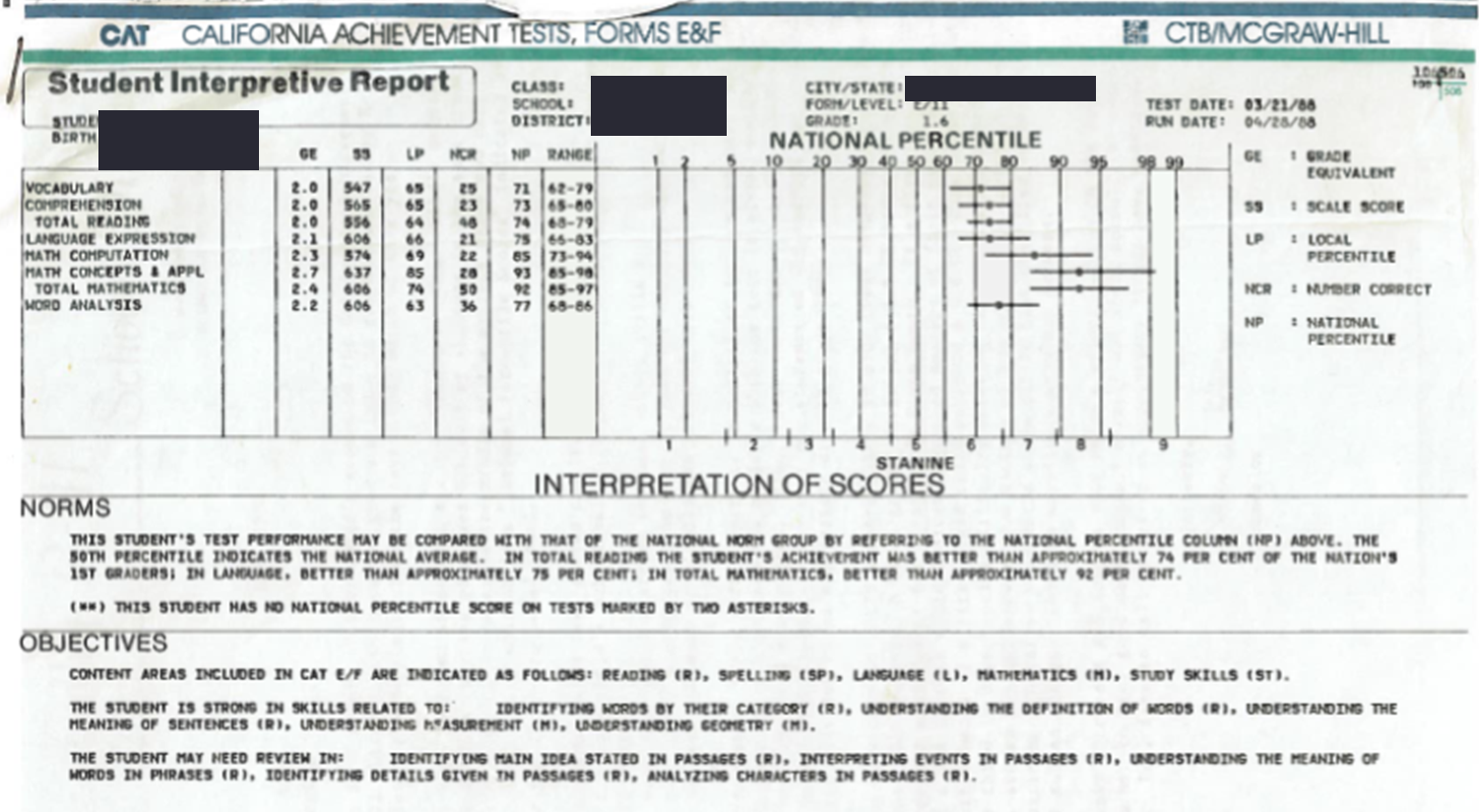
Missouri’s first statewide movement toward test-based accountability came in 1985, when lawmakers passed the Excellence in Education Act. Yet in 1988, Missouri still did not have standards or testing as we know them today. Instead, schools used the California Achievement Test, a standardized testing package sold by the McGraw-Hill publishing company. It is a norm-referenced aptitude test.
After students took the test, a report like the one below would be sent home. It told parents a lot about how their child performed. Parents could see their child’s Grade Level Equivalent, which indicated whether students were on track. They could also see how their child stacked up to other kids locally and around the nation with percentile ranks. Moreover, the report indicated specific strengths and weaknesses for each student. In other words, the tests actually told you something. Unfortunately, that’s not the case today.
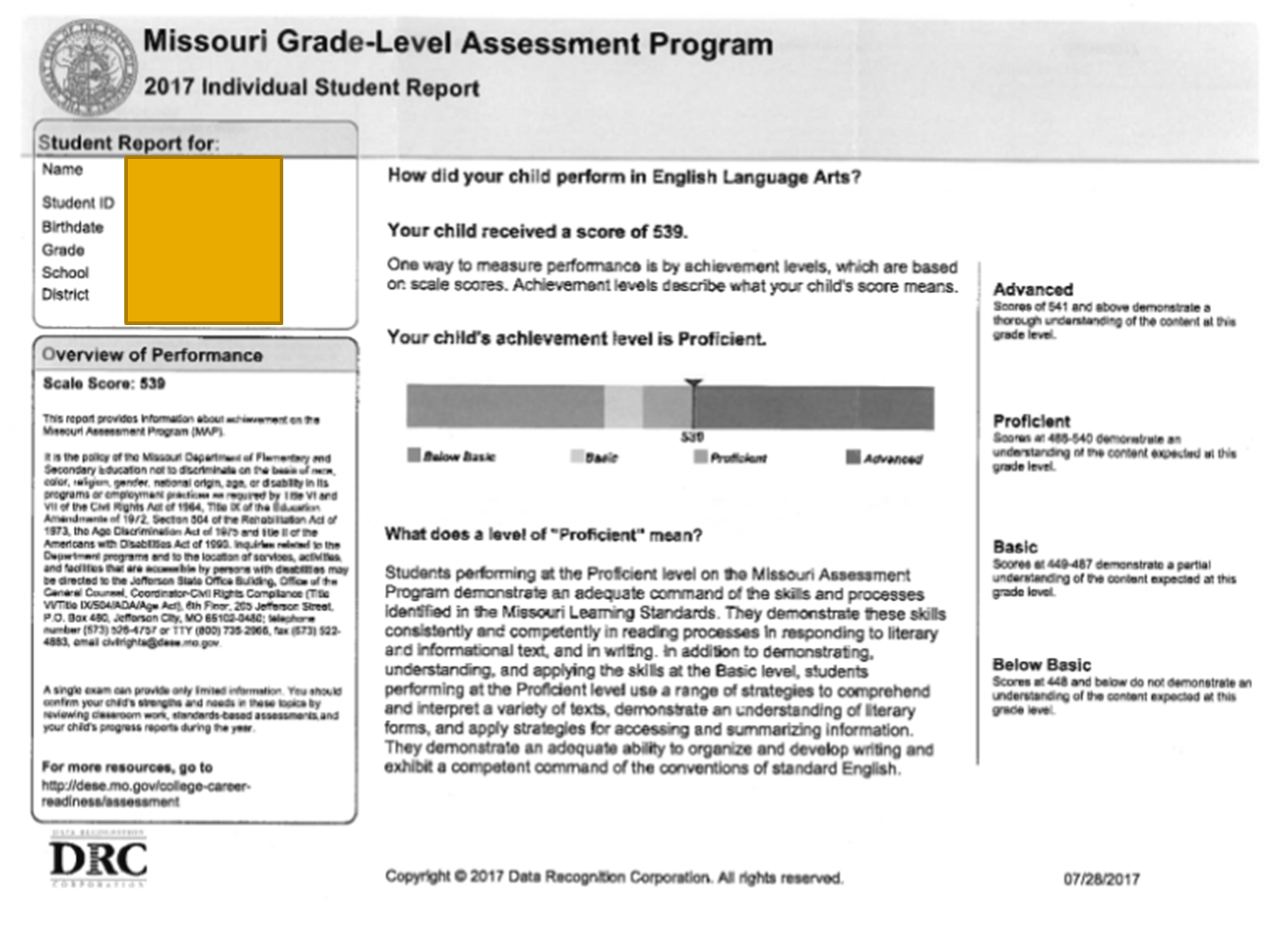
Fast forward to today. Missouri has developed standards for each grade, and students are tested every year in grades 3 through 8 and in various high school subjects. The state has spent considerable time and resources to develop a comprehensive accountability system built on standardized tests. Take a look at the report below and see what we have accomplished in the past three decades.
This report from a year ago gives parents little to no useful information. In fact, there are only two important pieces of information on the entire page: the scale score and the level of proficiency. The former is useless, and the latter is inadequate. The scale score, as presented here, has no meaning. What is a 539? What’s the lowest score possible? What’s the highest, the average, etc.? We can make no sense of 539 because we are given no context. We can see whether our children are “below basic,” “basic,” “proficient,” or “advanced,” but even this doesn’t help us much because we are not told any specific information about our child. Take a look at the section that explains what “proficient” means. If offers broad generalizations, whereas the 1988 exam offered student-specific suggestions.
Keep in mind, parents still have to wait roughly four months to receive these results. Even if the results weren’t useless, they’d almost be obsolete by the time they arrived.
How is it possible that we have come so far and not gotten anywhere?
It’s time for a change, and Missouri school leaders know it. St. Louis Public Radio has reported that more than 40 superintendents have formed the Missouri Assessment Partnership in an effort to improve these tests. They want to do so because the tests are used for school accountability, but we also need changes to make these tests provide useful information to parents.
Standardized testing can serve a useful purpose, but not if we can’t make any sense of the results.
For the last year or so, momentum has built behind the idea of reform to the state’s prevailing wage law. Between the prevailing wage’s negative impact on public construction costs and its unrepresentative calculation of market wages for professions in Missouri, reform is overdue. The simplest solution to the problem would be a simple repeal of the law. Twenty-two states don’t have prevailing wage laws. Missouri should join them.
It is disconcerting, then, that a minor bevy of similarly complicated prevailing wage “reforms” keep creeping out of the shadows. One would peg wages to county wage averages; another would lightly tinker with wage reporting requirements. Sometimes the prevailing wage would attach. Sometimes it wouldn’t. And so on.
Just stop.
I understand the appeal of keeping the prevailing wage in place to construction interests, since it props up their pay. However, legislators should be supporting the interests of taxpayers and acting to steward taxpayer money, not conjuring new ways to rebrand a Rube Goldberg public construction wage system that frankly shouldn’t exist. To put it plainly, this is a question of taxpayer interests versus special interests. Policymakers shouldn’t complicate an issue that, in the end, is that simple.
Indiana Governor Eric Holcomb has been sent legislation forbidding local governments from banning Airbnb and other short-term rental companies (STRs). Previously, cities in Indiana had, according to The Indianapolis Star, “prohibited people from renting out space that wasn’t their primary residence on a short-term rental platform.” Missouri would be wise to follow Indiana’s lead.
Cities across Missouri, including Kansas City and towns around St. Louis, have banned Airbnb outright in some areas. As we’ve written previously, this is an onerous and likely unconstitutional restriction on property rights. In 2017, home sharing advocates supported state legislation that would have pre-empted localities from imposing fees or prohibiting STRs outright, while permitting those subdivisions to impose “reasonable regulation” to “protect the public’s health and safety.” It may have been those undefined regulatory allowances that killed that bill, as supporters abandoned the effort at the end. A similar bill is being considered by the Missouri legislature this session.
The economic case for home sharing is compelling. Contrary to opponents’ fears, home sharing seems to increase home values in the surrounding area. However this has raised the concern that it increases rents as is displaces available housing units, although it hasn’t seemed to affect the hotel industry as much as hoteliers feared. As the industry matures, we will learn more about the consequences, intended or otherwise, of this new opportunity for homeowners.
Our guiding principle, however, must not be fear of change or of disruption, but protecting the economic freedom and individual liberty of Missourians. Protecting property rights against neighborhood NIMBYs remains a worthy endeavor.
In the 80’s and 90’s, politicians from both parties wanted to be tough on crime. A favored tool was stripping judges of their discretion in favor of mandatory minimum sentences set by the legislature. Unsurprisingly, prison populations have gone up. But has the investment of public dollars been worth the return on public safety? The research tells us that it hasn’t.
Missouri leads the Midwest in incarceration rates, and we’re eighth highest in the nation. We just recently lost to Kentucky our position of having the highest incarceration rate for women. If we do nothing to slow the flood of new inmates, Missouri will need to spend about $485 million in the next five years to build and operate two new prisons. For comparison’s sake, the entire budget of the state Department of Corrections is $725 million in 2018. (It was $580 million in 2006.)
According to the Missouri Department of Corrections’ 2016 Profile of Institutional and Supervised Offender Population, 41 percent of inmates are incarcerated for nonviolent and/or drug-related crimes. These two offender groups, incidentally, are the fastest-growing populations since 2011. Missourians could save hundreds of millions of dollars if courts had the flexibility to sentence these offenders to treatment programs or probationary periods prior to locking them up—while still retaining the ability to protect us from violent or habitual offenders.
Furthermore, research indicates that large sentences are not as effective a deterrent as swift capture and conviction. And large sentences are expensive, and not just in terms of the public dollars used to house and feed inmates. They also impose a significant cost on families and make it harder for ex-offenders to re-enter the workforce and become productive members of society.
The good news is that there is a better way.
Other states, such as Texas, have found ways to increase public safety and reduce recidivism while reducing public spending on prisons. Reducing mandatory minimum sentencing in certain circumstances is a part of that public policy strategy. Let’s return to judges the discretion they need to separate violent offenders from those who pose less of a threat. To do nothing will put greater pressure on public coffers while offering no respite from crime.
Support Us
The work of the Show-Me Institute would not be possible without the generous support of people who are inspired by the vision of liberty and free enterprise. We hope you will join our efforts and become a Show-Me Institute sponsor.