
Millennials *Still* Prefer the Kansas City Suburbs

For years, census data demonstrated that people are eschewing urban settings for the suburbs. Then, for a while, some urbanist pied pipers told us that if we only subsidized amenities popular with the so-called creative class, the millennials would return to the cities. In a twist, we paid the pipers handsomely and the children marched out of town anyway.

We’ve argued this basic fact for years, and some of the better-known pipers have even changed their tune (but not without charging the townspeople nonetheless). According to a recent study published by SmartAsset based on Pew Research data, Kansas City, Missouri, is not in the top 25 destinations for millennials. Overland Park, Kansas, ranked 14th.

More noteworthy, SmartAsset previously released a study indicating that two Kansas City suburbs ranked in the top 25 places in the United States where millennials are buying homes. Olathe, KS ranked first (!) and Overland Park 11th in the entire country. Kansas City, Missouri—despite our entertainment district, Sprint Center, streetcar, and subsidized corporate headquarters and high-rise luxury apartment buildings—did not appear anywhere in the top 25.

None of this should be surprising. We know that millennials are looking for exactly what previous generations wanted: homes in the suburbs, cars, and good schools. Yet Kansas City leaders persist in telling us we’re a millennial magnet. We aren’t.

There is no shortcut to growing a city; no magical policy that can reverse national demographic trends. A better investment, as Show-Me Institute analysts have argued for years, is for government’s action to be broad and neutral: keep taxes low for everyone, maintain infrastructure, deliver necessary city services, and ensure quality education. Maybe those aren’t as appealing as shiny new construction projects, but they are more successful.


Supreme Court Rules Against Agency Fees in Janus

For the legal eagles out there and the laypersons just curious to take a look at the decision, you can find the Court’s opinion here. I’m going to leave the most relevant summary from the opinion below, and for those unfamiliar, note that the “Abood” referenced here is the Supreme Court case Abood v. Detroit Board of Education, which allowed for agency shops in the government context. The Court’s view that the ruling in Abood  “is inconsistent with standard First Amendment principles” tells you just about everything you need to know about why it was overruled.

I and others will have more analysis of this over the next few hours and days, but suffice it to say that this is a win for supporters of the First Amendement, for government employees, and for taxpayers.

2. The State’s extraction of agency fees from nonconsenting publicsector employees violates the First Amendment. Abood erred in concluding otherwise, and stare decisis cannot support it. Abood is therefore overruled. Pp. 7–47.

(a) Abood’s holding is inconsistent with standard First Amendment principles. Pp. 7–18.

(1) Forcing free and independent individuals to endorse ideas they find objectionable raises serious First Amendment concerns. E.g., West Virginia Bd. of Ed. v. Barnette, 319 U. S. 624, 633. That includes compelling a person to subsidize the speech of other private speakers. E.g., Knox v. Service Employees, 567 U. S. 298, 309. In Knox and Harris v. Quinn, 573 U. S. ___, the Court applied an “exacting” scrutiny standard in judging the constitutionality of agency fees rather than the more traditional strict scrutiny. Even under the more permissive standard, Illinois’ scheme cannot survive. Pp. 7–11.


School Districts: Time to Turn in Your Homework

Taxpayers pay thousands of dollars a year to support their local school districts. Shouldn’t they be able to monitor how the schools are spending their money?

The passage of House Bill 1606 tells me that the Missouri Legislature thinks they should. If it’s signed by the governor, the new law would address transparency in school district spending by requiring public school districts to develop a searchable database to track their expenditures and revenue, which would be made publicly available. It also directs the Department of Elementary and Secondary Education to create a template for schools to use for expenditure and revenue tracking if they do not have a website to host a database.

It is encouraging to see the legislature offer this tool, which would allow taxpayers to scrutinize their schools’ spending decisions, especially when audits give reason to question the wisdom of certain expenditures.

Given some of the difficulties we’ve encountered in obtaining spending records for the Show-Me Checkbook Project,we understand that navigating the process for requesting information can be frustrating. That is why I (along with Show-Me Institute Director of Government Accountability Patrick Ishmael) testified in favor of the creation of a database similar to the one proposed in House Bill 1606, where public entities can upload their spending data as a way to increase transparency.

I hope the creation of a database to track school district spending will lead to the establishment of other databases to monitor how cities, counties, and special taxing districts spend their money. The legislature is to be commended for taking this step toward more transparency.

Kansas City Airport Stumbles Along

One year ago, Steve Vockrodt of The Kansas City Star wrote an excellent piece on the “original sin” of the airport’s new terminal effort. Among his findings was that the then-director of the Aviation Department, Mark VanLoh, did not know that Missouri law required a public vote on airport bonds. It may have been that ignorance of the need for public approval that so hampered the campaign. And what a campaign it was!

Fast forward a year and Vockrodt writes that the new Aviation Department director, Pat Klein, was unaware of Federal Aviation Administration (FAA) guidelines on conducting an environmental assessment. He writes,

Klein said there had been an assumption that the city could put out solicitations for certain construction work before the FAA approved an environmental assessment in October, and then signing those contracts shortly afterward.

“What we’ve been told initially by the FAA is they don’t think that’s a smart idea,” Klein said. “They think we should hold, so we’re in discussions with them to do that. That’s a three-, four-, five-month lag on our schedule, which could be the difference between summer or winter of 2022.”

Now we learn that even before construction has begun, the project’s opening is being delayed 11 months to October 2022 and will cost much more than originally planned. Delays and increased costs such as these are not surprising for such large projects. After all, the Aviation Department itself has been all over the map on costs for years. Changes in costs and timelines can be forgiven. Not knowing FAA rules on construction suggest a deeper problem of management.

The Kansas City Star editorial board rightly called for more transparency in the construction of the new airport terminal. The Show-Me Institute has also called repeatedly for more transparency in the airport process since 2013, when the Council first took up the matter.

It’s difficult to be confident that the City will suddenly adopt a position in favor of transparency after years during which the process was opaque. We remain confident, however, given the Aviation Director’s unfamiliarity with FAA guidelines, that transparency remains the highest need.

Recognizing and Reacting to Market Failure

It doesn’t happen often, but markets can fail. Markets usually work with almost uncanny efficiency, but free market proponents should recognize failure when it happens so that government intervention—which is almost always inefficient and often backfires—occurs only when absolutely necessary.

Award-winning legal scholar, teacher, and University of Missouri Law Professor Thomas Lambert recently brought this message to our state in a Show-Me Institute Policy Series.  His new book, How to Regulate: A Guide for Policy Makers, outlines the narrow circumstances in which markets fail and how regulators should approach the situation—like a doctor carefully considering the risks to the patient before prescribing surgery where a band-aid would suffice.

The Asterisk in Streetcar Reporting

Bill Turque over at The Kansas City Star wrote the standard piece on this week’s streetcar extension vote, and gave some attention to the uncertainty of necessary federal funds,

Taxes will not be collected until construction is ready to begin.

But the tax funds will not come close to covering the cost of building the new line. The KC Streetcar Authority will also seek $100 million in federal funds. Earlier this year Congress rolled back the Trump administration’s proposed deep cuts in transit funding. But the outlook for help from Washington remains uncertain.

That assertion isn’t wrong, but it is woefully incomplete. As we’ve reported previously, the Jackson County court ruling allowing for the creation of the transportation development district that will levy taxes for the streetcar includes an important restriction: No taxes or assessments are to be collected from within the district until enough external funding—in this case federal funds—is available.

And those federal funds are indeed uncertain. The Trump administration position seems to be that it won’t hand out construction money for transit capital grants unless a previous administration signed a full-funding grant agreement, and no such agreement is in place for Kansas City’s streetcar. The Federal Transit Administration has previously called for the New Starts/Small Starts grant program—on which the Kansas City effort is dependent for funding—to be scrapped. As of now it is authorized only through 2021, after which it will cease to exist. Congress seems unwilling to reauthorize it.

Even if the occupants of Congress or the White House change significantly in 2018 or 2020, we are a long way from receiving any federal money for the streetcar, money necessary to permit the TDD to collect taxes and assessments. In the meantime, expect streetcar advocates to start looking elsewhere for their financial support.

A is for Absent

Being financially responsible—keeping a close eye on your bank balance and even your credit score, for example—isn’t always pleasant. Being truly accountable for educating kids also requires keeping track of numbers, both good and bad. As President George W. Bush said, you can’t fix what you don’t measure.

From reading Missouri’s State Board of Education’s reports, one would think that the state’s kids are succeeding in their studies and attending their classes; however, this is not the case. While Missouri schools and districts report their average daily attendance, and it’s incorporated into their Annual Performance Report (APR), these numbers hide individual students who aren’t showing up.

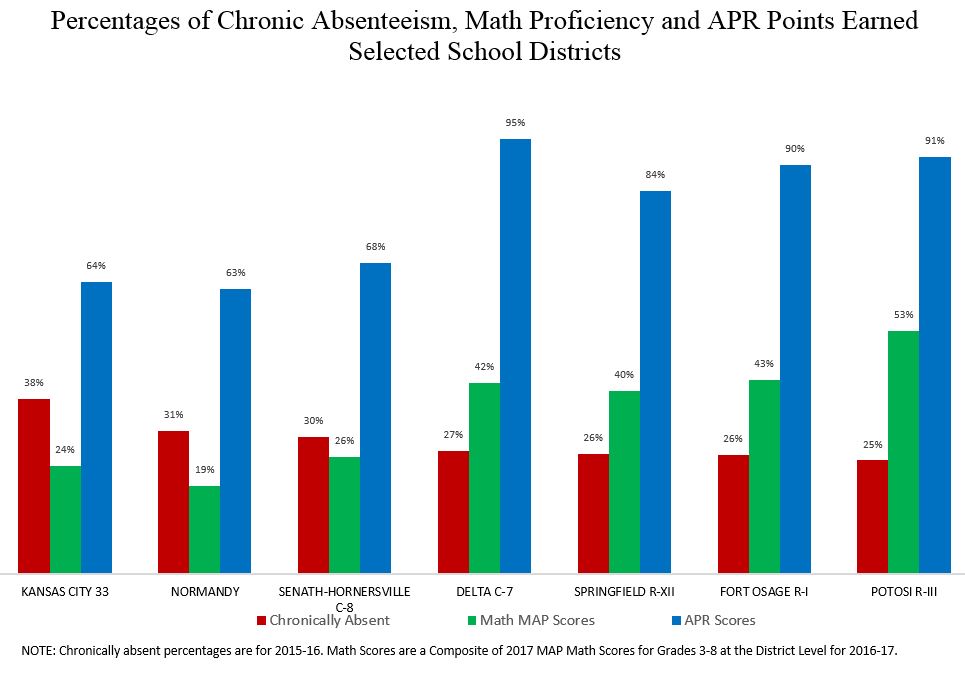
We can’t prove a causal relationship between truancy and poor academic outcomes, but the two are clearly correlated, and common sense tells us that students need to be present to learn. Unfortunately, recently released federal data show that nearly 110,000 Missouri students missed 15 or more days of school in the 2015–16 school year, meaning that they are categorized as “chronically absent.” In seven Missouri school districts, serving a total of over 50,000 students, more than one-quarter of the students were chronically absent.

At the school level, 42 Missouri schools had chronic absenteeism rates of more than 33 percent.

And yet these high-absence schools earned an average of 70 percent of the possible points in the APR evaluation in 2017—well above the 50 percent needed for full accreditation. It’s not surprising that with more than one-third of their students chronically absent, an average of only 15 percent of the students at these schools were proficient in math, and just 32 percent were proficient in reading. In one egregious case, at Kansas City’s Central Middle School, where 54 percent of the students were chronically absent, only 5 percent of students were proficient in math. Yet this school received 75 percent of their APR points, making it fully accredited.

The same trend is apparent at the district level. Kansas City leads with 38 percent of its students qualifying as chronically absent, even though DESE reports a proportional attendance rate of 83 percent for the same year (more on that disconnect in another blog) and a math proficiency rate of less than 25 percent. Yet, the district garnered an APR Score of 64 percent—making it provisionally accredited. Springfield was able to get 84 percent of its APR points, even though one-quarter of its students were chronically absent, and only 40 percent of them are proficient in math.

Though reducing chronic absences will not solve Missouri’s educational woes, making sure kids show up to class is an essential first step for progress. A rating system that gives the impression that children can get a good education when they are not physically present in schools robs them of the chance to succeed. Even more troubling are misleading APR scores that hide the fact that children are not being given the educational opportunities they deserve but being set up to fail.

Absenteeism chart

(Yet) Another Chapter in the Loop Trolley Bungle

The Loop Trolley appears stuck in an endless loop of delays.

It was recently announced that the opening of the over-budget historic streetcar line will be delayed yet again. This is, by our estimates, at least the fifth time the project’s opening has been delayed. Besides these delays, other snags have caught the project up along the way too.

The trolley line, which will run between University City Hall and the Missouri History Museum on Delmar Blvd and DeBaliviere Ave, was originally slated to begin operations in mid-2016. Since then, it’s been bailed out by taxpayers and private firms, threatened by the Federal Transit Administration, and under such financial strain it had to reduce its planned operating hours. It’s become increasingly hard to see the project as anything besides a policy and infrastructure disaster.

Whether you ultimately think the trolley will be a welcome addition to the Loop or just an eyesore and a money pit, all parties can agree the process of getting it up and running has been slow, painful, and embarrassing. This just doesn’t seem like how good policy is rolled out.

St. Louis, University City, County, and federal taxpayers deserve far better.

Support Us

The work of the Show-Me Institute would not be possible without the generous support of people who are inspired by the vision of liberty and free enterprise. We hope you will join our efforts and become a Show-Me Institute sponsor.

Donate
Man on Horse Charging