Follow-up on Kansas City Population Trends

The other day we published a post about some Brookings Institution data suggesting the Kansas City was doing well with millennials. The data was not specific to Kansas City, Missouri but rather the entire 14-county metropolitan area. There is reason to think that outer areas such as Olathe and Overland Park are doing well attracting millennials, but what about Kansas City proper? After all, the city has spent “hundreds of millions of dollars downtown, probably in excess of a billion” to attract millennials and others. Is it working?

The author of the Brookings Institution study referenced above does not know about Kansas City proper, or more specifically about downtown Kansas City. The Downtown Council itself apparently can’t provide worthwhile numbers either. Trying to piece together the data requires investing a lot of time and resources going through Census data at the county level. Until someone does that in 2019, we can rely on a 2016 paper for the Show-Me Institute by Wendell Cox, “Kansas City—Genuinely World Class.”

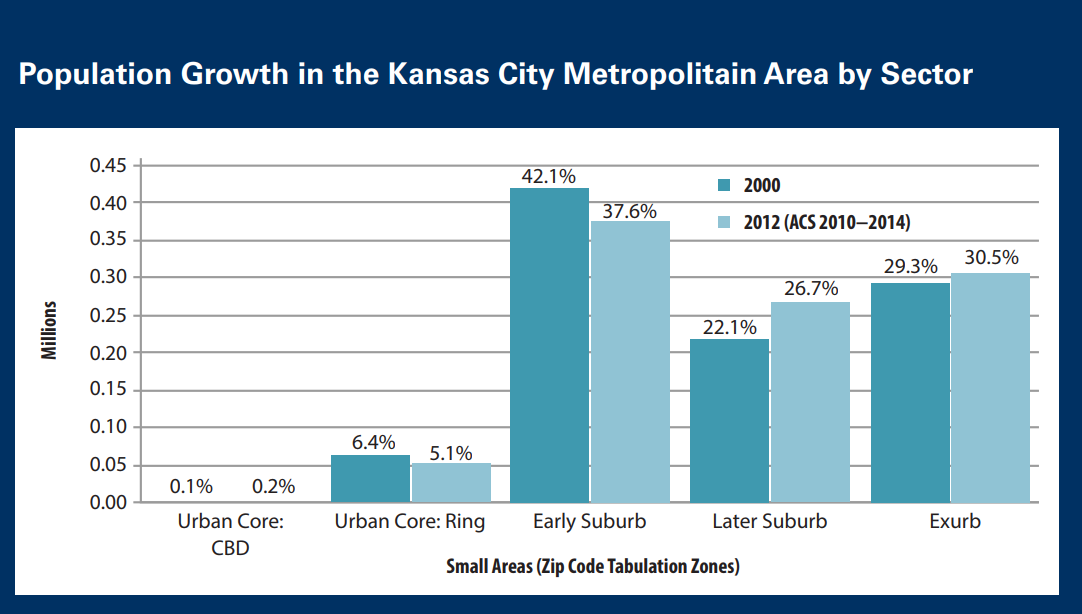
In Figure 3 on page 6, Cox offers us the chart at the top of this post. As you can see, populations have not grown in the urban parts of the Kansas City but rather in the areas outside the city proper. In fact, the urban and near-in suburbs are shrinking. This is expected to continue. Cox writes:

According to the Mid-America Regional Council, population growth will continue to be concentrated in the suburban counties. Between 2010 and 2040, it is projected that approximately 45 percent of the population growth will be in Johnson County, which will make up the bulk of the 55 percent of metropolitan area growth that is projected to occur in the Kansas suburbs. The Missouri counties are projected to constitute 45 percent of the metropolitan area growth, with Cass County accounting for 18 percent and Jackson County for 11 percent (Figure 4).

Lots of organizations spend a lot of money trying to attract people and jobs to Kansas City. All them have an incentive to show that all that money—in many cases tax dollars—is well spent so that their budgets will be expanded. Successes seem rare and the data aren’t promising. But if city leaders are serious about attracting residents and jobs, we need to have a serious conversation about what is working and what is not.

Some Promising Numbers About Millennials in Kansas City. Maybe.


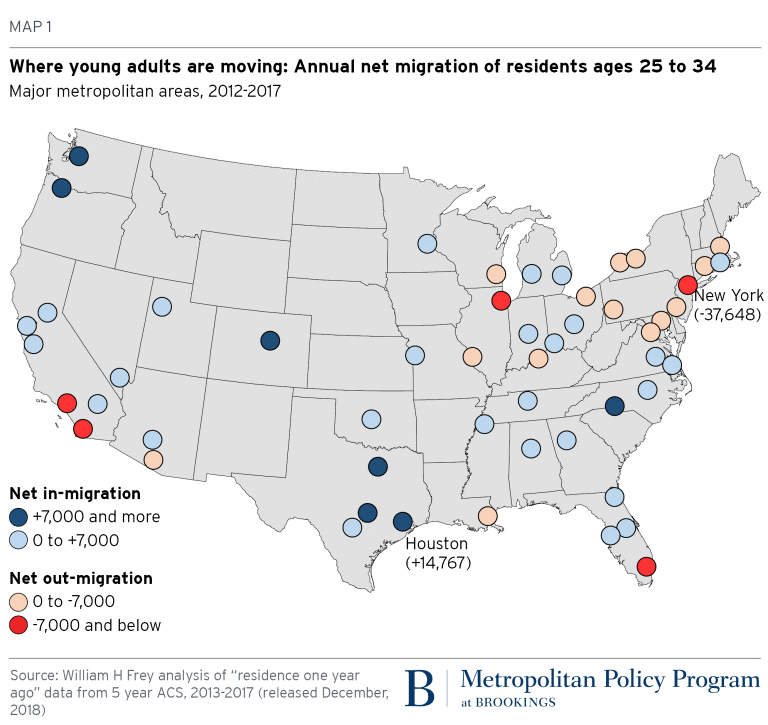
William Frey of the Brookings Institution just published a report entitled “How migration of millennials and seniors has shifted since the Great Recession,” and it has some promising numbers for Kansas City. In the report, Frey writes:

Another feature of young adult migration magnets is their location in the South and West “Sun Belt” region where all except three of the top 20 magnets are located. (Those three—Minneapolis-St. Paul, Columbus, and Kansas City—are among the most highly educated Midwest areas for millennials.)

…Today’s young adults, now encompassing those in the prime millennial ages, show a penchant for “educated places”—including Denver and Seattle—as well as more affordable areas like Minneapolis and Kansas City with pre-recession hot spots like Riverside, Phoenix, and Atlanta showing reduced appeal. 

Frey, as do most researchers, uses the term Kansas City broadly, to encompass an entire metropolitan statistical area (MSA). The Kansas City MSA stretches from Independence to Lawrence and includes 14 counties. Its population is 2.1 million, compared to the under 500,000 within the political boundaries of Kansas City, Missouri itself. Knowing whether a statistic describes a city or a metropolitan area is important, lest you conclude, as some would have you believe, that Kansas City gets 25 million visitors a year. It doesn’t.

It’s important to remember the Brookings Institution numbers on millennial migration speak to the broader MSA. Frey doesn’t report how much of the growth is taking place in downtown Kansas City, or how much is taking place in Olathe and Overland Park, two places recently listed as top destinations for millennials. Frey doesn’t report it because he doesn’t know it; I asked him.

As has happened before, it is possible that reports like this will be set upon by groups like the Downtown Council and the City of Kansas City as proof that the billions of dollars spent subsidizing wealthy developers in downtown Kansas City are bearing fruit. But until we know migration numbers within the MSAs, all that optimism is premature and skepticism is warranted.

Below: a map containg data from Frey’s analysis.

Map with net migration data

Springfield’s Convention Dream

Private consultants have determined that Springfield, Missouri is on the cusp of attracting a great deal of new convention business.

According to the Springfield Convention and Visitors Bureau, a study conducted by Hunden Strategic Partners “included a comprehensive market analysis that determined a convention center could support its operations and attract successful meetings and conventions if executed properly.” A press release about the study added the following good news:

The Springfield travel and tourism industry has experienced steady growth with more than five years of record overnight visitors, topping out at more than 1.38 million in 2018. However, the city’s convention market has been flat in recent years due to growing competition from cities offering newer convention facilities that are more appealing than what Springfield has available.

“We are not seeing growth in the convention business because we simply do not have competitive facilities,” said Tracy Kimberlin, president of the Springfield Convention and Visitors Bureau.

The Hunden study claims that over 20 years the convention center would generate $1.11 billion in revenue (page 129) and create 800 new full-time jobs over 10 years (page 131). What a great opportunity for private investors!

Except that somehow, it isn’t. The project apparently cannot happen without significant taxpayer investment—which is to say, free money from the government. Pages 122, 123 and 134 detail the need to increase and redirect existing taxes and levy new taxes through a CID (Community Improvement District) and maybe even through tax-increment financing or Chapter 100 bonds (page 122). As an aside, the Hunden report offers, “It will be very difficult to declare an area ‘Blighted’ that recently received a $300 million investment.” Alas, if only that were true.

This potential return on investment for a convention center in Springfield is either a good investment opportunity or not. We find out which when private developers put together a prospectus and share it with private investors who will decide for themselves whether to invest their own money. If developers cannot raise enough private capital, then the project is probably a bad idea.

Asking taxpayers to subsidize the project—exactly because developers cannot raise enough private capital—is admitting that they want public funds to support a bad idea. The proposal ought to be rejected on its face.

If you are interested in learning more about the dubious marketing claims of the convention hotel industry, you can watch this 2015 presentation by University of Texas at San Antonio professor Heywood Sanders, who wrote the book on convention centers in the United States.


Downtown Baseball? A Swing and a Miss

On the October 12, 2017 episode of KCPT’s Ruckus, panelists discussed the topic of moving Kauffman Stadium to downtown Kansas City. A panelist who has worked as a consultant to local governments and who has steered public funds toward private baseball business in the past said we ought to be having this conversation. More recently, the editorial board of The Kansas City Star said “Kansas City should launch a metro wide conversation about a decision with far-reaching consequences.”

Exactly what does it mean to have the conversation? It will doubtlessly require money spent on consultants to draft options, hold meetings, and the like. And what will those plans drive toward? Probably an expensive public finance project to buy a new stadium for a billionaire.

We’re spending money so we can spend money. It’s absurd.

It gets worse. The Star’s editorial board included this nugget:

City Manager Troy Schulte said his conversations with [Royals owner David] Glass associates have left the door open to that possibility.

“He (Glass) is saying, “Give us some options,” Schulte said. “He has not said no.”

In other words, the team owner isn’t even asking for any of this, he just didn’t refuse. And why should he? He’d be a fool to stop the city from offering him the same type of taxpayer subsidies that cities make all the time. As a result, city leaders, including the Star, are eager to start spending money on it.

Wait, there’s more. The Star makes clear there is additional cost beyond the taxpayer outlay of funds on consultants and construction subsidies:

Other possibilities remain east of City Hall and near the 18th & Vine Jazz District. “You’ve got to reserve it, or you’re losing development sites,” Schulte said.

Schulte is saying the city would intervene in the market to “reserve” sites, effectively stopping anyone else who might have a better, unsubsidized, idea for development. (One can imagine that at the time of construction, the then-mayor and council members will point to the lot they have kept vacant and say, “look at this lot no one has developed, we need this downtown stadium to address blight.”)

If Kansas City’s wealthy sports team owners want to consider other locations for their stadiums, and spend their own money doing so, they are free and welcome to do so. But the idea that taxpayers should take the initiative and spend money now so we can maybe spend money later is completely wrong.


States with School Choice Reap the Benefits

Kelly Clarkson says that what doesn’t kill you makes you stronger, and I believe her. You know who doesn’t believe her? Teachers who are willing to close down the schools in their state to prevent any student from having a choice when it comes to their education. Rather than adapting to charter school competition and becoming stronger in the process, some try to just kill charter schools outright. West Virginia teachers attempted this recently, and it worked. The threat of seven potential charter schools opening in their state was killed, even though the teachers would have received raises from the same bill.

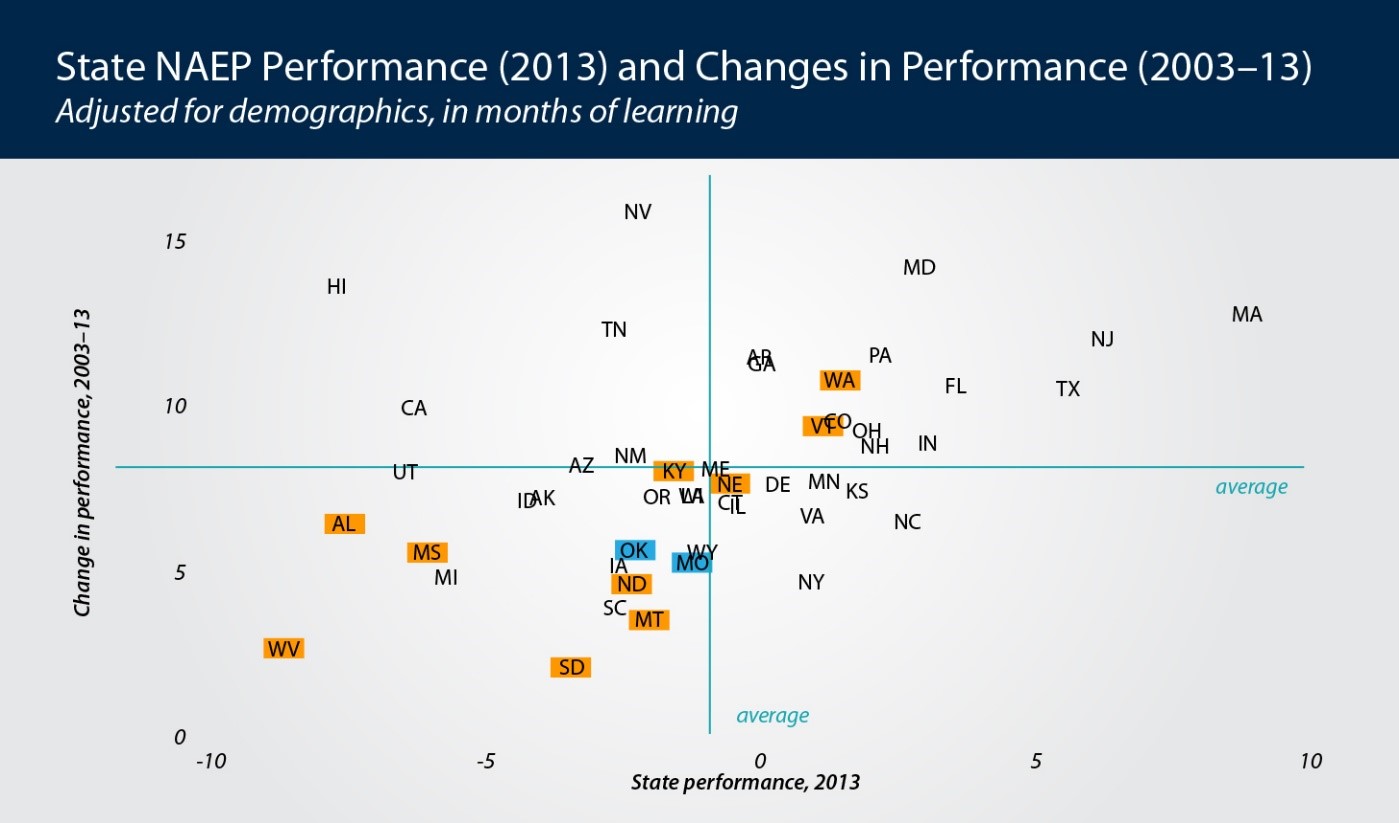
As a researcher, I can’t stress enough that correlation doesn’t equal causation, but I’m still struck by the following graphic.

State Performance Graph

This graphic was created by the Urban Institute for their 2015 report, Breaking the Curve: Promises and Pitfalls of Using NAEP Data to Assess the State Role in Student Achievement. The states in the bottom left quadrant are those that both performed in the bottom half of all states on National Assessment of Educational Progress (NAEP) in 2013, and also saw their NAEP scores decline between 2003 and 2013, after controlling for student demographics. And the states in this bottom left quadrant are mostly states with little or no school choice. The states in orange had no charter schools in 2013, and those in blue only allowed charter schools as punishment for low performance. Oklahoma gave up using charters as a last resort for low-performing districts in 2015, but Missouri has not. Iowa and Wyoming had fewer than 400 students in charter schools in 2013. By contrast, Florida and Texas had over 200,000 students enrolled in charter schools that same year. Pennsylvania had almost 120,000 charter school students and New Jersey and Massachusetts had about 30,000 each.

If school choice killed public education, this graphic would look a lot different. I’m perplexed that the states in the bottom left quadrant, including Missouri, think that taking a strong stance against school choice is a winning strategy.


Truly “Public” Schools?

Have you ever heard any of these chestnuts?

  • Unlike public schools, charter schools make families apply to them which keeps out kids from less-involved families.
  • Unlike public schools, charter schools require students to maintain a certain GPA to apply (or to stay enrolled).
  • Unlike public schools, charter schools require students to adhere to a conduct code or else get expelled.
  • Unlike public schools, charter schools require parents to come to meetings before they can enroll their children, so that the school can screen out less-involved parents.

These are serious charges. If charter schools can pick and choose their students, are they really public schools that are open to all?

I did some digging on the websites of Kansas City area schools, and some admissions requirements surprised me.

For example, to get into one Kansas City area school, “Applicants must score at or above the 60th percentile on a national standardized reading and math test to be eligible for entrance. Students must also have a record of good citizenship and a cumulative GPA of 2.5 or higher.”

To get into another, “Students must have a GPA of 2.35 or better, a 90% or better attendance record, and a discipline record that shows appropriate student behavior.”

To get into another, “They must be school ready and able to abide by school policies and expectations as indicated in ‘Behavioral Expectation Student Contract’, which will be distributed upon acceptance.” What’s more, “All new parents will be required to attend a mandatory informational [meeting] before a seat will be offered.”

Can you believe this? Ostensibly public schools are deliberately screening out low-performing students, students with discipline problems, and students with less involved families.

So now is the time I’d bet you’d like me to reveal the culprits. It might surprise you to learn that none of them are charter schools. All five of these examples come from Kansas City Public School Signature Schools, a group of magnet schools. The full list of requirements is on the KCPS website.

According to Rebecca Haessig of the local education blog Set the Schools Free, nearly 26 percent of KCPS students attend one of the seven Signature Schools that place admissions requirements on children or families. They play a huge part of the public school system in Kansas City, yet get very little attention. I wonder why?

For the record, charter schools cannot, by law, place requirements related to previous achievement or behavior on their students. They cannot force parents to attend informational meetings before children are offered a seat. Perhaps they’re the most public schools in town.


Low-Income Housing Tax Credits Are Being Reformed? Not So Fast

Last week, the Missouri Senate gave preliminary approval to a plan that supposedly “reforms” the state’s low-income housing tax credit (LIHTC) program. This proposal follows the announcement by Governor Parson last September that the Missouri Housing Development Commission, the body in charge of awarding LIHTCs, would not be issuing any new tax credits until the program is reformed by the legislature. At the time of the Governor’s announcement, my colleagues cheered the prospect of long-anticipated tax credit reform. Sadly, the most recent moves by the Senate deserve no cheers and should hardly be considered “reform.”

Prior to 2017, Missouri’s LIHTC program was one of the most generous in the country. The LIHTC program is federally created and funded, but in an effort to increase affordable housing development across the state, Missouri agreed to match up to 100% of the federal funds allocated to the state. The problem was that report after report showed the tax credit wasn’t an effective use of state funds. For example, a state auditor’s report showed that only 42 cents of each dollar allocated to LIHTCs was spent on the development of low-income housing. That was why the state’s portion of the program was halted in 2017.

But those who profit from the tax credits have always had a well-organized lobby, so it was only a matter of time until legislative efforts were made to restore Missouri’s funding. The measure approved last week returns Missouri’s funding for LIHTCs to 72.5% of the federally allocated funds.  Unsurprisingly, a St. Louis Post Dispatch article chronicling the negotiations notes the original “reform” proposal was to only return 50% of the funds, but developers felt that number was too low and as such eventually got the amount increased 77%, before eventually reaching the compromise number of 72.5%.

Just to summarize this backwards process: a program that currently receives zero state dollars was offered a return of 50% of their funding (over $100 million annually), supporters of that program claimed 50% was an inadequate number, and then the funding increase was bumped up north of 70% while no structural changes were made to the program that would actually ensure more dollars are spent on the original purpose of the tax credit (low income housing). If any dollars are going to be restored for the LIHTC program, there needs to be serious structural reform first. Anything else is just window dressing.


Support Us

The work of the Show-Me Institute would not be possible without the generous support of people who are inspired by the vision of liberty and free enterprise. We hope you will join our efforts and become a Show-Me Institute sponsor.

Donate
Man on Horse Charging