Missouri to End Debtors Prisons

Working in public policy rarely allows for complete, unadulterated wins. But the Missouri Supreme Court’s decision in Missouri v Richey was a pleasant exception. In a unanimous decision, the Court overruled previous courts, writing:

While persons are legally responsible for the costs of their board bills under section 221.070, if such responsibilities fall delinquent, the debts cannot be taxed as court costs and the failure to pay that debt cannot result in another incarceration.

We previously wrote about the plight of “pay to stay” debtors prisons. In short, courts were locking people up for not adequately paying the fees associated with their previous incarceration, triggering an awful cycle. The Show-Me Institute joined in filing a friend of the court brief on behalf of George Richey. We are grateful to Mr. Richey, among others, who chose to challenge this practice. We look forward to more victories in our search for sensible criminal justice reforms.


Baltimores on the Missouri?

At a recent conference on municipal policy, I had the opportunity to reflect on Baltimore, Maryland. Certainly Charm City has had its challenges in recent years. But there is a lot Missouri policymakers can learn from Baltimore. Specifically, what not to do.

Baltimore’s population has been steadily declining in the past few years. It stands at about 610,000 today—down from 620,000 in 2010 and 650,000 in 2000—and its height of 950,000 people in 1950. Like Kansas City and St. Louis, it has struggled with a high homicide rates, coming in second behind St. Louis in 2017 and ahead of fifth-ranked Kansas City. Like Kansas City’s moniker ‘Killa City,’ Baltimore’s homicide rate earned it the nickname ‘Bodymore, Murderland.’ Baltimore students are some of the worst served in the country.

No one can accuse Baltimore of doing nothing to reverse its fortunes. In fact, Baltimore seems to have done everything that developers and urban planners recommend. Consider the following amenities paid for in part with city and state subsidies:

  • Power Plant Live! entertainment district (developed by Baltimore-based The Cordish Companies, developers of Kansas City Power & Light District and St. Louis Ballpark Village)
  • Rail transit such as the Baltimore Metro and LightRail Link
  • A downtown baseball stadium, Oriole Park at Camden Yards
  • The National Aquarium
  • The Baltimore Convention Center, first renovated in 1996 and now considering another renovation and expansion; the convention center is connected by rail to . . .
  • Baltimore Washington International Airport (BWI), including recent renovations and new concourses
  • Baltimore even has a waterfront development!

These are developments that would make any recent Kansas City or St. Louis mayor salivate. And yet none would want to turn their cities into Baltimore. Why?

Maybe it is because we all understand—whether we admit it or not—that cities need to get the basics right. Cities should prioritize basic infrastructure, public safety, and tax policy done well before they splurge on expensive baubles. Kansas City and St. Louis do not yet have the basics right, and nothing should distract us from fixing it.


Pay to Play in Education

While Missourians clutch their pearls and are scandalized to find out that people with the means to simply pay for college admission do just that, they readily accept that it’s the way K-12 education works here. As Derrell Bradford of 50CAN rightly pointed out, pay to play in K-12 education is done through mortgages, rather than photoshopping pictures of athletes.

I’ve had numerous conversations with parents of young children in St. Louis County who are trying to figure out where and how to buy a house before their child enters kindergarten. And it matters. A 1,900 square foot home with three bedrooms and two bathrooms built in 1990 will cost $240,000 in Florissant, while a similar home would cost $389,900 in Frontenac. Sure, schools aren’t the only difference between the two communities, but they’re certainly factored into that $150,000 premium.

I don’t think I even need to convince anyone of this point—parents who can will pay more money for the same house to get their kids into a school they want. Parents who don’t have the money to do that are stuck. The idea of celebrities buying a spot at USC shocks us in a way that a family scraping together the money to move to a smaller house because it’s in Webster Groves doesn’t.

The quality of a child’s education shouldn’t be connected to the real estate industry. Every parent, regardless of their background or their neighborhood, should have access to an array of choices when it comes to their child’s education.


Just the Facts: Income Taxes Are Destructive to Growth

The debate over whether state legislators should hike taxes on Missourians this year is ramping up in the state Senate. The battle lines appear to be drawn, at least in some part, over the question of whether income taxes harm growth.

In fact, in terms of the research into such matters, the destructiveness of income taxes is among the few things where there is some general agreement in the economic literature. To once again quote researcher Jens Arnold of the Organisation for Economic Co-operation and Development and his review of the evidence:

A stronger reliance on income taxes seems to be associated with significantly lower levels of GDP per capita than the use of taxes on consumption and property. Within income taxes, those on corporate income seem to be associated with lower levels of GDP per capita than personal income taxesIn fact, corporate income taxes appear to be the least attractive choice from the perspective of raising GDP per capita. [emphasis mine]

Letting the government take people’s money before it can be saved or spent denies families and businesses the opportunity to invest that money in themselves, and those negative effects compound over time. That denial of investment impacts overall GDP. It’s that simple. Removing more and more money from the private economy and increasing government’s contribution to overall state GDP is a recipe for disaster that legislators shouldn’t be entertaining.

The goal should be to continue the work of reducing and eliminating income taxes in Missouri, and new taxes on, say, internet sales should not become play money for politicians rather than an offset for income tax relief.


Charter Schools Outperform in Indianapolis

 In Missouri, because of the narrow availability of school choice, you have to be lucky to have access to charter schools. On the other hand, Indiana has decided school choice shouldn’t be restricted to a lucky few. Although there are still gaps in choice across the state of Indiana, the state has charter schools available statewide, a voucher program, a scholarship tax credit and a private/homeschool tax deduction to help families access educational resources. Indiana’s charter school laws have even been ranked as the strongest in the nation for three years in a row since 2016.

The Center for Research on Education Outcomes (CREDO) at Stanford University released a recent study on Indianapolis charter school performance. The study tracked academic growth from the 2013-14 to the 2016-17 school years, comparing the average growth in reading and math in Indianapolis charter school students to traditional public school students.

In order to compare school performance between charter schools and traditional public schools, CREDO creates a “virtual twin” for each charter student that is a combination of similar public school students. This method considers seven characteristics (including ethnicity and income status) of a charter school student, and finds students from traditional public schools who share the same characteristics. The test scores of all the similar traditional public school students are averaged to create a growth score for the virtual twin, which is then compared to the charter student.

The CREDO study found that charter school students in Indianapolis experienced significantly more academic growth in both reading and math than traditional public school students. In the 2016-17 school year, Indianapolis charter school students gained 29 extra days of reading and 4 extra days of math compared to the state average (180 days of learning a school year). Traditional public schools were behind the state average in both subjects; 48 days behind in reading and 96 days behind in math. The difference between Indianapolis charter school students and traditional public school students is striking. Charter school students learned 100 more days of math and 77 more days of reading than the traditional public school students. That’s 20 extra weeks of math and over 15 weeks in reading for charter school students.

Charter schools also produced better results than the city’s traditional public schools for specific student groups. This held true for all the student groups the study measured: Black and Hispanic students, low-income students, English language learners and special education students.

Charter schools are helping Indianapolis students access a quality education. Why wouldn’t Missouri want the same?


Pre-K Supporters Dismiss Research on Efficacy of Pre-K

In a debate about the efficacy of pre-K, Kansas City Mayor Sly James was dismissive of research that suggested there might better ways to help low-income children achieve better education results. We’ve heard others tell us they don’t care about policy research, which is at best an unreasonable and potentially dangerous view, especially coming from a public official.

On Tuesday, March 12, I appeared as a panelist on an American Public Square discussion titled “Pre-K for All?“ about the upcoming April ballot measure. Proponents of pre-K point to a single, small-scale study of a specific pre-K program conducted from 1962 to 1967. The study, called HighScope Perry, did show a positive relationship between participation in the program and educational and financial success. However, the program that was studied was intensive, expensive, and only included 123 children. While the Mayor and Mid America Regional Council (MARC) specifically cites the HighScope Perry study, the plan they endorse for Kansas City is nothing like what was done there.

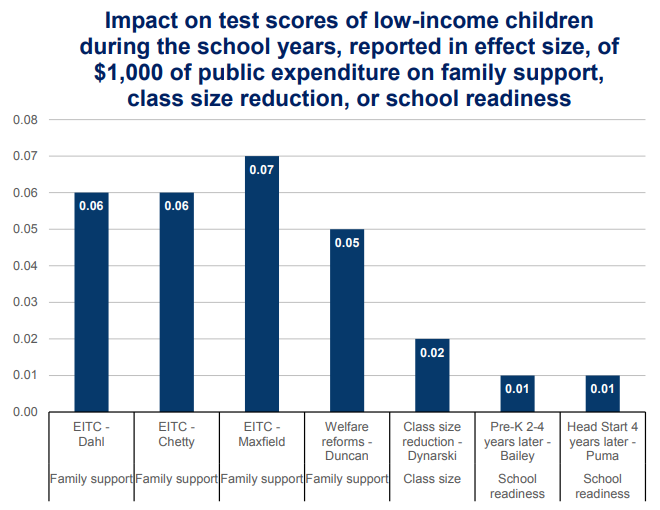
Russ Whitehurst of the Brookings Institution has written at length about the failure of larger-scale pre-K programs such as Head Start and the Tennessee Voluntary Pre-K Program to generate impressive results. We’ll discuss that research more in future blog posts. But in a survey of the research on various school-readiness interventions, Whitehurst pointed out that direct aid to families, such as the earned income tax credit (EITC), “produced substantially larger gains in children’s school achievement per dollar of expenditure than a year of preschool, participation in Head Start, or class size reduction in the early grades.” That is a fascinating bit of information and should be of interest to anyone who is serious about helping low-income children.

During the panel discussion I offered, “You could do more for poor families in Kansas City by removing the sales tax on food and by exempting, say, the first $26,000 of earnings from the earnings tax. You can do more by aiding families—giving them more money in their pocket—than you can by taxing them and providing a program.”

Test score expenditure graph

But Mayor James was not having it. He responded, “There’s no way that you can tell me, regardless of what study you may cite,” that by reducing taxes on the poor that they, “are going to use the money to educate their children.” And maybe they won’t, but the data Whitehurst cites don’t specify how families spend the extra money. EITC funds are not earmarked, yet this direct support to low-income families still outperformed pre-K according to Whitehurst’s research.

Perhaps what low-income families need is not to have more money taken away from them in order to provide them more services. Perhaps what they need is more money, more flexibility, more agency to address their own challenges as they see fit. Perhaps telling poor people that government knows best how to spend their money and educate their children isn’t the best way to solve problems. The research (at least if we go beyond a specific study that seems cherry-picked to support a rosy view of Pre-K programs) seems to suggest this, if only policymakers will listen.


What It Would Take to Bring Green Energy to Kingdom City, Missouri?

“We reason from the hand to the head,” Henry David Thoreau wrote, pointing out how a simple example drawn from ordinary life may serve to illuminate a larger truth.

As a revealing example of the magnitude of the changes that would be required to put the so-called “Green New Deal” into effect, let’s look at the little village of Kingdom City, Missouri, population 124. Endorsed by several presidential candidates, the Green New Deal would ban all use of fossil fuels over the next decade.

The big business in Kingdom City is servicing heavy trucks passing through Missouri going East and West on Interstate 70 and North and South on U.S. 54. Three filling stations in Kingdom City handle more than 450 18-wheelers on an average day.

What would it take for the Kingdom City filling stations to do the same work using electric power rather than diesel fuel?

That is an answerable question, using mathematics to convert from one form of energy usage to another. We know that a “Green” 18-wheeler must supply essentially the same average power to move a load of cargo over the same distance as a diesel-powered vehicle. Based on diesel fuel usage and engine efficiency, we estimate the required average power at 160 kW (a little over 200 horsepower).

To recharge a single truck after eight hours on the road in 20 minutes would require a charging station capacity of 3.88 megawatts. For three truck stops, each with 10 electric “pumps,” you must multiply this number by 30 to get the needed capacity. That comes to 116 megawatts, which is the equivalent of 58 2-megwatt windmills costing $3 to $4 million each.

In other words, to use electricity to refuel heavy trucks passing through Kingdom City would require a starting investment on the order of $200 million in new wind-generated electric capacity. This calculation does not include further substantial change-over costs, including the installation of additional transmission lines and the construction of recharging stations. For simplicity sake, we have also ignored the significant reduction in fuel economy caused by the approximately 10 tons of extra weight of the Tesla-like batteries that a “Green” 18-wheeler would carry.

The Kingdom City example underscores the prohibitively high cost of trying to implement even a tiny part of the all-encompassing Green New Deal. Take the $200 million starting investment in this little village and multiply it by the thousands of other locations across the United States. You quickly arrive at a figure in the hundreds of billions of dollars.

But would there be any positive impact on the environment?

Now, you must consider that three-quarters of Missouri’s electrical generating capacity comes from burning coal and another 5 percent from natural gas. We also get another 10 percent from nuclear energy, but the Green New Dealers are not calling for more nuclear power. So where, over the next decade, could we find the additional generating capacity that would power electric cars and trucks?

It could only come from increased burning of fossil fuels.


Summer Internships

The Show-Me Institute is pleased to offer internship opportunities for Summer 2019.

  • Internships are open to current undergraduate and graduate students, as well as recent graduates. 
  • Internships last approximately ten weeks. The exact starting and ending dates are flexible, but we anticipate that each internship will run from June 3 until August 16.
  • Summer interns will work a full-time schedule (9 a.m. to 5 p.m.). 
  • Interns will be involved in many aspects of the Institute’s operations. Interns will work closely with senior staff on a wide variety of projects. They can expect greater responsibility and personal attention than they would receive at larger organizations.
  • Interns will assist staff members with a variety of tasks. These may include researching public policy topics, assisting with social media, organizing events, and writing and editing op-eds, newsletter articles, studies, and other documents. Some administrative and clerical tasks will also be required.
  • Policy internships as well as communications and development internships are available.
  • A Show-Me Institute internship is an excellent opportunity to improve your research and writing skills. Each intern will produce regular blog posts and an op-ed on a public policy topic of interest to him or her. Each intern will receive feedback and assistance from staff members throughout the process.
  • Internships are offered in both the St. Louis and Kansas City offices.
  • Interns will be paid on an hourly basis.

Those wishing to be considered for an internship should submit the application (see below) and the requested supporting materials. The deadline for applications is Friday, April 26, 2019. However, we will begin conducting interviews as applications are received. Applicants can expect a decision in mid to late May.

School Choice Is Good

School choice is inherently good. I don’t mean to say school choice is good because it will lead to specific outcomes, such as higher test scores or higher graduation rates, although I think it will. Rather, I mean that school choice—the ability to choose your child’s school—is itself a good thing.

Education is more than teaching the three Rs; it is inherently value-laden. Education gets at our deep-seated values. Schools touch on these explicitly in what they choose to teach or not to teach. They also touch on these values in the little things they do. When we insist students call teachers Mr. or Mrs., for instance, we teach them to respect authority. When we recite the pledge of allegiance, we are inculcating reverence for our country. In almost every action, whether little or big, our schools are imparting values to our children.

This connection between schools and values is a problem in our public education system, which typically assigns students to schools. It means that if I want my values taught in the school, I must impose them on everyone else. As Vance Randall, an education professor at Brigham Young University, has written, “A major cost inherent in the establishment of state-sponsored schools in America was an educational program with conflict built into the system.”

But not every country has designed their system like ours. In Australia, Ireland, Belgium, and most other industrialized nations, the government provides some funding to non-governmental (private) schools. They allow for broader choice.

In the United States our system developed differently. Beginning in the mid to late 1800s, there was a push for the Common School. The leading lights of those days, however, such as Horace Mann, looked at the waves of immigrants coming into the country, the isolated rural villages teaching students in Polish or German, and thought that this decentralized system was chaos. They devised plans for a new system – a Common School System. As historian David Tyack put it in his 1975 book, “They tried to design, in short, the one best system.”

For over a hundred years now, America has been trying to build and refine this one best system. But it won’t work—because there is no single, best system. We disagree on which values we want imparted to our children. We also disagree on which instructional practices we want in our schools; I want direct instruction, you want discovery learning. We cannot both have our way in the traditional system. Either I win and you lose, or vice versa.

That is why school choice is good in and of itself. It recognizes that in our pluralistic society, we do not need to force one set of values and instruction on children. Instead, we can allow people—even people we disagree with—to voluntarily associate with one another and to choose the type of school that fits their child and their values.

We should not have to check our values at the schoolhouse door as a condition for receiving a public education. If we cherish freedom of thought, of expression, and of association—if we care about diversity—it hardly seems possible that we can cultivate those values by denying families the opportunity to pursue diverse educational opportunities that shape the thoughts and develop the minds of their children.


Support Us

The work of the Show-Me Institute would not be possible without the generous support of people who are inspired by the vision of liberty and free enterprise. We hope you will join our efforts and become a Show-Me Institute sponsor.

Donate
Man on Horse Charging