This morning, Show-Me Institute’s Patrick Ishmael joined Pete Mundo on KCMO-AM in Kansas City to discuss the potential impact of increasing the number of Missourians that are covered under the state’s Medicaid program.
LISTEN: https://bit.ly/2V3VlkQ

This morning, Show-Me Institute’s Patrick Ishmael joined Pete Mundo on KCMO-AM in Kansas City to discuss the potential impact of increasing the number of Missourians that are covered under the state’s Medicaid program.
LISTEN: https://bit.ly/2V3VlkQ
How much money should a municipality be allowed to make from fees and fines?
This morning, SMI’s Patrick Tuohey joined McGraw Milhaven on The Big 550 KTRS to discuss reports that the Missouri Attorney General is asking to be allowed to enforce portions of a 2015 law that Missouri courts initially set aside in 2016. The law at issue “set minimum standards for municipalities in St. Louis County and capped the amount of revenue they could raise in municipal court from traffic cases.”
LISTEN: https://soundcloud.com/550ktrs/show-me-institute-reinstating-court-caps
According to an article from the St. Louis Business Journal, the developers behind the Iron Hill complex (a 14-acre development with office, retail and multifamily components) are seeking more than $80 million in tax incentives. The proposed funding would come via a tax-increment financing (TIF) subsidy, a community improvement district (CID), and a transportation development district (TDD)—the trifecta of tax subsidies in Missouri.
This is a tired tale here in St. Louis; developers say they have a great idea and a great plan, and then turn to the government instead of the market to finance their idea. Government officials pick winners and losers by offering advantages to some and not others.
We can point fingers at the developers and say they should seek private investors, but they aren’t the only ones to blame. The various incentive and subsidy programs in St. Louis have created a situation where bargaining for handouts during the development process is the norm. You can’t blame developers for seeking the best deal they can get. It might be too much to ask developers not to reach for the millions of dollars offered to them; we need to get the government to stop offering!
In this particular case, there may actually be good news. Though the St. Louis City TIF Commission approved a motion for a public hearing for this project, there was some resistance from commissioners, and that’s what we need to see more of at the hearing. Good projects shouldn’t need to rely on handouts to be successful, and developers certainly shouldn’t assume taxpayer money will be gifted for private projects. Developers and government officials should allow projects to face market forces on equal footing to see which projects are truly demanded in the St. Louis market.
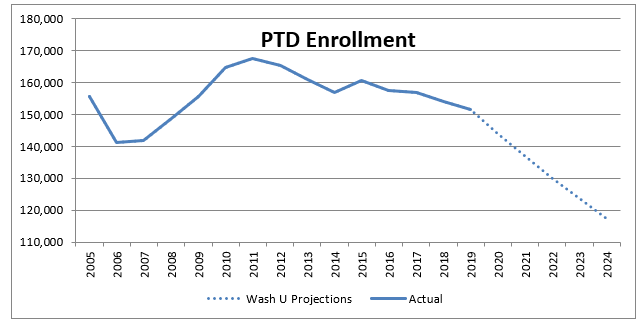
Supporters of expanding Medicaid in Missouri argue that expansion will save the state money. Washington University and the Missouri Budget Project developed models that project significant savings under Medicaid expansion. A big part of the “savings” the models achieve comes from assuming a more than 20% reduction in the number of disabled enrollees (see graph above). But since Medicaid expansion has no impact on the eligibility criteria for individuals who are considered permanently and totally disabled (PTD), how could this realistically occur? It turns out the state’s Medicaid agency would have to adopt enrollment policies that ignore federal law to accomplish this. And by 2024, this error would blow a nearly billion-dollar hole in the state savings from the model’s projections.
People with disabilities often deal with a variety of complex medical issues, which makes them the costliest group to cover under today’s Medicaid program. It follows that reducing this group’s enrollment would lower costs. But the models don’t actually project lower total enrollment for disabled Missourians. Instead, the models employ what they call “PTD shifting,” which is an attempt to get the federal government to pay more for a significant portion of Missouri’s currently disabled enrollees.
In practice, PTD shifting refers to reclassifying currently enrolled disabled Missourians into the newly eligible Medicaid expansion population. Once reclassified, Missouri would be able to receive nine federal dollars for each state tax dollar it spends to cover the “newly eligible” recipients. This is a stark improvement over the state’s current federal match, which is roughly two federal dollars for each dollar Missouri spends. The problem—and it’s a big one—is that purposely classifying those who meet pre-expansion Medicaid eligibility requirements as newly eligible in order to receive additional federal funds is not allowed, and if money is collected under such a scheme it would need to be returned.
Don’t just take my word for it. New York tried PTD shifting, and its Medicaid program was then audited by the federal Office of Inspector General (OIG). Here’s what the OIG concluded:
Beneficiaries Were Disabled – Individuals may not be enrolled in the new adult category if they are otherwise eligible for Medicaid through a mandatory category. For 3 of the 130 sampled beneficiaries, the State agency incorrectly enrolled the individuals in the new adult group despite their case files demonstrating that they were certified as disabled and receiving Social Security disability benefits—a mandatory coverage group for which the standard FMAP rate applied.
There is an argument to be made that individuals who first apply for Medicaid may not know whether they are eligible to qualify for the program using their disability, but the OIG report concludes that it is the state’s responsibility to determine whether they are categorically eligible for Medicaid based on disability (someone who would be currently eligible, and thus only receiving the 2 to 1 federal match) before enrolling someone in Medicaid based on income (which would be someone newly eligible, thus receiving the 9 to 1 match).
Missouri’s Medicaid enrollment for people with disabilities has totaled over 150,000 annually for well over a decade. Models that project savings based on disregarding federal law should be met with extreme skepticism, to say the least. And once you remove the PTD shifting assumption, the projected savings disappear entirely. Instead of continuing to look for a free lunch, we need to face the harsh truths about the cost of covering thousands more Missourians under Medicaid.
Sometimes, different people look at the same data but draw very different conclusions.
The head of the Loop Trolley Company, John Meyer, thinks that if policymakers don’t bail out the vintage streetcar line, bad things will happen. I look at the trolley’s situation and think that if policymakers do bail out the line, bad things will happen.
Here’s what Meyer recently claimed in a letter to local leaders: “Inaction [in regards to bailing the trolley out again] will result inevitably in additional burdens on St. Louis taxpayers, the loss of federal funds, the destruction of a transit asset and long-term harm to the reputation of the St. Louis region.”
Let’s consider these claims in turn.
How is it that should taxpayers not bail out the trolley, they will come to shoulder additional burdens? Perhaps Meyer thinks that the trolley tracks will have to be dealt with in some way or another, eventually, and taxpayers will have to fund that construction. Maybe Meyer is right, but that doesn’t mean bailing the trolley out is less of a burden than allowing it to languish. Moreover, without any more detail, I’m just not convinced that leaving the trolley to languish poses any additional burden to taxpayers; it costs nothing for the tracks to stay in the street.
What about the loss of federal funds? Meyer could be right about this; should the trolley shut down for good, St. Louis could lose out on future grants. But it isn’t clear that this is an unfair result. All the federal money St. Louis got to build the trolley could have gone to other, more deserving projects. There is a worthwhile project that didn’t get funding because St. Louis somehow got $34 million in federal dollars to build a novelty. One of the best ways to reduce poor spending like this is to punish those who encouraged it. (Of course, the federal granting agencies should have known better, too.) Now, if federal agencies pursue a lawsuit to recover some of the grant used to build the trolley, this money would come from agencies supported by local taxpayers. While that’s a real cost, the money would go back to federal taxpayers, some of which are, well, local taxpayers.
Meyer also claims that failing to revive the trolley will destroy a transit asset. While letting the trolley system collect dust isn’t the same as blowing it up, this is more or less true. But I’d quibble with one thing: the trolley is hardly an asset. Assets tend to be worth something, and it isn’t clear the Loop Trolley is worth much more than scrap metal. If the trolley were such an important regional asset, trolley advocates wouldn’t be begging taxpayers, again, for a bailout.
The final claim Meyer makes is that a non-operating trolley will mar the region’s reputation. This is true to a degree, but not the whole truth. The full truth is that the trolley, whether operating or not, is damaging to the region’s reputation. The trolley carries very few passengers, breaks down all the time, and is, well, pretty much a joke. How is having the trolley clanking around the loop any less damaging than having it sit quietly in a warehouse? What’s done is done.
It’s understandable that trolley proponents and employees want the line to get bailed out. But the data are clear—very few people think it’s worthwhile to ride the trolley—and there’s only one serious path forward. Here’s a hint: It doesn’t include any more taxpayer money.
A plan to keep the Trolley running for four more years under Metro’s guidance received no supporting votes during a recent Bi-State Development Agency (Metro) committee meeting. Metro had spent a month deliberating on the fate of the Trolley, with the recent vote being the latest development.
One part of the proposed plan was to allow riders to use Metro passes to pay for Trolley rides. The plan also would have used the Loop Trolley Transportation Development District (LTTDD) revenue to develop (page 3) a park-and-ride pass program to encourage—or potentially force—Loop business employees to park at a distance and take the trolley to work. If forcing people to park in inconvenient locations is the best way to get people to ride the trolley, that should tell you all you need to know about actual demand for the trolley.
Since this new plan received no support, it will not be sent to the Metro board of directors. Further, the Federal Transit Administration (FTA)—the source of the $34 million federal dollars to construct the trolley—has indicated it may sue the trolley’s tax district for $25 million. If the FTA does file suit, several entities that benefited from the federal money, such as St. Louis City and County, the LTTDD, and University City, could be on the hook for repayment.
The threatened lawsuit combined with the trolley closing has Metro concerned about future transportation grants being jeopardized. However, sinking millions of dollars more into the trolley is a poor way to try and save face. Bad projects should be allowed to end to make way for better ones, not kept alongside them.
St. Louis County has reiterated that no additional county funds will be spent on the trolley. The question of what to do will now be passed to the LTTDD. The LTTDD board members that have commented indicated they did not know what would come next, while the mayor of the City of St. Louis would like Bi-State to reconsider. If there is a market-based solution to keep the trolley running, let’s hear it. Until then, no more taxpayer money should be spent.
Forget the Academy Awards, the 16th annual Demographia International Housing Affordability Survey has just been released! It has some great information about the two biggest cities in the Show-Me State. Both Kansas City and St. Louis still score well on housing affordability compared with other cities, but both cities are becoming less affordable over time.
To measure affordability, researchers divided the median house price within a region by the median household income. Regions scoring under 3.0 are considered affordable. The regions examined don’t just include cities; researchers examined metropolitan statistical areas, often including the several counties surrounding an urban area. So the Kansas City and St. Louis regions include a number of more suburban municipalities as well.
Rochester, New York earned the best score out of the major housing markets, with a score of 2.5. St. Louis was tied for fourth most affordable with a score of 2.8. (This is up from St. Louis’s 2010 score of 2.6.) Kansas City fell within the top 20 with a score of 3.3 among major housing markets, but this too is an increase from previous years. In 1990 and 2015, Kansas City’s scores were 2.3 and 2.9., respectively.
Missouri’s cities have often benefitted from relatively low costs of living, driven largely by housing costs. This is due in part to a lack of a certain kind of land-use regulations that became prevalent in cities in places like California, Oregon and Washington. Missouri and its cities ought to be congratulated for avoiding these pitfalls.
As Kansas City and St. Louis seek to increase housing affordability, they ought to remember that their successes so far stem largely from avoiding overregulation. Many policies, despite being well intentioned, only increase costs by restricting availability.
For more information on housing affordability, read our 2016 study on Kansas City or our 2012 study on St. Louis.
KSDK has a great interview with Chester Asher, CEO of Northside Community School, a charter school in St. Louis.
Northside has consistently been one of the top-performing schools in St. Louis, and it’s easy to understand why when listening to Asher talk about his passion for serving low-income students and the culture of expectations and excellence that guides the school.
North Side puts to lie the pernicious notion that because a child comes from a certain neighborhood, is of a certain racial or ethnic group, or comes from a family that is struggling, they cannot learn.
It isn’t easy. Students who come from stable, two-parent homes in safe neighbors absolutely have advantages over those who do not. But just because it’s hard doesn’t mean its impossible. And just because it is hard doesn’t mean that it isn’t worth doing.
Part of the story, left unsaid in the KSDK spot, is that because of how Missouri authorizes charter schools, Northside is limited to serving students in St. Louis City even though it sits less than a 10 minutes’ drive from the boundary of the Normandy Schools Collaborative, one of the lowest-performing school districts in the state. Students born eight minutes away from the school instead of seven can’t attend, because politicians have created artificial barriers between children and opportunity.
That is not a happy story. It isn’t right. It isn’t fair. It should change.
There’s a wide variety of ways to offer school choice to students. Unfortunately, Missouri only permits a narrow and limited range of options, and for only some students. One way to expand choice is via a tax-credit scholarship program, as outlined in Senate Bill (SB) 581.
The program is called the Show Me a Brighter Future Scholarship Fund. The legislation would create a dollar-for-dollar tax credit for individuals and corporations that donate to a scholarship-granting organization. Qualifying students could then apply for the scholarships and use them toward private school tuition. SB 581 would allow for $25 million in tax credits. If the scholarship were fully funded at $25 million, that could mean roughly 7,100 students could receive $3,500 scholarships
Missouri would benefit from a tax-credit scholarship program. Previous research from Show-Me Institute authors has found that a tax-credit scholarship program in Missouri would save money for the state. Furthermore, there are seats open for over 28,000 students in Missouri private schools.
Eighteen other states currently have tax-credit scholarship programs, with almost 300,000 participating students as of August 2019. And even more are eager to participate. Over 8,000 students in Pennsylvania were turned away from one of the scholarship organizations because there were not enough scholarships available in 2017. When Illinois recently opened up applications for the 2020–21 school year for its scholarship program, nearly 25,000 students applied, which is more than four times as many students who are eligible to receive a scholarship.
Florida’s program has shown signs of success. A 2019 study of the program found that low-income students participating in the tax-credit scholarship program are more likely to enroll and graduate from college than those who didn’t participate in the program.
The Show Me a Brighter Future Scholarship Fund could help thousands of Missouri students access a quality private school. Private schools are a great option for many Missouri students, and a tax-credit scholarship program could help ensure that more families have that option.