More on the Earnings Tax

We have written several times about the earnings tax in recent weeks and its detrimental economic effects. On Tuesday, voters in both the City of St. Louis and Kansas City voted to retain the tax. Whatever your view of the tax, then candidate, now Mayor-elect, Tishaura Jones acknowledged in a recent St. Louis Business Journal Article:

[A]lternatives need to be examined because the tax totals a third of the city’s general revenue. “That is just unsustainable,” she said. “We need to see how we can diversify our sources of funds to make us not so dependent on the earnings tax should the voters ever decide that they don’t want to pay it anymore.”

She is absolutely right. The City of St. Louis needs to get serious about leaning less on the earnings tax, for a variety of reasons. The newest reason, resulting from the pandemic, is the increase in working from home. The city is, unfortunately, attempting to claim that people working from home in the suburbs still have to pay the tax. Through legislation or litigation, I hope that this new and intentionally improper implementation of the law is prohibited. Nevertheless, the long-term impacts from increased working from home on the earnings tax in St. Louis will likely be substantial.

And yes, voters may one day (Tuesday was clearly not that day) decide they want to phase it out, and the city should move in a direction to encourage that, not discourage it. The single most important thing the City of St. Louis can do is reduce the enormous tax subsidies it gives out each year. As stated in our recent op-ed in the St. Louis Business Journal, the city gives out about $70 million per year in subsidies. Expanding the tax base by letting those subsidies expire and not granting new ones is the single best way to phase out the earnings tax without large tax increases elsewhere.

Even if one thinks that the City of St. Louis (and Kansas City) should maintain the earnings tax, not depending on it so much would be a smart thing to do.

How Empowerment Scholarship Accounts (ESAs) Work

Download Infographic Here

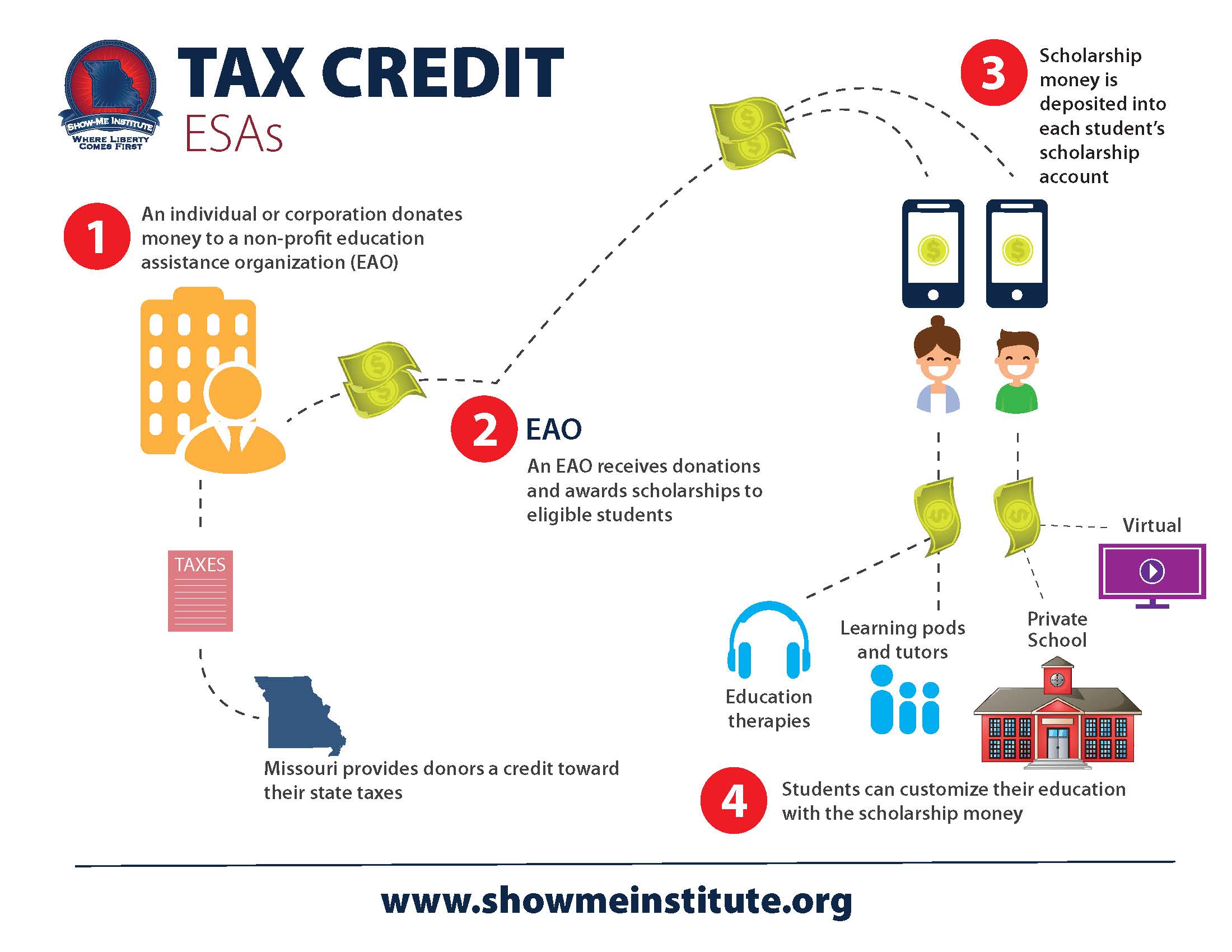
How ESAs would be funded

  • ESAs are not paid for through the state budget – Under the proposed ESA legislation, individuals and businesses would make a donation to a scholarship granting organization and in return receive a tax credit. Those donations would then be used to grant scholarships to qualifying students who could use the funds to enroll in another school district, a charter school, a private school, or cover the costs of homeschooling.
  • ESAs do not directly impact the funding formula – As a result of this funding structure, ESAs may result in decreases in the general revenue through tax collections, but they will not directly impact the foundation formula funding for public schools in Missouri.
  • Tax credits go to donors, not scholarship recipients – There is no connection between the individual or businesses making donations and those receiving scholarships. For example, making a donation does not guarantee access to a scholarship for your child and conversely, families do not receive any tax credit for paying for private school tuition or homeschooling expenses.
  • There are no federal funds being redirected to support proposed ESA legislation – ESAs would be funded solely through donations that would be encouraged/rewarded through tax credits. No direct funding, either from the state foundation formula or from federal education funding is involved.
  • Learn more here

ESAs actually increase funding for public schools

  • Two amendments to HB349 would actually increase funding for public schools in Missouri if Empowerment Scholarship Accounts are finally passed.
    • The first amendment ties the operation of the ESA program to increasing state reimbursement for school transportation costs to at least a 40% level. In recent years the state has only reimbursed district schools for 10%-15% of their transportation costs, so this would be a major increase in funding, especially for rural schools. The same provision has been added to SB55.
    • The second amendment creates a “hold-harmless” condition that guarantees that any district that has students leaving their schools as a result of receiving an ESA scholarship will still receive state funding for that student for five years. This means that over a five-year period district schools could receive $31,875 in state funding for every student who receives an ESA even though they no longer have to pay for that child’s education.
    • See the final text of HB349 passed by the House: https://house.mo.gov/billtracking/bills211/hlrbillspdf/0711H.03P.pdf

ESAs are not vouchers and not the same as 529 plans

  • Empowerment Scholarship Accounts are very different from vouchers used in other states:
    • Vouchers involve state funding being directly paid to private schools through a voucher distributed to families sending their children to those schools. Under the proposed ESA legislation, funds would be distributed directly to families who could then choose to use those funds in a variety of ways. As highlighted above, the funds sent to families would come from a non-profit scholarship granting organizations funded through donations NOT from the state budget.
    • Vouchers limit families to spending funds for private school tuition. The proposed ESA program would allow families to use funds for a wide variety of educational costs including costs for homeschooling, testing costs, tutoring needs, therapies for students with special needs, transportation to school, tuition at public charter and district schools outside of their home district and private school tuition. As a result, ESAs give families many more options to find an educational environment that meets their children’s specific needs.
  • ESAs are not the same as 529 plans
    • Under current federal law, families can open a 529 savings account for their children, use funds in that account to pay for private K-12 tuition and receive the same tax benefits (about $500 in savings a year) as they would if they used the 529 account to pay for college tuition. While this is a benefit to families who can already afford private school tuition, it does not make accessing a private school a possibility for low-income families in the same way that an ESA would. The Show Me A Brighter Future Scholarship program that has been proposed would be funded the same way as Empowerment Scholarship Accounts, but instead of disbursing funds to families through a scholarship granting organization, the state treasurer would set up a 529 account for families receiving a scholarship and they would then use that account to pay tuition.
    • Learn more here


Are Unemployment Benefits Making It Harder to Find Workers?

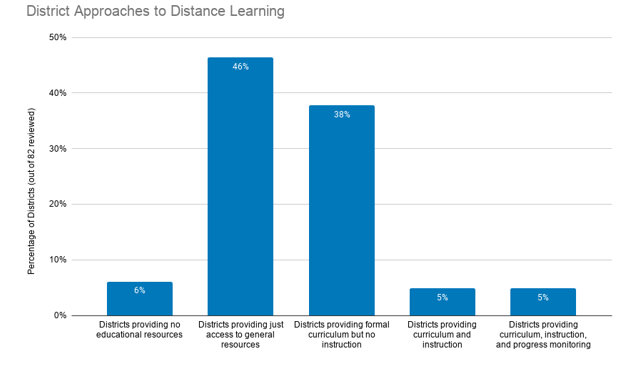
If you’re like me, you’ve probably seen “We’re Hiring” and “Help Wanted” signs all over the place in recent months. In fact, the level of job openings is now nearing pre-pandemic levels. I also know that unemployment, though much lower than its peak during the pandemic, is still higher than it was in 2018 and 2019, and the rate of hiring has dramatically slowed down since the summer and fall of 2020. Why is it that, despite strong job openings and millions more unemployed than before the pandemic, we aren’t seeing more people getting back to work?

We saw similar weak employment recovery following the 2009 financial crisis when endless extensions of unemployment insurance benefits discouraged some from seeking jobs and reduced job creation. Could the forces that created the “Redistribution Recession” last time also be a threat now?

One reason to be extra concerned is that people may be getting more money on unemployment than they would if they were working. The most recent federal relief package, the American Rescue Plan Act, extends unemployment benefits through at least September and maintains the $300 supplement that gets paid out on top of the usual state benefit.

Unemployment benefits are meant to provide temporary assistance for people as they look for jobs. These benefits are not intended to replace work and therefore should not put people in a position of taking a pay cut to get a job. Why would people go back to work if that’s the case? We also need to be mindful of other factors here—disincentivizing work hurts small businesses that are trying to find workers to get back up and running.

Of course, not all unemployment benefit recipients are receiving more than their previous paychecks. Some workers are getting paid too much—disincentivizing them from taking a job—while others are still left to make do with less money than when they had a job. To fix these problems, it may make sense to replace the $300 supplement with unemployment benefits that are more closely tied to previous wages.

The best way to get the economy on track is to help jobless workers avoid financial distress while still ensuring that it is financially advantageous for them to find a new job rather than remain unemployed. Putting money in people’s pockets is a temporary Band-Aid that staves off hardship. But if an unemployment insurance program delays the real cure of getting people back to work, is it really a stimulant for the economy? Or a depressant?

An Inconvenient Truth

The Missouri Legislature is considering allowing parents in larger communities (more than 30,000 residents) to access a portion of their state education funding for use outside the public school system. In typical fashion, many rural legislators want nothing to do with such a program and believe that the parents in their district don’t either.

Let’s take a look at some enrollment data to see if that checks out. The following table contains only those districts that saw a 10 percent or higher enrollment drop between 2019 and 2020, as measured by the Missouri Department of Elementary and Secondary Education (DESE).

As it turns out, quite a few parents chose to leave small rural districts. These districts only enrolled about 5,300 total students in both 2018 and 2019, but now over 600 of them have left. Because districts can base their state funding on enrollment from either this year, last year, or the year before, these students will continue to be funded even though they’ve left the district.

Where have they gone? We know that the homeschooling numbers in Missouri have increased dramatically in the last year and I suspect that explains many of the missing 600. Is it reasonable to suggest that these parents don’t need any financial support? At the state average funding of around $6,500 per student, nearly $4 million in state funding will go to these districts for students who aren’t enrolled. Meanwhile, the parents who have decided that their district couldn’t provide an acceptable education this year are left to figure out how to create one on their own dime.

It’s a convenient story that all rural parents love their local schools and have no need for school choice. It keeps all power in the hands of superintendents, school boards, and local teachers unions. But the facts suggest an inconvenient truth. Will legislators pay attention?

SMI Podcast – Better Charity with James Whitford

In 2012, James Whitford founded the True Charity Initiative to advance nationally the cause of privately-funded effective charity at the most local level. His work has appeared in Heritage Foundation’s Index of Culture and Opportunity, Patrick Henry College’s Newsmaker Series, World, The Christian Post, and The Hill.

Should You Pay the Earnings Tax in Wildwood?

At a mayoral candidate forum last week hosted by the St. Louis Business-Journal, the topic of the St. Louis earnings tax came up for discussion. There were several important points made in the talk (as shared in this article in the Business-Journal). Unfortunately, most of the points, (but not all) were erroneous.

Expanding the one percent earnings tax to include St. Louis County was proposed by one of the candidates at the forum. Can the earnings tax be extended to St. Louis County? The short answer is no. Proposition A, passed by voters in 2010, disallows earnings taxes in cities other than St. Louis and Kansas City. So, no, Chesterfield can’t impose an earnings tax even if it wanted to (and I’m pretty sure it doesn’t). State law can always be changed—as Proposition A itself did—but as it is now establishing an earnings tax in St. Louis County is not allowed.

In fairness to the candidate who discussed expanding it, she was aware of that. She discussed making earnings tax expansion a part of the currently stalled Board of Freeholders process (the Board of Freeholders is the entity considering changes to the relationship between the city and county). Could it happen that way? That is possible. If the Board of Freeholders suggested merging St. Louis City and St. Louis County into one unified city, and if voters approved that proposal, then it is possible that the current exemption allowing an earnings tax in the City of St. Louis could be applied to the new, unified city.

Short of a full reunification, could the Board of Freeholders simply choose to enact an earnings tax in St. Louis County as part of any new governmental plan? Again, perhaps. The state constitution states that the new plan:

shall become the organic law of the territory therein defined, and shall take the place of and supersede all laws, charter provisions and ordinances inconsistent therewith relating to said territory.

But a new Board of Freeholders charter won’t be able to just pass any new rule it wants in conflict with statewide rules on local governments. For example, the Board of Freeholders can’t decide that the new region will tax a retail merchant’s inventory or the car of a disabled former POW. There are limits on what can be passed. So would a county earnings tax be allowed in this situation? It would simply depend on how Proposition A is interpreted. The only thing I am comfortable predicting is that litigation would result, and the courts would decide the question.

All of this leaves aside the fact that expanding the earnings tax to St. Louis County is a bad idea in and of itself. More to come on this issue, including a post on the part of the article where I agree with the candidates.

Homeschooling in Missouri Nearly Doubled in 2020

Last week, the U.S. Census Bureau released the results of its Household Pulse Survey, an effort by the government to understand the impact of the coronavirus on American households. The survey, conducted  periodically since the pandemic started, asks questions about work, school, and a host of other issues.

One of the most interesting questions the Census Bureau asked concerns homeschooling. Surveys from EdChoice and others have found huge bumps in the favorability of homeschooling during the pandemic, but have those opinions translated into parents actually taking the leap and homeschooling their children?

According to the Pulse Survey, yes. Yes they have. When asked in late April and early May of 2020, 5.4 percent of American families responded that they were homeschooling their children. By late September and early October, that number had more than doubled to 11.1 percent. And just to be sure, the Census Bureau made clear in its questioning that “homeschooling” meant homeschooling, not simply students working remotely while still enrolled in their traditional school.

The Census Bureau broke down the findings by state, and in Missouri the percentage of families homeschooling nearly doubled, from 5.9 percent in the spring of 2020 to 10.9 percent in the fall. That means that more than 1 in 10 Missouri school children were homeschooled at that time.

The survey also found fascinating trends related to race, with huge increases in homeschooling from Black families (from 3.3 percent in the spring of 2020 to 16.1 percent in the fall), and Hispanic families as well (from 6.2 percent in the spring of 2020 to 12.1 percent in the fall). In fact, expressed as a percentage of all families, homeschooling is now more popular among Black and Hispanic families than among White families, only 9.7 percent of whom were homeschooling in the fall of 2020.

If these trends hold, they represent a sea change in the educational landscape of Missouri and America writ large. We’ll be watching for later iterations of the survey to see if they do.

The Biden Infrastructure Bungle

Following on the heels of its $1.9 trillion stimulus bill, the Biden administration just unveiled another multitrillion-dollar spending plan, this time notionally aimed at fixing America’s infrastructure needs. Unfortunately, the “American Jobs Plan” is just as much a misnomer as the “American Rescue Plan,” in that it does more to push liberal political goals than to light a fire under the economic recovery or long-term growth.

America’s infrastructure needs are genuine and significant. Investment in basic infrastructure (power, transportation, water supply, etc.) has failed or barely kept up with depreciation, leaving the country with an aging infrastructure stock with dwindling years of remaining service life. Moreover, although the United States spends roughly the same on infrastructure as it did in 1956 in inflation-adjusted per capita terms, it gets less bang for the buck today. In particular, the cost per mile of interstate construction has more than tripled in inflation-adjusted terms since the 1960s.

This combination of flat spending and rising costs means less actual new infrastructure. Worse yet, costs vary widely across states. From 1956 to 1993, high-cost states spent more than $8.8 million more per mile of interstate than low-cost states, and $3.3 million of this differential is due to factors under policymaker control. Thus, rather than measuring the ambition of a bill by the sticker shock of its price tag, a superior metric is to evaluate the quantity and quality of infrastructure it is likely to produce and what spillovers it will generate for economic productivity. On both counts, the Biden Administration’s plan falls far short.

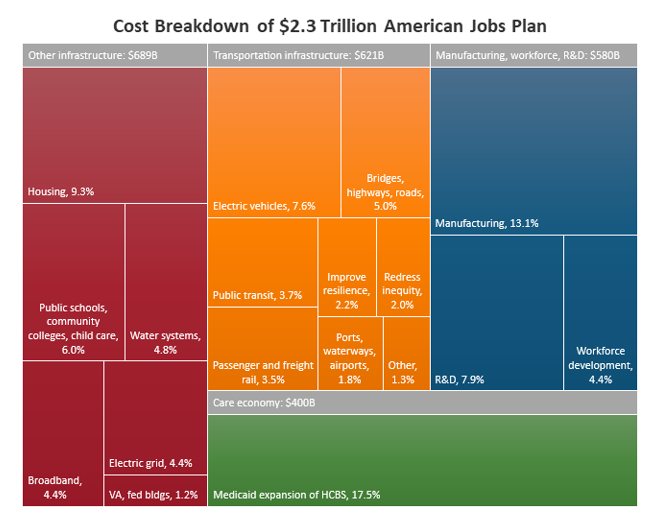
First, the composition of spending in the bill appears not to have gone through any credible cost–benefit analysis to determine where best to allocate scarce (or not so scarce, given the size of the bill) dollars. For example, the American Society of Civil Engineers reports that 20 percent of the more than 4 million miles of roads in the United States are in poor condition; the same report estimates a nearly $800 billion backlog of maintenance and repair needs. Why, then, does only 5 percent of the bill (see Figure 1) go to roads and bridges, only promising to fix 20,000 miles worth of road? Moreover, why spend nearly the same amount on public transportation even though only 5 percent of people rely on it to get to work? The bill also includes Medicaid expansion of home and community-based services (HCBS) masquerading as “infrastructure.” The administration every right to make its case for a “care economy” agenda, but simply calling it infrastructure to piggyback off of the popularity of spending on roads and bridges does not make it so.

Cost breakdown

Figure 1

Secondly, and more egregiously, the American Jobs Plan’s prevailing wage, project labor agreement, and PRO Act provisions are a huge giveaway to unions that would likely raise costs, reduce growth, tilt the playing field, and overturn the will of voters in states that passed right-to-work laws to safeguard worker freedoms. The practical effect of these measures will be to reduce the number of infrastructure projects that can get completed for a given amount of spending and to needlessly harm economic performance through the elimination of worker freedom protections.

Lastly, the Biden plan partly finances the eye-popping $2.3 trillion price tag by raising the corporate income tax, thereby undermining the very competitiveness that infrastructure investment is supposed to enhance. Even the administration tacitly admits the harm such a tax hike will cause for the economy, offering only to beg other countries to raise their own taxes to prevent them from attracting companies looking for friendlier business environments in what the Biden administration misleadingly calls a “race to the bottom.” It’s hard to imagine any countries taking us up on the offer. In all fairness, the American Jobs Plan does promise workers whose jobs are displaced counseling and case management services, though many will unsurprisingly prefer to keep their job instead.

In sum, America’s infrastructure could use a jolt of investment, but the spending priorities in the bill are off target and in many cases unrelated to true infrastructure. The bill is littered with union giveaways that will raise costs and reduce the quantity of new infrastructure that could otherwise be produced, and the promised corporate tax hikes counteract the same economic growth that infrastructure spending aims to ignite. But it’s not too late. The Biden administration should learn from previous mistakes, when the Obama stimulus failed to improve the nation’s highways, and instead refocus on a pro-growth and fiscally responsible approach to solving America’s pressing infrastructure needs.


St. Louis City’s Earnings Tax Is Not the Lowest in the Country

The earnings tax was one topic of conversation during a recent forum for St. Louis mayoral candidates. During the forum, one candidate claimed that St. Louis has the lowest earnings tax rate in the country. This claim was made while discussing a possible expansion of the earnings tax to St. Louis County. No matter how you look at it, the claim that St. Louis has the lowest earnings tax rate in the country is false.

Most cities in the United States, including most large cities, do not have any form of local income tax. As of 2019, there are only 17 states with local income tax jurisdictions and only 19 of the country’s 100 most populous cities have some form of local income tax. This means that thousands of cities (including comparable large cities such as Chicago, Omaha, and Nashville) have a lower earnings tax than St. Louis city—their earnings tax is 0 percent!

Even if we’re just looking at the jurisdictions with local income taxes, St. Louis still doesn’t have the lowest rate. Many jurisdictions in Indiana, Kentucky, and Ohio have rates below 1 percent. In Colorado, Aurora, Greenwood Village, and Sheridan have monthly local income taxes of $3.00 or less on those that make over $500 per month, which is a 0.6 percent local income tax at most. Clearly, St. Louis does not have the lowest rate among local income taxes.

Objectively, 1 percent is not all that high, and a few large cities with local income taxes have slightly higher rates. But the earnings taxes in St. Louis City and Kansas City are certainly not the lowest in the country and they are definitely not negligibly low. The additional 1 percent that Kansas City and St. Louis city residents and workers pay creates real negative effects for these cities. The local income tax in Missouri’s two largest cities is higher than those in hundreds of other cities in Missouri and thousands of cities across the country, making our largest cities less competitive while also taking money away from our hard-working citizens. That’s not a false claim.

Support Us

The work of the Show-Me Institute would not be possible without the generous support of people who are inspired by the vision of liberty and free enterprise. We hope you will join our efforts and become a Show-Me Institute sponsor.

Donate
Man on Horse Charging