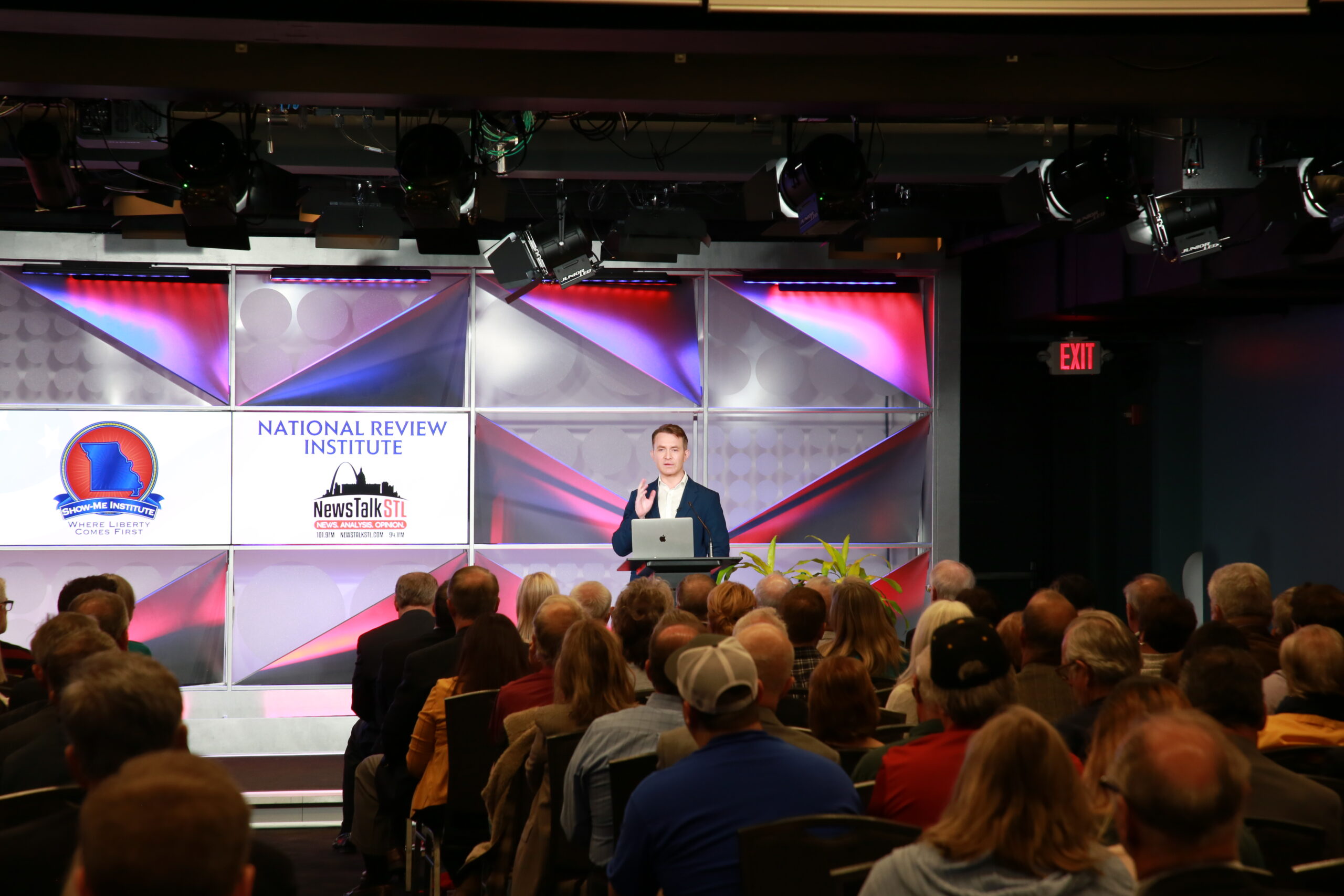
David Stokes and Elias Tsapelas join Zach Lawhorn to discuss next week’s special elections, the recent Medicaid expansion ruling and a drama-filled job search for a new Lake Ozark City Administrator.
Listen: How Many Missouri Schools are Teaching CRT?
Patrick Ishmael joined The Mark Reardon Show on 97.1 FM Talk to discuss what he’s learned after sending thousands of records requests to schools across Missouri.
Wait, the Columbia Public School District Said What about Teaching the 1619 Project?
The 1619 Project will be taught in the Columbia Public School District (CPS) and the instruction is supported by a grant issued by the Pulitzer Center. I know this because I have the memorandum of understanding between the district and Pulitzer, which in relevant part includes a commitment from CPS to:
develop standards-aligned units that engage their students in The 1619 Project, and other journalism and historical sources, to strengthen connections to existing curricula, practice media literacy skills, and build empathy. At least two educators from each team will then implement units with at least two classes, evaluate student outcomes, and share their projects publicly through Pulitzer Center’s lesson library and virtual professional development programs. [Emphasis mine]
I talked about this on Gary Nolan’s program last Thursday. I wrote about it two weeks ago. There’s no ambiguity about what CPS is being paid to do and has agreed to do. So I don’t know what exactly to make of this story from the Columbia Daily Tribune published this past Sunday, which suggests the district has represented to parents that The 1619 Project won’t be in classrooms.
Because it will be.
Elements of The 1619 Project will be used by teachers in two elective courses for high school seniors in Columbia as part of the Pulitzer Center’s The 1619 Project Education Network, an official with the center said Friday.
The Columbia Board of Education recently approved an agreement with the Pulitzer Center for two teachers to participate in the network, but in statements since the approval, Columbia Public Schools spokeswoman Michelle Baumstark distanced the district from the agreement, asserting it won’t result in aspects of The 1619 Project being taught.
“We do not have CRT (Critical Race Theory) or 1619 curriculum or lessons in Columbia Public Schools,” Baumstark said Tuesday, while acknowledging that a small group of teachers were looking at the primary source materials for The 1619 Project. [Emphasis mine]
Since I don’t live in Columbia, I wasn’t initially aware of the district’s representations. The only reason I became aware of the story is because a supporter called and recommended the article to me. Suffice it to say, I’m perplexed by the district’s assertion, which may be most charitably described as a word and tense game. Columbia taxpayers and parents deserve transparency and good-faith disclosure about existing or future curriculum plans from the public officials whose salaries they fund.
Update on Missouri’s Special Elections
David Stokes joined The TCT on NewsTalk STL to discuss some of the issues that will be voted on during Missouri’s special election.
Complete the Idea: Diversity, Equity, Inclusion—and Convergence (DEIC)
As I’ve shared before, my immigrant-turned-native-born family enjoyed and endured both the best and worst of America’s story. But my story isn’t unique; in fact, the idea of America as a “melting pot” is centuries old. It’s often said there are more Irish in America than in Ireland, because intermarriage has joined the Irish identity to many others in the United States and made all involved stronger.
But I worry that this key final step—convergence—is being lost in current “diversity, equity, and inclusion” (DEI) trainings, in particular those administered to our teachers.
“DEI” can suggest promoting the American melting pot: a breaking down of division in pursuit of a common, more prosperous, more perfect union through which all of our children can pursue happiness. But it can also imply a sociological Thunderdome where self-segregated interest groups battle it out over insatiable racial and cultural grievance.
There have already been hints of this grievance-based approach percolating through DEI materials received for the Show-Me Curricula Project. Eagle College Prep’s DEI materials capture the issue. For example, instructional material for teachers that the Institute requested and received contains the following PowerPoint slide, with the second “cage” figure of particular note:

Elsewhere, a PowerPoint on a “cycle of oppression” implies that non-whites are “colluding or surviving” by adopting notions such as:
- “Standards and norms lived by [whites] are the universal standards and norms”
- “Achievements have to do with me, not my membership in a group”
- “Things are earned through work and merit”
- “Uncapped possibility—life potential based on personal choices”
The graphic suggests that the cycle is broken by “going against conditioning” toward “liberation.” In context, this means rejecting notions of work, merit, free choice, and personal achievement.

Presumably these slides are discussed by an instructor, so there may be nuance that isn’t captured in the slides. But these materials appear to accentuate divides that work against our convergence as a country.
While the focus so far of my transparency project has been on curricula administered to children, taxpayers should also see the “curricula” and training that schools and school districts are administering to Missouri teachers. No one disputes Americans have differences, but a DEI curriculum that exploits and exacerbates them instead of emphasizing the importance of convergence—of our shared enterprise as a single community and single country—is one that does far more harm than good.
Additional Opportunities in Occupational Licensing
Occupational licensing has boomed in the last few decades. Today, one in three people needs an occupational license to work. In the 1950s, it was one in twenty. Missouri made big progress in reducing barriers to work by establishing occupational licensing reciprocity in 2020. This means that out-of-state licenses now qualify as licensure in Missouri. However, the legislature slowed down on occupational licensing reforms in the 2021 session. A few small (but meaningful, especially to those affected) changes were made, discussed here. Other states found various ways to reduce red tape for their workers, and Missouri lawmakers should take notes.
In Mississippi, eyebrow threaders, eyelash technicians, and makeup artists can now operate without an esthetician license. Niche occupations such as these often get lumped into a license for which the training and education requirements are overly broad and don’t relate to the specific occupation. Missouri lawmakers fixed one example of this problem this year—a shampooer no longer needs to be a fully licensed cosmetologist or barber. In the future, lawmakers should review occupational licenses to make sure other niche occupations are unfairly burdened by license regulations and standards.
Ohio will enter the Interstate Medical Licensure Compact this year (and the Nursing Licensure Compact, of which Missouri is already a member), allowing workers to move and work more freely between states. Though Missouri has universal licensing reciprocity, compacts such as these would make it easier for Missouri licensed workers to work in other states that may not have universal reciprocity, but are in the same compact.
South Carolina will soon allow licensed barbers to apply for a license to operate out of a mobile unit and Nebraska repealed locksmith registration requirements after a licensing review found many problems with the current state of locksmith registration. Both measures increase opportunities for workers and consumers, which can ultimately promote economic freedom and growth in these states.
Missouri has another chance to do right by its workers next year. Though lawmakers have taken steps to curb the negative effects of occupational licensing, that forward momentum should continue. Missouri could create opportunities for workers and consumers and spur economic growth by ensuring niche occupations are free from broad licensing requirements, participating in interstate licensing compacts, and eliminating overly burdensome and ineffective licenses and restrictions. Using other states as a guide, we should pursue similar occupational licensing reforms next year.
The Unbelievable “Whiteness” of Springfield Public Schools
The debate over critical race theory (CRT) is heating up in the Show-Me State. The legislature recently held a hearing on CRT to explore parents’ concerns about its appearance in K-12 classrooms. Our work highlighting Lee’s Summit’s five- to six-figure payment demands for its lesson plans even got a shout out from the committee chair.
While Lee’s Summit stands out for its fee demands, it isn’t alone in its dubious Sunshine Law practices. Last month the St. Louis public school district said it had no records responsive to my identical request of it and would send any if found. After a month without records being sent and after being told again it had no records to send, I informed the district that I knew it had responsive records and showed evidence, at which point the district suddenly, er, remembered it did have some of the documents I had asked for. Thanks to the insiders I’ve gotten to know and the documents I’ve received to date, I anticipate the “memories” of districts statewide are going to be jogged often in the weeks ahead.
It isn’t just some “big city” problem, either. A number of rural districts also have gotten my attention, with Morgan Co. R-I demanding $15,000 for its records. I’m still waiting for a list of how that number was arrived at. Districts and schools that received my inquiries but haven’t responded at all won’t escape scrutiny either; after all, they’re breaking the law by not responding.
The Sunshine Law process is pretty simple. Once a Sunshine Law request is received by a government body, it has three days to respond. Governments can charge reasonable fees for securing and transmitting documents, but they can also waive those fees when the documents requested are in the public interest. Agencies can and do consult lawyers, but in my experience lawyers aren’t the ones interacting with records requestors. Of the over 2,700 requests I’ve sent out to schools and districts, I’ve dealt with a lawyer directly only about a half dozen times, almost exclusively by email, and almost always in ways that would be indistinguishable from interaction with lay staff. In other words, it’s unusual when an attorney gets highly involved, but it isn’t always notable. The Sunshine Law process is that straightforward.
Some of the most outrageous interactions I’ve had so far are with districts that go out of their way to create the illusion of compliance with the Sunshine Law only to use supposed research and production costs to discourage inquiries and withhold public documents. By far the most eyebrow-raising district behavior in that vein has been from the Springfield Public School District.
On June 14th—about an hour after I sent out my Sunshine Law requests to schools and districts statewide—I received a phone call from an attorney representing the Springfield Public School District who (in short) wanted to find out what I was doing with the information I was seeking. I explained plainly to him that I was going to post everything online for the public to see.
The phone conversation, which lasted about half an hour, alternated between friendly and direct. At one point I was told that the only return I’d probably get would be for the term “whiteness,” and it would be from some art textbook. I chuckled that that’s always possible, but the attorney was quick to say that he was joking. The call concluded, and I waited for Springfield’s written response to my request, which was provided days later.
I mention the “whiteness” remark because included in Springfield’s very legalistic response demanding nearly $2,000 for records—signed by its custodian of records—was this odd tidbit:
A review of the District’s approved curriculum documents revealed only one book which has been approved in the past for use in the District’s High School literature classes, and it is not currently being used, that used the term “whiteness.” That book, Brave New World, uses the term once on page 15 in a sentence that reads: “…also pale as death, pale with the posthumous whiteness of marble.”
Am I to believe that in three days someone at the Springfield Public School District not only went through the curricula and lesson plans district wide and found nothing, but also went through books the district was no longer using by hand to search for terms and designate a page number? As the attorney suggested, the only term that the district discovered had to do with “whiteness,” and only in connection with something outside of the CRT context. Quite a coincidence.
I have contacted hundreds of districts and thousands of schools. No one besides Springfield has returned a result for a piece of literature, let alone one that was no longer taught. None have returned a result from an art or language arts class, either. In my opinion, Springfield’s was the kind of response a lawyer would deliver to flout the text and spirit of the Sunshine Law, and the demand for thousands of dollars was an added (but expected) insult that local governments often will present to stop transparency requests. This isn’t my first rodeo; we saw these ridiculous demands from local governments for their checkbooks, too.
I replied to Springfield by asking whether the district’s response represented the records held by the schools as well. I received a non-responsive answer. At the end of June, I sent a second Sunshine Law request for emails from within the district that related to our Sunshine Law correspondence. In July I got a response from the new custodian of records who had a remarkably similar writing style to the last custodian of records, and who now presented a bill for over $4,000 for that request, at a different and higher rate for “redaction and processing” activities the district said it would have to undertake. I asked for an explanation for that rate difference; I have received none.
I asked for the district to remove attorney time expenses, which is what the law requires, given the costs that were driving both estimates were related to redactions the district said had to be made and privileged correspondence the district said had to be excised. The district responded that attorney time expenses weren’t included. Really? So lay people are making the determinations about materials subject to attorney–client privilege and other legally sensitive redactions?
What is Springfield concerned about disclosing?
Sitting in the background throughout this process has been the fact that the Springfield Public School District is already under fire for the CRT-informed trainings it’s conducted with teachers. The idea that these professional trainings aren’t informing district curricula or lesson plans, explicitly and implicitly, doesn’t seem credible, and the refusal of the district to exercise complete openness and transparency in showing what is being taught to kids is wrong.
Parents and taxpayers deserve to know what their kids are being taught. If a district, school, or teacher doesn’t want to share that information, then they shouldn’t be teaching it.
Podcast: The COVID Economy, Masks in Schools and a CRT Hearing in Jeff City
Aaron Hedlund, Susan Pendergrass and Patrick Ishmael join Zach Lawhorn to discuss the state of the economic recovery, the possibility of mask mandates for the upcoming school year and the recent CRT listening session in Jefferson City.
Are Missouri Schools Being Honest About What They’re Teaching?
Patrick Ishmael joined The Gary Nolan Show to discuss this week’s CRT hearing and provide an update on the Show-Me Curricula Project.